
AERO-300 · Lesson 8 of 12 · 24 min
Finite wings and induced drag
Everything so far has been two-dimensional: an airfoil section as if the wing had infinite span. Real wings end. At each tip the high-pressure air underneath flows around to the low-pressure air on top, and the result is a pair of trailing vortices that change the flow over the whole wing. They reduce the lift slope, tilt the lift backward to create induced drag and leave a wake that can roll a following aircraft. For the Tern, induced drag is about a sixth of the total in cruise but more than half in a climb on a hot day, so the Block 2 team cares about it a great deal. This lesson explains where it comes from and how wing geometry controls it.
Trailing vortices and downwash
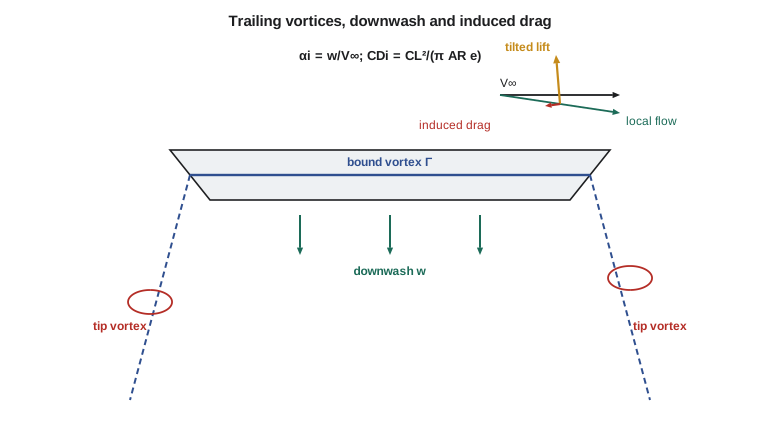
Lesson 2 showed that a wing carries a bound vortex and that Helmholtz's theorems forbid that vortex from ending at the tips. In the simplest picture, the bound vortex turns through a right angle at each tip and trails downstream as a tip vortex, forming a horseshoe vortex. Real wings shed vorticity all along the span wherever the circulation changes, and within a few spans downstream that sheet rolls up into two concentrated vortices near the tips. Their cores are visible as condensation trails on humid days and as curling smoke in flight tests.
The trailing vortices induce a downward velocity, called downwash, over the wing between them and behind it. A wing section therefore does not meet the free stream; it meets the free stream tilted slightly downward by the local downwash angle, called the induced angle of attack \(\alpha_i = w/V_\infty\). The section responds to the angle between its chord and the flow it actually meets, the effective angle of attack \(\alpha_{eff} = \alpha - \alpha_i\). Two consequences follow. The wing produces less lift at a given geometric angle than its sections would in two dimensions. And because the local lift is perpendicular to the local flow, which is tilted down, the lift vector is tilted back by \(\alpha_i\), giving a component along the free stream: the induced drag.
The elliptical wing
Prandtl's lifting-line theory, developed during the First World War and covered in detail in Lesson 9, shows that one particular spanwise distribution of circulation is special: the elliptical distribution, in which the circulation varies along the span like half an ellipse, largest at the root and falling to zero at the tips. For that distribution the downwash is the same at every point along the span, and the induced drag is the smallest possible for a planar wing of given span and lift.
An untwisted wing with an elliptical planform, its chord varying elliptically along the span, produces exactly this distribution. The Supermarine Spitfire is the famous example, although its designers chose the shape partly for structural and packaging reasons. For other wings the induced drag is higher, and the increase is captured by the span efficiency factor \(e\), which is 1 for the elliptical case and less than 1 otherwise. In whole-aircraft performance work, as in AERO-220, the closely related Oswald efficiency factor also absorbs the lift-dependent part of profile drag and fuselage effects, so it is lower, typically 0.75 to 0.85. In this course \(e\) means the inviscid span efficiency of the wing alone.
Lift slope of a finite wing
Because each section sees a reduced effective angle, the finite wing's lift slope \(a\) is lower than the section slope \(a_0\). For an elliptical wing the reduction follows directly from the constant induced angle; for other planforms a small correction factor is added. The lower the aspect ratio, the larger the reduction.
With a section slope of 96 percent of \(2\pi\), typical of real sections, the Tern's wing with aspect ratio 10.3 has a lift slope of about 0.088 per degree, against 0.105 for the sections. A low-aspect-ratio wing of aspect ratio 3, typical of a fighter, would have a slope near 0.055 per degree. Low-aspect-ratio wings must therefore fly at higher angles of attack to produce the same lift, which is why such aircraft land in a pronounced nose-up attitude.
# Finite-wing lift slope, induced angle and induced drag for the Tern
import math
a0 = 2 * math.pi * 0.96            # section lift slope per radian (about 96 percent of thin-airfoil theory)
S, b = 28.0, 17.0
AR = b * b / S
for e_lift, name in ((1.0, 'elliptic'), (0.95, 'tapered')):
    a = a0 / (1 + a0 / (math.pi * AR * e_lift))
    print(f"{name:9s} wing: AR = {AR:.2f}, lift slope = {a:.3f} per rad = {a * math.pi / 180:.4f} per deg")
rho, m, g = 0.909, 6500, 9.81
for label, V in (('cruise', 105.6), ('climb', 62.0), ('approach', 52.0)):
    rho_h = rho if label == 'cruise' else 1.112
    q = 0.5 * rho_h * V * V; CL = m * g / (q * S)
    ai = CL / (math.pi * AR)                   # elliptic induced angle
    for e in (1.0, 0.95):
        CDi = CL * CL / (math.pi * AR * e)
        print(f"{label:8s} V = {V:5.1f} m/s CL = {CL:.3f}: e = {e:.2f} CDi = {CDi:.4f}, "
              f"induced drag {CDi * q * S:6.0f} N, induced angle {math.degrees(ai):.2f} deg")
# Span extension versus winglet: same added wing root bending moment is the usual comparison; here just CDi
for tag, b2, e2 in (('baseline', 17.0, 0.95), ('span +1.0 m', 18.0, 0.95), ('winglets', 17.0, 0.99)):
    AR2 = b2 * b2 / S; q = 0.5 * 1.112 * 62.0 ** 2; CL = m * g / (q * S)
print(f"{tag:12s} climb induced drag {CL * CL / (math.pi * AR2 * e2) * q * S:6.0f} N")elliptic wing: AR = 10.32, lift slope = 5.086 per rad = 0.0888 per deg tapered wing: AR = 10.32, lift slope = 5.044 per rad = 0.0880 per deg cruise V = 105.6 m/s CL = 0.449: e = 1.00 CDi = 0.0062, induced drag 884 N, induced angle 0.79 deg cruise V = 105.6 m/s CL = 0.449: e = 0.95 CDi = 0.0066, induced drag 930 N, induced angle 0.79 deg climb V = 62.0 m/s CL = 1.066: e = 1.00 CDi = 0.0350, induced drag 2095 N, induced angle 1.88 deg climb V = 62.0 m/s CL = 1.066: e = 0.95 CDi = 0.0369, induced drag 2206 N, induced angle 1.88 deg approach V = 52.0 m/s CL = 1.515: e = 1.00 CDi = 0.0708, induced drag 2979 N, induced angle 2.68 deg approach V = 52.0 m/s CL = 1.515: e = 0.95 CDi = 0.0745, induced drag 3136 N, induced angle 2.68 deg baseline climb induced drag 2206 N span +1.0 m climb induced drag 1967 N winglets climb induced drag 2117 N
How big is induced drag?
In cruise at 3000 m, the Tern's lift coefficient is only 0.45, the induced angle is under one degree and the induced drag of the wing is about 930 N with \(e = 0.95\), about 18 percent of the aircraft's total drag of a little over 5 kN. In a climb at 62 m/s near sea level the lift coefficient rises to 1.07 and the induced drag to about 2200 N. On approach at 52 m/s it reaches about 3100 N. Induced drag grows with the square of the lift coefficient and so, at fixed weight, with the inverse square of speed: it dominates at low speed and fades in fast cruise. That is why climb performance after an engine failure, the case that sizes the motors of a twin, is so sensitive to span.
Written this way, in terms of span loading \(W/b\), the formula makes a point that aspect ratio hides: for a given weight, speed and altitude, induced drag depends on span, not on wing area. Doubling the area of a wing while keeping its span unchanged does not change the induced drag, although it halves the lift coefficient. Span is what matters, which is why gliders, long-range aircraft and human-powered aircraft all have very long wings.
Reducing induced drag: span, planform and winglets
The most direct way to cut induced drag is more span. The program shows that adding one metre of span to the Tern cuts its climb induced drag from about 2210 N to about 1970 N, an 11 percent reduction. The cost is in structure: the wing root bending moment rises with span, so the wing gets heavier, and a longer wing may not fit the hangars and gates the airline uses. Lesson 12's capstone weighs exactly this trade.
Winglets and other wingtip devices recover some of the benefit of extra span without as much increase in root bending moment. A winglet turns upward at the tip and works in the swirling flow of the tip vortex: the inflow it meets is tilted inward, so its lift has a forward component, a little thrust that offsets part of the induced drag. It also spreads the shed vorticity vertically, which has an effect similar to extra span. Winglets do add their own skin friction and weight, so their net benefit depends on the mission. They pay off on aircraft that spend a lot of time at high lift coefficients, such as climbing airliners and long-range business jets, and less on fast, lightly loaded aircraft. The program models a well-designed winglet as raising the span efficiency from 0.95 to 0.99, which cuts the Tern's climb induced drag by only about 4 percent: less than a one-metre span extension, but with a smaller structural penalty.
Planform matters too. A rectangular wing has too much lift near the tips and too little near the root compared with the ellipse, giving \(e\) of about 0.91 to 0.93 at high aspect ratio. A straight-tapered wing with a taper ratio of about 0.4 to 0.45 comes very close to elliptical loading, with \(e\) around 0.98, as Lesson 9 shows. Most aircraft use tapered wings because they are much easier to build than elliptical ones and nearly as efficient.
The wake and its hazards
The trailing vortices do not vanish when the aircraft has passed. They drift down and outward and persist for minutes, decaying slowly. A following aircraft that flies into one can be rolled sharply, which is dangerous close to the ground. That is why air traffic controllers in both Canada and the United States apply minimum separations between departing and landing aircraft based on wake turbulence categories set by aircraft weight, with the largest spacing behind the heaviest aircraft. The strength of the vortices grows with weight and falls with speed and span: they are strongest behind heavy aircraft flying slowly, exactly the take-off and landing condition. The Tern, as a light aircraft, is the one that must keep clear of the wakes of airliners at shared airports.
Worked problem
Induced drag of the Block 2 wing in climb
In the one-engine-inoperative climb at 62 m/s near sea level (\(\rho = 1.112\ \text{kg/m}^3\) at a hot-day density altitude), the Tern weighs 6500 kg, has a span of 17 m and a span efficiency of 0.95. Find the induced drag directly from the span-loading formula.
Show solution
- \(W = 6500\times 9.81 = 63\,765\ \text{N}\).
- \(q = 0.5\times 1.112\times 62^2 = 2137\ \text{Pa}\).
- \(D_i = (W/b)^2/(\pi e q) = (3751)^2/(\pi\times 0.95\times 2137) = 2205\ \text{N}\).
Answer: About 2.2 kN, matching the program. With one motor out, every newton counts, which is why the Block 2 team studied wingtip extensions.
Worked problem
Lift slope and angle of attack on approach
On approach with flaps up the Block 2 wing needs \(C_L = 1.0\). Its sections have \(\alpha_{L0} = -4.15°\) and slope 0.105 per degree, and its aspect ratio is 10.3 with \(e_L = 0.95\). Find the wing lift slope and the angle of attack needed.
Show solution
- \(a_0 = 0.105\times 180/\pi = 6.016\) per radian.
- \(a = 6.016/(1 + 6.016/(\pi\times 10.3\times 0.95)) = 6.016/1.196 = 5.03\) per radian, or 0.0878 per degree.
- \(\alpha = \alpha_{L0} + C_L/a = -4.15 + 1.0/0.0878 = 7.24°\).
Answer: The wing must fly at about 7.2 degrees, compared with 5.4 degrees for an infinite wing with the same sections. The difference is the induced angle, about 1.8 degrees at this lift coefficient.
Common mistakes
MistakeAssuming a larger wing area alone reduces induced drag.
InsteadAt fixed weight, speed and density, induced drag depends on span, not area.
MistakeTreating the span efficiency of the wing as the aircraft's Oswald factor.
InsteadThe Oswald factor also includes lift-dependent profile drag and fuselage effects, so it is lower.
MistakeThinking winglets always save fuel.
InsteadThey add weight and friction. They pay off mainly at high lift coefficients and on long missions.
MistakeUsing the section lift slope for a finite wing.
InsteadThe finite wing's slope is lower because of the induced angle, and the reduction grows as aspect ratio falls.
Summary and key terms
- A finite wing sheds trailing vortices, mainly from its tips, which induce downwash over the wing.
- The downwash reduces each section's effective angle of attack, lowering the wing's lift slope, and tilts the lift backward, producing induced drag C_Di = C_L²/(πAR e).
- Elliptical loading gives uniform downwash and the minimum induced drag for a given span.
- At fixed weight, induced drag depends on span loading and falls with the square of speed, so it dominates at low speed.
- Span extensions, winglets and tapered planforms reduce it, and the persistent wake vortices set separation rules at airports.
- Tip vortex
- The concentrated vortex formed as the trailing vorticity rolls up near each wingtip.
- Downwash
- The downward velocity induced over and behind a wing by its trailing vortices.
- Induced angle of attack
- The angle by which downwash tilts the local flow, w/V∞.
- Effective angle of attack
- The geometric angle of attack less the induced angle.
- Induced drag
- The drag caused by the backward tilt of lift due to downwash.
- Aspect ratio
- Span squared divided by wing area.
- Span efficiency factor
- The ratio of the minimum possible induced drag to the actual induced drag of a wing.
- Span loading
- Weight divided by span, the quantity that sets induced drag at a given speed.
- Winglet
- A near-vertical surface at the wingtip that reduces induced drag.
Practice problems
Work each problem on paper first, then reveal the answer to check.
A wing has AR = 8, e = 0.9 and C_L = 0.6. Find C_Di.
Show answer
C_Di = 0.36/(π × 8 × 0.9) = 0.0159.
Find the induced angle of attack of an elliptical wing with AR = 6 at C_L = 0.9.
Show answer
α_i = 0.9/(6π) = 0.0477 rad = 2.74°.
If an aircraft slows from 80 m/s to 60 m/s at constant weight and altitude, by what factor does its induced drag change?
Show answer
It rises by (80/60)² = 1.78.
A section has slope 0.105 per degree. Find the lift slope of an elliptical wing of AR 5 using it.
Show answer
a0 = 6.016/rad; a = 6.016/(1 + 6.016/(5π)) = 4.35/rad = 0.0760 per degree.
In the program, set the Tern's span to 15 m with the same area. What happens to the climb induced drag?
Show answer
It rises by (17/15)² = 1.28, to about 2830 N.
Why are wake vortices strongest behind heavy aircraft at low speed?
Show answer
Circulation is proportional to lift per unit span divided by ρV, so high weight and low speed give strong vortices.
Lesson quiz · 5 questions
Score 60% or more to complete this lesson.
Create a free account to save your progress, take quizzes and earn a certificate.