
AERO-300 · Lesson 11 of 12 · 25 min
Transition, separation and stall
Sam Littlechild, the Borealis Aerospace test pilot, describes a good stall in the Tern in a few words: the control column goes light, the aircraft shakes, the nose drops, and the wings stay level. The original wing met that standard most of the time, but on a gusty approach with the leading edges iced and the flaps up, the right wing once dropped sharply during a test. The Block 2 wing must do better. This lesson examines how a boundary layer becomes turbulent, why it separates, the different ways a wing section stalls, and what designers do to make a whole wing stall gently.
How transition happens
A laminar boundary layer is stable to disturbances at low Reynolds number. Above a critical Reynolds number, some small waves in the layer, called Tollmien-Schlichting waves after the German researchers who analysed them in the late 1920s and 1930s, begin to grow as they travel downstream. As they grow they become three-dimensional, break into spots of turbulence, and the spots merge until the whole layer is turbulent. Linear stability theory predicts how fast the waves grow, and the widely used \(e^N\) method says transition occurs when the most dangerous wave has grown by a factor of \(e^N\), with \(N\) about 9 for a quiet atmosphere and smaller values for noisier tunnels.
Three influences dominate in practice. Pressure gradient matters most: a falling pressure damps the waves and keeps the layer laminar, while a rising pressure makes them grow quickly. That is why transition on most wings occurs near the suction peak, and why laminar-flow sections are shaped to keep the pressure falling over as much of the chord as possible. Roughness is next: steps, gaps, rivet heads, insect remains and ice can trip the layer directly, bypassing the slow growth of waves. And free-stream turbulence, low in flight but significant in some wind tunnels, triggers earlier transition, one reason tunnel tests of laminar sections must be interpreted with care. On swept wings a fourth mechanism, crossflow instability, also appears, a topic for later courses.
Separation
Lesson 4 showed that a boundary layer separates when it cannot advance against a rising pressure. In more detail, the adverse pressure gradient decelerates the fluid in the layer, and the slowest fluid next to the wall decelerates first. Where the velocity gradient at the wall falls to zero, the wall shear stress vanishes and the flow just downstream reverses. The boundary layer then lifts off the surface, carrying its vorticity into the outer flow. Behind the separation point a region of recirculating flow forms, at a pressure close to the pressure at separation, and the pressure recovery that inviscid theory promised never happens.
Thwaites' method, published in 1949, gives a quick way to find where a laminar boundary layer will separate, using only the velocity distribution along the edge of the layer from an inviscid calculation. It integrates a simple formula for the momentum thickness and watches a pressure-gradient parameter \(\lambda = (\theta^2/\nu)\,du_e/dx\). When \(\lambda\) falls below about \(-0.09\), the laminar layer separates.
# Thwaites' method: where does a laminar boundary layer separate?
import math
def thwaites(ue, s_end, n=4000, nu=1.5e-5):
    """March theta^2 = 0.45 nu / ue^6 * int ue^5 ds; separation where lambda = theta^2/nu * due/ds < -0.09."""
    I = 0.0; ds = s_end / n
    for i in range(1, n + 1):
        s = i * ds; sm = s - ds / 2
        I += ue(sm) ** 5 * ds
        u = ue(s)
        if u <= 0: return s, None
        th2 = 0.45 * nu * I / u ** 6
        dudx = (ue(s + 1e-6) - ue(s - 1e-6)) / 2e-6
        lam = th2 / nu * dudx
        if lam < -0.09: return s, math.sqrt(th2)
    return None, None
V, R = 10.0, 0.05                                  # cylinder in a gentle breeze
s_sep, th = thwaites(lambda s: 2 * V * math.sin(s / R), math.pi * R)
print(f"Cylinder, ideal surface speed: laminar separation at {math.degrees(s_sep / R):.1f} deg from the front stagnation point")
# A linearly decelerating flow, ue = U0 (1 - x/L), the classic Howarth test case
s_sep, th = thwaites(lambda s: 10.0 * (1 - s / 1.0), 0.99)
print(f"Howarth flow: separation at x/L = {s_sep:.3f} (exact solutions give about 0.12)")
# Transition and laminar-bubble risk on the two aircraft
for name, V, c, nu in (('Tern wing, cruise', 105.6, 1.73, 1.858e-5), ('Skiff-W wing', 13.3, 0.32, 1.461e-5)):
    Re = V * c / nu
    risk = 'laminar separation bubbles likely near stall' if Re < 5e5 else 'transition before separation on most of the wing'
    print(f"{name:18s} Re = {Re:.2e}: {risk}")
# Wing CLmax: section clmax limited by the most heavily loaded section (from the lifting-line peak cl/CL)
for label, clmax, peak in (('clean, no washout', 1.70, 1.04), ('clean, 2.5 deg washout', 1.70, 1.06), ('iced leading edge', 1.70 * 0.70, 1.06)):
print(f"{label:24s} section clmax {clmax:.2f}: estimated wing CLmax = {0.95 * clmax / peak:.2f}")Cylinder, ideal surface speed: laminar separation at 103.1 deg from the front stagnation point Howarth flow: separation at x/L = 0.123 (exact solutions give about 0.12) Tern wing, cruise Re = 9.83e+06: transition before separation on most of the wing Skiff-W wing Re = 2.91e+05: laminar separation bubbles likely near stall clean, no washout section clmax 1.70: estimated wing CLmax = 1.55 clean, 2.5 deg washout section clmax 1.70: estimated wing CLmax = 1.52 iced leading edge section clmax 1.19: estimated wing CLmax = 1.07
For the ideal velocity distribution around a cylinder, Thwaites' method predicts laminar separation at about 103 degrees from the front stagnation point. In reality the separated wake changes the pressure distribution so that separation happens earlier, near 80 degrees, but the method shows correctly that the laminar layer cannot survive the rear half. For Howarth's classic test case, a flow decelerating linearly, it predicts separation at 12.3 percent of the length against about 12 percent from exact solutions. That is the strength of integral methods: one line of calculus per station, and answers within a few percent.
Laminar separation bubbles
At low Reynolds numbers something different happens. A laminar boundary layer separates near the suction peak, before it has had time to become turbulent. The separated shear layer, now free of the wall, is very unstable and becomes turbulent quickly. The turbulent shear layer mixes energetically with the outer flow and can reattach to the surface a little further back, trapping a pocket of slowly recirculating fluid: a laminar separation bubble.
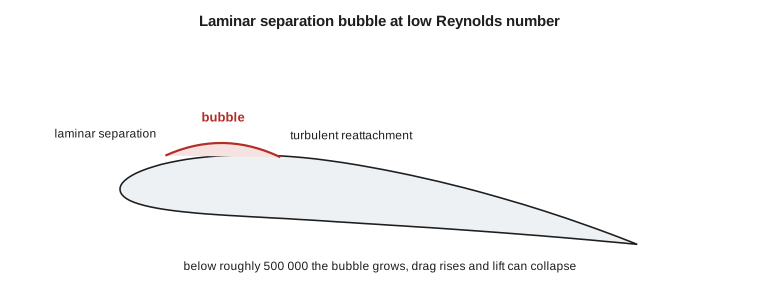
Short bubbles, a few percent of the chord long, are common on sections at chord Reynolds numbers of a few hundred thousand and are mostly harmless, apart from adding some drag. As the Reynolds number falls or the angle of attack rises, the bubble can grow long and then suddenly fail to reattach, bursting into separation over the whole upper surface. The lift can collapse abruptly. The Skiff-W wing, at a Reynolds number near 300 000, sits squarely in this regime, which is why its designers chose a section developed for low Reynolds numbers from the University of Illinois data and why a narrow zigzag strip of tape near its leading edge, a turbulator, was added to trip the boundary layer before the bubble could form. For the Tern, at several million, bubbles are confined to a tiny region near the nose, if they form at all.
Three ways a section stalls
As the angle of attack increases, the suction peak grows and the pressure recovery behind it steepens. Eventually separation spreads over enough of the upper surface that the lift stops rising: the section has reached its maximum lift coefficient. Tunnel tests in the 1950s showed that sections stall in three distinct ways, depending mostly on their thickness and leading-edge radius.
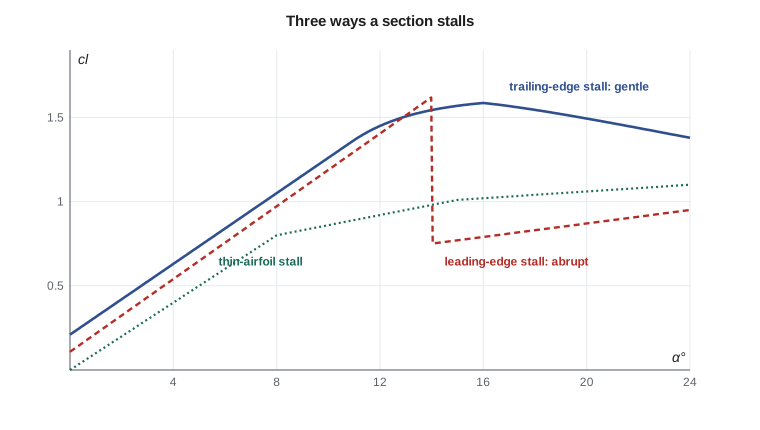
Trailing-edge stall is typical of thick sections of about 12 percent or more with generous nose radii, such as the NACA 4415. Turbulent separation begins at the trailing edge and creeps forward as the angle increases. The lift curve rounds over gently, the maximum lift is reached gradually, and the lift falls only slowly after it. Leading-edge stall is typical of moderately thin sections of about 9 to 12 percent with smaller nose radii. A short laminar bubble near the nose suddenly bursts, and the flow separates from the leading edge over the whole upper surface at once. The maximum lift can be high, but the drop after it is abrupt. Thin-airfoil stall happens on very thin sections with sharp noses. A long bubble forms at quite low angles and grows steadily aft; the lift curve bends over early and the maximum lift is low.
The Block 2 choice of NACA 4415 at the root and 4412 at the tip was made partly for this reason: both sections stall from the trailing edge at the Tern's Reynolds numbers, with the 4415 especially gentle. A thinner tip section would have saved a little drag but risked a sharper stall exactly where the ailerons are.
From section stall to wing stall
Lesson 9 showed that a wing begins to stall where the local section lift coefficient first reaches the section's maximum. A simple and widely used estimate of the wing's maximum lift divides the section maximum by the peak value of the ratio \(c_l/C_L\) from lifting-line theory, with a small factor, often about 0.9 to 0.95, for three-dimensional and Reynolds number effects. With a section maximum of 1.70 at the landing Reynolds number and the lifting-line results of Lesson 9, the program estimates a clean wing maximum lift coefficient of 1.55 without washout and 1.52 with 2.5 degrees of washout. The washout costs a little maximum lift because the tips can no longer be fully used, but it moves the start of the stall from mid-semispan to near the root.
Two more tools tune the stall. Stall strips are short sharp-edged strips fixed to the leading edge near the root. At high angles they provoke separation there first, ensuring the stall starts inboard and that the separated wake buffets the tail as a warning. Vortex generators are small vanes, typically a few millimetres to a couple of centimetres tall, set at an angle to the flow ahead of a region likely to separate. Each sheds a small vortex that mixes high-momentum outer air into the boundary layer, delaying separation. They are common ahead of ailerons on aircraft whose original wing tips stall too early, and the Block 2 wing will carry a row of them ahead of each aileron as insurance.
Ice, roughness and certification
Leading-edge contamination is the most serious threat to maximum lift. A thin layer of frost or a ridge of ice only a few millimetres high, on a wing whose chord is measured in metres, can trip the boundary layer early and disturb the suction peak so badly that the maximum lift falls by 20 to 40 percent and the stall angle drops by several degrees. The program shows the effect of a 30 percent loss in section maximum lift on the Block 2 wing: the wing maximum lift coefficient falls from 1.52 to about 1.07, which would raise the clean stall speed by about 19 percent. That is why aircraft must be free of frost, snow and ice before take-off under the rules of both Canada and the United States, and why aircraft certified for flight in icing have protected leading edges and higher stall-warning margins in icing conditions. The Tern Block 2 uses electrically heated leading edges, and the stall-warning system raises its warning speed automatically when the ice detector senses ice.
Certification standards for aircraft like the Tern, applied by Transport Canada, require that the stall can be recognized by clear warning, that the aircraft can be recovered with normal use of the controls, and that it does not roll or yaw excessively during the stall. The exact wording and the means of showing compliance differ between the Canadian and US standards, but the flight-test task is similar: Sam will fly stalls at each flap setting, with power on and off, wings level and in turns, slowly and with rapid entries, and record the roll and pitch behaviour. Lesson 12's capstone combines all of this in the final review.
Worked problem
Stall speed with an iced leading edge
The Block 2 clean wing has \(C_{L,max} = 1.52\). With leading-edge ice the program estimates 1.07. Find both stall speeds at 6500 kg at sea level and the percentage increase.
Show solution
- \(V_S = \sqrt{2W/(\rho S C_{L,max})}\).
- Clean: \(\sqrt{2\times 63\,765/(1.225\times 28\times 1.52)} = 49.5\ \text{m/s}\), about 178 km/h.
- Iced: \(\sqrt{2\times 63\,765/(1.225\times 28\times 1.07)} = 59.0\ \text{m/s}\), about 212 km/h.
Answer: Ice raises the clean stall speed by about 19 percent. An approach flown at a speed based on the clean stall would be only just above the iced stall, which is why icing procedures add speed and why the warning system adjusts automatically.
Worked problem
Laminar separation on the Skiff-W
Using the same Thwaites approach, a designer finds the laminar boundary layer on the Skiff-W wing separates at 12 percent chord at the cruise lift coefficient. With a chord of 0.32 m and 18 m/s, what is the local Reynolds number at separation, and is transition before separation likely?
Show solution
- \(Re_x = 18\times 0.12\times 0.32/1.461\times 10^{-5} = 4.7\times 10^4\).
- Natural transition at so low a local Reynolds number is very unlikely, so the layer will separate laminar.
Answer: A laminar separation bubble will form. A turbulator just ahead of 12 percent chord would make the layer turbulent before it reaches the adverse gradient, at the price of slightly higher friction.
Common mistakes
MistakeAssuming separation means the whole wing has stalled.
InsteadSeparation starts locally and spreads. The wing reaches maximum lift only when enough of it has separated.
MistakeTreating stall as occurring at a fixed speed.
InsteadThe wing stalls at a critical angle of attack. The speed at which that happens depends on weight, load factor, configuration and contamination.
MistakeBelieving a small amount of frost is harmless.
InsteadEven thin frost can cut maximum lift substantially and lower the stall angle.
MistakeAdding washout without considering its cost.
InsteadWashout lowers the wing's maximum lift slightly and changes cruise induced drag; it is a trade, not a free improvement.
Summary and key terms
- Transition occurs when disturbances in the laminar layer grow, mainly where the pressure starts rising or roughness trips the flow.
- Separation happens when the boundary layer can no longer advance against an adverse pressure gradient; Thwaites' method predicts laminar separation from the outer velocity alone.
- At low Reynolds number laminar separation bubbles form and can burst.
- Sections stall from the trailing edge, from the leading edge or in thin-airfoil fashion, and thick sections with round noses stall most gently.
- Wing stall starts where the section lift peaks, so washout, stall strips and vortex generators are used to make it start inboard.
- Ice and roughness can cut maximum lift drastically.
- Tollmien-Schlichting waves
- Small two-dimensional disturbances whose growth leads to transition in a laminar boundary layer.
- eN method
- A transition prediction method based on the amplification of the most unstable disturbance.
- Thwaites' method
- An integral method that predicts laminar boundary-layer growth and separation.
- Laminar separation bubble
- A region where a laminar layer separates, becomes turbulent and reattaches.
- Trailing-edge stall
- A gradual stall in which separation spreads forward from the trailing edge.
- Leading-edge stall
- An abrupt stall caused by sudden separation near the leading edge.
- Stall strip
- A sharp strip on the inboard leading edge that makes the root stall first.
- Vortex generator
- A small vane that mixes energetic air into the boundary layer to delay separation.
- Turbulator
- A trip strip that forces transition before laminar separation.
Practice problems
Work each problem on paper first, then reveal the answer to check.
A section's maximum lift coefficient is 1.6, and lifting-line theory gives a peak c_l/C_L of 1.08. Estimate the wing C_Lmax with a factor of 0.95.
Show answer
C_Lmax ≈ 0.95 × 1.6/1.08 = 1.41.
Why is transition usually found near the suction peak on a wing?
Show answer
Behind the peak the pressure rises, and an adverse gradient makes disturbances grow quickly.
A wing's C_Lmax falls by 25 percent because of frost. By what percentage does the stall speed rise?
Show answer
V_S ∝ 1/√C_Lmax: 1/√0.75 = 1.155, a 15.5 percent increase.
In the program, change the cylinder speed to 20 m/s. Does the laminar separation angle change?
Show answer
No. In Thwaites' method the separation position depends on the shape of the velocity distribution, not its scale.
Which type of stall would you expect on a 6 percent thick section with a sharp nose?
Show answer
Thin-airfoil stall, with a long bubble growing aft and a low, early maximum lift.
Why are vortex generators often placed ahead of the ailerons?
Show answer
To keep the flow attached over the ailerons near the stall, preserving roll control.
Lesson quiz · 5 questions
Score 60% or more to complete this lesson.
Create a free account to save your progress, take quizzes and earn a certificate.