
AERO-220 · Lesson 8 of 12 · 22 min
Endurance
Range is about distance; endurance is about time. An aircraft holding over an airport while a snow squall clears, a patrol aircraft circling a search area, or a drone watching over a pipeline all need to stay airborne as long as possible on the energy they carry, and distance does not matter. For the airline, endurance sets the holding fuel it must carry on every flight. For Sam Littlechild's Skiff-W programme, a utility company wants to use the drone for long inspection flights along power lines, and endurance is the headline number. This lesson derives endurance for propeller, jet and battery-electric aircraft and explains why each has a different best speed.
Endurance as an integral
Endurance is the time for which the aircraft can burn its fuel. In each interval \(dt\), it burns \(\dot{m}_f\,dt\) of fuel, so the time per kilogram is the inverse of the fuel flow. To maximize endurance, the pilot must minimize the fuel flow, not the fuel per kilometre. For a propeller aircraft, fuel flow is proportional to shaft power, so the minimum-power speed gives the best endurance. For a jet, fuel flow is proportional to thrust, so the minimum-drag speed gives the best endurance. For an electric aircraft, energy use is proportional to power, so like a propeller aircraft its best endurance is at minimum power.
| Aircraft type | Fuel or energy flow proportional to | Best endurance speed | Best range speed |
|---|---|---|---|
| Propeller (piston, turboprop) | Shaft power | Minimum power (0.76 V_md) | Minimum drag (V_md) |
| Jet (turbofan, turbojet) | Thrust | Minimum drag (V_md) | 1.316 V_md |
| Battery-electric | Power | Minimum power (0.76 V_md) | Minimum drag (V_md) |
| Hybrid-electric (Tern) | Power, from fuel and battery | Minimum power | Minimum drag |
Propeller aircraft
For a propeller aircraft with constant propeller efficiency and specific fuel consumption, the fuel flow at the minimum-power speed is proportional to \(W^{3/2}/\sqrt{\rho}\), because power required scales that way. Integrating as the weight falls gives the propeller endurance equation. Writing the fuel consumption as \(c_w = cg\), the weight of fuel burned per unit of shaft energy, gives the form found in most textbooks.
Three features of this equation guide the design of endurance aircraft. Endurance is greatest when \(C_L^{3/2}/C_D\) is greatest, which happens at the minimum-power condition, and that ratio grows strongly with aspect ratio, so endurance aircraft have very long wings. Endurance grows with the square root of density, so propeller aircraft loiter longest at low altitude, unlike jets. And the weight terms show that endurance falls as the aircraft gets heavier, more strongly than range does.
The square root of density deserves emphasis because it surprises students. A propeller aircraft at low altitude needs less power to fly at its minimum-power condition, because its true airspeed is lower, so it burns fuel more slowly. Patrol aircraft with turboprop engines often transit to their search area at high altitude for speed and range, then descend to loiter low, and some shut down one engine during the loiter to run the other at a more efficient power setting.
# Endurance: propeller, jet and battery-electric aircraft, and holding fuel for the Tern
import math
g = 9.81
def min_power(m, S, CD0, k, rho):
    W = m * g
    CL = math.sqrt(3 * CD0 / k)
    V = math.sqrt(2 * W / (rho * S * CL))
    return V, W / (CL / (CD0 + k * CL**2)) * V        # speed and power required (thrust power)
# Tern holding at 1500 m on generator power: fuel flow at the minimum-power speed
S, CD0, k = 28.0, 0.028, 0.039
rho_1500 = 1.058
for m in (6000, 5400):
    V, P = min_power(m, S, CD0, k, rho_1500)
    eta = 0.84 * (1 - math.exp(-V / 30))
    ff = 0.32 * P / eta / 1000                      # kg/h at 0.32 kg per kWh of shaft energy
    Vs = math.sqrt(2 * m * g / (rho_1500 * S * 1.6))         # clean stall speed (true airspeed)
    Vh = 1.3 * Vs                                            # practical holding speed with a stall margin
    CLh = 2 * m * g / (rho_1500 * Vh**2 * S)
    Ph = 0.5 * rho_1500 * Vh**3 * S * (CD0 + k * CLh**2)
    ffh = 0.32 * Ph / (0.84 * (1 - math.exp(-Vh / 30))) / 1000
    print(f"Tern at {m} kg: minimum power {V*3.6:.0f} km/h ({V/Vs:.2f} x stall), fuel {ff:.0f} kg/h;"
          f" holding at 1.3 x stall = {Vh*3.6:.0f} km/h, fuel {ffh:.0f} kg/h, 45 min needs {0.75*ffh:.0f} kg")
# Propeller endurance by stepping through the fuel burn (minimum-power speed, constant efficiency 0.78)
def prop_endurance(m0, fuel, rho, eta=0.78, c=0.32 / 3.6e6, dm=1.0):
    t, m = 0.0, m0
    while m > m0 - fuel:
        V, P = min_power(m, S, CD0, k, rho)
        t += dm / (c * P / eta); m -= dm
    return t / 3600
print(f"Tern endurance on 900 kg of fuel from 6500 kg at 1500 m: {prop_endurance(6500, 900, rho_1500):.1f} h")
# Jet endurance at maximum L/D: E = (L/D)/(c_T g) ln(m0/m1)
LDj, cT = 17.0, 0.055 / 3600
print(f"Regional jet holding on 3000 kg from 36 000 kg: {LDj/(cT*g)*math.log(36000/33000)/3600:.1f} h")
# Battery-electric endurance for the Skiff-W: usable energy x efficiency / thrust power at minimum power
E_wh, eta_tot = 6 * 220 * 0.80, 0.95 * 0.88 * 0.75   # usable energy; battery-to-thrust efficiency
for m in (24, 21):
    V, P = min_power(m, 1.4, 0.030, 0.0312, 1.1)
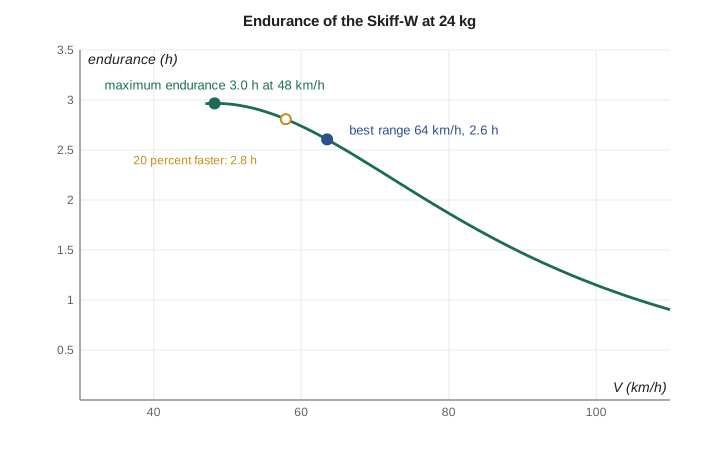
print(f"Skiff-W at {m} kg: loiter {V*3.6:.0f} km/h, thrust power {P:.0f} W, endurance {E_wh*eta_tot/P:.1f} h")Tern at 6000 kg: minimum power 187 km/h (1.04 x stall), fuel 108 kg/h; holding at 1.3 x stall = 233 km/h, fuel 109 kg/h, 45 min needs 82 kg Tern at 5400 kg: minimum power 178 km/h (1.04 x stall), fuel 94 kg/h; holding at 1.3 x stall = 221 km/h, fuel 95 kg/h, 45 min needs 71 kg Tern endurance on 900 kg of fuel from 6500 kg at 1500 m: 9.3 h Regional jet holding on 3000 kg from 36 000 kg: 2.7 h Skiff-W at 24 kg: loiter 48 km/h, thrust power 223 W, endurance 3.0 h Skiff-W at 21 kg: loiter 45 km/h, thrust power 183 W, endurance 3.6 h
Holding fuel in practice
The program shows something that matters for the airline. The Tern's minimum-power speed at 1500 m is only 1.04 times its clean stall speed, too close for comfort in turbulence or a holding turn. Pilots therefore hold at a higher speed, about 1.3 times the stall speed, which for the Tern at 6000 kg is about 233 km/h. The surprise is how little this costs: the fuel flow rises from 108 to 109 kg/h, because the power-required curve is very flat near its minimum and the propeller is more efficient at the higher speed. The 45-minute final reserve therefore needs about 82 kg of fuel at the start of the hold, or 71 kg if the aircraft arrives lighter.
Holding speeds are also limited by air traffic rules. Holding patterns are flown at or below published maximum speeds, which depend on altitude and differ slightly between countries, so that aircraft stay within the protected airspace of the pattern. Turboprop and electric aircraft hold comfortably within those limits; jets often hold close to their minimum-drag speed, which can be near the maximum allowed.
Worked problem
Final reserve fuel for the Tern
Operating rules require the Tern to land with enough fuel for 45 minutes of holding at 1500 m. The program gives a holding fuel flow of 95 kg/h at 5400 kg. The airline's procedures also require 5 percent of the trip fuel as a contingency. For a trip burning 180 kg, find the minimum fuel on board at departure if no alternate is required, ignoring taxi fuel.
Show solution
- Final reserve: \(0.75\ \text{h} \times 95\ \text{kg/h} = 71\ \text{kg}\).
- Contingency: \(0.05 \times 180 = 9\ \text{kg}\).
- Trip fuel plus reserves: \(180 + 9 + 71 = 260\ \text{kg}\).
- Add the battery reserve rule from Lesson 5: at least 40 kWh must remain in the battery at landing, which the generator can restore in cruise if needed.
Answer: On a typical short route the Tern takes off with only a few hundred kilograms of fuel, a small share of its weight, so its payload is limited more by its zero-fuel weight than by fuel. When an alternate airport is required, the fuel to fly there, often 60 to 100 kg for the Tern, is added before the final reserve.
Jets
For a jet, fuel flow equals \(c_T\) times thrust, and thrust equals the weight divided by L/D. The endurance equation is therefore simpler than the propeller form: it depends on L/D, the thrust-specific fuel consumption and the logarithm of the mass ratio, and not on density or speed. A jet's best endurance occurs at maximum L/D, the minimum-drag speed, at any altitude. In practice, jets hold at moderate to high altitude, because their engines are more efficient there and holding speeds are easier to manage.
The program gives the regional jet about 2.7 hours of holding on 3000 kg of fuel at maximum L/D, roughly 1100 kg per hour. A sobering comparison with the Tern's 95 kg per hour makes the case for small, efficient aircraft on thin routes: a jet that must hold for 30 minutes because of weather at a small airport burns more fuel in the hold than the Tern uses for an entire short trip.
Battery-electric aircraft
A battery-electric aircraft's mass does not change as it uses energy, so neither the logarithm nor the weight terms appear. Endurance is simply the usable battery energy, times the efficiency from battery to thrust power, divided by the power required. Since power required at the minimum-power condition scales with \(W^{3/2}/\sqrt{\rho}\), electric endurance falls steeply with weight and is best at low altitude, like a propeller aircraft.
Here \(e^*\) is the battery's usable specific energy and \(\eta_{total}\) combines the battery's discharge efficiency, the motor and controller efficiency and the propeller efficiency. For the Skiff-W, with 6 kg of cells at 220 Wh/kg, 80 percent usable, and a total efficiency of about 0.63, the program gives about 3.0 hours of loiter at 24 kg, rising to 3.6 hours at 21 kg with a lighter payload. That is respectable for a drone of its size and explains why long, slender wings are worth their awkwardness in transport and handling.
Design for endurance
Aircraft built mainly for endurance share recognizable features. They have very high aspect ratios, sometimes above 20, to maximize \(C_L^{3/2}/C_D\). They fly slowly at high lift coefficients, so their wings use sections with high maximum lift and low drag at those lift coefficients. They carry a large share of their weight as fuel or battery. And they often have efficient, lightly loaded propellers. Solar-electric drones take this to the extreme, with enormous wingspans and very low weights, so that the power needed for level flight can be supplied by sunlight during the day and stored batteries at night; some have stayed aloft for weeks.
For Sam's Skiff-W, the trade is between endurance and payload. Each additional kilogram of battery adds about 30 minutes of energy at constant weight but raises the power required by about 6 percent at the same lift coefficient. Beyond a certain battery fraction, adding cells gives diminishing returns, and the optimum for a given payload can be found by sweeping the battery mass in a simple program like the one in this lesson. The Skiff-W's 6 kg pack is close to that optimum for its standard 4 kg inspection payload.
Endurance versus range
A single aircraft can be flown for range or for endurance, but not both at once. Pilots of propeller aircraft who need to wait, for example for weather to improve at the destination, slow to the endurance speed; if they then need to divert, they speed up to the range speed. Jets do the same between the minimum-drag speed and the faster long-range cruise speed. Knowing which goal matters at each moment, and which speed serves it, is one of the most practical uses of the theory in this course.
Common mistakes
MistakeFlying at the best-range speed to wait for weather to clear.
InsteadTo maximize time aloft, fly at the best-endurance speed: minimum power for propeller and electric aircraft, minimum drag for jets.
MistakeAssuming propeller aircraft loiter longest at high altitude.
InsteadPropeller endurance grows with √ρ, so propeller aircraft loiter longest at low altitude.
MistakeHolding at the exact minimum-power speed close to the stall.
InsteadHold with a stall margin, about 1.3 V_S; the flat power curve means the fuel penalty is small.
MistakeApplying the logarithmic jet endurance equation to battery aircraft.
InsteadElectric endurance is energy times efficiency divided by power required; mass does not change.
MistakeAssuming more battery always means more endurance.
InsteadExtra battery mass raises power required, so endurance gains shrink and eventually reverse.
Summary and key terms
- Endurance is the integral of dm over fuel flow; best endurance minimizes fuel or energy flow.
- Propeller and electric aircraft get best endurance at minimum power; jets at minimum drag.
- Propeller endurance depends on C_L^1.5/C_D, √ρ and the inverse square roots of the weights.
- Jet endurance is (L/D)/(c_T g) × ln(m₀/m₁), independent of altitude in the simple model.
- Electric endurance is usable energy times efficiency divided by power required.
- Holding fuel reserves follow operating rules; practical holding speeds include a stall margin.
- Endurance
- The time an aircraft can remain airborne on a given load of fuel or energy.
- Best-endurance speed
- The speed that minimizes fuel or energy flow, giving the longest time aloft.
- Loiter
- Flight at the best-endurance condition, usually in one area, to wait or to observe.
- Holding pattern
- A standard racetrack pattern flown while waiting for clearance to continue.
- Final reserve fuel
- Fuel required by operating rules to remain at landing, usually for 30 or 45 minutes of flight.
- Usable energy
- The part of a battery's stored energy that may be used in service without harming its life or safety.
Practice problems
Work each problem on paper first, then reveal the answer to check.
A propeller aircraft's minimum-drag speed is 260 km/h. What is its best-endurance speed?
Show answer
0.760 × 260 = 198 km/h.
A jet with L/D = 16 and c_T = 0.06 kg/(N·h) burns from 30 000 to 28 000 kg. Find the endurance.
Show answer
E = 16/(1.667 × 10⁻⁵ × 9.81) × ln(30/28) = 6747 s, about 1.9 h.
A drone uses 300 W of thrust power, with 900 Wh of usable energy and a total efficiency of 0.6. Find its endurance.
Show answer
900 × 0.6/300 = 1.8 h.
By what factor does propeller endurance change if the same aircraft loiters where σ = 0.74 instead of at sea level?
Show answer
√0.74 = 0.86, about 14 percent less endurance.
Why does holding at 1.3 times the stall speed cost the Tern almost no extra fuel?
Show answer
The power-required curve is flat near its minimum and propeller efficiency improves at higher speed, so fuel flow barely changes.
In the program, give the Skiff-W 7 kg of cells, raising its mass to 25 kg. What endurance results?
Show answer
About 3.3 h.
Lesson quiz · 5 questions
Score 60% or more to complete this lesson.
Create a free account to save your progress, take quizzes and earn a certificate.