
AERO-220 · Lesson 5 of 12 · 24 min
Climb and descent
Two of the airline's questions are about climbing. How long does the Tern take to reach its 3000 m cruise altitude, and can it climb safely after a motor failure on take-off on a hot summer day? The first decides block time and energy use on short routes, where the climb is a large share of the trip. The second is a certification requirement and a safety question that no operator can compromise on. This lesson develops climb performance from the equations of Lesson 1, then turns to descent, which matters just as much for planning and for the Tern's energy budget.
Rate of climb from excess power
In a steady climb, the thrust along the flight path must balance the drag plus the weight component \(W\sin\gamma\). Multiplying by the speed turns forces into powers: the thrust power available equals the power needed to overcome drag plus the rate at which potential energy increases. The vertical speed, or rate of climb, is \(V\sin\gamma\), so it equals the excess power divided by the weight.
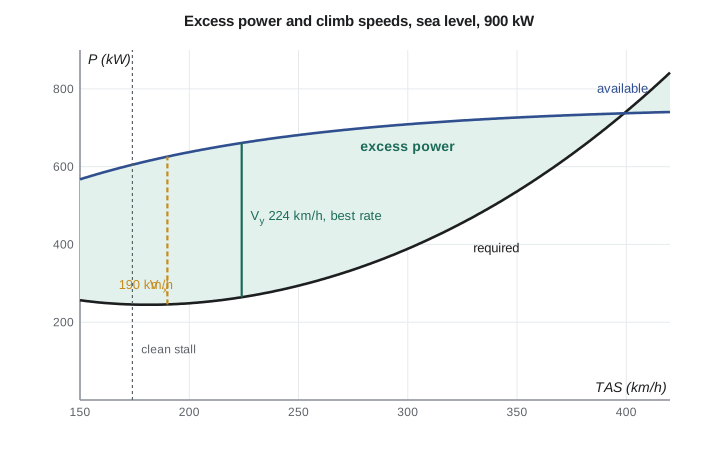
Strictly, the power required in a climb is a little less than in level flight at the same speed, because lift is \(W\cos\gamma\), not \(W\), and induced drag is slightly smaller. For climb angles under about 15 degrees the difference is small, and engineers use the level-flight power required. On a graph, the rate of climb at any speed is the vertical gap between the power-available and power-required curves, divided by the weight.
Best rate and best angle
Two climb speeds matter to pilots. The best rate of climb speed \(V_Y\) gives the greatest height gain per unit of time; it is used for most climbs, because it minimizes the time spent at low, inefficient altitudes. The best angle of climb speed \(V_X\) gives the greatest height gain per unit of horizontal distance; it is used to clear obstacles after take-off from short runways. For a propeller aircraft, excess thrust is greatest at low speed, so \(V_X\) is lower than \(V_Y\) and often lies close to the stall speed. For a jet, with roughly constant thrust, \(V_X\) is near the minimum-drag speed and \(V_Y\) is well above it.
If a propeller aircraft's power available were exactly constant with speed, \(V_Y\) would equal the minimum-power speed. In reality propeller efficiency rises with speed over the climb range, so \(V_Y\) is somewhat faster. As altitude increases, \(V_Y\) in true airspeed rises and \(V_X\) rises too; at the absolute ceiling they meet, because only one speed allows level flight.
# Climb performance of the Tern: rate of climb, best speeds, time to climb, ceiling and one-motor-out gradient
import math
g, S, m = 9.81, 28.0, 6500.0
W = m * g
def rho_at(h, dT=0.0):
    T = 288.15 - 0.0065 * h
    p = 101325 * (T / 288.15) ** 5.2559
    return p / (287.05 * (T + dT))
def eta(V): return 0.84 * (1 - math.exp(-V / 30))
def climb(V, rho, Pshaft, CD0=0.028, k=0.039):
    q = 0.5 * rho * V**2; CL = W / (q * S)
    D = q * S * (CD0 + k * CL**2)
    excess = eta(V) * Pshaft - D * V
    return excess / W, (eta(V) * Pshaft / V - D) / W     # rate of climb (m/s), climb gradient
def best(rho, Pshaft, **kw):
    speeds = [v / 3.6 for v in range(190, 400)]       # do not fly slower than 190 km/h, about 1.1 x clean stall
    vy = max(speeds, key=lambda V: climb(V, rho, Pshaft, **kw)[0])
    vx = max(speeds, key=lambda V: climb(V, rho, Pshaft, **kw)[1])
    return vy, climb(vy, rho, Pshaft, **kw)[0], vx, climb(vx, rho, Pshaft, **kw)[1]
def gen_power(h): return 760e3 * (rho_at(h) / 1.225) ** 0.45   # turbine generator shaft power after losses
# All motors, 900 kW (generator plus battery)
for h in (0, 1500, 3000):
    vy, rc, vx, gr = best(rho_at(h), 900e3)
    print(f"{h:5d} m, 900 kW: V_y {vy*3.6:.0f} km/h, RC {rc:.1f} m/s ({rc*196.9:.0f} ft/min); best angle at {vx*3.6:.0f} km/h (lowest speed allowed), gradient {gr*100:.1f}%")
# Time to climb from sea level to 3000 m at V_y with 900 kW, in 100 m steps
t = 0.0
for h in range(0, 3000, 100):
    t += 100 / best(rho_at(h + 50), 900e3)[1]
print(f"Time to 3000 m at full climb power: {t/60:.1f} min")
# Ceiling on generator power alone (battery empty)
for h in range(0, 9001, 500):
    rc = best(rho_at(h), gen_power(h))[1]
    if rc < 0.5:
        print(f"Service ceiling on generator power alone: about {h} m ({h/0.3048:.0f} ft)"); break
# One motor failed: 600 kW contingency, take-off flaps, gear up, propeller feathered, ISA+20 at sea level
rho_hot = rho_at(0, 20)
V2 = 1.2 * math.sqrt(2 * W / (rho_hot * S * 2.1))
rc, gr = climb(V2, rho_hot, 600e3, CD0=0.044, k=0.042)
print(f"One motor out at V2 = {V2*3.6:.0f} km/h on an ISA+20 day: RC {rc:.2f} m/s, gradient {gr*100:.1f}% (rule for this class: 1%)")0 m, 900 kW: V_y 224 km/h, RC 6.2 m/s (1225 ft/min); best angle at 190 km/h (lowest speed allowed), gradient 11.3% 1500 m, 900 kW: V_y 236 km/h, RC 6.1 m/s (1207 ft/min); best angle at 190 km/h (lowest speed allowed), gradient 10.8% 3000 m, 900 kW: V_y 249 km/h, RC 6.0 m/s (1181 ft/min); best angle at 190 km/h (lowest speed allowed), gradient 10.0% Time to 3000 m at full climb power: 8.2 min Service ceiling on generator power alone: about 8000 m (26247 ft) One motor out at V2 = 188 km/h on an ISA+20 day: RC 1.74 m/s, gradient 3.3% (rule for this class: 1%)
The program shows several things Arjun will put in the bid. With both motors at their 900 kW continuous rating, using battery and generator together, the Tern climbs at about 6 m/s and reaches 3000 m in about 8 minutes. Because electric motors do not lose power with height, the climb rate barely falls with altitude, a striking difference from a turboprop. The best-angle speed lands at the lowest speed Arjun allowed in the search, 190 km/h, about 1.1 times the clean stall speed, showing that for this aircraft the steepest climb always comes at the slowest safe speed.
Time to climb and the energy cost of climbing
The time to climb from one height to another is the integral of the inverse of the rate of climb. When the rate of climb falls roughly linearly with altitude, as it does for many engine types, the integral has a neat closed form. When it does not, the integral is done numerically in steps, as in the program. The fuel or energy used in the climb is the power drawn multiplied by the time.
Climbing costs energy because the aircraft gains potential energy, and the propulsion system must also supply drag power throughout. Lifting the Tern 3000 m stores \(63\,765 \times 3000 = 191\ \text{MJ}\), about 53 kWh, as potential energy. Some of that is recovered in the descent, when the aircraft can fly with reduced power while gliding gently down. Short routes are inefficient partly because the climb and descent take a larger share of the trip, and partly because the energy recovery in descent is never complete.
Worked problem
Battery energy used in the climb
During the 8.2 minute climb to 3000 m, the motors draw 900 kW of shaft power and the generator supplies about 710 kW on average, after losses, over that height range. The rest comes from the battery. Find the battery energy used, allowing for 95 percent efficiency between battery and motor shaft.
Show solution
- Shaft power from the battery: \(900 - 710 = 190\ \text{kW}\).
- Battery output, allowing for losses: \(190/0.95 = 200\ \text{kW}\).
- Energy: \(200 \times 8.2/60 = 27\ \text{kWh}\).
- The 600 kg pack holds about 150 kWh, of which about 120 kWh is usable to protect battery life, so the climb uses a little under a quarter of the usable energy.
Answer: The battery can be recharged in cruise when the generator has spare capacity, or on the ground. Arjun keeps at least 40 kWh in reserve at all times, enough for a full-power go-around and climb after a missed approach, and builds that rule into the mission analysis in Lesson 12.
Ceilings
As an aircraft climbs, its rate of climb eventually falls. The absolute ceiling is the altitude at which the maximum rate of climb is zero; the aircraft can just maintain level flight there, at one speed. Since the rate of climb approaches zero gradually, reaching the absolute ceiling would take an infinite time, so practical ceilings are defined by small positive rates. The service ceiling is the altitude where the maximum rate of climb falls to 0.5 m/s for propeller aircraft, and the cruise ceiling, used by some manufacturers, at 1.5 m/s.
On generator power alone, with an empty battery, the Tern's service ceiling is about 8000 m. It will never fly there in service. Because it is not pressurized, operating rules require supplemental oxygen for crew and passengers above roughly 3000 to 4000 m, so its practical operating ceiling is set by physiology, not performance. The ceiling still matters for one critical case: the altitude it can hold with one motor failed over high terrain, the one-motor-out service ceiling, which determines which routes are safe over mountains. The routes to Thompson cross only gentle terrain, so this is not limiting for the launch airline.
Climb after a motor failure
The most demanding climb requirement for a multi-engine aircraft follows a failure of one engine or motor during take-off. With half its power gone, the aircraft must still climb away from the runway, clear obstacles and reach a safe height. Certification rules set minimum climb gradients for this case. Under the airworthiness standards Transport Canada applies to commuter aeroplanes (Chapter 523 of the Airworthiness Manual), an aircraft of the Tern's size and speed class must show a one-engine-inoperative climb gradient of at least 1 percent at 400 ft above the take-off surface with the landing gear retracted and the flaps in the take-off position. Larger, faster commuter aircraft must show 2 percent. Separate rules set an all-engine climb gradient after take-off and a 3 percent gradient for a balked landing, a go-around from close to touchdown with flaps and gear down.
Meeting these numbers on a hot day at a high airport is often the hardest performance requirement in a new design, because the remaining engine produces less power in hot, thin air while the aircraft must fly faster to make the same lift. For the Tern, the electric motors help: the remaining motor's power does not fall in heat, and its 600 kW contingency rating is available for five minutes. The program shows a one-motor-out gradient of 3.3 percent at a speed of 1.2 times the take-off stall speed on a sea-level day 20 °C hotter than standard, with the failed propeller feathered and the drag of flying with asymmetric thrust included. That is a comfortable margin over the 1 percent minimum.
The asymmetric thrust after a motor failure creates a yawing moment that the rudder must balance, and the pilot also banks slightly toward the working engine to reduce sideslip. Both add drag. The minimum control speed \(V_{MC}\) is the lowest speed at which the rudder can still hold the aircraft straight with the critical engine failed and the other at maximum power. Take-off safety speeds must be above it, and Lesson 9 shows how it shapes the take-off.
Descent
Descent is the reverse of climb. With power reduced below the power required, the aircraft descends at a rate equal to the power deficit divided by weight. Commercial descents are planned to arrive at the destination at the right height and speed with minimum energy use, ideally in one continuous descent with engines near idle. A common rule of thumb is to begin descent at a distance in nautical miles of about three times the height to lose in thousands of feet, which corresponds to a descent angle of about 3 degrees.
For the Tern, descent offers an energy opportunity. In a gentle descent at reduced power, the propellers can be set to windmill slightly and the motors run as generators, recovering some energy into the battery. The recovery is modest, because windmilling is inefficient and passengers dislike steep descents, but over many short flights it adds up. Arjun's estimate, about 4 kWh recovered on a typical descent from 3000 m, is included in the mission analysis but kept out of the guaranteed numbers until flight testing confirms it.
| Climb or descent quantity | Typical Tern value | Where it is used |
|---|---|---|
| Best rate of climb speed, sea level | 224 km/h | Normal climb schedule |
| Maximum rate of climb, sea level | 6.2 m/s | Time and energy to climb |
| Time to 3000 m | About 8 min | Block time, battery planning |
| One-motor-out gradient, hot day | 3.3 percent | Certification, obstacle clearance |
| Normal descent angle | About 3° | Descent planning |
| Service ceiling, generator only | About 8000 m | Not used: oxygen rules limit altitude |
Common mistakes
MistakeUsing the best-angle speed for a normal climb.
InsteadBest angle maximizes height per distance and is for obstacle clearance; best rate minimizes time and is normal practice.
MistakeExpecting the climb rate of an electric aircraft to fall with altitude like a piston aircraft.
InsteadElectric motor power is independent of density, so the climb rate falls much more slowly.
MistakeTreating the absolute ceiling as reachable in practice.
InsteadThe climb rate approaches zero there, so practical ceilings use 0.5 m/s or 1.5 m/s.
MistakeForgetting the drag of a windmilling propeller and sideslip after a motor failure.
InsteadFeather the propeller and include the asymmetric-flight drag in one-engine-out climb estimates.
MistakePlanning a descent too late.
InsteadUse about 3 NM per 1000 ft to lose, adjusted for wind and speed.
Summary and key terms
- Rate of climb equals excess power divided by weight; climb gradient equals excess thrust divided by weight.
- V_Y gives the best rate of climb; V_X, at lower speed, the best angle; for propeller aircraft V_X lies near the stall.
- Time to climb is the integral of dh/RC; energy used is power drawn times time.
- Absolute ceiling has zero climb rate; service ceiling 0.5 m/s for propeller aircraft.
- One-engine-inoperative climb gradients at 400 ft are key certification requirements: 1 percent or 2 percent depending on the class.
- Descent rate is the power deficit over weight; plan descents at about 3 NM per 1000 ft.
- Rate of climb
- The vertical component of the aircraft's velocity in a climb.
- Climb gradient
- Height gained per unit of horizontal distance, usually given in percent.
- Best rate of climb speed
- V_Y, the speed giving the greatest rate of climb.
- Best angle of climb speed
- V_X, the speed giving the steepest climb gradient.
- Absolute ceiling
- The altitude at which the maximum rate of climb falls to zero.
- Service ceiling
- The altitude at which the maximum rate of climb falls to 0.5 m/s (100 ft/min) for propeller aircraft.
- Balked landing
- A go-around started close to touchdown, with gear and flaps in the landing position.
- Minimum control speed
- V_MC, the lowest speed at which directional control can be held with the critical engine inoperative.
Practice problems
Work each problem on paper first, then reveal the answer to check.
An aircraft of 2500 kg has 50 kW of excess power. Find its rate of climb in m/s and ft/min.
Show answer
RC = 50 000/24 525 = 2.04 m/s, about 400 ft/min.
An aircraft climbs at 2.5 m/s at 60 m/s true airspeed. Find its climb gradient.
Show answer
2.5/60 = 4.2 percent.
An aircraft's rate of climb falls linearly from 5 m/s at sea level to zero at 6000 m. How long does it take to climb to 3000 m?
Show answer
t = (6000/5) ln(6000/3000) = 1200 × 0.693 = 832 s, about 13.9 min.
How far before the destination should an aircraft at 10,000 ft start descending to arrive at 1000 ft?
Show answer
3 × 9 = 27 NM.
Why is the one-engine-inoperative climb gradient hardest to meet on hot days at high airports?
Show answer
Less dense air means higher true speeds for the same lift and, for engines that breathe air, less power, so excess thrust is smaller.
In the program, raise the one-motor-out drag coefficient C_D0 to 0.060 to represent an unfeathered propeller. What gradient results?
Show answer
About 2.2 percent, a third less than with the propeller feathered, which shows why feathering matters.
Lesson quiz · 5 questions
Score 60% or more to complete this lesson.
Create a free account to save your progress, take quizzes and earn a certificate.