
AERO-220 · Lesson 7 of 12 · 24 min
Range and the Breguet equation
The airline's request for proposal includes a payload-range question: how many passengers and bags can the Tern carry on each of its routes, and how far can it fly with a full load? Range is where performance turns most directly into money. Each extra kilogram of fuel the aircraft must carry is a kilogram of payload it cannot sell, and each percent of fuel saved is a percent off the largest variable cost of flying. This lesson derives the classic range equations for propeller aircraft and jets, explains the speed for best range, and builds the payload-range diagram the airline will use to plan its network.
Range as an integral
Range is the distance flown while the aircraft burns its fuel. In each small interval of time \(dt\), the aircraft covers \(V\,dt\) and burns fuel at the rate \(\dot{m}_f\), so it gets lighter by \(dm = -\dot{m}_f\,dt\). Dividing gives the distance per unit of fuel, the specific air range, and integrating from the starting mass to the final mass gives the range.
Everything else follows from what the fuel flow depends on. For a propeller aircraft, fuel flow is the specific fuel consumption \(c\) times the shaft power, which is the power required divided by the propeller efficiency. For a jet, fuel flow is the thrust-specific fuel consumption \(c_T\) times the thrust, which equals the drag. In both cases the drag is the weight divided by L/D, so the fuel flow is proportional to the current weight, and the integral produces a logarithm.
The Breguet equation for propeller aircraft
For a propeller aircraft flying at constant L/D and constant propeller efficiency, the fuel flow is \(c\,mg\,V/(\eta_p\,L/D)\). Substituting into the integral, the speed cancels, and the range depends only on the propulsive efficiency, the specific fuel consumption, the lift-to-drag ratio and the ratio of starting to final mass. This is the Breguet range equation, named after the French aviation pioneer Louis Breguet, who popularized it in the early twentieth century.
The equation splits range into three independent factors, each the responsibility of a different engineering team. The propulsion team owns \(\eta_p/c\), the efficiency with which fuel energy becomes thrust power. The aerodynamics team owns L/D. The structures and weights team owns the mass ratio, which grows when the empty weight falls. A 5 percent improvement in any one gives a 5 percent increase in range, which is why designers trade between them constantly.
Because the speed has cancelled, the best range for a propeller aircraft comes from flying at the lift coefficient for maximum L/D, the minimum-drag speed, provided the propeller efficiency stays near its peak there. In practice, efficiency is a little lower at slow speeds, so the best-range speed is slightly above the minimum-drag speed, and as the aircraft burns fuel and gets lighter, that speed falls with the square root of the weight.
Worked problem
Breguet range for the Tern
The Tern's turbine generator and drivetrain use 0.32 kg of fuel per kWh of shaft energy at the propellers, and the propeller efficiency in cruise is 0.82. Find the range when the Tern burns 900 kg of fuel from 6500 kg, first at its maximum L/D of 15.1, then at the cruise L/D of 12.5 at 380 km/h.
Show solution
- Convert the fuel consumption: \(c = 0.32/(3.6 \times 10^6) = 8.89 \times 10^{-8}\ \text{kg/J}\).
- Efficiency factor: \(\eta_p/(cg) = 0.82/(8.89 \times 10^{-8} \times 9.81) = 940\ \text{km}\) per unit of L/D and logarithm.
- Mass ratio: \(\ln(6500/5600) = 0.149\).
- Range: at L/D = 15.1, \(R = 940 \times 15.1 \times 0.149 = 2120\ \text{km}\); at L/D = 12.5, \(R = 940 \times 12.5 \times 0.149 = 1750\ \text{km}\).
Answer: Flying at the airline's preferred speed costs about 17 percent of the ideal range. These are still-air cruise figures; climb, descent, routing and reserves reduce the practical range considerably, as the payload-range diagram shows.
Specific air range and the best-range speed
Airlines usually think about fuel in terms of specific air range, the distance flown per kilogram of fuel, at the current weight and conditions. Plotting it against speed shows a broad peak: flying a little faster or slower than the best speed costs little, but large departures cost a lot. The program computes it for the Tern at 3000 m.
# Range: Breguet equations, specific air range and the Tern's payload-range diagram
import math
g = 9.81
# --- Propeller form for the Tern (fuel burned by the turbine generator)
eta, c = 0.82, 0.32 / 3.6e6          # propeller efficiency; fuel per joule of shaft energy (0.32 kg/kWh)
S, CD0, k = 28.0, 0.028, 0.039
LDmax = 1 / (2 * math.sqrt(CD0 * k))
def breguet_prop(m0, fuel, LD): return eta / (c * g) * LD * math.log(m0 / (m0 - fuel))
print(f"Tern, 900 kg fuel from 6500 kg: at max L/D {LDmax:.1f}: {breguet_prop(6500, 900, LDmax)/1000:.0f} km; at cruise L/D 12.5: {breguet_prop(6500, 900, 12.5)/1000:.0f} km")
# Specific air range at 3000 m: km flown per kg of fuel, against speed
rho, m = 0.9093, 6200.0
def eta_v(V): return 0.84 * (1 - math.exp(-V / 30))
print("Tern specific air range at 3000 m, 6200 kg:")
best = None
for kmh in range(220, 420, 20):
    V = kmh / 3.6; q = 0.5 * rho * V**2; CL = m * g / (q * S)
    D = q * S * (CD0 + k * CL**2)
    fuel_flow = 0.32 * D * V / eta_v(V) / 1000      # kg per hour (0.32 kg per kWh of shaft energy)
    sar = kmh / fuel_flow
    best = max(best or (0, 0), (sar, kmh))
    print(f"  {kmh} km/h: fuel flow {fuel_flow:5.0f} kg/h, specific air range {sar:.2f} km/kg")
print(f"  best specific air range {best[0]:.2f} km/kg at {best[1]} km/h")
# --- Jet form for the regional jet
V, LDj, cT = 230.0, 16.0, 0.06 / 3600      # cruise speed m/s, L/D, kg of fuel per newton per second
Rj = V * LDj / (cT * g) * math.log(38000 / 32000)
print(f"Regional jet, 6000 kg of cruise fuel from 38 000 kg: {Rj/1000:.0f} km")
# --- Payload-range for the Tern: OEW 4200, MTOW 6500, max payload 1400, tank 1100 kg, reserve 180 kg
OEW, MTOW, PLmax, TANK, RES = 4200, 6500, 1400, 1100, 180
def trip_range(payload, fuel):
    m0 = OEW + payload + fuel
    return breguet_prop(m0, fuel - RES, 12.5) / 1000 * 0.85   # cruise L/D; 15% allowance for climb, descent and routing
for label, pl in (("max payload", PLmax), ("full tanks at MTOW", MTOW - OEW - TANK), ("ferry, no payload", 0)):
    fuel = min(TANK, MTOW - OEW - pl)
print(f"{label:20s}: payload {pl:4d} kg, fuel {fuel:4d} kg, range {trip_range(pl, fuel):5.0f} km")Tern, 900 kg fuel from 6500 kg: at max L/D 15.1: 2121 km; at cruise L/D 12.5: 1752 km Tern specific air range at 3000 m, 6200 kg: 220 km/h: fuel flow 117 kg/h, specific air range 1.88 km/kg 240 km/h: fuel flow 118 kg/h, specific air range 2.04 km/kg 260 km/h: fuel flow 122 kg/h, specific air range 2.13 km/kg 280 km/h: fuel flow 129 kg/h, specific air range 2.17 km/kg 300 km/h: fuel flow 139 kg/h, specific air range 2.16 km/kg 320 km/h: fuel flow 152 kg/h, specific air range 2.11 km/kg 340 km/h: fuel flow 167 kg/h, specific air range 2.03 km/kg 360 km/h: fuel flow 186 kg/h, specific air range 1.94 km/kg 380 km/h: fuel flow 207 kg/h, specific air range 1.84 km/kg 400 km/h: fuel flow 231 kg/h, specific air range 1.73 km/kg best specific air range 2.17 km/kg at 280 km/h Regional jet, 6000 kg of cruise fuel from 38 000 kg: 3868 km max payload : payload 1400 kg, fuel 900 kg, range 1173 km full tanks at MTOW : payload 1200 kg, fuel 1100 kg, range 1525 km ferry, no payload : payload 0 kg, fuel 1100 kg, range 1905 km
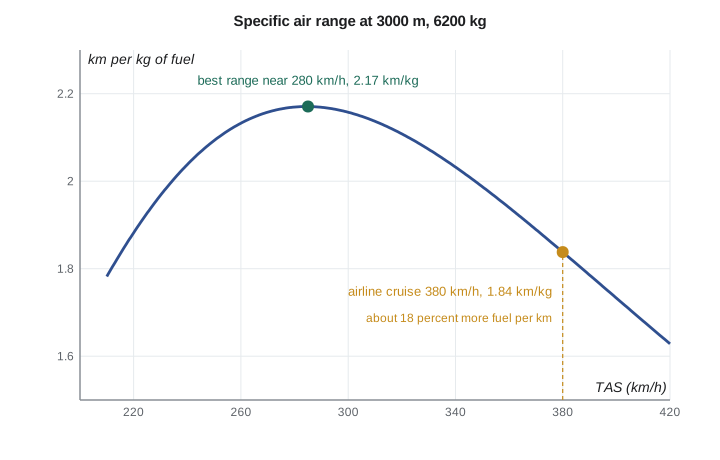
The peak, 2.17 km/kg at 280 km/h, lies near the minimum-drag speed at this weight and height. At the airline's preferred 380 km/h, the Tern flies 1.84 km on each kilogram of fuel, so it uses about 18 percent more fuel per kilometre. On a 650 km route that is roughly 55 kg of fuel per trip, worth far less than the 37 minutes the faster speed saves in crew time, aircraft use and passenger appeal. Most operators therefore fly well above the best-range speed, at a long-range cruise speed defined as the speed giving 99 percent of the maximum specific air range on the fast side, or faster still when time matters more than fuel.
The Breguet equation for jets
For a jet, fuel flow is \(c_T\) times thrust, and thrust equals drag, \(mg/(L/D)\). The speed does not cancel this time, so the range depends on the product \(V \times L/D\). Jets therefore get their best range not at maximum L/D but at the speed where \(V \times L/D\), or equivalently \(\sqrt{C_L}/C_D\), is greatest. For the parabolic polar this happens at a lift coefficient of \(\sqrt{C_{D0}/(3k)}\), at 1.316 times the minimum-drag speed, where the L/D is 0.866 times its maximum.
The jet equation also explains why jets cruise high. The minimum drag is the same at every altitude, but the speed at which it occurs rises as density falls, so flying higher increases \(V\) at the same L/D and the same thrust, and range grows. The limits are the engines, whose thrust falls with altitude, and compressibility, which adds wave drag above the drag-divergence Mach number. The best jet cruise altitude, typically near 10,000 to 12,000 m, is where these balance. The program's regional jet flies 3870 km in still air on 6000 kg of cruise fuel at Mach 0.78.
Cruise programmes
The Breguet equation assumes the aircraft flies at constant L/D and constant propulsive efficiency as it gets lighter. Since the lift coefficient is \(2W/(\rho V^2 S)\), keeping it constant as weight falls requires either flying slower or climbing gradually into thinner air. Three cruise programmes are possible. In a cruise-climb at constant lift coefficient and Mach number, the aircraft drifts upward as fuel burns; this matches Breguet exactly and gives the best range, but air traffic control rarely allows continuous climbs. At constant altitude and constant lift coefficient, the speed falls with the square root of weight. At constant altitude and constant speed, the lift coefficient falls and L/D drifts away from its best value. Airlines use step climbs, climbing a few thousand feet at a time as weight falls, to approximate the cruise-climb within air traffic rules.
| Cruise programme | What is held constant | Range compared with Breguet ideal | Practicality |
|---|---|---|---|
| Cruise-climb | C_L and speed (or Mach) | Equal | Rarely allowed by air traffic control |
| Constant altitude, constant C_L | Height and C_L; speed falls | Nearly equal | Speed changes complicate scheduling |
| Constant altitude, constant speed | Height and speed | A few percent less | Simplest and most common on short routes |
| Step climb | Speed; height in steps | Close to cruise-climb | Common on long jet flights |
For the Tern on routes of a few hundred kilometres, the differences between these programmes are tiny, under 1 percent, because the fuel burned is only a small fraction of the aircraft's weight. Arjun uses constant altitude and constant speed for all his calculations, the simplest programme and the one the airline will actually fly.
Wind and range
Wind changes range over the ground but not over the air. A headwind of speed \(V_w\) reduces the ground speed to \(V - V_w\), so the ground range shrinks by the factor \((V - V_w)/V\). For a slow aircraft, wind matters much more than for a fast one: a 50 km/h headwind cuts the Tern's ground range by 13 percent at 380 km/h, but a jet's by only 6 percent at 830 km/h. As with gliding, the best speed into a headwind is faster than the still-air best-range speed. Airlines plan each flight with forecast winds, and the planned fuel load changes from day to day for the same route.
Payload and range together
The payload-range diagram combines range with the aircraft's weight limits. It plots payload against range and has three corners. At the first, the aircraft carries its maximum payload, limited by the maximum zero-fuel weight, and as much fuel as fits within the maximum take-off weight. Beyond that range, extra fuel can be carried only by removing payload, until the tanks are full. Beyond the second corner, the aircraft is full of fuel and at maximum take-off weight; further range comes only from flying lighter, giving the third corner, the ferry range with no payload.
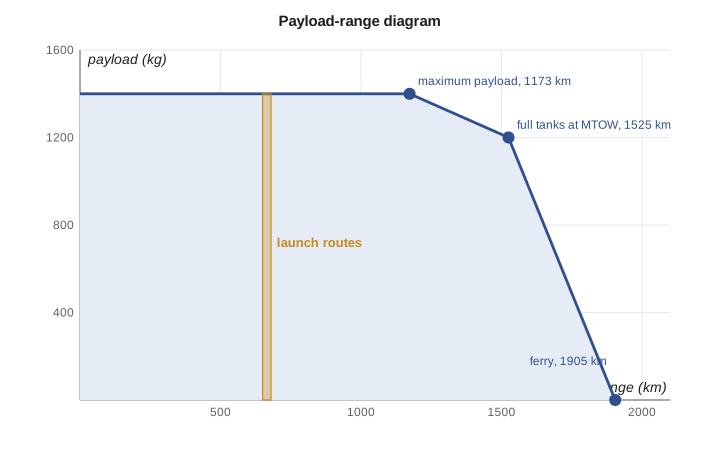
The program computes the corners, keeping 180 kg of fuel in reserve and reducing the Breguet range by 15 percent for climb, descent and routing. With its full 1400 kg payload, the Tern flies 1173 km; trading 200 kg of payload for fuel to fill the 1100 kg tanks takes it to 1525 km; and with no payload it could ferry 1905 km. The launch airline's longest route is 650 km, so every route can be flown with a full load, with room to spare for headwinds and diversions. The airline's planners can read off at a glance which future routes the aircraft could serve.
Reserves deserve a word. Operating rules require commercial flights to carry fuel to reach the destination, then an alternate airport if weather or other problems require it, plus a final reserve for holding, usually 30 or 45 minutes depending on the type of operation. The exact requirements are set by Canadian Aviation Regulations and the operator's approved procedures. The Tern also keeps a battery reserve, as Lesson 5 explained, so its reserves are a combination of fuel and battery energy.
Common mistakes
MistakeAssuming propeller aircraft get best range at a higher speed than minimum drag, like jets.
InsteadPropeller aircraft get best range near the minimum-drag speed; jets at about 1.32 times it.
MistakeUsing the Breguet equation for a whole flight including climb and descent.
InsteadBreguet covers cruise; add climb, descent, routing and reserves separately.
MistakeApplying the logarithm to battery energy.
InsteadBatteries do not get lighter, so electric range has no logarithmic term.
MistakeIgnoring wind for slow aircraft.
InsteadA headwind reduces ground range by (V − V_w)/V, a much larger effect for slow aircraft.
MistakeReading payload-range diagrams without reserves.
InsteadPractical diagrams subtract reserve fuel; ideal ones overstate usable range.
Summary and key terms
- Range is the integral of specific air range, V divided by fuel flow, over the mass burned.
- Propeller Breguet: R = (η_p/cg)(L/D) ln(m₀/m₁); best range near maximum L/D.
- Jet Breguet: R = (V/c_T g)(L/D) ln(m₀/m₁); best range where V × L/D is greatest, at 1.316 V_md.
- Airlines usually cruise faster than the best-range speed, trading some fuel for time.
- Cruise programmes differ in what is held constant; step climbs approximate the ideal cruise-climb.
- The payload-range diagram shows the trade between payload and range set by MZFW, MTOW and tank capacity.
- Specific air range
- The distance flown per unit mass of fuel at the current weight and conditions.
- Breguet range equation
- A relation giving cruise range from propulsive efficiency, fuel consumption, L/D and the mass ratio.
- Long-range cruise speed
- The speed on the fast side of the best-range speed that gives 99 percent of the maximum specific air range.
- Cruise-climb
- A cruise in which the aircraft climbs gradually as fuel burns to keep its lift coefficient and Mach number constant.
- Step climb
- A cruise in which the aircraft climbs in steps as it gets lighter.
- Payload-range diagram
- A graph of payload against range showing the limits set by aircraft weights and fuel capacity.
- Ferry range
- The range with full fuel and no payload.
Practice problems
Work each problem on paper first, then reveal the answer to check.
For η_p = 0.85, c = 0.28 kg/kWh, L/D = 14 and m₀/m₁ = 1.15, find the Breguet range.
Show answer
c = 7.78 × 10⁻⁸ kg/J; R = 0.85/(7.78 × 10⁻⁸ × 9.81) × 14 × ln 1.15 = 2.18 × 10⁶ m, about 2180 km.
A jet has c_T = 0.065 kg/(N·h), V = 240 m/s, L/D = 17 and burns 20 percent of its starting mass. Find the range.
Show answer
c_T = 1.81 × 10⁻⁵ kg/(N·s); R = 240 × 17/(1.81 × 10⁻⁵ × 9.81) × ln 1.25 = 5.14 × 10⁶ m, about 5140 km.
An aircraft's minimum-drag speed is 400 km/h. At what speed does a jet with the same polar get its best range?
Show answer
1.316 × 400 = 526 km/h.
By what percentage does a 40 km/h headwind cut ground range for an aircraft cruising at 320 km/h?
Show answer
40/320 = 12.5 percent.
Why do the cruise programmes matter little for the Tern on short routes?
Show answer
Fuel burned is a small fraction of the aircraft's mass, so its weight, C_L and best speed change little during the cruise.
In the program, raise the reserve fuel to 250 kg. What is the range with maximum payload?
Show answer
About 1053 km.
Lesson quiz · 5 questions
Score 60% or more to complete this lesson.
Create a free account to save your progress, take quizzes and earn a certificate.