
AERO-220 · Lesson 6 of 12 · 22 min
Gliding flight
Every aircraft becomes a glider when its power fails. For the Tern, losing both motors at once is extremely unlikely, because each motor has its own inverter and the aircraft can run on either the battery or the generator alone. But the airline's safety team still asks how far the Tern could glide from its cruise altitude, and Sam Littlechild needs the same analysis for the Skiff-W cargo drone, which must glide to a safe landing area if its single motor stops. Gliding is also the simplest case of performance: with no thrust, the only forces are lift, drag and weight, and the results are clean enough to reveal the role of the lift-to-drag ratio more directly than anything else in the course.
The glide angle
In a steady glide with no thrust, the equations of motion from Lesson 1 become \(L = W\cos\gamma\) and \(D = -W\sin\gamma\), where the flight path angle \(\gamma\) is negative. Dividing one by the other gives a beautifully simple result: the glide angle depends only on the lift-to-drag ratio. It does not depend on weight, wing area or altitude.
The glide ratio, horizontal distance covered per unit of height lost, equals L/D. An aircraft with a lift-to-drag ratio of 15 glides 15 km for every kilometre of height. To get the flattest glide, the pilot flies at the speed for maximum L/D, the minimum-drag speed of Lesson 3. Modern competition sailplanes reach glide ratios of 50 to 70, airliners about 17 to 20, the Tern about 14.6 with both propellers feathered, and a helicopter in autorotation only about 4.
Sink rate and the glide polar
The rate at which the aircraft descends, the sink rate, is the vertical component of its velocity. Since the drag power \(DV\) is being supplied by the loss of potential energy, the sink rate equals the power required divided by the weight. Minimum sink therefore occurs at the minimum-power speed, which is slower than the best-glide speed. A glider pilot who wants to stay up as long as possible, for example while waiting in rising air, flies at minimum sink; one who wants to go as far as possible flies at best glide.
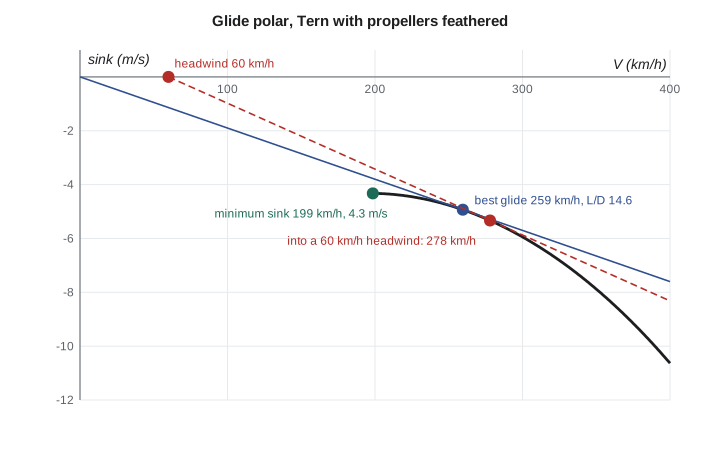
Glider pilots summarize this in the glide polar, a graph of sink rate against airspeed, drawn with sink downward. It is the power-required curve of Lesson 3, scaled by the weight and turned upside down. Its top point gives the minimum sink rate. A line from the origin that just touches the curve gives the best glide, because the ratio of speed to sink rate, which equals L/D, is greatest there.
# Gliding: sink rate polar, best glide, minimum sink and the effect of wind
import math
g = 9.81
def glide_polar(m, S, CD0, k, rho):
    W = m * g
    out = []
    for i in range(400):
        V = 5 + i * 0.25
        CL = 2 * W / (rho * V**2 * S)
        if CL > 1.5: continue               # stay below the stall
        CD = CD0 + k * CL**2
        out.append((V, V * CD / CL))      # sink rate = V sin(gamma) = V * D/L for small angles
    return out
def summary(name, m, S, CD0, k, rho, heights):
    pol = glide_polar(m, S, CD0, k, rho)
    v_ms, s_ms = min(pol, key=lambda p: p[1])
    v_bg, s_bg = max(pol, key=lambda p: p[0] / p[1])
    print(f"{name}: min sink {s_ms:.2f} m/s at {v_ms*3.6:.0f} km/h; best glide L/D {v_bg/s_bg:.1f} at {v_bg*3.6:.0f} km/h")
    for h in heights:
        print(f"   from {h} m in still air: {h * v_bg / s_bg / 1000:.1f} km")
    return pol
tern = summary("Tern, both propellers feathered", 6500, 28.0, 0.030, 0.039, 1.0, [1000, 3000])
skiff = summary("Skiff-W drone, motor off", 24, 1.4, 0.030, 0.0312, 1.1, [120])
# Speed to fly into a headwind: maximize ground distance per metre of height, (V - wind)/sink
for wind_kmh in (0, 30, 60):
    w = wind_kmh / 3.6
    v, s = max(tern, key=lambda p: (p[0] - w) / p[1])
print(f"Tern into a {wind_kmh} km/h headwind: fly {v*3.6:.0f} km/h, glide ratio over the ground {(v - w)/s:.1f}")Tern, both propellers feathered: min sink 4.33 m/s at 199 km/h; best glide L/D 14.6 at 259 km/h from 1000 m in still air: 14.6 km from 3000 m in still air: 43.9 km Skiff-W drone, motor off: min sink 0.96 m/s at 52 km/h; best glide L/D 16.3 at 64 km/h from 120 m in still air: 2.0 km Tern into a 0 km/h headwind: fly 259 km/h, glide ratio over the ground 14.6 Tern into a 30 km/h headwind: fly 268 km/h, glide ratio over the ground 13.0 Tern into a 60 km/h headwind: fly 278 km/h, glide ratio over the ground 11.4
The program confirms the theory. The Tern's minimum sink speed, 199 km/h, is 0.77 times its best-glide speed of 259 km/h, close to the factor 0.760 from Lesson 3. From 3000 m in still air, it can glide about 44 km. The little Skiff-W, with its slender aspect-ratio-12 wing, has an even better glide ratio of 16.3 but descends much more slowly, under 1 m/s at minimum sink, because its wing loading is tiny. From its typical operating height of 120 m, it can reach a landing area about 2 km away.
Weight and altitude in a glide
Since the glide ratio depends only on L/D, a heavier aircraft glides exactly as far as a light one from the same height. It does so faster, because the speed for any lift coefficient scales with the square root of weight, and so it also sinks faster and arrives sooner. Competition glider pilots exploit this: on days with strong rising air, they carry water ballast in the wings to raise their wing loading and cruise faster between thermals at the same glide ratio, then dump the water if conditions weaken.
Altitude works the same way. The glide ratio is unchanged, but the true speeds and sink rates at altitude are higher by the factor \(1/\sqrt{\sigma}\). A glide from cruise altitude therefore starts faster and slows down, in true airspeed terms, as the aircraft descends into denser air, while the indicated airspeed for best glide stays almost constant. That is convenient for pilots: one indicated best-glide speed, adjusted for weight, works at any height.
Worked problem
Gliding to an airport after a double failure
Suppose both of the Tern's motors stop at 3000 m, 35 km from the nearest airport, with no wind. Is the airport reachable? What if there is a 30 km/h headwind? Use the results of the program.
Show solution
- Still air: glide ratio 14.6, so the glide distance is \(3.0 \times 14.6 = 43.9\ \text{km}\). The airport at 35 km is reachable with about 9 km to spare, enough for a circuit and approach.
- Headwind of 30 km/h: flying at the best speed into wind, 268 km/h, the glide ratio over the ground drops to 13.0, so the distance is \(3.0 \times 13.0 = 39\ \text{km}\).
- The airport is still reachable, with about 4 km of margin.
- Time aloft: the sink rate at 268 km/h is roughly 5.1 m/s, so the glide from 3000 m lasts about \(3000/5.1 = 590\ \text{s}\), close to 10 minutes.
Answer: Ten minutes is enough time to restart the generator or switch to battery power, which is what the emergency checklist directs. The analysis also gives the airline a planning figure: at 3000 m over the gently sloping terrain on its routes, the Tern is almost always within gliding range of a usable runway.
Wind and the speed to fly
Wind does not change the glide angle relative to the air, but it changes the path over the ground. In a headwind, the aircraft covers less ground for each metre of height lost; in a tailwind, more. To get the greatest distance over the ground, the pilot should adjust the speed. The best speed is found by drawing the tangent to the glide polar from a point on the speed axis displaced by the wind speed: to the right for a headwind, to the left for a tailwind. The rule that results is easy to remember: fly faster than best glide into a headwind, and slightly slower with a tailwind.
The same construction handles sinking or rising air. In descending air, the polar is shifted downward, and the tangent from the origin touches it at a higher speed: the pilot should hurry through sinking air. In rising air, the opposite applies. Glider pilots use these ideas, formalized in the 1930s and refined since, to decide how fast to fly between thermals, and modern glider flight computers compute the speed to fly continuously from measured vertical air motion.
| Condition | Best speed compared with still-air best glide | Effect on ground distance |
|---|---|---|
| Headwind | Faster | Reduced |
| Tailwind | Slightly slower | Increased |
| Sinking air | Faster | Reduced |
| Rising air | Slower | Increased |
| Higher weight, no wind | Faster, same glide ratio | Unchanged |
Drag devices and the glide angle
Sometimes an aircraft needs to descend steeply without speeding up, for example to approach a short field over obstacles. It does so by deliberately reducing its L/D. Extending flaps, landing gear, spoilers or airbrakes raises the drag; sideslipping, flying with crossed controls so the fuselage meets the air at an angle, does the same in light aircraft. A propeller set to fine pitch at low power also adds drag. Gliders use airbrakes on the wings to control their approach angle precisely, since they cannot add power to correct an approach that is too low.
The opposite case, a windmilling propeller that the pilot cannot feather, is a serious hazard after an engine failure. Its drag can halve the glide ratio of a light twin with both propellers windmilling. That is why feathering is an emergency memory item for multi-engine pilots, and why the Tern's motor controllers feather a stopped propeller automatically.
Gliding drones and the Skiff-W
The Skiff-W hybrid vertical take-off drone, introduced in AERO-200, flies its cruise segments on a fixed wing with a pusher propeller. If the cruise motor fails, it can either use its battery to restart the vertical lift rotors for a powered landing or glide to an emergency landing area. Sam's team programmed its flight computer to compute the reachable area continuously from the current height, airspeed and wind, using exactly the glide polar from the program, and to keep at least one pre-approved landing site inside that area at all times. Drone rules in both countries require operators to plan for loss of power and loss of control link, and a glide footprint is one of the most convincing ways to show that an operation is safe.
Glide range also matters for small drones in another way. Some long-endurance fixed-wing drones exploit rising air the way gliders do, climbing in thermals or along ridges with the motor off to extend their endurance. Research projects have shown large gains in endurance for drones that soar autonomously, and the same idea could one day help small electric aircraft extend their range on suitable days.
A historical glide
The value of glide performance was demonstrated dramatically in 1983, when the Air Canada Boeing 767 mentioned in Lesson 1 ran out of fuel at 41,000 ft over Manitoba. With both engines stopped, the crew glided the aircraft at its best-glide speed, using the captain's experience as a glider pilot, and landed safely on a disused runway at Gimli, sideslipping on the final approach to lose excess height. With both engines stopped the airliner still had a glide ratio of about 12, enough to cover many tens of kilometres from its cruise altitude. The event is still taught as a case study in unit errors, crew coordination and the practical use of glide performance.
Common mistakes
MistakeAssuming a heavier aircraft glides a shorter distance.
InsteadGlide ratio depends only on L/D; a heavier aircraft glides the same distance, faster.
MistakeFlying at minimum-sink speed to reach a distant airport.
InsteadMinimum sink maximizes time aloft; best glide, at higher speed, maximizes distance.
MistakeFlying slower into a headwind to stretch the glide.
InsteadInto a headwind, fly faster than still-air best glide; slowing down makes the headwind's effect worse.
MistakeLeaving a failed propeller windmilling.
InsteadA windmilling propeller can greatly reduce the glide ratio; feather it.
MistakeUsing true airspeed for the best-glide speed at different altitudes.
InsteadThe best-glide indicated airspeed stays nearly constant with altitude; adjust it only for weight.
Summary and key terms
- In a steady glide, the glide angle satisfies tan θ = 1/(L/D), independent of weight and altitude.
- Best glide occurs at the minimum-drag speed; glide distance equals height times (L/D)max.
- Sink rate equals power required divided by weight; minimum sink occurs at the minimum-power speed.
- The glide polar shows sink rate against speed; the tangent from the origin gives best glide.
- Fly faster than best glide into a headwind or through sinking air, slightly slower with a tailwind or in rising air.
- Drag devices steepen the glide; a windmilling propeller can seriously shorten it.
- Glide ratio
- Horizontal distance travelled per unit of height lost in a glide, equal to L/D.
- Sink rate
- The vertical speed of descent in a glide.
- Glide polar
- A graph of sink rate against airspeed for a gliding aircraft.
- Best-glide speed
- The speed giving the greatest distance per unit of height lost, the minimum-drag speed.
- Minimum-sink speed
- The speed giving the lowest rate of descent, the minimum-power speed.
- Speed to fly
- The airspeed that maximizes distance over the ground, allowing for wind and vertical air motion.
- Sideslip
- Flight with the fuselage at an angle to the oncoming air, used to steepen the descent without increasing speed.
Practice problems
Work each problem on paper first, then reveal the answer to check.
A glider with L/D = 40 is at 1200 m. How far can it glide in still air?
Show answer
1.2 × 40 = 48 km.
An aircraft glides at 180 km/h with a sink rate of 3.5 m/s. What is its glide ratio?
Show answer
50/3.5 = 14.3.
An aircraft's best-glide speed is 250 km/h at 6000 kg. What is it at 4800 kg?
Show answer
250 × √(4800/6000) = 224 km/h.
A glider has a glide ratio of 30 at 100 km/h. Flying into a 20 km/h headwind at the same speed, what is its ratio over the ground?
Show answer
30 × (100 − 20)/100 = 24.
Why does a glider pilot carry water ballast on strong days?
Show answer
Higher weight raises the speed for best glide without changing the glide ratio, so the glider travels faster between thermals.
In the program, raise the Tern's C_D0 to 0.045 to represent unfeathered propellers. What is the best glide ratio?
Show answer
About 11.9.
Lesson quiz · 5 questions
Score 60% or more to complete this lesson.
Create a free account to save your progress, take quizzes and earn a certificate.