
AERO-220 · Lesson 3 of 12 · 23 min
Thrust and power required
With the drag polar measured, Arjun can answer the most basic performance question: how much thrust and power does the Tern need to fly level at any speed, weight and altitude? The answers form two curves, thrust required and power required, that every later lesson builds on. Maximum speed, climb rate, best cruise speed, endurance and ceiling all come from comparing these curves with what the propulsion system can deliver. This lesson derives the curves, finds their special points and shows how weight and altitude move them.
Thrust required
In steady level flight, thrust equals drag and lift equals weight. Substituting the lift coefficient \(C_L = 2W/(\rho V^2 S)\) into the drag polar and multiplying by the dynamic pressure and wing area gives the drag, and therefore the thrust required, as a function of speed. The result has two terms with opposite behaviour.
The first term, parasite drag, grows with the square of speed. The second term, induced drag, falls with the inverse square of speed, because at higher speed the wing needs a smaller lift coefficient. Their sum is a U-shaped curve with a minimum at the speed where the two terms are equal. That is the minimum-drag speed, and since lift equals weight, minimum drag is the same as maximum L/D.
A remarkable feature of the minimum thrust required is that it does not depend on altitude. At any height, the aircraft can fly at the lift coefficient for maximum L/D, and the drag there is simply the weight divided by \((L/D)_{max}\). For the Tern at 6500 kg, that minimum is 63,765/15.2 = 4.2 kN. What changes with altitude is the true airspeed at which the minimum occurs: it rises in proportion to \(1/\sqrt{\sigma}\).
Power required
Engines that drive propellers, including electric motors and turboprop engines, produce shaft power rather than thrust. For them, the natural quantity is the power required, which is the drag times the true airspeed. Multiplying the thrust required by speed gives a curve that also has a minimum, but at a lower speed.
Setting the derivative to zero shows that minimum power occurs where induced drag is three times parasite drag, at a lift coefficient of \(\sqrt{3C_{D0}/k}\). The minimum-power speed is \(3^{-1/4} = 0.760\) times the minimum-drag speed. At that speed the aircraft uses energy at the slowest rate, which is why it gives the longest endurance for propeller and electric aircraft and the best rate of climb when power available is roughly constant.
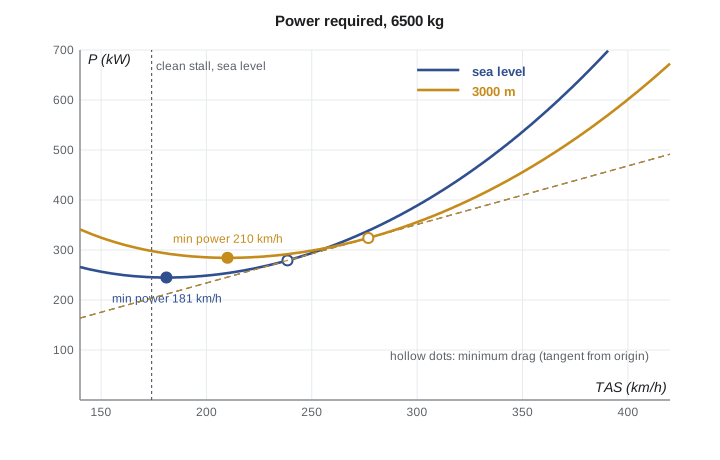
A neat geometric result links the two curves. Because thrust equals power divided by speed, the thrust required at any speed is the slope of a straight line from the origin to that point on the power-required curve. The line from the origin that just touches the curve has the smallest slope, so its point of contact is the minimum-drag speed. Arjun uses this construction constantly, because it lets him read both best-endurance and best-range speeds for a propeller aircraft off one graph.
# Thrust required and power required for the Tern at two heights and two weights
import math
S, CD0, k, g = 28.0, 0.028, 0.039, 9.81
def required(V, m, rho):
    W = m * g
    q = 0.5 * rho * V**2
    CL = W / (q * S)
    D = q * S * (CD0 + k * CL**2)
    return D, D * V
def speeds(m, rho):
    W = m * g
    base = 2 * W / (rho * S)
    V_md = math.sqrt(base * math.sqrt(k / CD0))
    V_mp = math.sqrt(base * math.sqrt(k / (3 * CD0)))
    return V_md, V_mp
for label, m, rho in (("6500 kg, sea level", 6500, 1.225), ("6500 kg, 3000 m", 6500, 0.9093), ("5200 kg, 3000 m", 5200, 0.9093)):
    V_md, V_mp = speeds(m, rho)
    D_md, P_md = required(V_md, m, rho)
    D_mp, P_mp = required(V_mp, m, rho)
    print(f"{label}:")
    print(f"  minimum drag  {V_md*3.6:5.0f} km/h  T_req {D_md/1000:5.2f} kN  P_req {P_md/1000:5.0f} kW")
    print(f"  minimum power {V_mp*3.6:5.0f} km/h  T_req {D_mp/1000:5.2f} kN  P_req {P_mp/1000:5.0f} kW")
print("Power required at 3000 m, 6500 kg:")
for kmh in (200, 240, 280, 320, 360, 400, 440):
    D, P = required(kmh / 3.6, 6500, 0.9093)
print(f" {kmh} km/h: thrust {D/1000:5.2f} kN, power {P/1000:4.0f} kW")6500 kg, sea level: minimum drag 238 km/h T_req 4.21 kN P_req 279 kW minimum power 181 km/h T_req 4.87 kN P_req 245 kW 6500 kg, 3000 m: minimum drag 277 km/h T_req 4.21 kN P_req 324 kW minimum power 210 km/h T_req 4.87 kN P_req 284 kW 5200 kg, 3000 m: minimum drag 248 km/h T_req 3.37 kN P_req 232 kW minimum power 188 km/h T_req 3.89 kN P_req 203 kW Power required at 3000 m, 6500 kg: 200 km/h: thrust 5.14 kN, power 285 kW 240 km/h: thrust 4.39 kN, power 292 kW 280 km/h: thrust 4.22 kN, power 328 kW 320 km/h: thrust 4.39 kN, power 390 kW 360 km/h: thrust 4.81 kN, power 481 kW 400 km/h: thrust 5.41 kN, power 601 kW 440 km/h: thrust 6.16 kN, power 753 kW
How altitude moves the curves
Altitude changes the curves in a simple way. If the aircraft flies at the same equivalent airspeed, it has the same dynamic pressure, the same lift coefficient and therefore the same drag at any height. Its true airspeed, however, is higher by the factor \(1/\sqrt{\sigma}\). Since power is drag times true speed, the power required at a given equivalent airspeed rises by the same factor. On a graph against true airspeed, the whole power-required curve slides up and to the right along lines through the origin.
At 3000 m, where \(\sigma = 0.742\), the factor is 1.16. The program confirms it: the Tern's minimum power rises from 245 kW at sea level to 284 kW at 3000 m, and the speed for minimum power rises from 181 to 210 km/h. The minimum thrust stays at 4.21 kN. For a turbine or piston engine, whose power falls with altitude, the combination of rising power required and falling power available is what sets the ceiling. For the Tern's electric motors, which do not lose power with altitude, the limit at height comes instead from the turbine generator and from the propellers, whose efficiency changes in thin air.
How weight moves the curves
Weight affects only the induced term. At the same lift coefficient, the speed scales with \(\sqrt{W}\) and the drag scales with \(W\), so the power scales with \(W^{3/2}\). A Tern that has burned 400 kg of fuel and arrives light at its destination needs noticeably less power for the same lift coefficient. In the program, reducing the weight from 6500 to 5200 kg, a 20 percent drop, cuts the minimum power at 3000 m from 284 to 203 kW, a 28 percent drop, matching \(0.8^{1.5} = 0.716\).
These scaling rules let engineers present performance for many weights and altitudes on one chart. Instead of plotting separate curves, they plot power required times \(\sqrt{\sigma}/W^{3/2}\) against speed times \(\sqrt{\sigma/W}\), and all the curves collapse onto one. Flight-test engineers use the same trick in reverse to reduce test points flown at many weights and heights to one standard set of conditions.
Worked problem
Power required for the airline's cruise speed
The airline wants to know the shaft power the Tern needs to cruise at 380 km/h at 3000 m at a mid-trip weight of 6200 kg. Use the polar \(C_D = 0.028 + 0.039\,C_L^2\), \(\rho = 0.909\ \text{kg/m}^3\) and a propeller efficiency of 0.82.
Show solution
- Speed and dynamic pressure: \(V = 105.6\ \text{m/s}\), \(q = 0.5 \times 0.909 \times 105.6^2 = 5068\ \text{Pa}\).
- Lift coefficient: \(C_L = 6200 \times 9.81/(5068 \times 28) = 0.429\).
- Drag: \(C_D = 0.028 + 0.039 \times 0.184 = 0.0352\), so \(D = 5068 \times 28 \times 0.0352 = 4995\ \text{N}\).
- Thrust power: \(P_R = 4995 \times 105.6 = 527\ \text{kW}\); shaft power \(= 527/0.82 = 643\ \text{kW}\).
Answer: The two motors must deliver about 643 kW between them in cruise, well within their combined continuous rating of 900 kW. That power comes from the turbine generator, so its continuous rating at 3000 m must exceed about 680 kW once motor and inverter losses of about 5 percent are added. Borealis Aerospace's chosen generator produces about 700 kW at that height, leaving little spare, which is one reason the company does not offer a faster cruise.
Speeds on the back side of the curve
The power-required curve has two regions. To the right of the minimum-power speed, flying faster needs more power, which is the normal, intuitive behaviour. To the left, on what pilots call the back side of the power curve or the region of reversed command, flying slower also needs more power, because induced drag rises steeply. An aircraft on the back side is speed-unstable: if it slows a little with power unchanged, drag rises, it slows further and it starts to sink. Pilots on a slow approach must add power to slow down or to stop a sink, which feels backward and has caught out many pilots over the years.
For the Tern at 6500 kg, the minimum-power speed at sea level is 181 km/h, only 4 percent above the clean stall speed of 174 km/h. That is typical for aircraft with long wings: their minimum-power speed lies close to the stall, so the whole low-speed region is on the back side. Approach and climb speeds are set well above the stall, for margin against gusts and manoeuvres, and with flaps extended the stall speed drops further, so in practice the aircraft is flown on the front side of its configured power curve.
Thrust required for jets
A turbojet or turbofan produces thrust that is roughly constant with speed at a given altitude, so for jets the thrust-required curve is the more natural one. The minimum thrust required, at the minimum-drag speed, determines the jet's best endurance and its steepest climb. Its best range, as Lesson 7 shows, occurs at a higher speed, about 1.32 times the minimum-drag speed. Lesson 4 contrasts the Tern with a 76-seat regional jet that cruises near Mach 0.78, where compressibility adds wave drag and the parabolic curves need correction.
Propeller aircraft have one more speed worth knowing, sometimes called the Carson speed after the engineer who described it. It is the speed that gives the least power per unit of speed, the best compromise between going fast and using little energy, and for a parabolic polar it equals 1.316 times the minimum-drag speed, the same as the jet best-range speed. For the Tern at 3000 m and 6500 kg that is about 365 km/h, close to the 380 km/h the airline asked for. Arjun points this out in the bid: the airline's chosen cruise speed is not wasteful, because it sits near the point where each extra kilometre per hour starts to cost disproportionately more power. Above about 400 km/h the power required climbs steeply, as the program's table shows, and the turbine generator would run out of capacity.
Arjun also checks how sensitive these numbers are to the drag polar itself. If the real zero-lift drag turned out 5 percent higher than the flight-test fit, the cruise power at 380 km/h would rise by almost 4 percent, because parasite drag dominates at that speed, while the minimum power near 210 km/h would rise by only about 1 percent, because induced drag dominates there. A 5 percent error in the Oswald factor does the opposite. Knowing which part of the polar drives which number tells the team where better data would pay off most, and it is why the bid quotes cruise fuel with a slightly larger margin than endurance.
| Special point | Lift coefficient | Speed (relative to V_md) | Why it matters |
|---|---|---|---|
| Minimum power | √(3C_D0/k) | 0.760 | Propeller and electric endurance, best rate of climb |
| Minimum drag (max L/D) | √(C_D0/k) | 1.000 | Propeller range, jet endurance, steepest jet climb |
| Jet best range | √(C_D0/(3k)) | 1.316 | Maximum distance per kilogram of jet fuel |
| Stall | C_L,max | about 0.7 for the Tern at 6500 kg | Lowest steady speed |
Common mistakes
MistakeAssuming minimum power and minimum drag occur at the same speed.
InsteadMinimum power is at 0.760 times the minimum-drag speed, where induced drag is three times parasite drag.
MistakeSaying that minimum thrust required rises with altitude.
InsteadMinimum thrust is W/(L/D)max at every altitude; only the true airspeed at which it occurs rises.
MistakeForgetting that power required at constant EAS rises with altitude.
InsteadPower is drag times true airspeed, which grows by 1/√σ for the same EAS.
MistakeTreating weight as affecting parasite drag.
InsteadWeight changes only the induced drag term; parasite drag depends on speed and density.
MistakeFlying slow on the back side of the power curve without adding power.
InsteadIn the region of reversed command, slowing needs more power; without it the aircraft sinks and slows further.
Summary and key terms
- Thrust required equals drag: a parasite term ∝ V² plus an induced term ∝ 1/V².
- Minimum thrust required is W/(L/D)max, at the minimum-drag speed V_md, independent of altitude.
- Power required is D × V; its minimum occurs at 0.760 V_md, where induced drag is three times parasite drag.
- At constant EAS, true speed and power required both scale with 1/√σ.
- At constant C_L, speed scales with √W, drag with W and power with W^1.5.
- Below the minimum-power speed lies the back side of the power curve, where slower flight needs more power.
- Thrust required
- The thrust needed for steady level flight at a given speed, equal to the drag.
- Power required
- The thrust power needed for steady level flight, drag multiplied by true airspeed.
- Minimum-drag speed
- The speed of maximum lift-to-drag ratio, where induced and parasite drag are equal.
- Minimum-power speed
- The speed at which power required is least, where induced drag is three times parasite drag.
- Back side of the power curve
- The speed range below minimum-power speed, where flying slower requires more power.
- Region of reversed command
- Another name for the back side of the power curve.
- Shaft power
- The mechanical power delivered by an engine or motor to the propeller shaft.
Practice problems
Work each problem on paper first, then reveal the answer to check.
An aircraft of 2000 kg has (L/D)max = 12. Find its minimum thrust required.
Show answer
T = 19 620/12 = 1635 N.
If an aircraft's minimum-drag speed is 250 km/h, what is its minimum-power speed?
Show answer
0.760 × 250 = 190 km/h.
Power required at 2000 m is how many times greater than at sea level for the same EAS, if σ = 0.822?
Show answer
1/√0.822 = 1.103, about 10 percent more.
An aircraft's weight rises by 10 percent. By what factor does its minimum power required change?
Show answer
1.1^1.5 = 1.154, about 15 percent more.
Using the table in the program, how much more power does the Tern need at 400 km/h than at 360 km/h at 3000 m?
Show answer
601 − 481 = 120 kW, a 25 percent increase for an 11 percent speed increase.
In the program, change the second case to 4500 m (ρ = 0.777). What is the minimum power?
Show answer
About 308 kW, since P scales with 1/√σ: 245/√(0.777/1.225) = 308 kW.
Lesson quiz · 5 questions
Score 60% or more to complete this lesson.
Create a free account to save your progress, take quizzes and earn a certificate.