
AERO-220 · Lesson 12 of 12 · 23 min
Mission analysis
The previous eleven lessons each answered one question about the Tern: how much drag it makes, how fast it climbs, how far it glides, how much runway it needs. An airline does not buy answers to separate questions. It buys an aircraft that flies a specific mission, from gate to gate, with a given payload, on a given route, every day, within the rules. Mission analysis puts all the pieces together. This final lesson builds the Tern's mission from Winnipeg to Thompson, accounts for fuel and battery energy segment by segment, adds the reserves the rules require, and uses the result for the trade studies that shape both the airline's operation and the aircraft's design.
The mission profile
A mission profile breaks a flight into segments, each flown in a known way. A typical commuter mission has taxi out, take-off and initial climb, climb to cruise altitude, cruise, descent, approach and landing, and taxi in. Each segment is analysed with the tools of earlier lessons: take-off with the ground roll of Lesson 9, climb with the excess power of Lesson 5, cruise with the specific air range of Lesson 7, descent with the gliding performance of Lesson 6 and landing with Lesson 10. The mission analysis adds up the time, distance, fuel and energy for each segment.
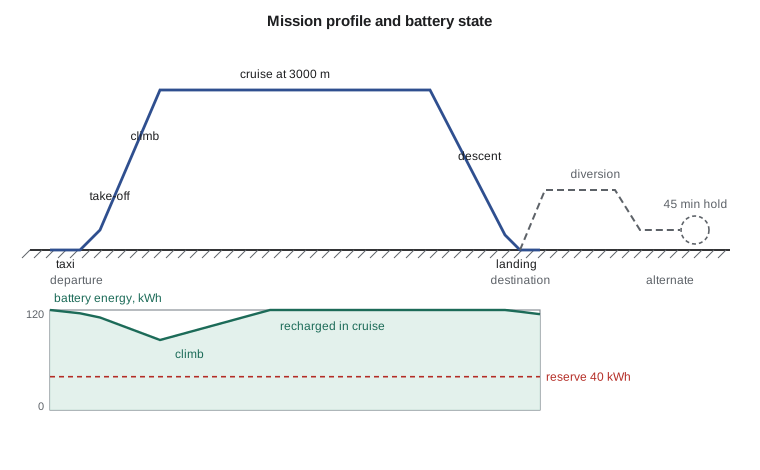
Hybrid-electric aircraft add a second energy account. The Tern carries fuel for its turbine generator and a battery that supplies peak power. The analysis must track both, and it must respect the rules Arjun set in Lesson 5: never let usable battery energy fall below 40 kWh, so a full-power go-around and climb remain available at any point. The battery also enables two tricks that conventional turboprops cannot use: taxiing on battery power alone, which saves fuel and noise at the gate, and recovering a little energy in the descent by windmilling the propellers.
Reserves
The fuel a flight must carry has several parts. The trip fuel covers the planned flight from engine start to shutdown. Contingency fuel, often 5 percent of the trip fuel or a fixed minimum, covers forecast errors, routing changes and other variations. Alternate fuel covers a missed approach at the destination, a climb and a cruise to the alternate airport and a landing there. The final reserve is typically 30 or 45 minutes of holding, depending on the operation. Operators may carry extra fuel at the captain's discretion for weather or delays. The precise requirements are set out in Canadian Aviation Regulations; the analysis here uses representative values that the airline's planners will refine.
| Fuel element | Purpose | Tern assumption |
|---|---|---|
| Trip fuel | Planned flight from start-up to shutdown | From the segment analysis |
| Contingency | Forecast errors and variations | 5 percent of trip fuel |
| Alternate | Missed approach and diversion | 150 km diversion plus climb, about 102 kg |
| Final reserve | Holding at the alternate | 45 minutes at 1500 m, 82 kg (Lesson 8) |
| Battery reserve | Go-around and climb capability | At least 40 kWh usable at all times |
# Mission analysis: fuel and battery energy for the Tern on the launch route, with reserves and a speed trade study
import math
g, S, CD0, k = 9.81, 28.0, 0.028, 0.039
OEW, PAYLOAD, ROUTE = 4200.0, 1100.0, 650      # kg, kg, km
SFC = 0.32                                      # kg of fuel per kWh of generator shaft output
USABLE, BAT_RES = 120.0, 40.0                   # usable battery energy and minimum battery reserve, kWh
def rho_at(h):
    T = 288.15 - 0.0065 * h
    return 101325 * (T / 288.15) ** 5.2559 / (287.05 * T)
def eta(V): return 0.84 * (1 - math.exp(-V / 30))
def shaft_power(m, V, rho):                     # shaft power for level flight, kW
    q = 0.5 * rho * V**2; CL = m * g / (q * S)
    return q * S * (CD0 + k * CL**2) * V / eta(V) / 1000
def mission(cruise_kmh, fuel_load=600.0, verbose=False):
    fuel, bat, dist, t, log = 0.0, USABLE, 0.0, 0.0, []
    def seg(name, minutes, gen_kw, bat_kw, km):
        nonlocal fuel, bat, dist, t
        f = SFC * gen_kw * minutes / 60; e = bat_kw * minutes / 60 / 0.95 if bat_kw > 0 else bat_kw * minutes / 60 * 0.9
        fuel += f; bat = min(USABLE, bat - e); dist += km; t += minutes
        log.append(f"  {name:22s} {minutes:5.1f} min {f:6.1f} kg  battery {-e:+6.1f} kWh  {km:5.0f} km")
    m0 = OEW + PAYLOAD + fuel_load              # take-off mass with the planned fuel load
    seg("Taxi out (battery)", 8, 0, 30, 0)
    seg("Take-off, initial climb", 2, 760, 140, 6)
    seg("Climb to 3000 m", 8.2, 710, 190, 34)
    rho = rho_at(3000); V = cruise_kmh / 3.6
    descent_km, approach_km = 65, 20
    cruise_km = ROUTE - dist - descent_km - approach_km
    m, x, cf, ct, recharge = m0 - fuel, 0.0, 0.0, 0.0, 0.0
    while x < cruise_km:                         # 5 km steps through the cruise
        P = shaft_power(m, V, rho)
        spare = max(0.0, 665 - P)                # spare generator power charges the battery
        charge = min(spare, 100.0) if bat + recharge < USABLE else 0.0
        dt = 5 / cruise_kmh
        f = SFC * (P + charge) * dt
        cf += f; m -= f; ct += dt; recharge += charge * dt * 0.9; x += 5
    fuel += cf; bat = min(USABLE, bat + recharge); dist += cruise_km; t += ct * 60
    log.append(f"  {'Cruise at ' + str(cruise_kmh) + ' km/h':22s} {ct*60:5.1f} min {cf:6.1f} kg  battery {recharge:+6.1f} kWh  {cruise_km:5.0f} km")
    seg("Descent (regeneration)", 12, 150, -20, descent_km)
    seg("Approach and landing", 6, 280, 20, approach_km)
    seg("Taxi in (battery)", 5, 0, 30, 0)
    trip = fuel
    contingency = 0.05 * trip
    alternate = 150 / 1.84 + 20                  # 150 km at the cruise specific air range, plus climb allowance
    final_reserve = 82.0                         # 45 minutes holding at 1500 m (Lesson 8)
    total = trip + contingency + alternate + final_reserve
    if verbose:
        print(f"Mission: {ROUTE} km, payload {PAYLOAD:.0f} kg")
        print("\n".join(log))
        print(f"Trip fuel {trip:.0f} kg; contingency {contingency:.0f} kg; alternate {alternate:.0f} kg; final reserve {final_reserve:.0f} kg")
        print(f"Fuel required {total:.0f} kg; take-off mass {OEW + PAYLOAD + total:.0f} kg (limit 6500)")
        print(f"Battery on arrival {bat:.0f} kWh (minimum {BAT_RES:.0f}); block time {t:.0f} min")
    return t, trip, bat, total
fuel = 600.0
for _ in range(3):                               # the fuel load affects the mass, so repeat until it settles
    fuel = mission(380, fuel)[3]
mission(380, fuel, verbose=True)
print("Cruise speed trade study:")
for v in (300, 330, 360, 380):
    t, trip, bat, total = mission(v, fuel)
print(f" {v} km/h: block {t:4.0f} min, trip fuel {trip:4.0f} kg, battery on arrival {bat:4.0f} kWh")Mission: 650 km, payload 1100 kg Taxi out (battery) 8.0 min 0.0 kg battery -4.2 kWh 0 km Take-off, initial climb 2.0 min 8.1 kg battery -4.9 kWh 6 km Climb to 3000 m 8.2 min 31.1 kg battery -27.3 kWh 34 km Cruise at 380 km/h 82.9 min 289.1 kg battery +36.9 kWh 525 km Descent (regeneration) 12.0 min 9.6 kg battery +3.6 kWh 65 km Approach and landing 6.0 min 9.0 kg battery -2.1 kWh 20 km Taxi in (battery) 5.0 min 0.0 kg battery -2.6 kWh 0 km Trip fuel 347 kg; contingency 17 kg; alternate 102 kg; final reserve 82 kg Fuel required 548 kg; take-off mass 5848 kg (limit 6500) Battery on arrival 115 kWh (minimum 40); block time 124 min Cruise speed trade study: 300 km/h: block 146 min, trip fuel 299 kg, battery on arrival 115 kWh 330 km/h: block 137 min, trip fuel 311 kg, battery on arrival 115 kWh 360 km/h: block 129 min, trip fuel 331 kg, battery on arrival 115 kWh 380 km/h: block 124 min, trip fuel 347 kg, battery on arrival 115 kWh
The launch route
The program flies the 650 km route to Thompson with 1100 kg of payload, nine passengers and their bags plus some freight. Taxi out on battery uses about 4 kWh. The take-off and climb to 3000 m use 39 kg of fuel and about 32 kWh of battery energy. The cruise at 380 km/h covers 525 km in 83 minutes on 289 kg of fuel, and the small surplus of generator power at the lighter cruise weights recharges the battery. The descent and approach use little fuel. The trip takes 124 minutes from gate to gate and burns 347 kg of fuel.
Adding 17 kg of contingency, 102 kg for an alternate and 82 kg of final reserve gives a fuel requirement of 548 kg and a take-off mass of 5848 kg, well inside the 6500 kg maximum. The battery arrives with about 115 kWh, far above its 40 kWh floor. The mission fits easily, with 650 kg of take-off weight to spare. That spare capacity is the airline's room for headwinds, extra freight, a longer alternate in winter, or a future route further north.
Trade studies
Once the mission model exists, it can answer questions quickly. The most common is cruise speed. Flying faster shortens the block time, which lets the airline fly more trips per day with the same aircraft and crew and pleases passengers; flying slower saves fuel. The trade study in the program shows the balance.
| Cruise speed | Block time | Trip fuel |
|---|---|---|
| 300 km/h | 146 min | 299 kg |
| 330 km/h | 137 min | 311 kg |
| 360 km/h | 129 min | 331 kg |
| 380 km/h | 124 min | 347 kg |
Cruising at 380 km/h rather than 300 km/h saves 22 minutes per trip for 48 kg of extra fuel. Whether that is worth it depends on the airline's costs. If the aircraft's hourly ownership and crew costs are high compared with fuel, as they usually are for small aircraft, the faster speed wins. If fuel prices spike, or a carbon charge raises the cost of each kilogram, the balance shifts toward the slower speed. Airlines often use a cost index, the ratio of time-related to fuel-related costs, to let the flight management system choose the speed automatically.
Worked problem
Valuing time against fuel
The airline estimates its time-related costs for the Tern at 900 Canadian dollars per block hour and its fuel at 1.60 Canadian dollars per kilogram, including carbon charges. Using the trade study, compare the cost of a trip at 300 km/h and 380 km/h.
Show solution
- At 300 km/h: time cost \(900 \times 146/60 = 2190\); fuel cost \(1.60 \times 299 = 478\); total 2668 dollars.
- At 380 km/h: time cost \(900 \times 124/60 = 1860\); fuel cost \(1.60 \times 347 = 555\); total 2415 dollars.
- The faster speed saves about 253 dollars per trip.
- Break-even: the extra 48 kg would have to cost as much as 330 dollars of time, about 6.90 dollars per kilogram, before slowing down paid.
Answer: For a small commuter with high time costs, flying fast pays at any plausible fuel price. That is one reason the airline asked for a 380 km/h cruise in its request for proposal, and why the Tern's generator was sized to reach it. For a large airliner, where fuel is a bigger share of trip cost, the optimum moves closer to the best-range speed.
Trades that reach back into the design
Mission analysis is not only for operations. Early in a design, the same model is run thousands of times to size the aircraft. Each design choice changes the mission: a larger wing lowers the stall speed and shortens the field lengths but adds weight and drag in cruise; a bigger battery adds climb power and reserve energy but costs payload; a larger generator raises the cruise speed but burns more fuel at part power. Arjun's team at Borealis Aerospace uses the mission model to test each change against the airline's requirements, keeping a matrix of the results.
| Design change | Field length | Cruise and range | Mission fuel |
|---|---|---|---|
| Wing area +10 percent | Shorter, about 9 percent | Slightly lower L/D at 380 km/h | Up about 2 percent |
| Battery +100 kg | Unchanged | Range slightly lower from weight | Up about 1 percent; more reserve energy |
| Generator +10 percent power | Unchanged | Cruise speed about 3 percent higher | Up at the higher speed |
| Drag coefficient −0.002 | Unchanged | Range up about 5 percent | Down about 5 percent |
These trades show why drag reduction is so valuable: it improves every cruise-related measure at once, with no penalty elsewhere. They also show why the field-length requirement at the shortest strips and the cruise-speed requirement pull the wing size in opposite directions. The final design is a balance that meets every requirement with a margin, rather than an optimum for any one of them.
The Skiff's mission
The same method applies to the Skiff cargo drone. Its typical mission is a medical delivery: take off vertically from a hospital rooftop, transition to wing-borne flight, cruise to a clinic, descend, land vertically, and return. The hover segments dominate its energy budget, because hover power is several times cruise power for a small vehicle, so the mission model for the Skiff-W counts seconds of hover carefully. Its reserve rules are set by the operator's approved procedures rather than airline fuel rules, but they serve the same purpose: always enough energy to reach a safe landing site, whatever happens. With the endurance from Lesson 8, the Skiff-W comfortably covers a round trip of more than 100 km with a reserve.
Bringing it together
Aircraft performance is the engineering of what an aircraft can do with the forces acting on it. Lift, drag, thrust and weight, combined through Newton's laws and energy, give the speeds, distances, rates and endurance that define an aircraft's capability. Certification and operating rules then turn capability into the margins that make flying safe. Mission analysis brings it all together into the answer the customer cares about: can this aircraft carry this load on this route, reliably, at an acceptable cost? For the Tern on its launch route, the answer is yes, with room to grow.
Common mistakes
MistakePlanning fuel for the trip alone.
InsteadContingency, alternate and final reserve fuel must be added.
MistakeUsing cruise performance for the whole flight.
InsteadClimb, descent, approach and taxi have different fuel and energy rates and must be analysed separately.
MistakeIgnoring the second energy account in a hybrid aircraft.
InsteadBattery state of charge must be tracked and must stay above its reserve throughout.
MistakeChoosing the cruise speed for minimum fuel only.
InsteadTime-related costs often dominate, so the cost-optimal speed is usually faster than best range.
MistakeTreating design requirements as independent.
InsteadField length, speed and range pull design variables in different directions; mission models show the trade.
Summary and key terms
- A mission profile divides a flight into segments analysed with the methods of earlier lessons.
- Fuel required is trip fuel plus contingency, alternate and final reserve.
- Hybrid aircraft must also track battery energy and keep a battery reserve.
- Trade studies compare options such as cruise speed using time and fuel costs.
- A cost index balances time-related and fuel-related costs.
- Design trades use the mission model to balance competing requirements.
- Mission profile
- The sequence of flight segments that makes up a mission.
- Trip fuel
- The fuel planned for the flight from start-up to shutdown.
- Contingency fuel
- Extra fuel to cover variations from the plan, often 5 percent of trip fuel.
- Alternate fuel
- Fuel to fly from the destination to an alternate airport.
- Final reserve
- Fuel for a period of holding, typically 30 or 45 minutes.
- Block time
- The time from leaving the gate to arriving at the gate.
- Cost index
- The ratio of time-related costs to fuel costs, used to choose cruise speed.
- Trade study
- A comparison of design or operating options against requirements and costs.
Practice problems
Work each problem on paper first, then reveal the answer to check.
A trip burns 400 kg of fuel. Find the fuel required with 5 percent contingency, 120 kg alternate fuel and 90 kg final reserve.
Show answer
400 + 20 + 120 + 90 = 630 kg.
A climb draws 900 kW for 8 minutes, with 700 kW from the generator. How much battery energy does it use, at 95 percent efficiency?
Show answer
200/0.95 × 8/60 = 28 kWh.
Flying faster saves 15 minutes for 40 kg of fuel. With time costs of 800 dollars per hour, what fuel price makes the two options equal?
Show answer
Time saving worth 200 dollars; 200/40 = 5 dollars per kilogram.
Why does a bigger battery not always improve the mission?
Show answer
Its extra mass reduces payload and range, though it adds climb power and reserve energy.
In the program, raise the payload to 1400 kg. Is the take-off mass still within 6500 kg?
Show answer
Yes; it rises to about 6150 kg.
In the program, change the cruise speed to 340 km/h. Estimate the block time and trip fuel.
Show answer
About 134 minutes and 317 kg.
Lesson quiz · 5 questions
Score 60% or more to complete this lesson.
Create a free account to save your progress, take quizzes and earn a certificate.