
AERO-220 · Lesson 10 of 12 · 21 min
Landing performance
Landing is the take-off run in reverse, with one important difference: the aircraft must arrive at the runway at a controlled speed and height, then get rid of all its kinetic energy in a known distance, whatever the weather has done to the runway surface. The airline flies into strips in northern Manitoba where the runway is gravel for part of the year and covered in compacted snow or ice for another part, so landing distances drive many of its payload decisions. This lesson builds the landing distance from its parts, integrates the braked ground roll, and shows how operating rules and runway condition reports turn the aircraft's capability into the distance a dispatcher must plan for.
The parts of a landing
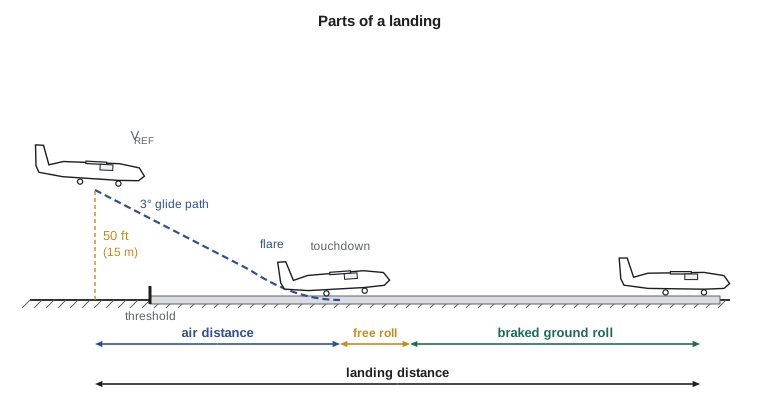
The certified landing distance is measured from a point 50 ft above the runway threshold to the point where the aircraft comes to a stop. It has three parts. The approach segment covers the steady descent on the glide path, typically 3 degrees, from 50 ft down to the start of the flare. The flare is the gentle pull-up that reduces the descent rate to near zero just before touchdown, during which the aircraft also floats and slows a little. The ground roll begins at touchdown and includes a short free roll while the pilot lowers the nose, applies the brakes and selects reverse pitch or spoilers, followed by the braked deceleration to rest.
Approach speed and air distance
The pilot flies the final approach at the reference landing speed \(V_{REF}\), at least 1.3 times the stall speed in the landing configuration, \(V_{S0}\). That margin protects against gusts, wind shear and the extra lift needed in the flare. With full landing flaps, the Tern's maximum lift coefficient is about 2.6, so at its maximum landing weight of 6300 kg its sea-level stall speed is 134 km/h and \(V_{REF}\) is 174 km/h. Touchdown happens at about 1.15 \(V_{S0}\), roughly 154 km/h.
On a 3 degree path, descending from 15 m to about 3 m, where the flare begins, takes about 230 m of horizontal distance. The flare and float add roughly 4 seconds at the average of the approach and touchdown speeds, about 180 m. So the Tern covers more than 400 m in the air before its wheels touch the runway. That air distance is a large part of the total, and it is very sensitive to piloting technique: crossing the threshold 10 km/h fast or 20 ft high, or floating for an extra two seconds, can add 100 m or more. Steeper approaches shorten the air distance, which is why some short-field aircraft are certified for approach angles of 4.5 degrees or more.
The braked ground roll
Once the aircraft is on its wheels, the decelerating forces are aerodynamic drag, wheel braking and any reverse thrust. Braking acts on the load the wheels carry, so dumping lift quickly after touchdown with spoilers or by lowering the nose firmly makes the brakes more effective. The braking coefficient \(\mu_B\) depends on the runway surface, the tires and the anti-skid system: around 0.35 to 0.4 on a dry paved runway for a modern system, about half that on a wet runway, and much less on snow, slush or ice.
A simple check uses energy. At touchdown, the Tern carries about \(\tfrac{1}{2}\times 6300\times 42.8^2 = 5.8\ \text{MJ}\) of kinetic energy. Most of it goes into heat in the brakes, which is why brake temperature limits appear in performance manuals and why quick turnarounds after heavy landings can be restricted. Reverse pitch on the propellers turns them into air brakes, taking load off the wheel brakes and adding deceleration that does not depend on runway friction, which matters most on slippery surfaces.
# Landing: air distance from 50 ft, flare, ground roll by integration, and factored field length
import math
g, S = 9.81, 28.0
def rho_at(h, dT):
    T = 288.15 - 0.0065 * h
    return 101325 * (T / 288.15) ** 5.2559 / (287.05 * (T + dT))
def landing(m, h=0, dT=0, mu_b=0.35, rev=0.0, label="", CLmax=2.6, slope=3.0):
    rho = rho_at(h, dT); W = m * g
    Vs0 = math.sqrt(2 * W / (rho * S * CLmax))         # stall speed, landing flaps (true airspeed)
    Vref, Vtd = 1.3 * Vs0, 1.15 * Vs0
    gam = math.radians(slope)
    s_app = (15.2 - 3.0) / math.tan(gam)                # steady approach from 50 ft down to about 3 m
    s_flare = (Vref + Vtd) / 2 * 4.0                    # about 4 s of flare and float while slowing
    s_free = Vtd * 2.0                                   # 2 s from touchdown to full braking
    V, s, dt = Vtd * 0.97, 0.0, 0.01
    while V > 0.5:                                       # braked ground roll with lift dumped
        q = 0.5 * rho * V**2
        D = q * S * (0.095 + 0.04 * 0.3**2)              # landing flaps, gear, spoilers
        F = D + mu_b * (W - q * S * 0.3) + rev * W       # braking on the wheel load; reverse as fraction of W
        V -= F / m * dt; s += V * dt
    total = s_app + s_flare + s_free + s
    print(f"{label:30s} V_REF {Vref*3.6:4.0f} km/h  air {s_app+s_flare:4.0f} m  ground {s_free+s:4.0f} m"
          f"  total {total:5.0f} m  factored {total/0.6:5.0f} m")
    return total
landing(6300, label="6300 kg, dry paved")
landing(6300, mu_b=0.20, label="6300 kg, wet paved")
landing(6300, mu_b=0.20, rev=0.08, label="6300 kg, wet, reverse pitch")
landing(6300, mu_b=0.15, label="6300 kg, firm gravel")
landing(6300, mu_b=0.08, label="6300 kg, compacted snow")
landing(6300, mu_b=0.05, rev=0.08, label="6300 kg, ice, reverse pitch")
landing(6300, h=1600, dT=15, label="6300 kg, 1600 m, ISA+15, dry")
# Energy check: kinetic energy at touchdown that the brakes must absorb
m, V = 6300, 1.15 * math.sqrt(2 * 6300 * g / (1.225 * S * 2.6))
print(f"Touchdown kinetic energy {0.5*m*V**2/1e6:.1f} MJ at {V*3.6:.0f} km/h")6300 kg, dry paved V_REF 174 km/h air 415 m ground 338 m total 753 m factored 1255 m 6300 kg, wet paved V_REF 174 km/h air 415 m ground 506 m total 921 m factored 1535 m 6300 kg, wet, reverse pitch V_REF 174 km/h air 415 m ground 389 m total 805 m factored 1341 m 6300 kg, firm gravel V_REF 174 km/h air 415 m ground 626 m total 1042 m factored 1736 m 6300 kg, compacted snow V_REF 174 km/h air 415 m ground 994 m total 1409 m factored 2348 m 6300 kg, ice, reverse pitch V_REF 174 km/h air 415 m ground 675 m total 1090 m factored 1817 m 6300 kg, 1600 m, ISA+15, dry V_REF 193 km/h air 435 m ground 406 m total 841 m factored 1402 m Touchdown kinetic energy 5.8 MJ at 154 km/h
Reading the results
On a dry paved runway at maximum landing weight, the Tern lands in about 750 m from 50 ft. More than half of that is the air distance, which barely changes from one surface to another. The ground roll changes a great deal: it grows by half on a wet runway, nearly doubles on gravel, and triples on compacted snow. Reverse pitch recovers much of the loss on wet or icy surfaces, because its force does not depend on friction. At a high, warm airport, the higher true airspeed for the same indicated speed lengthens both air distance and ground roll, by about 12 percent at 1600 m and ISA+15.
| Runway condition | Braking coefficient | Landing distance from 50 ft | Factored (÷ 0.6) |
|---|---|---|---|
| Dry paved | 0.35 | 753 m | 1255 m |
| Wet paved | 0.20 | 921 m | 1535 m |
| Wet paved, reverse pitch | 0.20 | 805 m | 1341 m |
| Gravel | 0.15 | 1042 m | 1736 m |
| Compacted snow | 0.08 | 1409 m | 2348 m |
| Ice, reverse pitch | 0.05 | 1090 m | 1817 m |
Operating margins
The distance demonstrated in certification flight tests is flown by test pilots, in calm conditions, on a carefully measured runway, with aggressive braking. Airline pilots on a gusty night at the end of a long duty day will not repeat it. Operating rules therefore add margins at dispatch. For many commercial operations, the rule is that the aircraft must be able to land within 60 percent of the runway available at the destination, which is the same as multiplying the demonstrated distance by about 1.67. Where the runway is expected to be wet, a further 15 percent is commonly added. The details depend on the aircraft's certification basis and the kind of operation, set out in Canadian Aviation Regulations, but the principle is consistent: dispatch with enough runway that an ordinary landing has a wide margin.
The dispatch check is made before departure, using forecast conditions. At the time of arrival, crews make a second assessment using the actual runway condition and wind, with a smaller margin, typically about 15 percent over the expected landing distance. If the runway has deteriorated, the crew may need to hold, divert or wait for the runway to be cleared or treated.
Worked problem
Planning a landing on a gravel strip
One of the airline's northern strips has 1500 m of gravel. Using the program, find whether the Tern can be dispatched there at its maximum landing weight without credit for reverse pitch, and if not, the approximate weight at which it can.
Show solution
- Allowable landing distance: \(0.6 \times 1500 = 900\ \text{m}\).
- At 6300 kg on gravel the program gives 1042 m, which exceeds 900 m, so the Tern cannot be dispatched at maximum landing weight.
- Running the program at lower weights: 5600 kg gives 966 m, 5300 kg gives 933 m and 5000 kg gives 901 m.
- The allowable landing weight is therefore about 5000 kg, a reduction of 1300 kg.
Answer: Landing distance is much less sensitive to weight than take-off distance, because the air distance changes only with the square root of weight and is a large part of the total. So meeting a short-runway limit by reducing weight can cost a great deal of payload. Better braking, a steeper approach or a credit for reverse pitch, where the rules permit it, are often worth more. For the Tern on gravel, reverse pitch brings the distance at 6300 kg down to 863 m, inside the limit.
Runway condition reports
Braking on a contaminated runway is difficult to predict, and many landing accidents have happened where crews received vague or out-of-date reports of conditions. The industry responded by standardizing how airports describe runway surfaces. In the United States, the Takeoff and Landing Performance Assessment took effect on October 1, 2016, introducing a runway condition assessment matrix that converts the type and depth of contaminant in each third of the runway into a runway condition code from 6, for dry, down to 0, for nil braking. Canada adopted the closely aligned ICAO Global Reporting Format in 2021. Pilots can report braking action, and those reports can downgrade the code.
| Code | Typical surface | Expected braking |
|---|---|---|
| 6 | Dry | Normal |
| 5 | Wet, or frost, or thin slush or dry snow | Good |
| 4 | Compacted snow at very cold temperatures | Good to medium |
| 3 | Wet and slippery, or compacted snow, or dry snow over compacted snow | Medium |
| 2 | Deeper standing water or slush | Medium to poor |
| 1 | Ice | Poor |
| 0 | Wet ice, or water on compacted snow | Nil |
Each code links to braking performance data the manufacturer supplies, so the crew can look up a landing distance for the reported conditions. The Tern's performance engineers at Borealis Aerospace must produce those data for each code, using flight tests on wet runways and agreed models for the contaminated cases, much like the program's braking coefficients.
Common mistakes
MistakeThinking that the landing distance is mainly the ground roll.
InsteadFor the Tern on a dry runway, more than half the distance from 50 ft is in the air.
MistakeAssuming landing distance scales with weight squared, like take-off.
InsteadAir distance scales roughly with the square root of weight, so landing distance is less sensitive to weight.
MistakeUsing the demonstrated distance directly for dispatch.
InsteadOperating rules commonly require the landing to fit in 60 percent of the runway, plus more on wet runways.
MistakeTreating reverse pitch as negligible.
InsteadOn slippery surfaces, reverse pitch can provide a large share of the deceleration because it does not depend on friction.
MistakeFlying the approach faster for safety.
InsteadEach extra 10 km/h adds tens of metres of float and ground roll; the margin is in V_REF already.
Summary and key terms
- Landing distance runs from 50 ft over the threshold to a stop.
- V_REF is at least 1.3 V_S0; touchdown is near 1.15 V_S0.
- Air distance covers the approach segment and the flare and depends strongly on technique.
- The ground roll integrates drag, braking on the wheel load and reverse thrust.
- Dispatch rules commonly require the landing to fit in 60 percent of the runway, plus more when wet.
- Runway condition codes from 6 to 0 link reported surfaces to braking data.
- V_REF
- The reference landing speed at 50 ft, at least 1.3 times the landing-configuration stall speed.
- Air distance
- The horizontal distance from 50 ft over the threshold to touchdown.
- Flare
- The final pull-up that reduces the rate of descent before touchdown.
- Braking coefficient
- The ratio of braking force to wheel load, set by surface, tires and anti-skid.
- Reverse pitch
- A propeller blade angle that produces rearward thrust to slow the aircraft.
- Factored landing distance
- The demonstrated distance divided by a factor such as 0.6 to give the runway required for dispatch.
- Runway condition code
- A number from 6 to 0 describing expected braking on each third of the runway.
Practice problems
Work each problem on paper first, then reveal the answer to check.
A 3 degree approach descends from 15 m to a flare height of 3 m. Find the horizontal distance.
Show answer
12/tan 3° = 229 m.
An aircraft's demonstrated landing distance is 800 m. Find the runway required under a 60 percent rule, and with a further 15 percent for a wet runway.
Show answer
800/0.6 = 1333 m; wet 1333 × 1.15 = 1533 m.
If V_S0 is 130 km/h, find V_REF and the approximate touchdown speed.
Show answer
V_REF = 169 km/h; touchdown about 150 km/h.
An aircraft touches down at 40 m/s and decelerates at an average of 2.5 m/s². Estimate the braked ground roll.
Show answer
40²/(2 × 2.5) = 320 m.
Why does a 10 percent weight increase raise the landing distance by much less than 21 percent?
Show answer
The air distance scales with speed, which goes with the square root of weight, and makes up a large part of the total.
In the program, set the approach angle to 3.5 degrees for the dry case. What is the new total?
Show answer
About 720 m, roughly 33 m shorter.
Lesson quiz · 5 questions
Score 60% or more to complete this lesson.
Create a free account to save your progress, take quizzes and earn a certificate.