
ACCT-470 · Lesson 6 of 12 · 25 min
Impairment of non-financial assets and goodwill
ACCT-211 introduced impairment: the IAS 36 recoverable amount test, cash-generating units and the first look at goodwill. This lesson goes into the judgments that make impairment one of the most scrutinized areas of financial reporting. Goodwill is often the largest asset on the balance sheet of an acquisitive company, it is never amortized under IFRS Accounting Standards, and its only check is an annual impairment test built on management's own forecasts. Regulators have long criticized impairments as too little, too late, and the IASB's goodwill project, discussed at the end of the lesson, is a response. Tamarind Bay's Frozen unit gives a realistic case.
Why the Frozen unit is tested in 2026
Tamarind Bay acquired its Frozen business in 2019 for a price that included 138 million of goodwill. Since then the business has struggled: private-label competition has grown, two large customers have consolidated their suppliers, and the cost of energy and packaging has risen faster than prices. Frozen's 2026 adjusted EBITDA margin of about 12 per cent compares with 15 per cent for the other segments and with the 16 per cent the acquisition model assumed. In the third quarter the company announced a network review that will close one of Frozen's three plants. The share price has fallen, and at one point in 2026 the market capitalization was close to the book value of equity.
Goodwill and indefinite-life intangibles must be tested at least annually, at the same time each year, and whenever there is an indication of impairment; other assets are tested only when there is an indication. Indicators include adverse changes in the market, technology or legal environment, an increase in market interest rates, a market capitalization below net assets, evidence of obsolescence or physical damage, plans to restructure or dispose of an asset, and internal evidence that performance is worse than expected. Tamarind Bay's annual test date is October 1, but the network review, the margin decline and the market capitalization are each indicators, so it updates the test at December 31.
The CGU and the allocation of goodwill
A cash-generating unit (CGU) is the smallest identifiable group of assets that generates cash inflows that are largely independent of the cash inflows from other assets or groups of assets. Goodwill is allocated to the CGUs or groups of CGUs expected to benefit from the synergies of the combination, at the lowest level at which it is monitored for internal management purposes and never larger than an operating segment. The Frozen business has three plants, but they share customers, a sales force and a distribution network, and a customer order can be filled from any plant, so the plants do not generate largely independent cash inflows. The whole Frozen business is one CGU, and the 138 million of goodwill is allocated to it. Corporate assets, such as the head office and the enterprise resource planning system, are allocated to CGUs on a reasonable and consistent basis where possible; Tamarind Bay's allocation for Frozen is included in the 552 million of other assets.
Getting the unit right matters more than any assumption. Defining the unit too broadly lets a healthy business shelter a failing one: had Frozen been combined with the profitable Snacks business for testing, no impairment would arise. Regulators challenge CGU and reporting unit definitions that appear designed to avoid impairment, and they expect the definition to match how management monitors the business. Tamarind Bay's CODM reviews Frozen separately, which settles the question.
Measuring the recoverable amount
# IAS 36 impairment test for the Frozen cash-generating unit (CGU), December 31, 2026 (invented).
cf = [49.0, 52.0, 55.0, 58.0, 60.5]     # pre-tax cash flows from the approved five-year plan
g, r = 0.020, 0.105                      # terminal growth, pre-tax discount rate
def viu(cf, r, g):
    pv = sum(c / (1 + r) ** (t + 1) for t, c in enumerate(cf))
    tv = cf[-1] * (1 + g) / (r - g)
    return pv + tv / (1 + r) ** len(cf)
goodwill, other = 138.0, 552.0
carrying = goodwill + other
v = viu(cf, r, g); fvlcd = 630.0
rec = max(v, fvlcd)
loss = max(0.0, carrying - rec)
print(f"Carrying amount of CGU (incl. goodwill): {carrying:.1f}")
print(f"Value in use: {v:.1f}   Fair value less costs of disposal: {fvlcd:.1f}")
print(f"Recoverable amount (higher of the two): {rec:.1f}")
print(f"Impairment loss: {loss:.1f}  -> goodwill {min(loss, goodwill):.1f}, other assets {max(0, loss - goodwill):.1f}")
print("\nSensitivity of value in use (rows: discount rate, columns: terminal growth)")
print("        " + "".join(f"{gg:>9.1%}" for gg in (0.015, 0.020, 0.025)))
for rr in (0.100, 0.105, 0.110):
print(f"{rr:>7.1%} " + "".join(f"{viu(cf, rr, gg):>9.1f}" for gg in (0.015, 0.020, 0.025)))Carrying amount of CGU (incl. goodwill): 690.0
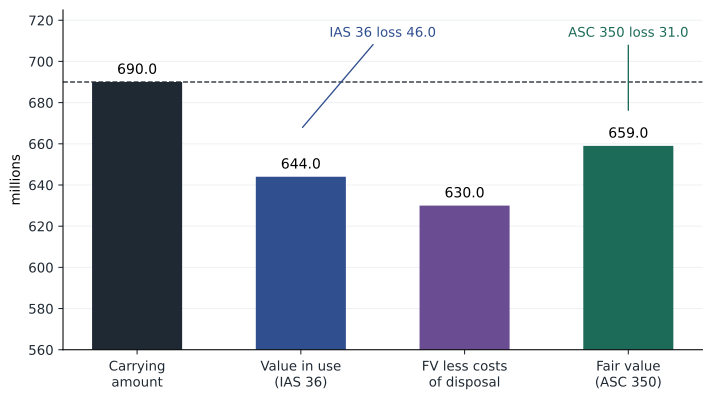
Value in use: 644.0 Fair value less costs of disposal: 630.0
Recoverable amount (higher of the two): 644.0
Impairment loss: 46.0 -> goodwill 46.0, other assets 0.0
Sensitivity of value in use (rows: discount rate, columns: terminal growth)
1.5% 2.0% 2.5%
10.0% 654.6 685.0 719.4
10.5% 617.5 644.0 673.8
11.0% 584.3 607.6 633.6The recoverable amount is the higher of value in use (VIU) and fair value less costs of disposal (FVLCD). Value in use is the present value of the future cash flows expected from the CGU in its current condition. IAS 36 imposes discipline on the forecast: cash flows must be based on reasonable and supportable assumptions, give greater weight to external evidence, use the most recent budgets approved by management for no more than five years unless a longer period can be justified, and extrapolate beyond that with a steady or declining growth rate that does not exceed the long-term average growth rate for the products, industries or countries concerned. The forecast must exclude cash flows from future restructurings to which the entity is not yet committed and from improving or enhancing the asset's performance. Because Tamarind Bay announced the plant closure before year end and has a detailed formal plan, the related savings and costs may be included. The discount rate is a pre-tax rate reflecting current market assessments of the time value of money and the risks specific to the asset, usually derived from a post-tax weighted average cost of capital and grossed up.
The program finds a VIU of 644.0 million and an FVLCD of 630.0 million, based on a valuation using market multiples of comparable frozen food businesses less estimated selling costs. The recoverable amount is therefore 644.0 million, and the CGU's carrying amount of 690.0 million exceeds it by 46.0 million. The impairment loss is allocated first to goodwill, reducing it from 138.0 to 92.0 million, and then, if any remained, pro rata to the other assets, though no asset may be written down below the highest of its FVLCD, VIU and zero. The loss is recognized in profit or loss, within operating profit under IFRS 18, and it can never be reversed, because IAS 36 prohibits reversing goodwill impairments. Impairments of other assets can be reversed if the estimates used to determine the recoverable amount change.
| Feature | IAS 36 | ASC 350 and ASC 360 |
|---|---|---|
| Unit for goodwill | CGU or group of CGUs, not larger than a segment | Reporting unit: segment or one level below |
| Long-lived asset test | Recoverable amount (discounted) in one step | Undiscounted recoverability, then fair value |
| Measure | Higher of value in use and fair value less costs of disposal | Fair value (exit price) |
| Qualitative screen | No equivalent for the annual goodwill test | Optional step zero |
| Reversal of goodwill impairment | Prohibited | Prohibited |
| Reversal for other assets | Required if estimates change | Prohibited for assets held and used |
| Private companies | ASPE: goodwill tested on triggering events against fair value | PCC: may amortize goodwill over up to ten years |
Sensitivity and the discount rate judgment
The sensitivity table in the program shows how fragile the answer is. A rise of half a point in the discount rate, to 11.0 per cent, would reduce VIU to about 608 million and nearly double the impairment; a fall of half a point would cut it to about 5 million. Terminal growth matters almost as much. Because so much depends on these inputs, IAS 36 requires disclosure of the key assumptions for each CGU with significant goodwill, the approach to determining them, the period of the forecast, the growth rate used to extrapolate and the discount rate. Where a reasonably possible change in a key assumption would cause or increase an impairment, the entity must disclose the amount of headroom, the value assigned to the assumption, and the change that would make the recoverable amount equal the carrying amount. After the 2026 impairment, Frozen has no headroom at all, so any further deterioration will lead to another loss.
The discount rate is the input auditors challenge most. Management naturally prefers its own cost of capital, which reflects the whole company, but the rate should reflect the risks of the unit being tested. Frozen's risks are higher than Snacks': lower margins, higher customer concentration and greater exposure to energy costs. Tamarind Bay's valuation specialists build the rate from a risk-free rate, an equity risk premium, a beta from a peer group of frozen food producers, a size premium where justified and a cost of debt reflecting the capital structure of peers, then gross it up to a pre-tax rate for value in use. If management's forecasts are more optimistic than the market expects, the risk can be reflected either in the cash flows or in the rate, but not in both and not in neither.
Forecasting discipline
Regulators' reviews of impairment tests find the same weaknesses year after year: forecasts that show a sudden recovery after years of decline, so-called hockey sticks; terminal growth rates above long-term inflation; margins that never return to historical levels; and cash flows that include the benefits of restructuring not yet committed. Tamarind Bay's 2026 forecast starts from the approved 2027 budget, assumes Frozen margins recover to only 13 per cent by 2031, and uses terminal growth of 2 per cent, in line with long-term inflation targets. The audit committee asked management to compare previous years' forecasts with actual results; Frozen missed its forecast in each of the last three years, which is itself evidence that should temper optimism.
Climate-related matters increasingly enter impairment tests. Carbon pricing, energy transition costs and changes in consumer demand can affect cash flows and useful lives. Tamarind Bay has committed publicly to reduce its operational emissions by half by 2035. The cost of replacing Frozen's ammonia refrigeration and gas-fired boilers is included in the forecast capital expenditure, but only to the extent required to maintain the assets in their current condition or required by enacted regulation; voluntary enhancements that would increase performance are excluded from VIU under IAS 36. Lesson 11 returns to how climate commitments affect the financial statements.
Private enterprises and the goodwill project
ASPE Section 3064 does not require an annual goodwill test: goodwill is tested when events or changes in circumstances indicate that the carrying amount of a reporting unit may exceed its fair value, and the loss is the excess, limited to goodwill. Section 3063 tests long-lived assets for recoverability on an undiscounted basis, like US GAAP. In 2025 the AcSB issued an exposure draft, Relief from Recognition of Acquired Intangible Assets and Amortization of Goodwill, proposing to let private enterprises amortize goodwill and subsume certain acquired intangibles into it; the comment period ended January 31, 2026, so check the AcSB's website for the outcome. For listed companies, the IASB published an exposure draft in March 2024, Business Combinations: Disclosures, Goodwill and Impairment, which proposes disclosures about the performance of acquisitions against management's objectives and changes to the impairment test, such as removing the restriction on including future restructurings in value in use and allowing post-tax inputs. It does not propose to reintroduce amortization. As of the IASB's September 2026 meeting, the Board was still redeliberating the proposals, with no decision on finalizing them or on an effective date.
Common mistakes
MistakeTesting goodwill at a level larger than the one at which it is monitored.
InsteadAllocate goodwill to the lowest level at which management monitors it, never larger than an operating segment.
MistakeIncluding benefits of restructurings not yet committed in value in use.
InsteadInclude only restructurings to which the entity is committed at the test date.
MistakeUsing the company's overall cost of capital for a riskier unit.
InsteadUse a rate that reflects the specific risks of the unit, without double counting risks in the cash flows.
MistakeForecasting a sharp recovery after years of decline.
InsteadCompare past forecasts with actual results and justify any recovery with external evidence.
MistakeDisclosing generic key assumptions.
InsteadDisclose unit-specific assumptions, headroom and the change that would eliminate it.
MistakeReversing a goodwill impairment when results improve.
InsteadGoodwill impairments are never reversed under either framework.
Summary and key terms
- Goodwill is tested at least annually and when indicators or triggering events arise.
- The unit is the CGU or group of CGUs at which goodwill is monitored, never larger than a segment.
- Recoverable amount is the higher of value in use and fair value less costs of disposal; Frozen's loss is 46.0 million.
- Small changes in the discount rate or terminal growth can change the result substantially, so sensitivity disclosure is essential.
- Forecasts should be tested against history and exclude uncommitted restructurings and enhancements.
- The IASB's goodwill project is still being redeliberated in 2026; ASPE amortization of goodwill is under consideration.
- Cash-generating unit (CGU)
- The smallest identifiable group of assets generating largely independent cash inflows.
- Value in use
- The present value of future cash flows expected from an asset or CGU in its current condition.
- Fair value less costs of disposal
- The price that would be received to sell an asset in an orderly transaction, less incremental disposal costs.
- Recoverable amount
- The higher of value in use and fair value less costs of disposal.
- Goodwill
- The future economic benefits from assets acquired in a business combination that are not individually identified and separately recognized.
- Headroom
- The excess of recoverable amount or fair value over carrying amount.
- Terminal growth rate
- The growth rate used to extrapolate cash flows beyond the explicit forecast period.
- Triggering event
- An event or change in circumstances that requires an impairment test outside the annual cycle.
Practice problems
Work each problem on paper first, then reveal the answer to check.
Name three indicators that led Tamarind Bay to update the Frozen test.
Show answer
The announced plant closure and network review, declining margins below the acquisition model, and market capitalization close to book value.
Why are the three Frozen plants not separate units?
Show answer
They share customers, sales and distribution, so their cash inflows are not largely independent.
Rerun the IAS 36 program with a discount rate of 10.0 per cent. What is the impairment?
Show answer
VIU 685.0; recoverable amount 685.0; impairment 5.0.
Why may the plant closure be included in the value in use forecast?
Show answer
The entity is committed to it, with an announced detailed formal plan, at the test date.
Why must the discount rate reflect the unit's specific risks?
Show answer
Using the company-wide rate for a riskier unit overstates its value and can avoid a needed impairment.
What does a history of missed forecasts imply for the impairment test?
Show answer
Management's forecasts may be optimistic; the assumptions need more support or more conservatism.
Can the Frozen goodwill impairment be reversed if margins recover in 2028?
Show answer
No. Goodwill impairments cannot be reversed under either framework.
What would happen if Frozen were tested together with Snacks?
Show answer
The combined unit's headroom would hide Frozen's shortfall, which is why regulators challenge broad units.
What disclosure helps a reader judge the risk of further impairment?
Show answer
Headroom and the change in a key assumption that would eliminate it, or under US practice the percentage by which fair value exceeds carrying amount.
What is the status of the IASB's goodwill and impairment project as of September 2026?
Show answer
The Board is still redeliberating its March 2024 exposure draft; no final amendments or effective date.
Lesson quiz · 5 questions
Score 60% or more to complete this lesson.
Create a free account to save your progress, take quizzes and earn a certificate.