
ACCT-470 · Lesson 12 of 12 · 27 min
Capstone: going concern, events after the reporting period and the reporting issues memo
The final lesson brings the course together. Disclosure is where all the earlier judgments become visible to users, and three areas tie the year end together: the going concern assessment, events after the reporting period and related party transactions. The lesson then shows how Tamarind Bay's reporting team summarizes the year's significant judgments in a reporting issues memo for the audit committee, the document that connects the accounting to governance.
Going concern
Financial statements are prepared on a going concern basis unless management intends to liquidate the entity or cease trading, or has no realistic alternative but to do so. Management must assess the entity's ability to continue as a going concern, considering all available information about the future, at least twelve months from the end of the reporting period. When management is aware of material uncertainties related to events or conditions that may cast significant doubt on the entity's ability to continue as a going concern, those uncertainties must be disclosed. Since 2027, these requirements sit in IAS 8, as renamed by IFRS 18, rather than IAS 1, but they have not changed in substance. When significant judgment was required to conclude that no material uncertainty exists, a so-called close call, the IFRS Interpretations Committee's 2014 agenda decision and regulators expect disclosure of that judgment.
Tamarind Bay is a profitable company with access to credit, so no one expects a going concern problem. But the Frozen impairment, the recall and the loss of headroom in a segment are exactly the circumstances in which audit committees ask whether covenants are safe. The treasury team prepares a covenant stress test.
# Going concern support: covenant headroom under stress (invented figures, millions).
net_debt, ebitda, interest = 728.0, 268.4, 41.3
max_lev, min_cov = 3.50, 3.00
print(f"{'Scenario':<34}{'EBITDA':>8}{'Net debt':>10}{'Leverage':>10}{'Coverage':>10}  Result")
for name, d_e, d_debt in [("Base case (2026 actual)", 0.00, 0), ("Frozen volumes -10%", -0.06, 10),
                          ("Severe: recall repeat, input costs", -0.15, 35), ("Downside: lost major customer", -0.22, 45)]:
    e = ebitda * (1 + d_e); nd = net_debt + d_debt
    lev, cov = nd / e, e / interest
    ok = lev <= max_lev and cov >= min_cov
    print(f"{name:<34}{e:>8.1f}{nd:>10.1f}{lev:>10.2f}{cov:>10.1f}  {'compliant' if ok else 'BREACH'}")
breakeven = 1 - net_debt / max_lev / ebitda
print(f"\nEBITDA could fall {breakeven:.1%} (net debt unchanged) before the leverage covenant is breached.")
# Events after the reporting period (year end December 31, 2026; statements authorized March 4, 2027)
events = [("Jan 19: court settles a 2025 supplier dispute for 2.1 (provision was 1.5)", "adjusting"),
          ("Feb 3: fire destroys a warehouse; insured; operations relocated", "non-adjusting"),
          ("Feb 12: lab results show the October recall affected 2 more lots", "adjusting"),
          ("Feb 20: board approves acquisition of a Quebec bakery brand", "non-adjusting"),
          ("Feb 26: Frozen CGU's largest customer files for creditor protection", "adjusting (evidence of year-end conditions)")]
print()
for e, kind in events:
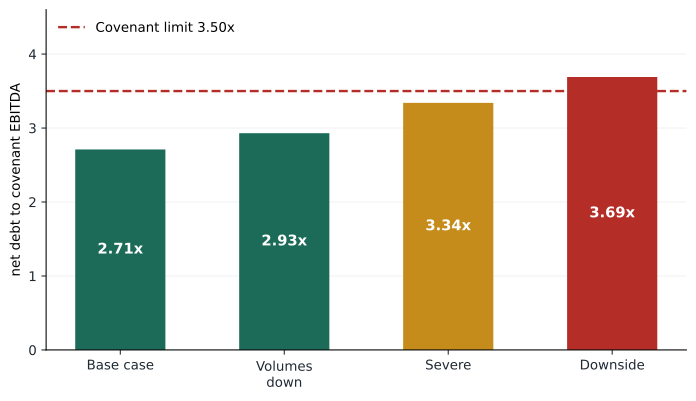
print(f"{kind:<46}{e}")Scenario EBITDA Net debt Leverage Coverage Result Base case (2026 actual) 268.4 728.0 2.71 6.5 compliant Frozen volumes -10% 252.3 738.0 2.93 6.1 compliant Severe: recall repeat, input costs 228.1 763.0 3.34 5.5 compliant Downside: lost major customer 209.4 773.0 3.69 5.1 BREACH EBITDA could fall 22.5% (net debt unchanged) before the leverage covenant is breached. adjusting Jan 19: court settles a 2025 supplier dispute for 2.1 (provision was 1.5) non-adjusting Feb 3: fire destroys a warehouse; insured; operations relocated adjusting Feb 12: lab results show the October recall affected 2 more lots non-adjusting Feb 20: board approves acquisition of a Quebec bakery brand adjusting (evidence of year-end conditions) Feb 26: Frozen CGU's largest customer files for creditor protection
The leverage covenant, net debt to covenant EBITDA of no more than 3.50 times, has headroom in the base case and in two downside scenarios, and is breached only in the severe case of losing a major customer, which would cut EBITDA by 22 per cent. The impairment does not affect the covenant, because covenant EBITDA adds back impairments. Management concludes that there is no material uncertainty about going concern and that the conclusion did not require significant judgment, because the breakeven decline of 22.5 per cent is far outside any reasonably possible scenario in the next twelve months and the company has an undrawn revolving credit facility of 250 million. The analysis is documented and shared with the auditor, who is required to evaluate management's assessment.
Covenants also affect classification. A liability is classified as current if the entity does not have the right at the end of the reporting period to defer settlement for at least twelve months, and a covenant breach at or before the reporting date can make long-term debt current unless the lender has agreed, before the reporting date under IFRS, to a waiver that gives at least twelve months' grace. Under US GAAP, a waiver obtained after the balance sheet date but before issuance can keep the debt non-current in some circumstances, a difference that matters to companies close to their limits. The IASB's 2020 and 2022 amendments to IAS 1, effective 2024, also require disclosure of information about covenants that must be complied with within twelve months, so that users can assess the risk that non-current liabilities could become repayable early. Tamarind Bay discloses its covenants and headroom.
Events after the reporting period
IAS 10 Events after the Reporting Period distinguishes adjusting events, which provide evidence of conditions that existed at the end of the reporting period, from non-adjusting events, which are indicative of conditions that arose after it. Adjusting events change the amounts recognized; non-adjusting events are disclosed if material, with an estimate of their financial effect or a statement that one cannot be made. The period runs to the date the financial statements are authorized for issue, which for Tamarind Bay is March 4, 2027, when the board approves them. The program classifies the events reported to the audit committee.
The settlement of the supplier dispute for 2.1 million confirms an obligation that existed at year end, so the provision is increased from 1.5 to 2.1 million. The laboratory results on the recall provide evidence about the extent of contamination that existed at year end, so the recall provision is updated. The customer's filing for creditor protection in February is evidence that the customer was already in financial difficulty at year end; IAS 10 gives this as an example of an adjusting event, so Tamarind Bay increases the credit loss allowance on that customer's receivable of 6.4 million and also reconsiders the Frozen impairment test, which assumed continuing sales to that customer. The warehouse fire and the bakery acquisition arose after year end; they are disclosed but do not change the 2026 amounts. Dividends declared after the reporting period are also non-adjusting and are not recognized as liabilities.
The customer bankruptcy shows how one event can touch several earlier judgments. Reopening the impairment test late in the year-end process is uncomfortable, but the standards require it: the test must reflect the best information available about conditions at the reporting date. Tamarind Bay's team reruns the Frozen model with the customer's volumes reduced by half and finds that the recoverable amount falls by a further 9 million. That increases the impairment and is recorded before the statements are authorized. The lesson is that year-end judgments are not final until the statements are issued.
Related party transactions
IAS 24 Related Party Disclosures requires disclosure of the nature of related party relationships and of transactions and outstanding balances, including commitments, needed for users to understand the potential effect of the relationships, together with key management personnel compensation in total and by category. Related party transactions are material by nature because of the risk that they are not conducted on arm's-length terms. Tamarind Bay buys about 3.4 million a year of organic berries from a farm owned by the chief executive's brother, a close family member and therefore a related party. The purchases are at prices comparable with those paid to other suppliers, but the relationship and amounts must be disclosed, and the company may state that the terms are equivalent to arm's-length terms only if that can be substantiated. Canadian securities law adds MI 61-101 for certain related party transactions, requiring formal valuations and minority approval in some cases.
Disclosure effectiveness
Over the course of this year end, Tamarind Bay's notes have grown: new IFRS 18 or DISE preparation, more segment information, expanded tax disclosures, supplier finance, crypto assets and the recall. Regulators and standard setters have for years urged companies to make disclosures more effective, not merely longer: to remove immaterial information, avoid boilerplate, organize notes logically, cross-refer rather than repeat, and tailor accounting policy disclosures to the entity's own material policies rather than reciting the standards. The IASB's 2021 amendments to IAS 1 require disclosure of material accounting policy information rather than significant accounting policies, and regulators have praised companies that have cut generic policy notes. Tamarind Bay's 2026 project removes about eight pages of generic policies and reorganizes its notes so that each significant judgment appears with the related amounts.
Disclosure in MD&A complements the notes. The MD&A explains results through management's eyes, covering trends, risks and uncertainties, liquidity and capital resources and critical accounting estimates, and it is where adjusted measures and key performance indicators appear, subject to the rules in lesson 3. The financial statements and MD&A must tell a consistent story: a regulator who reads about a struggling Frozen business in MD&A will check that the impairment test assumptions reflect it.
The reporting issues memo
Every year end, Tamarind Bay's chief financial officer presents a reporting issues memo to the audit committee. It lists each significant accounting judgment, the facts, the alternatives considered, the conclusion, the effect on the statements and the disclosure, and it records where management and the auditor disagreed and how the disagreement was resolved. The audit committee uses the memo to discharge its oversight responsibility, and the auditor's communication of key or critical audit matters, discussed in ACCT-431, typically mirrors its most significant items. The 2026 memo summarizes the course.
| Issue | Judgment | Effect (IFRS) | Lesson |
|---|---|---|---|
| Prior-year promotion accrual error | Material on qualitative grounds | Restate 2025 comparatives by 5.9 million | 1 |
| IFRS 18 transition | Classification of income and expenses | Operating profit falls by 6.4 million (associate moves to investing) | 2 |
| Adjusted operating profit | Slotting fee adjustment rejected | MPM of 196.7 million with tax and NCI effects | 3 |
| Revenue: rebates and co-manufacturing | Expected value; principal | Rebate rate 2.72 per cent; gross revenue | 4 |
| Sale and leaseback | Sale qualifies; gain on rights transferred | Gain of 10.94 million | 5 |
| Frozen CGU impairment | Value in use assumptions | Goodwill impairment of 46.0 million, plus about 9 million after the customer bankruptcy | 6 |
| ESG-linked loan; convertible notes; NCI put | SPPI passed; compound split; liability | Amortized cost; interest 18.16 million; liability about 31 million | 7 |
| Credit losses and hedges | Stage 2 transfer; forward-looking overlay | Allowances updated; hedge ineffectiveness to profit | 8 |
| Earn-out and bitcoin | Level 3 inputs; IAS 38 cost model | Earn-out 14.2 million; bitcoin at 12.0 million | 9 |
| Diluted EPS | Convertible notes anti-dilutive | Basic 0.49, diluted 0.48 before the late adjustment | 10 |
| Tax and recall | IFRIC 23 expected value; best estimate | Uncertain tax liability 3.05 million; recall provision 4.64 million | 11 |
| Going concern and subsequent events | No material uncertainty; customer bankruptcy adjusting | Allowance and impairment increased | 12 |
The late adjustment from the customer bankruptcy changes several figures: the impairment rises to about 55 million, profit and EPS fall, and the MPM reconciliation and EPS note must be updated before the statements are authorized. A good reporting process anticipates such changes by building the year-end model so that a change in one input flows through every affected note. The final check is consistency: the same numbers in the statements, the notes, the MD&A, the earnings release and the sustainability report.
Ethics and the reporting culture
The judgments in this course can be made well or badly. The difference often comes down to culture: whether the finance team feels able to tell the chief executive that an adjustment is not acceptable, whether the audit committee asks hard questions, and whether incentives reward accurate reporting or reported results. Professional accountants are bound by codes of conduct that require integrity and objectivity, and by securities law that holds the chief financial officer personally responsible for certifying the statements. ACCT-460 shows what happens when the culture fails. The best defence is the discipline this course has practised: identify the issue, find the requirements, weigh the alternatives against the evidence, decide without bias, document the reasoning and disclose what users need to know.
Worked problem
Adjusting or not?
After December 31, 2026 but before the statements are authorized, three things happen: (a) a competitor announces a price cut that will reduce Frozen's 2027 margins; (b) the tax authority issues a reassessment on the transfer pricing position for 3.4 million, based on facts that existed in 2026; (c) Tamarind Bay's share price falls 15 per cent. Which are adjusting events?
Show solution
- (a) The price cut arose after year end and reflects new conditions: not adjusting, but consider disclosure and its effect on future impairment tests.
- (b) The reassessment provides evidence about the uncertain position that existed at year end: update the liability if the new information changes the estimate.
- (c) A decline in market value after year end reflects conditions arising after year end: not adjusting, though a significant decline may be disclosed.
- Document each conclusion in the subsequent events memo.
Answer: Only (b) is adjusting.
Common mistakes
MistakeAssuming a profitable company needs no going concern assessment.
InsteadAssess and document going concern every period, including covenant headroom.
MistakeTreating a customer bankruptcy after year end as non-adjusting.
InsteadA bankruptcy shortly after year end usually confirms that the customer was impaired at year end; adjust.
MistakeForgetting to rerun related estimates after a subsequent event.
InsteadTrace each event to all affected judgments, such as impairment tests and allowances.
MistakeStating that related party transactions are at arm's length without evidence.
InsteadMake that statement only if it can be substantiated.
MistakeAdding new disclosures without removing immaterial ones.
InsteadRemove boilerplate and immaterial information; tailor policies to the entity.
MistakeLetting the MD&A and the notes tell different stories.
InsteadCheck consistency across the statements, notes, MD&A, releases and sustainability reports.
Summary and key terms
- Going concern is assessed for at least twelve months from the reporting date, with disclosure of material uncertainties and close calls.
- Covenant stress tests support going concern conclusions and the classification of debt.
- Adjusting events provide evidence of year-end conditions; non-adjusting events are disclosed if material.
- Related party transactions are material by nature and must be disclosed with their terms.
- Effective disclosure removes boilerplate and connects judgments to the amounts they affect.
- A reporting issues memo documents significant judgments for the audit committee and links accounting to governance.
- Material uncertainty
- An uncertainty related to events or conditions that may cast significant doubt on the ability to continue as a going concern.
- Adjusting event
- An event after the reporting period that provides evidence of conditions existing at the end of the period.
- Non-adjusting event
- An event after the reporting period indicative of conditions that arose after it.
- Going concern
- The assumption that an entity will continue to operate for the foreseeable future.
- Covenant
- A condition in a loan agreement, such as a maximum leverage ratio, that the borrower must meet.
- Related party
- A person or entity related to the reporting entity, such as key management, close family members or entities they control.
- Reporting issues memo
- A document summarizing significant accounting judgments for the audit committee.
- Boilerplate disclosure
- Generic disclosure that repeats requirements without entity-specific information.
Practice problems
Work each problem on paper first, then reveal the answer to check.
What EBITDA decline would breach the leverage covenant with net debt unchanged?
Show answer
About 22.5 per cent.
Rerun the covenant program with a covenant limit of 3.25. Which scenarios breach?
Show answer
The severe scenario (3.34) and the downside scenario (3.69).
Why does the goodwill impairment not affect the covenant?
Show answer
Covenant EBITDA adds back impairments.
Why is the customer's filing for creditor protection an adjusting event?
Show answer
It provides evidence that the customer was in financial difficulty at year end.
Which earlier judgment must be revisited because of the customer bankruptcy?
Show answer
The Frozen impairment test, because it assumed continuing sales to that customer; also the credit loss allowance.
Why is the warehouse fire not adjusted?
Show answer
It arose after year end and reflects new conditions; it is disclosed if material.
What must be disclosed about purchases from the CEO's brother's farm?
Show answer
The relationship, the amounts and balances, and the terms; arm's-length statements only if substantiated.
Give two ways to make disclosures more effective.
Show answer
Remove immaterial and generic information; tailor accounting policies; place judgments with related amounts; cross-refer instead of repeating.
What is the purpose of the reporting issues memo?
Show answer
To document significant judgments, alternatives, conclusions and disagreements for audit committee oversight.
Why must the MD&A and impairment assumptions be consistent?
Show answer
Regulators compare narrative descriptions of business performance with the assumptions used in estimates.
Lesson quiz · 5 questions
Score 60% or more to complete this lesson.
Create a free account to save your progress, take quizzes and earn a certificate.