
ACCT-470 · Lesson 11 of 12 · 26 min
Income taxes, provisions and climate-related matters
Income taxes and provisions have one thing in common: both require an entity to estimate obligations whose amount and timing depend on future events, often decided by someone else, such as a tax authority or a court. ACCT-212 covered the mechanics of current and deferred tax, losses and valuation, uncertain tax positions and provisions. This lesson takes four harder situations from Tamarind Bay's 2026 year end: deferred tax arising in a business combination, an uncertain transfer pricing position, the global minimum tax, and a product recall with an associated consumer claim. It ends with climate-related matters, which affect several estimates at once.
Deferred tax in a business combination
When Tamarind Bay acquired Greenfold in 2025, it bought the shares, so the tax bases of Greenfold's assets did not change. In the purchase price allocation, however, the brand and customer relationships were recognized at their fair values of 28.0 and 12.0 million, while their tax bases were zero. IAS 12 requires deferred tax to be recognized on these temporary differences, and because the business combination is not exempt from recognition, the deferred tax liability of 10.6 million at 26.5 per cent is part of the net assets acquired. It reduces the identifiable net assets, which increases goodwill by the same amount. Goodwill itself does not give rise to a deferred tax liability at initial recognition, under IAS 12's initial recognition exception, because recognizing one would only increase goodwill further in a circular way.
# Income tax judgments at Tamarind Bay Foods (IAS 12 and IFRIC 23; invented figures, millions).
rate = 0.265
# 1. Deferred tax in the 2025 acquisition of Greenfold Plant Kitchen (share purchase).
consideration = 96.0 + 12.0            # cash plus fair value of the earn-out at acquisition
assets = {"Working capital": (9.0, 9.0), "Property, plant and equipment": (15.0, 15.0),
          "Brand": (28.0, 0.0), "Customer relationships": (12.0, 0.0)}   # (fair value, tax base)
dtl = sum(max(0.0, fv - tb) for fv, tb in assets.values()) * rate
net = sum(fv for fv, _ in assets.values()) - dtl
print(f"Deferred tax liability on intangibles: {dtl:.2f}")
print(f"Net identifiable assets: {net:.2f}   Goodwill: {consideration - net:.2f}")
print("No deferred tax is recognized on the goodwill itself (initial recognition exception).")
# 2. Uncertain tax treatment: a transfer pricing position worth 8.0 of tax.
outcomes = [(8.0, 0.40), (5.0, 0.35), (0.0, 0.25)]   # (benefit sustained, probability)
ev = sum(b * p for b, p in outcomes)
ml = max(outcomes, key=lambda o: o[1])[0]
print(f"\nExpected value of benefit sustained: {ev:.2f} -> liability {8.0 - ev:.2f}")
print(f"Most likely amount: {ml:.2f} -> liability {8.0 - ml:.2f}")
print("IFRIC 23: acceptance of the full position is not probable, and with a spread of outcomes")
print(f"the expected value better predicts the resolution -> uncertain tax liability {8.0 - ev:.2f}")Deferred tax liability on intangibles: 10.60 Net identifiable assets: 53.40 Goodwill: 54.60 No deferred tax is recognized on the goodwill itself (initial recognition exception). Expected value of benefit sustained: 4.95 -> liability 3.05 Most likely amount: 8.00 -> liability 0.00 IFRIC 23: acceptance of the full position is not probable, and with a spread of outcomes the expected value better predicts the resolution -> uncertain tax liability 3.05
As the brand and customer relationships are amortized for accounting purposes (the brand is assessed as having an indefinite life, the customer relationships are amortized over eight years), the deferred tax liability on the customer relationships unwinds through deferred tax income, keeping the effective tax rate close to the statutory rate. The indefinite-lived brand's deferred tax liability remains until the brand is impaired or sold, a so-called naked credit that cannot be used to support recognition of deferred tax assets that reverse within a definite period. These details matter because errors in purchase price allocation tax accounting are a recurring source of restatements.
An uncertain transfer pricing position
Tamarind Bay's Mexican brand licence from lesson 4 is held by a group company in a lower-tax jurisdiction that charges the Canadian parent a fee for brand management services. The tax authority could challenge the fee as excessive, which would increase Canadian taxable income. The total tax at stake is 8.0 million. IFRIC 23 Uncertainty over Income Tax Treatments requires an entity to consider whether it is probable that the taxation authority will accept the treatment, assuming the authority will examine it with full knowledge of all relevant information. If acceptance is probable, the tax is measured consistently with the treatment in the tax return. If not, the entity reflects the uncertainty using whichever of the most likely amount and the expected value better predicts the resolution. With three distinct possible outcomes, the expected value is the better predictor here, giving an uncertain tax liability of 3.05 million.
Both frameworks require interest and penalties to be considered: Tamarind Bay accrues interest on the uncertain liability and, as permitted, classifies it within income tax expense, a policy that must be applied consistently and disclosed. Uncertain tax liabilities are reassessed each period as audits progress, statutes of limitation expire and case law develops, and the reassessment is a change in estimate. Regulators also expect disclosure of the judgments made and, where significant, of the possible range of outcomes.
Pillar Two: the global minimum tax
Tamarind Bay's consolidated revenue exceeds 750 million euros, so it is within the scope of the OECD's Pillar Two model rules, which aim to ensure that large multinational groups pay a minimum effective tax rate of 15 per cent in every jurisdiction where they operate. Canada enacted the Global Minimum Tax Act in June 2024, effective for fiscal years beginning on or after December 31, 2023, including an income inclusion rule and a domestic minimum top-up tax; the low-tax jurisdiction where the brand company sits has not enacted a qualified domestic minimum top-up tax. Top-up tax in respect of the low-tax brand company is therefore payable in Canada. IAS 12 was amended in May 2023 to introduce a mandatory temporary exception from recognizing and disclosing deferred taxes arising from Pillar Two legislation, so top-up tax is accounted for as current tax only. Entities must disclose that they have applied the exception, current tax expense related to Pillar Two, and, where legislation is enacted but not yet in effect, information about their exposure. Tamarind Bay's 2026 current tax includes 1.3 million of top-up tax.
Tamarind Bay's tax note will also be affected by IFRS 18, which moves the income tax expense into its own category, and by a pending IASB exposure draft on the presentation of taxes under IFRS 18, expected in the fourth quarter of 2026 according to the IASB's September 2026 update.
The product recall provision
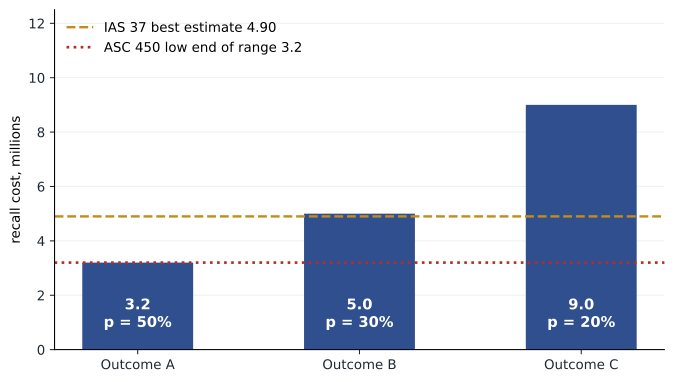
In October 2026 Tamarind Bay recalled several lots of frozen meals after a supplier's ingredient tested positive for listeria. No illnesses were confirmed by year end, but the recall involved retrieving products from retailers, destroying inventory, compensating retailers and consumers, and investigating the cause. At December 31 the company estimated the remaining costs at 3.2, 5.0 or 9.0 million, with probabilities of 50, 30 and 20 per cent. A consumer class action alleging distress and economic loss has also been filed; counsel estimates the probability of an unfavourable outcome at 30 per cent.
# Product recall provision and a consumer claim, December 31, 2026 (invented, millions).
scen = [(3.2, 0.50), (5.0, 0.30), (9.0, 0.20)]     # total recall cost, probability
ev = sum(c * p for c, p in scen)
ml = max(scen, key=lambda s: s[1])[0]
print(f"Most likely outcome: {ml:.2f}   Expected value: {ev:.2f}")
# Payments: 60% in 2027, 40% in 2028; discount rate 4.0% (pre-tax, risk-free plus adjustment)
paid = [(1, 0.6), (2, 0.4)]
def pv(amount): return sum(amount * w / 1.04 ** t for t, w in paid)
print("\nIAS 37 (single obligation; other outcomes are mostly higher, so a higher estimate is used)")
best = ev
print(f"  best estimate {best:.2f}, discounted {pv(best):.2f}; unwinding in 2027 {pv(best) * 0.04:.2f}")
print("ASC 450 (probable and reasonably estimable; no amount in the range is a better estimate)")
print(f"  accrue the low end of the range {min(c for c, _ in scen):.2f}, usually undiscounted;")
print(f"  disclose the reasonably possible additional loss of up to {max(c for c, _ in scen) - min(c for c, _ in scen):.2f}")
claim_p = 0.30
print(f"\nConsumer class action, probability of loss {claim_p:.0%}:")
print("  IAS 37 - not probable (more likely than not): disclose a contingent liability, no provision")
print(" ASC 450 - reasonably possible: disclose the nature and an estimate or range, no accrual")Most likely outcome: 3.20 Expected value: 4.90 IAS 37 (single obligation; other outcomes are mostly higher, so a higher estimate is used) best estimate 4.90, discounted 4.64; unwinding in 2027 0.19 ASC 450 (probable and reasonably estimable; no amount in the range is a better estimate) accrue the low end of the range 3.20, usually undiscounted; disclose the reasonably possible additional loss of up to 5.80 Consumer class action, probability of loss 30%: IAS 37 - not probable (more likely than not): disclose a contingent liability, no provision ASC 450 - reasonably possible: disclose the nature and an estimate or range, no accrual
IAS 37 requires a provision when there is a present obligation from a past event, an outflow of resources is probable, meaning more likely than not, and a reliable estimate can be made. The recall creates a constructive obligation, because Tamarind Bay announced the recall publicly and retailers and consumers expect compensation. The amount is the best estimate of the expenditure required to settle the obligation. For a large population of items, such as warranties, the expected value is used. For a single obligation, the individual most likely outcome may be the best estimate, but IAS 37 requires consideration of other possible outcomes, and when they are mostly higher, the best estimate will be higher. Here the outcomes above 3.2 are substantial, so Tamarind Bay provides the expected value of 4.90 million, discounted at 4.0 per cent to 4.64 million because payment will extend into 2028. The unwinding of the discount is recognized in the financing category under IFRS 18.
The class action is treated differently. Under both frameworks, a loss that is not probable is not recognized, but it must be disclosed unless the possibility of an outflow is remote. IAS 37 calls this a contingent liability and requires a description, an estimate of its financial effect, the uncertainties and any possibility of reimbursement; ASC 450 requires disclosure of the nature of a reasonably possible loss and an estimate of the possible loss or range, or a statement that an estimate cannot be made. Companies often argue that disclosure would prejudice their position in litigation. IAS 37 permits omitting some information in extremely rare cases where disclosure would seriously prejudice the entity's position, with disclosure of the general nature of the dispute and the reason; US GAAP has no equivalent exemption, though SEC registrants commonly say that an estimate cannot be made, which the SEC staff often challenges.
| Issue | IAS 37 | ASC 450 |
|---|---|---|
| Recognition threshold | Probable = more likely than not | Probable = likely, a higher threshold |
| Measurement | Best estimate; expected value for large populations | Best estimate in range; minimum if none better |
| Range with equal likelihood | Midpoint | Low end |
| Discounting | Required if material | Generally not, unless timing and amount are fixed |
| Constructive obligations | Recognized | Generally recognized only if legally enforceable or specific guidance applies |
| Prejudicial disclosure exemption | Available in extremely rare cases | None |
The IASB has a project to make targeted improvements to IAS 37, including the timing of recognition of some levies and the discount rate, which should reflect non-performance risk under the proposals; as of its September 2026 meeting it was still making tentative decisions, with no effective date. Harrow Creek, under ASPE Section 3290, recognizes contingent losses only when it is likely, a high threshold, that a future event will confirm a liability, which is closer to the US approach.
Climate-related matters in the financial statements
Tamarind Bay has announced a target of halving its operational greenhouse gas emissions by 2035 from a 2022 baseline and reaching net zero by 2050. Do these commitments create obligations or affect amounts in the statements? A public commitment alone does not create a provision: there is no present obligation from a past event until the company has a legal obligation, such as under carbon pricing regulation, or a constructive one, such as a commitment to a third party that it cannot realistically avoid. But climate matters affect many estimates: useful lives of assets that will be replaced earlier to meet targets, impairment cash flows that include carbon costs, expected credit losses on customers in exposed sectors, the fair value of assets, decommissioning obligations and the measurement of inventories. In November 2025 the IASB published illustrative examples showing how existing requirements in standards such as IAS 1, IAS 36, IAS 37 and IFRS 9 apply to disclosures about climate-related and other uncertainties. They have no effective date, but the IASB expects companies to consider them on a timely basis, and Canadian regulators have long asked for consistency between the narrative in sustainability reports and the assumptions in the financial statements.
For Tamarind Bay, the most significant effect is on the Frozen unit: the replacement of ammonia refrigeration and gas boilers is brought forward, shortening the useful lives of the existing equipment and increasing depreciation by about 1.8 million a year from 2026, a change in estimate applied prospectively. The impairment test in lesson 6 includes the replacement costs required by enacted regulation. The financial statements disclose these judgments, and the chief financial officer checks that the numbers in the sustainability report, such as the cost of the transition plan, are consistent with those in the impairment model.
Common mistakes
MistakeIgnoring deferred tax on intangible assets recognized in a share acquisition.
InsteadRecognize deferred tax on the difference between fair values and tax bases, which increases goodwill.
MistakeRecognizing the full tax benefit of an uncertain position because it is defensible.
InsteadReflect uncertainty using the expected value or most likely amount when acceptance is not probable.
MistakeRecognizing deferred taxes for Pillar Two top-up tax.
InsteadApply the mandatory IAS 12 exception and account for top-up tax as current tax.
MistakeProviding the most likely outcome for a recall when worse outcomes are substantial.
InsteadConsider other possible outcomes; the best estimate may be higher than the most likely outcome.
MistakeTreating a net-zero pledge as a provision.
InsteadA pledge alone is not an obligation, but climate matters affect estimates such as useful lives and impairment.
MistakeOmitting contingent liability disclosure because the case might be lost.
InsteadDisclose unless the possibility of outflow is remote, within the limited exemptions available.
Summary and key terms
- Deferred tax on intangibles recognized in a business combination increases goodwill; no deferred tax arises on non-deductible goodwill.
- IFRIC 23 measures uncertain tax treatments at the expected value or most likely amount when acceptance is not probable.
- Pillar Two top-up tax is current tax, with a mandatory exception from deferred tax under IAS 12.
- IAS 37 recognizes provisions when an outflow is more likely than not and measures them at a best estimate, discounted.
- Contingent liabilities are disclosed unless remote.
- Climate commitments rarely create provisions on their own but affect many estimates and must be consistent with sustainability reporting.
- IFRIC 23
- The interpretation on uncertainty over income tax treatments.
- Global Minimum Tax Act
- Canada's 2024 Pillar Two legislation.
- Initial recognition exception
- The IAS 12 rule that no deferred tax is recognized on the initial recognition of goodwill.
- Temporary difference
- A difference between the carrying amount of an asset or liability and its tax base.
- Pillar Two
- The OECD model rules for a 15 per cent global minimum tax on large multinational groups.
- Top-up tax
- Additional tax payable to bring a jurisdiction's effective tax rate up to the minimum rate.
- Constructive obligation
- An obligation arising from an entity's actions that create a valid expectation it will discharge responsibilities.
- Contingent liability
- A possible obligation, or a present obligation not recognized, that is disclosed unless remote.
- Transfer pricing
- The pricing of transactions between related entities in different tax jurisdictions.
Practice problems
Work each problem on paper first, then reveal the answer to check.
Why does the deferred tax liability on Greenfold's intangibles increase goodwill?
Show answer
It reduces the identifiable net assets acquired, so the residual goodwill is larger.
Rerun the tax program with a tax rate of 25 per cent. What is goodwill?
Show answer
Deferred tax 10.00, net assets 54.00, goodwill 54.00.
Why is no deferred tax recognized on goodwill?
Show answer
Recognizing it would increase goodwill, which would require more deferred tax, a circular result; the standards prohibit it.
When would IFRIC 23 use the most likely amount?
Show answer
When outcomes are binary or concentrated, so the most likely amount better predicts the resolution.
How is Pillar Two top-up tax presented?
Show answer
As current tax, with disclosures, under the IAS 12 temporary exception.
Why does the recall create an obligation at year end?
Show answer
The public recall announcement created a constructive or legal obligation to compensate retailers and consumers for a past event.
Rerun the provision program with outcomes of 4.0, 5.0 and 6.0. What are the most likely outcome and expected value?
Show answer
Most likely 4.0; expected value 4.0 × 0.5 + 5.0 × 0.3 + 6.0 × 0.2 = 4.70.
How is the consumer class action treated?
Show answer
Not recognized, because a loss is not probable; disclosed as a contingent liability because it is not remote.
Does Tamarind Bay's net-zero target require a provision?
Show answer
No; a public target alone is not a present obligation, though it affects estimates such as useful lives.
What is the effect of shortening the Frozen equipment's useful life?
Show answer
Higher depreciation of about 1.8 million a year, a change in estimate applied prospectively.
Lesson quiz · 5 questions
Score 60% or more to complete this lesson.
Create a free account to save your progress, take quizzes and earn a certificate.