
ACCT-470 · Lesson 5 of 12 · 27 min
Leases: complex judgments
ACCT-212 covered the mechanics of lessee accounting under IFRS 16: measuring the lease liability and right-of-use asset, remeasurement, modifications and sale-and-leaseback. Almost a decade after IFRS 16 took effect in 2019, the mechanics are routine. The judgments are not. Whether a contract contains a lease at all, how long the lease term is, what discount rate to use and how to treat variable payments all affect the balance sheet by large amounts, and they are the questions that auditors and regulators ask most often. This lesson works through those judgments using Tamarind Bay's 2026 lease portfolio of about 96 million dollars of lease liabilities, and compares the outcome under ASC 842, which many of its US competitors apply, and ASPE, which its subsidiary uses.
Is there a lease? Embedded leases in service contracts
In 2026 Tamarind Bay signed a five-year logistics contract with a third-party cold storage provider for its Frozen products. The provider stores the products and ships them to customers. The contract specifies a 9,000-pallet freezer building that the provider operates exclusively for Tamarind Bay, and the provider cannot move Tamarind Bay's products to another building without consent. Tamarind Bay decides how much to store, when products move in and out, and which customers to serve. The provider is paid a fixed monthly fee plus a charge per pallet moved.
A contract contains a lease if it conveys the right to control the use of an identified asset for a period of time in exchange for consideration. Control requires the right to obtain substantially all the economic benefits from use of the asset and the right to direct how and for what purpose it is used. The building is an identified asset: it is specified in the contract and the provider has no substantive right to substitute another, because doing so would require Tamarind Bay's consent and would bring the provider no economic benefit. Tamarind Bay obtains substantially all the benefits, since the building is exclusive to it. And Tamarind Bay directs how and for what purpose the building is used, by deciding what is stored, how much and when. The contract therefore contains a lease of the building, embedded in a logistics service contract.
| Question | Facts | Conclusion |
|---|---|---|
| Identified asset? | Building specified; substitution requires consent and brings the supplier no benefit | Yes |
| Substantially all economic benefits? | Exclusive use for five years | Yes |
| Right to direct use? | Tamarind Bay decides what, how much and when to store and ship | Yes |
| Result | Lease component (the building) plus non-lease services (labour, handling) | Embedded lease |
Once a lease is identified, the contract consideration is allocated between the lease component and the non-lease components, such as warehouse labour and handling, on the basis of their relative standalone prices, unless the lessee elects the practical expedient, by class of underlying asset, to account for each lease component and its associated non-lease components as a single lease. Electing the expedient simplifies the accounting but increases the lease liability. Tamarind Bay does not elect it for warehouses, so only the estimated standalone price of the building, about 1.1 million a year, enters the lease liability. The per-pallet charges are variable payments not based on an index or rate, so they are expensed as incurred.
Embedded leases are easy to miss, because they sit in procurement contracts that the accounting team never sees: dedicated trucks in a transportation contract, a power plant built for a single customer under a power purchase agreement, a data centre cage in an outsourcing deal, or customer-specific moulds held at a supplier's plant. Tamarind Bay's controls now require procurement to flag any contract that specifies an asset or grants exclusive use, so that accounting can assess it. Missing an embedded lease understates assets and liabilities and, under IFRS 16, shifts expense from depreciation and interest to operating costs, affecting EBITDA.
The lease term: reasonably certain options
The lease term is the non-cancellable period plus periods covered by an option to extend if the lessee is reasonably certain to exercise it, and periods covered by an option to terminate if the lessee is reasonably certain not to exercise it. Reasonably certain is a high threshold, and it is assessed using all relevant facts and circumstances that create an economic incentive, not management's stated intentions alone. Relevant factors include significant leasehold improvements that would be lost, the cost of relocating, the importance of the asset to operations, and option prices compared with market rents.
Tamarind Bay's main distribution centre lease illustrates the judgment. The original lease, signed in 2022, ran ten years with no extension option. In 2025 the company installed an automated storage and retrieval system costing 22 million, with a 15-year life, bolted to the building's floor. The system cannot be moved economically. When the landlord offered to extend the lease in 2026, the team concluded that, with the automation in place, Tamarind Bay would almost certainly stay beyond the original term, and negotiated the modification analysed below. Even without a formal modification, the installation of the automation would have been a significant event within the lessee's control requiring reassessment of an existing option, if one had existed.
Discount rate
The lease liability is measured using the interest rate implicit in the lease if it can be readily determined, which it usually cannot for a lessee, and otherwise the lessee's incremental borrowing rate (IBR): the rate the lessee would have to pay to borrow, over a similar term and with similar security, the funds necessary to obtain an asset of similar value in a similar economic environment. Estimating the IBR requires judgment: a reference rate for the currency and term, the company's credit spread, an adjustment for security, since a lease is effectively secured by the asset, and sometimes an adjustment for the subsidiary's own credit if it borrows independently. Tamarind Bay builds its IBR from government bond yields, adds its credit spread from recent bond issues and subtracts a security adjustment based on secured lending spreads. For the 2026 distribution centre modification the result is 6.5 per cent, compared with 5 per cent when the lease began in 2022.
US GAAP permits private companies to elect a risk-free rate instead of the IBR, which increases the lease liability, and since ASU 2021-09 they may make that election by class of underlying asset. IFRS 16 has no equivalent. Public companies must use the IBR under both frameworks.
Modifications and sale-and-leaseback in numbers
# Two lease judgments at Tamarind Bay Foods (invented figures, millions).
def pv(pmt, r, n): return pmt * (1 - (1 + r) ** -n) / r
# 1. Distribution warehouse lease modified on January 1, 2026: 6 years left at 6.0 a year (5%).
#    New terms: 4 more years (10 left) at 5.4 a year; revised discount rate 6.5%.
old = pv(6.0, 0.05, 6); new = pv(5.4, 0.065, 10)
print("Lease modification (not a separate lease)")
print(f"  Liability before: {old:.2f}   remeasured: {new:.2f}   increase to right-of-use asset: {new - old:.2f}")
# 2. Sale and leaseback of a plant: price 60.0 (fair value), carrying amount 38.0,
#    leaseback 10 years at 4.1 a year in arrears, discount rate 6%.
price, carrying, lpv = 60.0, 38.0, pv(4.1, 0.06, 10)
gain = price - carrying
rou_ifrs = carrying * lpv / price
gain_ifrs = gain * (price - lpv) / price
print("\nSale and leaseback (transfer qualifies as a sale)")
print(f"  PV of leaseback payments: {lpv:.2f}")
print(f"  IFRS 16: right-of-use asset {rou_ifrs:.2f}, gain recognized {gain_ifrs:.2f} of {gain:.1f}")
print(f"  ASC 842 (operating leaseback): right-of-use asset {lpv:.2f}, gain recognized {gain:.2f}")
# What if the lease included a purchase option at fair value? Under ASC 842 a repurchase
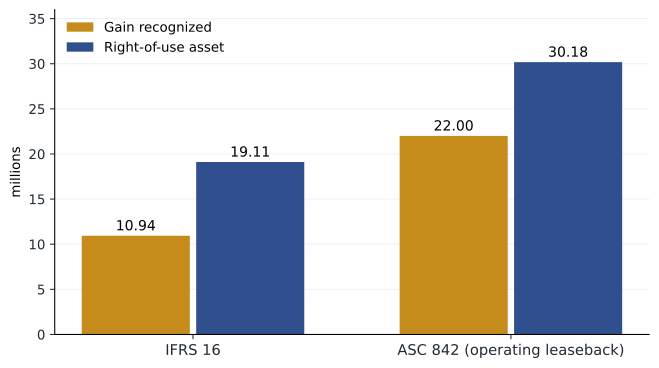
# option generally fails sale accounting unless strict conditions are met.Lease modification (not a separate lease) Liability before: 30.45 remeasured: 38.82 increase to right-of-use asset: 8.37 Sale and leaseback (transfer qualifies as a sale) PV of leaseback payments: 30.18 IFRS 16: right-of-use asset 19.11, gain recognized 10.94 of 22.0 ASC 842 (operating leaseback): right-of-use asset 30.18, gain recognized 22.00
The modification extends the term and reduces the rent. Because it does not add the right to use an additional asset, it is not a separate lease. Tamarind Bay remeasures the liability using the revised discount rate of 6.5 per cent at the modification date, and the increase of 8.37 million is added to the right-of-use asset. Under IFRS 16 every lease is accounted for like a financed purchase, so the remeasured liability accrues interest and the larger asset is depreciated over the new remaining term of ten years.
The sale-and-leaseback is where the two frameworks diverge most sharply. Tamarind Bay sold its older Snacks plant to a real estate investor for its fair value of 60.0 million and leased it back for ten years to keep production running while a new plant is built. The transfer qualifies as a sale under the revenue standard: the buyer obtains control, and there is no repurchase option. Under IFRS 16, the seller-lessee recognizes only the gain that relates to the rights transferred to the buyer-lessor. The right-of-use asset is measured at the proportion of the previous carrying amount that relates to the rights retained, here 30.18 ÷ 60.0 of the 38.0 carrying amount, or 19.11 million, and only 10.94 million of the 22.0 million economic gain is recognized. Under ASC 842, when the sale qualifies and the leaseback is an operating lease, the seller recognizes the full gain of 22.0 million and records the leaseback like any other lease.
Two refinements matter in practice. First, IFRS 16 was amended in 2022, effective 2024, to require the seller-lessee to measure the leaseback liability so that it recognizes no gain or loss relating to the right of use it retains, even when the lease payments are variable and do not depend on an index or rate. Before that amendment, a leaseback with fully variable payments could have produced a lease liability of zero and an inflated gain. Second, under ASC 842 a sale fails if the seller-lessee has a repurchase option, unless the option is at fair value and alternative assets are readily available in the market, which is rare for real estate, or if the leaseback is a finance lease. A failed sale is accounted for as a financing: the seller keeps the asset on its books and records the proceeds as a liability. Investors who compare a Canadian and a US food company that have both sold and leased back plants need to know this difference.
ASPE and the US model compared
| Feature | IFRS 16 | ASC 842 | ASPE 3065 |
|---|---|---|---|
| Lessee model | Single on-balance-sheet model | Finance and operating leases, both on balance sheet | Capital leases on balance sheet; operating leases off |
| Expense pattern | Depreciation plus interest | Finance: front-loaded; operating: straight-line single cost | Capital: front-loaded; operating: rent expense |
| Low-value asset exemption | Yes (the IASB had in mind about 5,000 US dollars when new) | No | Not applicable |
| Short-term exemption | Yes (12 months or less) | Yes | Not applicable |
| Sale-and-leaseback gain | Only on rights transferred | Full gain if sale and operating leaseback | Deferred and amortized in most cases |
| Private company discount rate | IBR only | Risk-free rate election | Lower of IBR and implicit rate |
ASPE still uses the classification model of the old Section 3065, which follows the former CICA standard: a lease that transfers substantially all the benefits and risks of ownership is a capital lease recognized on the balance sheet, and others are operating leases with rent expense. Harrow Creek's three equipment leases are operating leases under ASPE, so its own balance sheet shows no lease liabilities; on consolidation, Tamarind Bay brings them on balance sheet under IFRS 16. The AcSB has discussed ASPE leases in its detailed review of ASPE, but as of 2026 no change has been proposed.
Disclosures and analysis
Lease disclosures should allow a reader to assess the effect of leases on financial position, performance and cash flows: the carrying amount of right-of-use assets by class, depreciation, interest, short-term and variable lease expense, total cash outflow, a maturity analysis of lease liabilities, and significant judgments such as the treatment of extension options and the discount rate. Analysts frequently adjust EBITDA and leverage for leases, because IFRS 16 moves lease costs below EBITDA while operating leases under ASC 842 leave them above. Tamarind Bay's credit agreement, written in 2021, freezes the treatment of leases at the pre-2019 definitions for covenant purposes, a common feature that requires the company to keep a parallel calculation for its lenders.
Worked problem
Lease or service?
Tamarind Bay contracts with a trucking company for refrigerated transport. The contract requires the trucker to provide capacity for 40 loads a week using any of its 300 refrigerated trailers, chosen by the trucker. Does the contract contain a lease of trailers?
Show solution
- Identify the asset: no specific trailers are specified.
- Substitution: the trucker can use any of its 300 trailers and benefits from flexibility, so it has a substantive substitution right.
- Conclusion: no identified asset, so no lease.
- Account for the contract as a service, expensing the fees as incurred.
Answer: No lease. A substantive substitution right means there is no identified asset.
Common mistakes
MistakeAssuming that service contracts never contain leases.
InsteadAssess contracts that specify assets or grant exclusive use for embedded leases.
MistakeIncluding an extension period because management intends to stay.
InsteadInclude optional periods only if the lessee is reasonably certain to exercise, based on economic incentives.
MistakeUsing the group's unsecured bond yield as the incremental borrowing rate.
InsteadAdjust for term, security and the economic environment of the lease.
MistakeRecognizing the full gain on a sale-and-leaseback under IFRS 16.
InsteadRecognize only the gain relating to the rights transferred to the buyer-lessor.
MistakeTreating a modification that extends the term as a separate lease.
InsteadA modification is a separate lease only if it adds the right to use an additional asset at a commensurate price.
MistakeComparing leverage across frameworks without adjusting for leases.
InsteadAdjust for the different treatment of leases under IFRS 16, ASC 842 and ASPE.
Summary and key terms
- A contract contains a lease if it conveys control of the use of an identified asset; embedded leases hide in service contracts.
- The lease term includes optional periods only when the lessee is reasonably certain, based on economic incentives.
- The incremental borrowing rate is built from a reference rate, credit spread and security adjustment.
- Modifications that extend the term are remeasured at a revised discount rate with an adjustment to the right-of-use asset.
- IFRS 16 limits sale-and-leaseback gains to the rights transferred; ASC 842 can recognize the full gain but fails a sale with a repurchase option.
- ASPE retains the capital and operating lease model, so private Canadian companies may show no lease liabilities.
- Embedded lease
- A lease contained within a broader contract, such as a service or supply agreement.
- Substantive substitution right
- A supplier's practical ability and economic incentive to substitute alternative assets, which means there is no identified asset.
- Lease term
- The non-cancellable period plus optional periods the lessee is reasonably certain to include.
- Incremental borrowing rate
- The rate a lessee would pay to borrow funds to obtain a similar asset over a similar term with similar security.
- Sale-and-leaseback
- A transaction in which an entity sells an asset and leases it back from the buyer.
- Practical expedient for non-lease components
- An election to account for lease and associated non-lease components as a single lease component.
Practice problems
Work each problem on paper first, then reveal the answer to check.
What three elements show that the cold storage contract contains a lease?
Show answer
An identified asset, the right to substantially all its economic benefits and the right to direct its use.
Why is the per-pallet charge excluded from the lease liability?
Show answer
It is a variable payment not based on an index or rate, so it is expensed as incurred.
Rerun the lease program with a revised discount rate of 5.0 per cent. What is the increase to the right-of-use asset?
Show answer
The remeasured liability is about 41.70, so the increase is about 11.25.
Rerun the sale-and-leaseback with leaseback payments of 3.0 a year. What gain does IFRS 16 recognize?
Show answer
PV ≈ 22.08; gain ≈ 22.0 × (60 − 22.08) ÷ 60 ≈ 13.90.
Why does the automation system matter for the distribution centre lease term?
Show answer
Significant immovable improvements create an economic incentive to stay, making extension reasonably certain.
What makes a sale-and-leaseback fail under ASC 842?
Show answer
A repurchase option (unless at fair value with readily available alternative assets) or a finance leaseback.
Why might a lender freeze lease definitions in a covenant?
Show answer
To keep leverage calculations consistent despite changes in accounting standards.
Name one exemption available under IFRS 16 but not ASC 842.
Show answer
The low-value asset exemption.
How does ASPE treat Harrow Creek's equipment leases?
Show answer
As operating leases with rent expense, off balance sheet, if they do not transfer substantially all risks and rewards.
Why do embedded leases affect EBITDA under IFRS 16?
Show answer
Recognizing a lease moves the cost from operating expense to depreciation and interest, increasing EBITDA.
Lesson quiz · 5 questions
Score 60% or more to complete this lesson.
Create a free account to save your progress, take quizzes and earn a certificate.