
ACCT-470 · Lesson 2 of 12 · 26 min
Presentation under IFRS 18: categories, subtotals and aggregation
For more than twenty years, companies reporting under IFRS Accounting Standards had wide freedom in how they laid out the statement of profit or loss. IAS 1 required few line items and no defined subtotals, so one company's operating profit included its share of associates' results and foreign exchange losses while another's excluded them, and many companies invented their own subtotals. Investors complained that comparing companies took hours of adjustment. IFRS 18 Presentation and Disclosure in Financial Statements, issued in April 2024, is the IASB's answer. It replaces IAS 1 for annual periods beginning on or after January 1, 2027, with earlier application permitted, and the AcSB has incorporated it into Part I of the CPA Canada Handbook. For a December year end like Tamarind Bay's, the first IFRS 18 statements will be those for 2027, with restated 2026 comparatives, so the 2026 year end is when the preparation work happens.
This lesson works through the main requirements of IFRS 18 that affect the statement of profit or loss, the related changes to the statement of cash flows, and the principles for aggregating and disaggregating information. Lesson 3 covers the other major part of IFRS 18: management-defined performance measures.
Five categories and two new subtotals
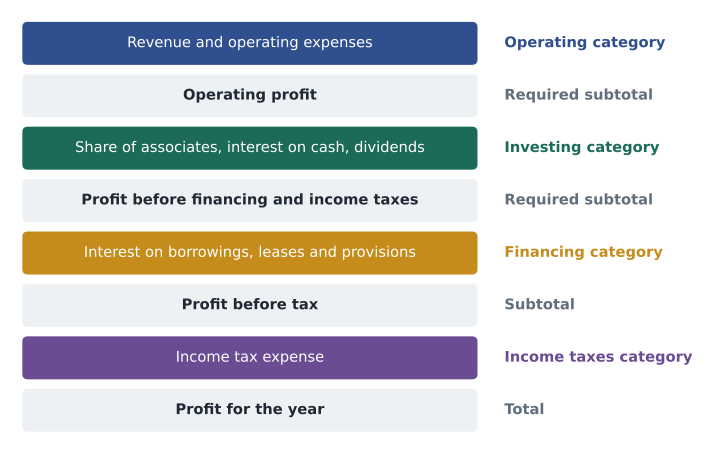
IFRS 18 requires every item of income and expense in the statement of profit or loss to be classified into one of five categories: operating, investing, financing, income taxes and discontinued operations. The operating category is the residual: it contains everything that is not in another category, including volatile and unusual items such as impairments and restructuring costs. The investing category contains income and expenses from investments in associates and joint ventures accounted for using the equity method, from cash and cash equivalents, and from other assets that generate a return individually and largely independently of the entity's other resources, such as most equity investments and investment property. The financing category contains income and expenses from liabilities that arise from raising finance, such as interest on bank loans and bonds, and interest from other liabilities, such as the unwinding of discount on provisions and interest on lease liabilities.
Classification into the investing and financing categories depends on the entity's main business activities. For an entity whose main business activity is investing in assets, such as an investment company, or providing financing to customers, such as a bank, income and expenses that would otherwise be in the investing or financing category are classified in operating, because they arise from the main business. For a manufacturer like Tamarind Bay, the general rules apply. IFRS 18 then requires two new subtotals: operating profit or loss, and profit or loss before financing and income taxes. The second is not required for entities whose main business is providing financing.
# Sorting Tamarind Bay's 2026 income and expenses into the IFRS 18 categories
# (a manufacturer whose main business activity is not investing or financing).
items = [
    ("Revenue", 1840.0, "operating"),
    ("Cost of sales", -1232.8, "operating"),
    ("Selling, general and administrative", -392.2, "operating"),
    ("Research and development", -22.4, "operating"),
    ("Restructuring", -18.6, "operating"),
    ("Goodwill impairment, Frozen CGU", -46.0, "operating"),
    ("Foreign exchange gain on trade payables", 1.2, "operating"),
    ("Share of profit of associate (equity method)", 6.4, "investing"),
    ("Dividend income on equity investment", 0.8, "investing"),
    ("Interest income on cash and cash equivalents", 3.1, "investing"),
    ("Interest expense on borrowings", -36.3, "financing"),
    ("Interest on lease liabilities", -4.4, "financing"),
    ("Unwinding of discount on provisions", -0.6, "financing"),
    ("Income tax expense", -38.2, "income taxes"),
]
tot = {}
for name, amt, cat in items:
    tot[cat] = tot.get(cat, 0) + amt
print(f"{'Category':<14}{'Total':>9}")
for cat in ("operating", "investing", "financing", "income taxes"):
    print(f"{cat:<14}{tot[cat]:>9.1f}")
pbfit = tot["operating"] + tot["investing"]
pbt = pbfit + tot["financing"]
print(f"\nOperating profit                            {tot['operating']:>8.1f}")
print(f"Profit before financing and income taxes    {pbfit:>8.1f}")
print(f"Profit before tax                           {pbt:>8.1f}")
print(f"Profit for the year {pbt + tot['income taxes']:>8.1f}")Category Total operating 129.2 investing 10.3 financing -41.3 income taxes -38.2 Operating profit 129.2 Profit before financing and income taxes 139.5 Profit before tax 98.2 Profit for the year 60.0
The program sorts Tamarind Bay's 2026 items into the IFRS 18 categories using the case's IFRS figures, including the 46.0 million goodwill impairment on the Frozen cash-generating unit worked out in lesson 6. Three classifications deserve comment. The share of profit of the associate, which IAS 1 allowed many companies to show within operating profit, now falls in investing. The foreign exchange gain on trade payables stays in operating, because IFRS 18 classifies exchange differences in the same category as the income and expenses from the items that gave rise to them. And the unwinding of the discount on the decommissioning and recall provisions moves to financing, together with lease interest, even though neither arises from borrowing money.
Classification judgments under IFRS 18
Most classifications are mechanical, but several require judgment. The first is identifying assets that generate a return individually and largely independently of other resources. A plot of land held for capital appreciation does; a warehouse used in the business does not. The second is classifying gains and losses on derivatives: a derivative used to manage a risk is classified in the category affected by the risk it manages, so Tamarind Bay's forward contracts hedging US-dollar ingredient purchases fall in operating, while a derivative that is not used for risk management, unusual for a food company, would fall in investing unless it relates to financing. The third is hybrid contracts and liabilities that both raise finance and arise in operations, such as supplier finance arrangements; the classification follows the classification of the liability in the statement of financial position. Getting these right matters because operating profit will become a standard comparison point for analysts.
The new required subtotals also affect contracts and key performance indicators. Debt covenants that refer to operating profit as defined in the financial statements, executive bonus plans and analysts' models may all need updating, because IFRS 18 operating profit will differ from the operating profit that many companies previously reported. Tamarind Bay's 2026 operating profit under its old presentation was 135.6 million, because it included the 6.4 million share of the associate's profit that IFRS 18 moves to investing. Fortunately, the bank's covenant definitions, which use an adjusted EBITDA defined in the credit agreement rather than the IFRS subtotal, are unaffected. Not every company will be so lucky.
Aggregation, disaggregation and the notes
IFRS 18 introduces principles for aggregating and disaggregating information, applying to the primary financial statements and the notes. Items are aggregated on the basis of shared characteristics and disaggregated on the basis of characteristics that are not shared, and disaggregation is required when the resulting information is material. The primary statements should provide a useful structured summary, and the notes provide the detail. IFRS 18 discourages labels such as other expenses for large residual amounts: if an entity uses such a label, it must consider whether a more informative description is possible and disclose information about the composition of the amount.
IFRS 18 also requires an entity that presents expenses by function in the statement of profit or loss to disclose in a single note the amounts of depreciation, amortization, employee benefits, impairment losses and write-downs of inventories included in each line item. This is the same kind of information the FASB's DISE standard requires, and the two boards developed their requirements in parallel, though the details differ. Tamarind Bay presents by function, as most manufacturers do, so it must prepare this note for 2027 and the comparative 2026 year.
Segment reporting: what the chief operating decision maker sees
Segment reporting under IFRS 8 Operating Segments follows the management approach: operating segments are components whose operating results are regularly reviewed by the chief operating decision maker (CODM) to allocate resources and assess performance, and reportable segments are identified by applying aggregation criteria and quantitative thresholds. IFRS 18 does not change IFRS 8, but the IASB's 2023 agenda decision and regulators' reviews emphasize that if the CODM regularly reviews specified amounts of segment expenses, such as cost of sales or employee costs, those amounts must be disclosed for each reportable segment. Tamarind Bay's CODM, the chief executive, receives a monthly pack with revenue, cost of sales, marketing spend and adjusted EBITDA by segment, so all four must be disclosed.
| Segment | Revenue | Cost of sales | Marketing | Other segment items | Adjusted EBITDA |
|---|---|---|---|---|---|
| Snacks | 820.0 | 529.0 | 58.5 | 108.9 | 123.6 |
| Beverages | 610.0 | 398.5 | 47.2 | 71.1 | 93.2 |
| Frozen | 410.0 | 305.3 | 24.0 | 31.8 | 48.9 |
| Corporate (not a segment) | - | - | - | - | 2.7 |
| Total | 1,840.0 | 1,232.8 | 129.7 | 211.8 | 268.4 |
The segment figures also matter for impairment testing. Goodwill is allocated to cash-generating units or reporting units that are no larger than an operating segment, and the Frozen segment's low margin of about 12 per cent, against 15 per cent for Snacks and Beverages, is one of the indicators that leads to the impairment test in lesson 6. Investors read segment information precisely to find such differences, which is why regulators press companies not to aggregate segments with different economic characteristics.
Statement of cash flows changes
IFRS 18 also amends IAS 7. Operating profit becomes the required starting point for the indirect method, replacing the various profit figures companies used before, and the choice in classifying interest and dividends is removed for most entities: interest paid and dividends paid are classified as financing, and interest and dividends received as investing, for entities whose main business is not investing or providing finance. Tamarind Bay currently classifies interest paid as operating, so its 2027 cash flow from operations will rise by about 39 million simply because interest paid moves to financing, and its free cash flow measure, if defined using cash from operations, will change with it.
| Topic | IFRS 18 (from 2027) | US GAAP (from 2027) |
|---|---|---|
| Defined operating profit | Required subtotal, operating category is the residual | Not defined; practice varies |
| Profit before financing and income taxes | Required for most entities | No equivalent |
| Equity method income | Investing category, below operating profit | Placement varies |
| Natural expense information | Depreciation, amortization, employee benefits, impairments and inventory write-downs by line item if presenting by function | Purchases of inventory, employee compensation, depreciation, amortization by relevant caption (ASU 2024-03) |
| Management performance measures | Defined MPMs disclosed and reconciled in the notes | Non-GAAP measures regulated by SEC rules outside the statements |
| Interest paid in cash flow statement | Financing for most entities | Operating |
Preparing for transition
IFRS 18 is applied retrospectively, with restated comparatives. In the first year, an entity must also disclose, for the comparative period, a reconciliation for each line item in the statement of profit or loss between the amounts restated under IFRS 18 and the amounts previously presented under IAS 1. Tamarind Bay's transition plan includes mapping every general ledger account to an IFRS 18 category, deciding the line items and the level of disaggregation, updating the chart of accounts and the consolidation system so that the 2026 comparatives can be produced, reviewing contracts and incentive plans that refer to profit subtotals, and briefing the audit committee, analysts and lenders on the change. The company also has to decide its management-defined performance measures, which is the subject of the next lesson.
Worked problem
Classifying under IFRS 18
Classify these 2026 items of Tamarind Bay Foods Inc. under IFRS 18: (a) a 2.4 million gain on the sale of land held for capital appreciation; (b) a 0.9 million loss on an interest rate swap that hedges floating-rate bank debt; (c) a 1.6 million write-down of obsolete packaging inventory; (d) 0.5 million of dividends from a minority stake in a listed company.
Show solution
- (a) The land generates a return independently of other resources: investing.
- (b) The swap manages the risk on financing liabilities, so its loss goes in the same category as the interest: financing.
- (c) Inventory write-downs arise from operations: operating, and also disclosed in the note on specified expenses by function.
- (d) Dividends on an equity investment that generates a return independently: investing.
Answer: Investing, financing, operating, investing.
Common mistakes
MistakeAssuming IFRS 18 changes profit before tax.
InsteadIFRS 18 changes presentation and classification, not measurement; profit for the year is unaffected.
MistakePutting the share of associates' profit in operating profit.
InsteadFor an entity whose main business is not investing, equity method income is in the investing category.
MistakeWaiting until the first reporting year to gather the data.
InsteadComparatives must be produced for the prior year, so systems must capture the data during that year.
MistakeDisclosing only the segment measure without the expenses the CODM reviews.
InsteadDisclose the significant segment expenses regularly provided to the CODM.
MistakeUsing a large other line without explanation.
InsteadConsider a more informative label and disclose the composition of large residual amounts.
MistakeIgnoring covenants and bonus plans that refer to old subtotals.
InsteadReview contracts and incentive plans for references to profit measures that will change.
Summary and key terms
- IFRS 18 replaces IAS 1 for periods beginning on or after January 1, 2027, with restated comparatives.
- All income and expenses are classified as operating, investing, financing, income taxes or discontinued operations.
- Operating profit and profit before financing and income taxes are new required subtotals.
- Segment disclosures must include the significant expenses that the chief operating decision maker regularly reviews.
- IAS 7 now starts the indirect method from operating profit and fixes the classification of interest and dividends for most entities.
- Transition requires system changes during the comparative year and a review of contracts that refer to profit subtotals.
- IFRS 18
- Presentation and Disclosure in Financial Statements, effective January 1, 2027, replacing IAS 1.
- Operating category
- The residual IFRS 18 category containing income and expenses not classified elsewhere.
- Investing category
- The IFRS 18 category for income and expenses from equity-accounted investees, cash and assets generating returns independently.
- Financing category
- The IFRS 18 category for income and expenses from liabilities that raise finance and interest on other liabilities.
- Chief operating decision maker (CODM)
- The function that allocates resources and assesses performance of operating segments.
- Management approach
- Segment reporting based on how management internally organizes and reviews the business.
- Presentation by function
- Classifying expenses according to their function, such as cost of sales or selling expenses.
- Presentation by nature
- Classifying expenses according to their nature, such as materials, employee costs or depreciation.
Practice problems
Work each problem on paper first, then reveal the answer to check.
Into which IFRS 18 category does a manufacturer classify interest on lease liabilities?
Show answer
Financing.
Why is the share of profit of an associate not in operating profit under IFRS 18?
Show answer
Equity method investees are in the investing category for entities whose main business is not investing.
Rerun the classification program with the impairment set to zero. What is operating profit?
Show answer
175.2 million.
What must a company disclose about its CODM?
Show answer
Under the new US segment standard, the CODM's title and position and how the CODM uses the segment measure; under IFRS 8, the identity of the CODM function is implied by the management approach.
Why does the Frozen segment's margin matter beyond segment reporting?
Show answer
Low margins are an indicator of impairment for the goodwill allocated to the Frozen unit.
How will IFRS 18 change Tamarind Bay's cash from operations?
Show answer
Interest paid moves to financing, increasing cash from operating activities by about the amount of interest paid.
What should a company do with a large amount labelled other expenses?
Show answer
Consider a more informative description and disclose the composition of the amount.
Why should covenants be reviewed before adopting new presentation requirements?
Show answer
Definitions referring to reported subtotals may change, affecting compliance and pricing.
Is IFRS 18 applied prospectively?
Show answer
No; it is applied retrospectively with a reconciliation of comparative line items.
Give two segment expenses Tamarind Bay must disclose.
Show answer
Cost of sales and marketing spend by segment, because the CODM regularly reviews them.
Lesson quiz · 5 questions
Score 60% or more to complete this lesson.
Create a free account to save your progress, take quizzes and earn a certificate.