
ACCT-470 · Lesson 6 of 12 · 24 min
Impairment of non-financial assets and goodwill
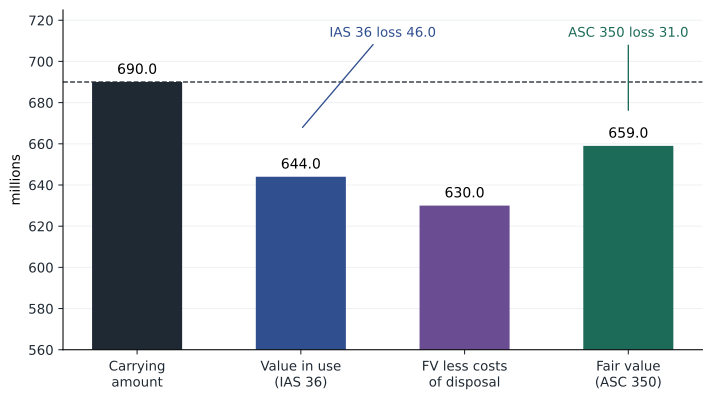
ACCT-211 introduced impairment: the ASC 360 recoverability test for long-lived assets and the first look at goodwill under ASC 350. This lesson goes into the judgments that make impairment one of the most scrutinized areas of financial reporting. Goodwill is often the largest asset on the balance sheet of an acquisitive company, public companies do not amortize it, and its only check is an impairment test built partly on management's own forecasts. Regulators have long criticized impairments as too little, too late. Tamarind Bay's Frozen reporting unit gives a realistic case, and the lesson compares the result under IAS 36, which produces a different answer from the same facts.
Why the Frozen unit is tested in 2026
Tamarind Bay acquired its Frozen business in 2019 for a price that included 138 million of goodwill. Since then the business has struggled: private-label competition has grown, two large customers have consolidated their suppliers, and the cost of energy and packaging has risen faster than prices. Frozen's 2026 adjusted EBITDA margin of about 12 percent compares with 15 percent for the other segments and with the 16 percent the acquisition model assumed. In the third quarter the company announced a network review that will close one of Frozen's three plants. The share price has fallen, and at one point in 2026 the market capitalization was close to the book value of equity.
Goodwill must be tested at least annually and between annual tests when an event occurs or circumstances change that would more likely than not reduce a reporting unit's fair value below its carrying amount. Before a quantitative test, an entity may perform a qualitative assessment, often called step zero, to decide whether it is more likely than not that the reporting unit is impaired. Long-lived assets are tested for recoverability only when events or changes in circumstances indicate that the carrying amount may not be recoverable, such as a significant adverse change in use or condition, a history of operating losses, or a current expectation that an asset will be sold or disposed of significantly before the end of its life. Tamarind Bay's annual goodwill test date is October 1, but the network review, the margin decline and the market capitalization point to a triggering event, so it skips step zero and performs quantitative tests at December 31.
Asset groups and reporting units
Two different units are involved. An asset group is the lowest level for which identifiable cash flows are largely independent of the cash flows of other assets and liabilities; it is the unit for the ASC 360 recoverability test. A reporting unit is an operating segment or one level below, called a component, if discrete financial information is available and segment management regularly reviews it; it is the unit for goodwill testing. The Frozen business has three plants, but they share customers, a sales force and a distribution network, so they form a single asset group. Frozen is also an operating segment with no components below it that qualify, so it is one reporting unit, and the 138 million of goodwill is assigned to it. The order matters: long-lived assets are tested first, any ASC 360 impairment is recorded, and only then is goodwill tested using the adjusted carrying amounts.
Getting the unit right matters more than any assumption. Defining the unit too broadly lets a healthy business shelter a failing one: had Frozen been combined with the profitable Snacks business for testing, no impairment would arise. Regulators challenge CGU and reporting unit definitions that appear designed to avoid impairment, and they expect the definition to match how management monitors the business. Tamarind Bay's CODM reviews Frozen separately, which settles the question.
Measuring the recoverable amount
# US GAAP impairment testing for the Frozen reporting unit, December 31, 2026 (invented).
# Step 1 (ASC 360): long-lived asset group recoverability using undiscounted cash flows.
group_carrying = 552.0                 # property, plant, equipment and finite-lived intangibles
undiscounted = [49.0, 52.0, 55.0, 58.0, 60.5] + [60.5] * 10   # remaining life of primary asset
print(f"Asset group carrying amount: {group_carrying:.1f}")
print(f"Sum of undiscounted cash flows: {sum(undiscounted):.1f}")
print("Recoverable - no ASC 360 impairment" if sum(undiscounted) >= group_carrying
      else "Not recoverable - measure at fair value")
# Step 2 (ASC 350, after ASU 2017-04): compare the reporting unit's fair value with its carrying amount.
goodwill = 138.0
ru_carrying = group_carrying + goodwill
income_approach, market_approach = 650.0, 672.5     # DCF and guideline public company multiples
fv = 0.6 * income_approach + 0.4 * market_approach
loss = min(goodwill, max(0.0, ru_carrying - fv))
print(f"\nReporting unit carrying amount: {ru_carrying:.1f}")
print(f"Fair value (60% income, 40% market approach): {fv:.1f}")
print(f"Goodwill impairment: {loss:.1f} (capped at goodwill of {goodwill:.1f})")
# Sensitivity: weighting and market multiple
for w in (0.5, 0.6, 0.7):
    f = w * income_approach + (1 - w) * market_approach
print(f" weight on income approach {w:.0%}: fair value {f:.1f}, impairment {min(goodwill, max(0, ru_carrying - f)):.1f}")Asset group carrying amount: 552.0 Sum of undiscounted cash flows: 879.5 Recoverable - no ASC 360 impairment Reporting unit carrying amount: 690.0 Fair value (60% income, 40% market approach): 659.0 Goodwill impairment: 31.0 (capped at goodwill of 138.0) weight on income approach 50%: fair value 661.2, impairment 28.8 weight on income approach 60%: fair value 659.0, impairment 31.0 weight on income approach 70%: fair value 656.8, impairment 33.2
The ASC 360 recoverability test compares the asset group's carrying amount with the sum of its undiscounted future cash flows over the remaining life of its primary asset. Because the cash flows are not discounted, the test is easy to pass: Frozen's undiscounted cash flows of 879.5 million comfortably exceed the 552.0 million carrying amount of its long-lived assets, so no impairment of property, plant and equipment or finite-lived intangibles is recorded, even though the business earns less than its cost of capital. Goodwill is then tested under ASC 350, as amended by ASU 2017-04, by comparing the reporting unit's fair value with its carrying amount, including goodwill. Any excess of carrying amount over fair value is an impairment loss, limited to the goodwill allocated to the unit. The former step two, which measured the implied fair value of goodwill through a hypothetical purchase price allocation, was eliminated for public companies from 2020. If goodwill is tax deductible, the loss must be grossed up for the related deferred tax effect, a simultaneous calculation that does not arise for Frozen because its goodwill is not deductible.
Fair value under ASC 820 is an exit price, measured from the perspective of market participants rather than the entity. Tamarind Bay weights an income approach, a discounted cash flow using market participant assumptions, at 60 percent, and a market approach based on multiples of guideline public companies at 40 percent, giving a fair value of 659.0 million. The impairment is 31.0 million, reducing goodwill from 138.0 to 107.0 million. It is recognized in operating income and can never be reversed. The weighting is itself a judgment, and the program shows that moving it 10 points either way changes the impairment by about 2 million. A reconciliation of the fair values of all reporting units to the company's market capitalization, allowing for a reasonable control premium, is a common check that auditors expect to see.
| Feature | IAS 36 | ASC 350 and ASC 360 |
|---|---|---|
| Unit for goodwill | CGU or group of CGUs, not larger than a segment | Reporting unit: segment or one level below |
| Long-lived asset test | Recoverable amount (discounted) in one step | Undiscounted recoverability, then fair value |
| Measure | Higher of value in use and fair value less costs of disposal | Fair value (exit price) |
| Qualitative screen | No equivalent for the annual goodwill test | Optional step zero |
| Reversal of goodwill impairment | Prohibited | Prohibited |
| Reversal for other assets | Required if estimates change | Prohibited for assets held and used |
| Private companies | ASPE: goodwill tested on triggering events against fair value | PCC: may amortize goodwill over up to ten years |
Sensitivity and the discount rate judgment
The fair value measurement is just as sensitive to its inputs. The DCF within the income approach uses a market participant discount rate and terminal growth, and a half-point change in either moves the fair value by tens of millions. ASC 350 requires disclosure of the facts and circumstances leading to the impairment, the amount and the method of determining fair value, and SEC registrants discuss the key assumptions, the percentage by which fair value exceeded carrying amount for units at risk, and the potential events that could cause further impairment in their critical accounting estimates. After the 2026 impairment, Frozen's fair value equals its carrying amount, so any further deterioration will lead to another loss.
The discount rate is the input auditors challenge most. Management naturally prefers its own cost of capital, which reflects the whole company, but the rate should reflect the risks of the unit being tested. Frozen's risks are higher than Snacks': lower margins, higher customer concentration and greater exposure to energy costs. Tamarind Bay's valuation specialists build the rate from a risk-free rate, an equity risk premium, a beta from a peer group of frozen food producers, a size premium where justified and a cost of debt reflecting the capital structure of peers, then gross it up to a pre-tax rate for value in use. If management's forecasts are more optimistic than the market expects, the risk can be reflected either in the cash flows or in the rate, but not in both and not in neither.
Forecasting discipline
Regulators' reviews of impairment tests find the same weaknesses year after year: forecasts that show a sudden recovery after years of decline, so-called hockey sticks; terminal growth rates above long-term inflation; margins that never return to historical levels; and cash flows that include the benefits of restructuring not yet committed. Tamarind Bay's 2026 forecast starts from the approved 2027 budget, assumes Frozen margins recover to only 13 percent by 2031, and uses terminal growth of 2 percent, in line with long-term inflation targets. The audit committee asked management to compare previous years' forecasts with actual results; Frozen missed its forecast in each of the last three years, which is itself evidence that should temper optimism.
Climate-related matters increasingly enter impairment tests. Carbon pricing, energy transition costs and changes in consumer demand can affect cash flows and useful lives. Tamarind Bay has committed publicly to reduce its operational emissions by half by 2035. The cost of replacing Frozen's ammonia refrigeration and gas-fired boilers is included in the forecast capital expenditure, but only to the extent required to maintain the assets in their current condition or required by enacted regulation; voluntary enhancements that would increase performance are excluded from VIU under IAS 36. Lesson 11 returns to how climate commitments affect the financial statements.
Private companies and future changes
Private companies may elect the PCC alternative to amortize goodwill on a straight-line basis over ten years or less, and to test it only when a triggering event occurs, at the entity or reporting unit level. Since ASU 2021-03, private companies may also evaluate triggering events only at the reporting date. Harrow Creek uses these alternatives, but they are reversed in Tamarind Bay's consolidated statements. The FASB considered extending amortization to public companies and in 2022 removed the project from its agenda. Internationally, the IASB published an exposure draft in March 2024, Business Combinations: Disclosures, Goodwill and Impairment, proposing disclosures about the performance of acquisitions and simplifications to the impairment test, but no return to amortization; as of September 2026 it was still redeliberating.
Common mistakes
MistakeTesting goodwill at a level larger than the one at which it is monitored.
InsteadAllocate goodwill to the lowest level at which management monitors it, never larger than an operating segment.
MistakePassing the ASC 360 test and concluding no goodwill impairment exists.
InsteadTest goodwill separately; undiscounted recoverability says nothing about fair value.
MistakeUsing the company's overall cost of capital for a riskier unit.
InsteadUse a rate that reflects the specific risks of the unit, without double counting risks in the cash flows.
MistakeForecasting a sharp recovery after years of decline.
InsteadCompare past forecasts with actual results and justify any recovery with external evidence.
MistakeDisclosing generic key assumptions.
InsteadDisclose unit-specific assumptions, headroom and the change that would eliminate it.
MistakeReversing a goodwill impairment when results improve.
InsteadGoodwill impairments are never reversed under either framework.
Summary and key terms
- Goodwill is tested at least annually and when indicators or triggering events arise.
- Long-lived assets are tested in asset groups first; goodwill is tested at the reporting unit level.
- Goodwill impairment is the excess of the reporting unit's carrying amount over its fair value; Frozen's loss is 31.0 million.
- Small changes in the discount rate or terminal growth can change the result substantially, so sensitivity disclosure is essential.
- Forecasts should be tested against history and exclude uncommitted restructurings and enhancements.
- Private companies may amortize goodwill under the PCC alternative; public companies may not.
- Reporting unit
- An operating segment or one level below for which goodwill is tested.
- Asset group
- The lowest level of assets and liabilities with largely independent identifiable cash flows.
- Step zero
- The optional qualitative assessment of whether a goodwill impairment is more likely than not.
- Recoverability test
- The ASC 360 comparison of an asset group's carrying amount with its undiscounted cash flows.
- Goodwill
- The future economic benefits from assets acquired in a business combination that are not individually identified and separately recognized.
- Headroom
- The excess of recoverable amount or fair value over carrying amount.
- Terminal growth rate
- The growth rate used to extrapolate cash flows beyond the explicit forecast period.
- Triggering event
- An event or change in circumstances that requires an impairment test outside the annual cycle.
Practice problems
Work each problem on paper first, then reveal the answer to check.
Name three indicators that led Tamarind Bay to update the Frozen test.
Show answer
The announced plant closure and network review, declining margins below the acquisition model, and market capitalization close to book value.
Why are the three Frozen plants not separate units?
Show answer
They share customers, sales and distribution, so their cash inflows are not largely independent.
Rerun the US program with a 70/30 weighting. What is the impairment?
Show answer
Fair value 656.8; impairment 33.2.
Why does the ASC 360 test pass even though goodwill is impaired?
Show answer
It uses undiscounted cash flows, a much lower hurdle than fair value.
Why must the discount rate reflect the unit's specific risks?
Show answer
Using the company-wide rate for a riskier unit overstates its value and can avoid a needed impairment.
What does a history of missed forecasts imply for the impairment test?
Show answer
Management's forecasts may be optimistic; the assumptions need more support or more conservatism.
Can the Frozen goodwill impairment be reversed if margins recover in 2028?
Show answer
No. Goodwill impairments cannot be reversed under either framework.
What would happen if Frozen were tested together with Snacks?
Show answer
The combined unit's headroom would hide Frozen's shortfall, which is why regulators challenge broad units.
What disclosure helps a reader judge the risk of further impairment?
Show answer
Headroom and the change in a key assumption that would eliminate it, or under US practice the percentage by which fair value exceeds carrying amount.
What is the status of the IASB's goodwill and impairment project as of September 2026?
Show answer
The Board is still redeliberating its March 2024 exposure draft; no final amendments or effective date.
Lesson quiz · 5 questions
Score 60% or more to complete this lesson.
Create a free account to save your progress, take quizzes and earn a certificate.