
ACCT-470 · Lesson 7 of 12 · 26 min
Financial instruments I: classification, measurement and liability or equity
Financial instruments are where accounting meets legal drafting. Small changes in a contract's wording, such as a clause that links an interest rate to a sustainability target or a put option held by a minority shareholder, can change an instrument's classification, its measurement basis and the volatility of reported profit. IFRS 9 Financial Instruments and IAS 32 Financial Instruments: Presentation provide the rules, and both have recently been amended or are under review. This lesson takes Tamarind Bay's portfolio of financial assets, its convertible notes and the put option over the non-controlling interest in Harrow Creek, and works through the classification judgments.
Classifying financial assets
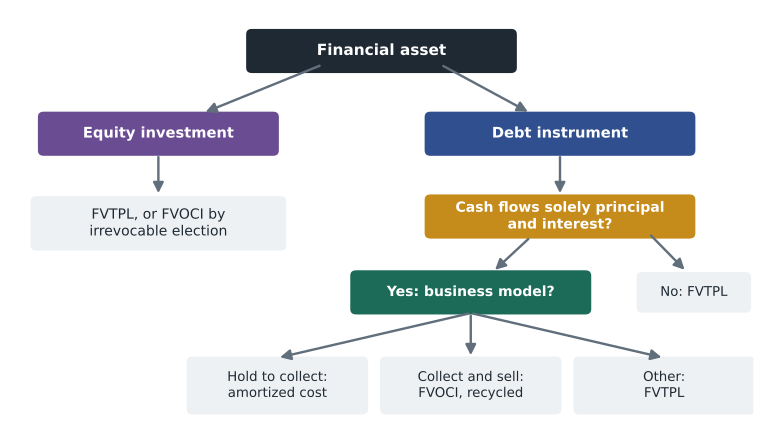
IFRS 9 classifies financial assets into three measurement categories on the basis of two tests. The business model test asks how the entity manages a group of assets to generate cash flows: by collecting contractual cash flows (hold to collect), by both collecting and selling (hold to collect and sell), or otherwise, for example by trading. The contractual cash flow characteristics test, usually called the SPPI test, asks whether the contractual terms give rise on specified dates to cash flows that are solely payments of principal and interest on the principal outstanding, consistent with a basic lending arrangement. A debt instrument that passes SPPI and is held to collect is measured at amortized cost; one that passes SPPI and is held to collect and sell is measured at fair value through other comprehensive income (FVOCI), with gains and losses recycled to profit or loss on derecognition; everything else is measured at fair value through profit or loss (FVTPL). Equity investments are at FVTPL unless, for an equity investment that is not held for trading, the entity makes an irrevocable election at initial recognition to present fair value changes in OCI, in which case they are never recycled, even on sale.
# Classifying Tamarind Bay's financial instruments under IFRS 9 and US GAAP (invented facts).
instruments = [
    # name, cash flows SPPI?, business model, equity?, FVOCI election?
    ("Loan to supplier, ESG-linked margin step", True, "hold to collect", False, False),
    ("Term deposits", True, "hold to collect", False, False),
    ("Government bonds, liquidity portfolio", True, "collect and sell", False, False),
    ("Listed shares, strategic stake", None, None, True, True),
    ("Unlisted fund units (puttable)", False, "hold to collect", False, False),
]
def ifrs9(sppi, bm, equity, oci):
    if equity: return "FVOCI (election, no recycling)" if oci else "FVTPL"
    if not sppi: return "FVTPL (fails SPPI)"
    return {"hold to collect": "Amortized cost", "collect and sell": "FVOCI (recycled)"}.get(bm, "FVTPL")
def usgaap(name, equity):
    if equity: return "Fair value through net income (ASC 321)"
    if "Loan" in name: return "Amortized cost, held for investment (ASC 310)"
    if "bonds" in name: return "Available-for-sale (ASC 320)"
    if "fund" in name: return "Fair value through net income (ASC 321)"
    return "Amortized cost (cash equivalent or deposit)"
for name, sppi, bm, eq, oci in instruments:
    print(f"{name}\n   IFRS 9 : {ifrs9(sppi, bm, eq, oci)}\n   US GAAP: {usgaap(name, eq)}")
# Convertible notes issued January 1, 2025: 300.0, 5 years, 4.5% coupon; straight debt rate 6.5%
face, coupon, n, mkt = 300.0, 0.045, 5, 0.065
liab = sum(face * coupon / (1 + mkt) ** t for t in range(1, n + 1)) + face / (1 + mkt) ** n
print("\nConvertible notes at issue")
print(f"  IAS 32 split: liability {liab:.2f}, equity component {face - liab:.2f}")
print(f"  ASC 470-20 after ASU 2020-06: single liability {face:.2f}, no equity component")
bal = liab
for yr in (2025, 2026):
    i = bal * mkt; bal += i - face * coupon
print(f" {yr}: IFRS interest {i:.2f} (liability {bal:.2f}); US GAAP interest {face * coupon:.2f}")Loan to supplier, ESG-linked margin step IFRS 9 : Amortized cost US GAAP: Amortized cost, held for investment (ASC 310) Term deposits IFRS 9 : Amortized cost US GAAP: Amortized cost (cash equivalent or deposit) Government bonds, liquidity portfolio IFRS 9 : FVOCI (recycled) US GAAP: Available-for-sale (ASC 320) Listed shares, strategic stake IFRS 9 : FVOCI (election, no recycling) US GAAP: Fair value through net income (ASC 321) Unlisted fund units (puttable) IFRS 9 : FVTPL (fails SPPI) US GAAP: Fair value through net income (ASC 321) Convertible notes at issue IAS 32 split: liability 275.07, equity component 24.93 ASC 470-20 after ASU 2020-06: single liability 300.00, no equity component 2025: IFRS interest 17.88 (liability 279.45); US GAAP interest 13.50 2026: IFRS interest 18.16 (liability 284.11); US GAAP interest 13.50
The ESG-linked supplier loan
In 2026 Tamarind Bay lent 25.0 million to its largest packaging supplier, repayable over five years, to fund a plant that makes recyclable trays. The interest rate is a benchmark plus 3.00 per cent, reduced by 0.25 per cent if the supplier meets an annual target for recycled content verified by an independent auditor, and increased by 0.25 per cent if it misses the target. Does a margin that varies with a sustainability target fail the SPPI test, forcing the loan to FVTPL?
Before 2026 this was a contested question, because a payment linked to an event that is not a basic lending risk, such as achieving an environmental target, can introduce variability that is inconsistent with a basic lending arrangement. The IASB's May 2024 Amendments to the Classification and Measurement of Financial Instruments, effective for annual periods beginning on or after January 1, 2026, clarify the answer. A contingent feature does not cause a failure of SPPI if the contingent event is specific to the debtor, as the supplier's own recycled content target is, and the resulting cash flows would not be significantly different from those of an otherwise identical instrument without the feature. A swing of 0.25 per cent on a 3.00 per cent margin is not significantly different, so the loan passes SPPI and, held to collect, is measured at amortized cost. The amendments also require new disclosures for instruments with contingent features and for equity investments designated at FVOCI, and they permit an entity to derecognize a financial liability settled through an electronic payment system before the settlement date if specified conditions are met. 2026 is the first year Tamarind Bay applies them.
Getting this right matters for volatility. If the loan were at FVTPL, every change in market interest rates and in the supplier's credit spread would flow through profit each quarter. Many banks and corporates now issue and hold sustainability-linked loans, and their classification was one of the main reasons the IASB made the 2024 amendments.
Equity investments and the FVOCI election
Tamarind Bay holds a 4 per cent stake in a listed company that develops compostable packaging, acquired in 2025 for 18.0 million as part of a strategic partnership. At initial recognition it elected to present fair value changes in OCI, because the stake is a long-term strategic holding and management did not want its share price swings in profit. The election has two consequences that are easy to forget. Gains and losses in OCI are never recycled to profit or loss, even when the shares are sold; the accumulated amount may be transferred within equity. And dividends are recognized in profit or loss unless they clearly represent a recovery of part of the cost. The election is irrevocable and made instrument by instrument.
Liability or equity: the convertible notes
In January 2025 Tamarind Bay issued 300.0 million of five-year convertible notes with a 4.5 per cent coupon. Each 1,000 note converts into 41.67 shares, a fixed number, at the holder's option. Under IAS 32, an instrument that contains both a contractual obligation to deliver cash and an option for the holder to convert into a fixed number of the issuer's own shares is a compound instrument. The issuer separates it into a liability component, measured at the fair value of a similar liability without the conversion option, and an equity component, measured as the residual. With a straight-debt rate of 6.5 per cent, the liability component was 275.07 million and the equity component 24.93 million. The liability accretes to face value over five years at 6.5 per cent, so interest expense in 2026 is 18.16 million, well above the 13.5 million cash coupon. The equity component is never remeasured.
The fixed-for-fixed condition is central. The conversion option is equity only if it will be settled by exchanging a fixed amount of cash or another financial asset for a fixed number of the issuer's own equity instruments. Anti-dilution adjustments that preserve the relative rights of holders and shareholders, such as adjustments for share splits, are generally consistent with the condition, but adjustments that compensate holders for changes in the share price, or settlement options that allow the issuer to pay cash or a variable number of shares, can make the option a derivative liability measured at fair value through profit or loss. Drafting conversion terms without consulting the accounting team is a common source of surprises.
Puttable non-controlling interests
When Tamarind Bay bought 80 per cent of Harrow Creek in 2024, it wrote a put option giving the founding family the right to sell their remaining 20 per cent to Tamarind Bay in 2029 at a price based on a multiple of EBITDA. Under IAS 32, a contract that contains an obligation for an entity to purchase its own equity instruments for cash gives rise to a financial liability for the present value of the redemption amount, even though the obligation is conditional on the holder exercising. Shares in a subsidiary held by non-controlling shareholders are equity instruments of the group, so Tamarind Bay recognizes a gross liability for the estimated redemption price, about 31 million at the end of 2026. Practice has varied on the other side of the entry, whether to derecognize the NCI or debit another component of equity, and on where remeasurement goes.
The IASB's Financial Instruments with Characteristics of Equity (FICE) project aims to address these inconsistencies. Its November 2023 exposure draft proposed clarifications on the fixed-for-fixed condition, obligations to purchase own equity instruments such as NCI puts, contingent settlement provisions and shareholder discretion, together with new presentation and disclosure requirements. At its September 2026 meeting the IASB tentatively decided, among other things, that when an entity first recognizes a liability for an NCI put, it should determine whether it already has access to the returns of ownership; if not, the debit should reduce NCI without derecognizing it and be presented as a separate line deducted from gross NCI, and remeasurement gains and losses on the liability should be recognized in profit or loss. Measurement of the liability was still under discussion, and no effective date had been set. Tamarind Bay's current policy follows the most common existing practice and will be revisited when the amendments are issued.
Supplier finance arrangements
Tamarind Bay's largest retail customers, and Tamarind Bay itself with its own suppliers, use supplier finance or reverse factoring programmes: a bank pays the supplier early at a discount and Tamarind Bay pays the bank on an extended due date. The classification question is whether Tamarind Bay's obligation remains a trade payable, within working capital and operating cash flows, or has become a borrowing from the bank, within debt and financing cash flows. The answer depends on whether the terms are substantially different from ordinary trade payables, such as a payment term extended well beyond industry norms or security provided to the bank. Because these programmes can make operating cash flow look better and hide debt, both boards added disclosure requirements effective from 2024: the terms of the arrangements, the carrying amounts of the related liabilities and the portion already paid by the finance providers, the range of payment due dates, and non-cash changes. Tamarind Bay's programme extends payment terms from 60 to 90 days, within industry practice, so the liabilities, about 64 million at year end, remain trade payables with the required disclosures.
ASPE and the framework compared
| Issue | IFRS 9 and IAS 32 | US GAAP | ASPE 3856 |
|---|---|---|---|
| Debt instrument classification | Business model and SPPI tests | Legal form and intent (ASC 320, 310) | Amortized cost by default; fair value option |
| Equity investments | FVTPL or irrevocable FVOCI election | Fair value through net income (or measurement alternative) | Fair value if quoted in active market; otherwise cost |
| Convertible debt | Split into liability and equity | Single liability after ASU 2020-06 | Equity component may be measured at zero or residual |
| Written put over NCI | Financial liability at redemption amount | Temporary equity for SEC registrants | Generally a liability if the terms require it |
| Credit losses | Expected loss model (lesson 8) | CECL (lesson 8) | Incurred loss model |
ASPE Section 3856 is much simpler: most financial assets and liabilities are measured at amortized cost, equity investments quoted in an active market at fair value, and other equity investments at cost less impairment. It contains special rules for shares issued in tax planning arrangements, such as retractable preferred shares issued in an estate freeze, which may be presented as equity if specified conditions are met even though the holder can demand redemption. Harrow Creek's financial instruments are mainly receivables, payables and a bank loan, so the conversion to the group's IFRS policies is minor.
Common mistakes
MistakeAssuming any sustainability-linked feature fails the SPPI test.
InsteadApply the 2024 amendments: a debtor-specific contingent feature passes if the cash flows are not significantly different.
MistakeRecycling FVOCI equity gains to profit on sale.
InsteadFVOCI equity gains are never recycled; they may be transferred within equity.
MistakeRecording convertible notes as a single liability.
InsteadSeparate the liability and equity components of a compound instrument under IAS 32.
MistakeIgnoring a written put over the NCI because it may not be exercised.
InsteadRecognize a financial liability for the redemption amount; the obligation exists even though it is conditional.
MistakeClassifying supplier finance liabilities as trade payables without examining the terms.
InsteadAssess whether the terms are substantially different from trade payables and provide the required disclosures.
MistakeDrafting conversion features without accounting input.
InsteadCheck the fixed-for-fixed condition before terms are agreed.
Summary and key terms
- IFRS 9 classifies debt assets by business model and SPPI; equity investments are FVTPL unless the irrevocable FVOCI election is made.
- The May 2024 amendments, effective 2026, let debtor-specific ESG-linked features pass SPPI if cash flows are not significantly different.
- Convertible notes with fixed-for-fixed conversion are split into liability and equity components under IAS 32.
- A written put over NCI creates a financial liability; the FICE project is refining the accounting, with no effective date as of 2026.
- Supplier finance arrangements require analysis of their terms and detailed disclosures from 2024.
- ASPE uses a simpler cost-based model with an incurred loss approach.
- SPPI test
- The IFRS 9 test of whether contractual cash flows are solely payments of principal and interest.
- Business model test
- The IFRS 9 assessment of how a group of financial assets is managed to generate cash flows.
- FVOCI election
- The irrevocable IFRS 9 option to present fair value changes of an equity investment in OCI without recycling.
- FICE project
- The IASB project on financial instruments with characteristics of equity.
- Amortized cost
- Measurement at initial amount, less principal repayments, plus cumulative amortization using the effective interest method, less allowance for credit losses.
- Compound instrument
- An instrument containing both liability and equity components, such as convertible debt with a fixed conversion ratio.
- Fixed-for-fixed condition
- The requirement that a derivative on own equity be settled by exchanging a fixed amount of cash for a fixed number of shares to be equity.
- Supplier finance arrangement
- A programme in which a finance provider pays suppliers and the entity pays the provider later.
- Embedded derivative
- A component of a hybrid contract that causes some cash flows to vary like a derivative.
Practice problems
Work each problem on paper first, then reveal the answer to check.
Why does the ESG-linked supplier loan stay at amortized cost?
Show answer
The contingent event is specific to the debtor and the cash flows are not significantly different from a loan without the feature, so it passes SPPI under the 2024 amendments.
What happens to the accumulated OCI on the packaging shares when they are sold?
Show answer
Nothing is recycled to profit; it may be transferred within equity to retained earnings.
Rerun the convertible program with a straight-debt rate of 7.5 per cent. What is the equity component under IAS 32?
Show answer
The liability component falls to about 263.6, so the equity component is about 36.4.
Why does reported interest on the notes differ between the frameworks?
Show answer
IAS 32 accretes a discounted liability component at the market rate; ASU 2020-06 keeps a single liability at the coupon rate.
Which feature could make a conversion option a derivative liability?
Show answer
Settlement in a variable number of shares, adjustments that compensate holders for share price changes, or issuer cash settlement choices that breach fixed-for-fixed.
How is the Harrow Creek put presented under IAS 32?
Show answer
As a financial liability for the present value of the redemption amount.
What did the IASB tentatively decide about remeasurement of NCI put liabilities in September 2026?
Show answer
Remeasurement gains and losses should be recognized in profit or loss.
When does a supplier finance liability become a borrowing?
Show answer
When its terms are substantially different from ordinary trade payables, for example far longer payment terms or security given to the bank.
Name one disclosure required for supplier finance arrangements.
Show answer
Terms, carrying amounts and the portion paid by finance providers, ranges of payment due dates, or non-cash changes.
How does ASPE measure an equity investment that is not quoted in an active market?
Show answer
At cost less impairment.
Lesson quiz · 5 questions
Score 60% or more to complete this lesson.
Create a free account to save your progress, take quizzes and earn a certificate.