
ACCT-470 · Lesson 2 of 12 · 26 min
Presenting performance: expense disaggregation and segments
US GAAP has long required public companies to present their income statements in a reasonably consistent way, through SEC Regulation S-X, but investors have pressed for more detail about what is inside the large expense captions such as cost of sales and selling, general and administrative. The FASB has responded with two standards. ASU 2023-07, Segment Reporting: Improvements to Reportable Segment Disclosures, effective for public entities for fiscal years beginning after December 15, 2023, requires much more information about segment expenses. ASU 2024-03, Disaggregation of Income Statement Expenses, issued in November 2024 and clarified by ASU 2025-01, requires public business entities to break the main expense captions down by nature in the notes for annual periods beginning after December 15, 2026, and interim periods within annual periods beginning after December 15, 2027. For a calendar-year company like Tamarind Bay, the first annual DISE disclosures will be in the 2027 Form 10-K, so the 2026 year end is when the data work happens.
This lesson works through the DISE requirements, the expanded segment disclosures and the presentation choices that remain open under US GAAP, and compares them with IFRS 18, the IASB's new presentation standard that applies to many of Tamarind Bay's foreign competitors from 2027. Lesson 3 covers non-GAAP measures and the IFRS equivalent, management-defined performance measures.
What US GAAP requires on the face of the income statement
Regulation S-X Article 5 sets out the captions that commercial companies present, such as net sales, costs and expenses applicable to sales, selling, general and administrative expenses, interest expense, income tax expense and income from discontinued operations. US GAAP does not define operating income, and companies differ in what they include in it: some present equity method earnings or gains on sales of assets above it and some below. Companies may present expenses by function, such as cost of sales and selling, general and administrative, which is the usual choice, or by nature in some industries, but the face of the income statement gives little information about what kinds of costs make up each function.
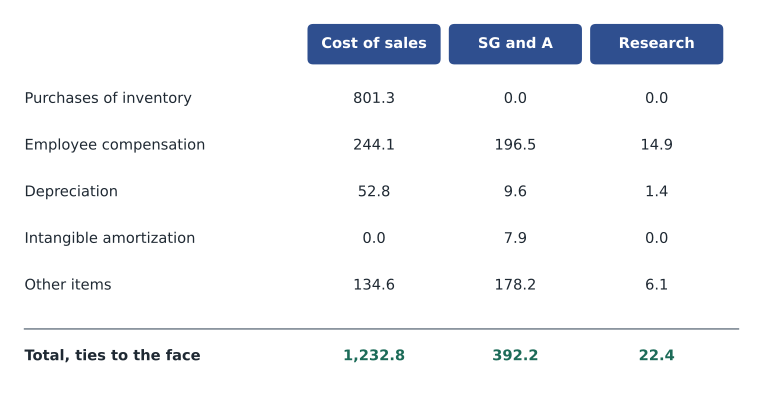
ASU 2024-03 leaves the face of the income statement alone. Instead, for each relevant expense caption presented on the face, a public business entity must disclose in a tabular note the amounts of purchases of inventory, employee compensation, depreciation, intangible asset amortization and depreciation, depletion and amortization recognized as part of oil and gas producing activities, with the rest described qualitatively as other items. It must also include certain amounts already disclosed elsewhere, such as restructuring costs, in the same table, disclose the total amount of selling expenses and its definition of selling expenses, and explain the remaining amounts qualitatively. A relevant expense caption is one that contains any of the specified natural categories.
# ASU 2024-03 (DISE): disaggregating relevant expense captions by natural category.
# Tamarind Bay Foods, 2026, millions of dollars (invented). Each caption's total must tie.
captions = {
    "Cost of sales": {"Purchases of inventory": 801.3, "Employee compensation": 244.1,
                      "Depreciation": 52.8, "Intangible asset amortization": 0.0, "Other": 134.6},
    "Selling, general and administrative": {"Purchases of inventory": 0.0, "Employee compensation": 196.5,
                      "Depreciation": 9.6, "Intangible asset amortization": 7.9, "Other": 178.2},
    "Research and development": {"Purchases of inventory": 0.0, "Employee compensation": 14.9,
                      "Depreciation": 1.4, "Intangible asset amortization": 0.0, "Other": 6.1},
}
reported = {"Cost of sales": 1232.8, "Selling, general and administrative": 392.2,
            "Research and development": 22.4}
cats = ["Purchases of inventory", "Employee compensation", "Depreciation",
        "Intangible asset amortization", "Other"]
print(f"{'Natural category':<32}" + "".join(f"{c[:14]:>16}" for c in captions))
for cat in cats:
    print(f"{cat:<32}" + "".join(f"{captions[c][cat]:>16.1f}" for c in captions))
print(f"{'Total':<32}" + "".join(f"{sum(captions[c].values()):>16.1f}" for c in captions))
for c, v in reported.items():
    diff = round(sum(captions[c].values()) - v, 1)
    print(f"{c}: ties to face of income statement" if diff == 0 else f"{c}: off by {diff}")
selling = 141.7
print(f"Selling expenses (separate disclosure, with the entity's definition): {selling:.1f}")Natural category Cost of sales Selling, gener Research and d Purchases of inventory 801.3 0.0 0.0 Employee compensation 244.1 196.5 14.9 Depreciation 52.8 9.6 1.4 Intangible asset amortization 0.0 7.9 0.0 Other 134.6 178.2 6.1 Total 1232.8 392.2 22.4 Cost of sales: ties to face of income statement Selling, general and administrative: ties to face of income statement Research and development: ties to face of income statement Selling expenses (separate disclosure, with the entity's definition): 141.7
The program builds the DISE table from Tamarind Bay's 2026 general ledger. Depreciation and amortization of 71.7 million is spread across three captions; employee compensation of 455.5 million is spread across the same three. The table must tie to the face of the income statement, and gathering the data is harder than it looks: purchases of inventory are not the same as materials consumed, because inventory purchases include amounts still in inventory at year end and exclude the labor and overhead costs that are capitalized into inventory. The ASU addresses this by requiring the change in inventory to be described qualitatively, and Tamarind Bay's controller is building a reconciliation from purchases to cost of sales for the auditor.
Judgments in building the DISE table
Building the table requires several judgments. The first is defining the relevant expense captions, because a company that presents a single total costs and expenses line has one large relevant caption. The second is the definition of each natural category, which the ASU ties to existing guidance: employee compensation, for example, includes wages, benefits, share-based compensation and pension costs, while purchases of inventory include amounts recognized as inventory, whether bought or produced. The third is how to handle costs capitalized into inventory and released later, and costs capitalized into self-constructed assets. The fourth is the interim requirement that begins one year later, which will push the data work into each quarter. None of these changes the amounts reported; all of them change how much of the cost structure investors can see.
These changes also affect contracts and key performance indicators. Debt covenants, executive bonus plans and analysts' models rarely refer to the natural expense categories, but the new disclosures will invite questions about cost trends, such as why employee compensation in cost of sales grew faster than volume. Tamarind Bay's investor relations team is preparing for those questions now.
Aggregation, disaggregation and the notes
US GAAP has no single principle for aggregating and disaggregating information comparable to the one in IFRS 18, which requires items to be grouped on the basis of shared characteristics and split when the split is material. Instead, specific standards and SEC rules require particular disaggregations: revenue by category under ASC 606, segment information under ASC 280, and now natural expense categories under ASU 2024-03. The SEC staff also comments when a company uses large other captions without explanation.
IFRS 18, which applies from 2027 to companies reporting under IFRS Accounting Standards, contains a similar requirement: an entity that presents expenses by function must disclose depreciation, amortization, employee benefits, impairment losses and inventory write-downs included in each line item. The two boards developed these requirements in parallel, but the details differ: IFRS 18 does not require purchases of inventory, and the FASB's standard does not require impairment losses in the table. A US company comparing itself with a Canadian or European competitor will find the two disclosures similar but not identical.
Segment reporting: what the chief operating decision maker sees
Segment reporting under ASC 280 follows the management approach: operating segments are components whose operating results are regularly reviewed by the chief operating decision maker (CODM) to allocate resources and assess performance. ASU 2023-07 adds significant requirements. A public entity must disclose, for each reportable segment, the significant segment expenses that are regularly provided to the CODM and included in the reported measure of segment profit or loss, an amount for other segment items with a description, the title and position of the CODM and how the CODM uses the measure. It may report more than one measure of segment profit if the CODM uses more than one, provided one is the measure most consistent with GAAP. All annual segment disclosures are also required in interim periods, and single-segment entities must provide the full set. Tamarind Bay's CODM, the chief executive, receives a monthly pack with revenue, cost of sales, marketing spend and adjusted EBITDA by segment, so all must be disclosed.
| Segment | Revenue | Cost of sales | Marketing | Other segment items | Adjusted EBITDA |
|---|---|---|---|---|---|
| Snacks | 820.0 | 529.0 | 58.5 | 108.9 | 123.6 |
| Beverages | 610.0 | 398.5 | 47.2 | 71.1 | 93.2 |
| Frozen | 410.0 | 305.3 | 24.0 | 31.8 | 48.9 |
| Corporate (not a segment) | - | - | - | - | 2.7 |
| Total | 1,840.0 | 1,232.8 | 129.7 | 211.8 | 268.4 |
The segment figures also matter for impairment testing. Goodwill is allocated to cash-generating units or reporting units that are no larger than an operating segment, and the Frozen segment's low margin of about 12 percent, against 15 percent for Snacks and Beverages, is one of the indicators that leads to the impairment test in lesson 6. Investors read segment information precisely to find such differences, which is why regulators press companies not to aggregate segments with different economic characteristics.
Comparing US GAAP and IFRS 18
The table summarizes how the two frameworks compare from 2027. US GAAP continues to permit wide variation on the face of the income statement and relies on note disclosures for detail; IFRS 18 imposes structure on the face and also requires note disclosure of selected natural expenses. Neither framework changes the measurement of revenue or expenses, so profit before tax is unaffected; what changes is what investors can see and compare.
| Topic | IFRS 18 (from 2027) | US GAAP (from 2027) |
|---|---|---|
| Defined operating profit | Required subtotal, operating category is the residual | Not defined; practice varies |
| Profit before financing and income taxes | Required for most entities | No equivalent |
| Equity method income | Investing category, below operating profit | Placement varies |
| Natural expense information | Depreciation, amortization, employee benefits, impairments and inventory write-downs by line item if presenting by function | Purchases of inventory, employee compensation, depreciation, amortization by relevant caption (ASU 2024-03) |
| Management performance measures | Defined MPMs disclosed and reconciled in the notes | Non-GAAP measures regulated by SEC rules outside the statements |
| Interest paid in cash flow statement | Financing for most entities | Operating |
Preparing for transition
ASU 2024-03 can be applied prospectively or retrospectively; Tamarind Bay has chosen retrospective application so that analysts can compare 2027 with 2026 and 2025. Its plan includes mapping every general ledger account to a natural category, deciding how to treat costs capitalized into inventory, updating the consolidation system so that the disclosure can be produced each quarter from 2028, testing the controls over the new data, and briefing the audit committee and analysts. The company also has to review its non-GAAP measures, which is the subject of the next lesson.
Worked problem
Building the DISE table
Assign these 2026 costs of Tamarind Bay Foods Inc. to DISE categories: (a) 3.1 million of share-based compensation for sales staff, presented in selling, general and administrative; (b) 9.6 million of depreciation of head office and distribution assets; (c) 2.2 million of freight-in capitalized into inventory and released to cost of sales; (d) 18.6 million of restructuring costs, of which 12.4 million are severance.
Show solution
- (a) Share-based compensation is employee compensation, in the selling, general and administrative column.
- (b) Depreciation, in the selling, general and administrative column.
- (c) Freight-in is part of inventory cost; it appears in purchases of inventory or other items depending on the entity's policy, applied consistently, and the qualitative description explains it.
- (d) Severance of 12.4 million is employee compensation; the restructuring total is also disclosed in the table because it is already disclosed elsewhere.
Answer: Employee compensation; depreciation; policy-based treatment of capitalized costs; severance as employee compensation with restructuring shown in the table.
Common mistakes
MistakeAssuming the DISE standard changes the amounts reported.
InsteadDISE adds note disclosure; measurement of expenses is unchanged.
MistakeTreating purchases of inventory as the same as materials consumed.
InsteadPurchases include amounts still in inventory and exclude capitalized labor and overhead; explain the difference.
MistakeWaiting until the first reporting year to gather the data.
InsteadComparatives must be produced for the prior year, so systems must capture the data during that year.
MistakeDisclosing only the segment measure without the expenses the CODM reviews.
InsteadDisclose the significant segment expenses regularly provided to the CODM.
MistakeUsing a large other line without explanation.
InsteadConsider a more informative label and disclose the composition of large residual amounts.
MistakeIgnoring covenants and bonus plans that refer to old subtotals.
InsteadReview contracts and incentive plans for references to profit measures that will change.
Summary and key terms
- ASU 2024-03 requires natural-expense disaggregation for annual periods beginning after December 15, 2026.
- Each relevant expense caption is broken down into purchases of inventory, employee compensation, depreciation, amortization and other items.
- US GAAP still does not define operating income, so presentation on the face varies.
- Segment disclosures must include the significant expenses that the chief operating decision maker regularly reviews.
- IFRS 18 and DISE are similar in spirit but differ in detail, so cross-border comparisons still need care.
- Transition requires system changes during the comparative year and a review of contracts that refer to profit subtotals.
- DISE
- Disaggregation of income statement expenses required by ASU 2024-03.
- Relevant expense caption
- An expense caption on the face of the income statement that contains a specified natural category.
- Significant segment expenses
- Segment expenses regularly provided to the CODM and included in segment profit or loss, disclosed under ASU 2023-07.
- Chief operating decision maker (CODM)
- The function that allocates resources and assesses performance of operating segments.
- Management approach
- Segment reporting based on how management internally organizes and reviews the business.
- Presentation by function
- Classifying expenses according to their function, such as cost of sales or selling expenses.
- Presentation by nature
- Classifying expenses according to their nature, such as materials, employee costs or depreciation.
Practice problems
Work each problem on paper first, then reveal the answer to check.
Which natural categories must the DISE table show?
Show answer
Purchases of inventory, employee compensation, depreciation, intangible asset amortization, and DD&A for oil and gas activities, with other amounts described qualitatively.
Why must the DISE table tie to the face of the income statement?
Show answer
It disaggregates the amounts presented, so each column must total the caption on the face.
Rerun the DISE program after moving 2.0 million of depreciation from cost of sales to SG&A without changing the totals on the face. What happens?
Show answer
Both columns stop tying to the face of the income statement; the program reports the differences.
What must a company disclose about its CODM?
Show answer
Under the new US segment standard, the CODM's title and position and how the CODM uses the segment measure; under IFRS 8, the identity of the CODM function is implied by the management approach.
Why does the Frozen segment's margin matter beyond segment reporting?
Show answer
Low margins are an indicator of impairment for the goodwill allocated to the Frozen unit.
Name one difference between DISE and the IFRS 18 note on specified expenses.
Show answer
DISE requires purchases of inventory; IFRS 18 requires impairment losses and inventory write-downs.
What should a company do with a large amount labeled other expenses?
Show answer
Consider a more informative description and disclose the composition of the amount.
Why should covenants be reviewed before adopting new presentation requirements?
Show answer
Definitions referring to reported subtotals may change, affecting compliance and pricing.
Can ASU 2024-03 be applied retrospectively?
Show answer
Yes; it may be applied prospectively or retrospectively.
Give two segment expenses Tamarind Bay must disclose.
Show answer
Cost of sales and marketing spend by segment, because the CODM regularly reviews them.
Lesson quiz · 5 questions
Score 60% or more to complete this lesson.
Create a free account to save your progress, take quizzes and earn a certificate.