
ACCT-211 · Lesson 9 of 12 · 32 min
Property, plant and equipment: acquisition and cost
Property, plant and equipment (PP&E) are tangible items held for use in production or supply of goods or services, for rental to others or for administrative purposes, and expected to be used during more than one period. For Northlake they include land and a factory, calibration equipment, a fleet of service vans and the sensor stations it leases to some customers. IAS 16, Property, Plant and Equipment, governs IFRS reporters; ASPE Section 3061 private enterprises. This lesson covers recognition and the measurement of cost: which costs are capitalized, how lump-sum purchases, self-constructed assets, deferred payments, exchanges and government assistance are handled, when borrowing costs are capitalized, and how significant components are identified. Lesson 10 covers depreciation, the revaluation model and derecognition; lesson 11 impairment.
Recognition
An item of PP&E is recognized as an asset when it is probable that future economic benefits associated with it will flow to the entity and its cost can be measured reliably. In practice, the key judgement is the line between capital expenditure and expense. Small items such as tools and office chairs are often expensed under a capitalization threshold policy (for example, items under $2,500), justified by materiality. Spare parts and servicing equipment are PP&E if they are expected to be used for more than one period; otherwise they are inventory. Safety and environmental equipment that does not itself increase benefits is capitalized if it is necessary for the entity to obtain the benefits of its other assets, as when a regulator requires emissions scrubbers before a plant can operate.
Elements of cost
PP&E is initially measured at cost. Cost includes the purchase price, including import duties and non-refundable purchase taxes, after deducting trade discounts and rebates; any costs directly attributable to bringing the asset to the location and condition necessary for it to operate as management intends; and the initial estimate of the costs of dismantling and removing the item and restoring the site, where the entity has an obligation. Directly attributable costs include employee benefits arising directly from construction or acquisition, site preparation, delivery and handling, installation and assembly, testing whether the asset is functioning properly, and professional fees.
Costs that are not part of PP&E include costs of opening a new facility, introducing a new product or service (including advertising), conducting business in a new location or with a new class of customer (including training staff), administration and general overheads, and costs incurred while an asset capable of operating as intended has not yet been brought into use or is operating below full capacity. Initial operating losses are expensed. Since a 2020 amendment to IAS 16, proceeds from selling items produced while bringing an asset to the location and condition necessary for it to operate (such as samples produced during testing) are recognized in profit or loss, not deducted from the cost of the asset. Recoverable GST and HST paid on the purchase are claimed as input tax credits and excluded from cost.
Worked problem
Capitalizing the cost of a calibration machine
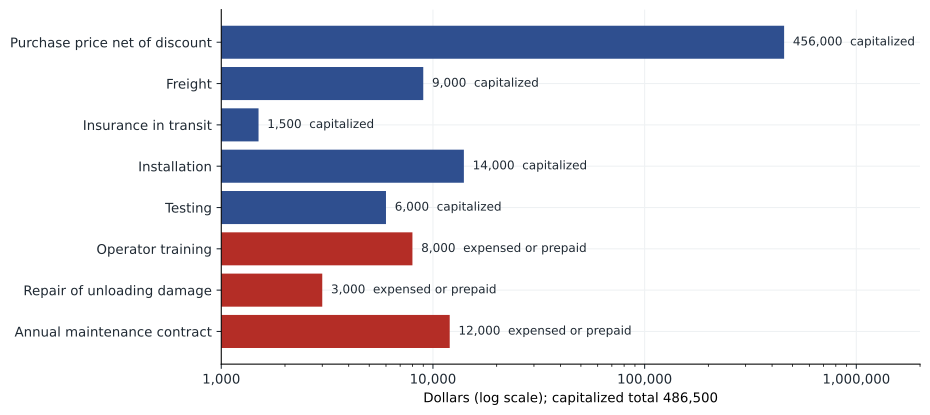
Northlake buys a calibration machine. Costs: invoice price $480,000 less a 5 per cent trade discount; freight $9,000; insurance in transit $1,500; installation $14,000; testing $6,000; a two-week training course for operators $8,000; repair of damage caused by Northlake staff while unloading $3,000; annual maintenance contract $12,000. Compute the capitalized cost.
Show solution
- Purchase price: 480,000 × 95% = $456,000.
- Directly attributable: freight 9,000 + insurance in transit 1,500 + installation 14,000 + testing 6,000 = $30,500.
- Excluded: training $8,000 (expense), damage repair $3,000 (expense: not necessary to bring the asset to working condition), maintenance contract $12,000 (prepaid expense over the year).
- Capitalized cost = 456,000 + 30,500 = $486,500.
Answer: The machine is recorded at $486,500; $23,000 of the other costs are expensed or prepaid.
Lump-sum purchases
When several assets are bought together for one price, such as land and a building, the price is allocated to the individual assets in proportion to their fair values at the purchase date. The allocation matters because land is not depreciated while buildings and equipment are. Costs of demolishing an old building to make way for a new one are part of the cost of the land if the old building was bought with the land intending to demolish it; if the entity demolishes a building it has been using, the old building's remaining carrying amount is derecognized as a loss and demolition costs are generally expensed or treated as part of site preparation for the new building.
Worked problem
Lump-sum allocation
Northlake buys a site with a building and equipment for $3,600,000. Appraised fair values are land $1,200,000, building $2,400,000 and equipment $400,000. Allocate the cost.
Show solution
- Total fair value = $4,000,000; the purchase price is 90 per cent of fair value.
- Land = 1,200,000 × 0.9 = $1,080,000. Building = 2,400,000 × 0.9 = $2,160,000. Equipment = 400,000 × 0.9 = $360,000.
Answer: Land $1,080,000 (not depreciated), building $2,160,000 and equipment $360,000.
Self-constructed assets
When an entity builds an asset for its own use, cost is determined using the same principles as for acquired assets: materials, direct labour and directly attributable overhead. Fixed overhead is included only to the extent it is incremental or directly attributable; some companies allocate a share of normal factory overhead, but abnormal costs (wasted materials, labour inefficiency) are excluded, and any internal profit is eliminated. The asset cannot be carried above its recoverable amount: if building it in-house costs more than buying a similar asset, the excess is a loss.
Borrowing costs
IAS 23 requires borrowing costs directly attributable to the acquisition, construction or production of a qualifying asset, one that necessarily takes a substantial period of time to get ready for its intended use or sale, to be capitalized as part of its cost. Other borrowing costs are expensed. For funds borrowed specifically for the asset, the capitalized amount is the actual borrowing cost incurred less any investment income on temporarily invested funds. For funds borrowed generally, a capitalization rate (the weighted average of borrowing costs on general borrowings outstanding) is applied to the expenditures on the asset, and the amount capitalized cannot exceed the borrowing costs actually incurred. Capitalization begins when expenditures and borrowing costs are being incurred and activities to prepare the asset are under way, is suspended during extended periods without active development and ceases when the asset is substantially ready. ASPE Section 3850 gives a policy choice: capitalize interest on qualifying assets or expense it, with disclosure.
# Interest capitalized on a self-constructed test facility (illustrative)
# Expenditures during the year: (month spent, amount)
spend = [(1, 600_000), (4, 1_200_000), (9, 900_000)]       # facility completed 31 Dec
specific_loan, specific_rate = 1_000_000, 0.06               # borrowed for the project
general_debt, general_interest = 5_000_000, 400_000          # other borrowings
general_rate = general_interest / general_debt

waae = sum(amount * (12 - (m - 1)) / 12 for m, amount in spend)   # months outstanding
print(f"Weighted-average accumulated expenditures: {waae:,.0f}")
on_specific = min(waae, specific_loan) * specific_rate
on_general = max(waae - specific_loan, 0) * general_rate
avoidable = on_specific + on_general
actual = specific_loan * specific_rate + general_interest
capitalized = min(avoidable, actual)
print(f"Specific {on_specific:,.0f} + general at {general_rate:.1%} {on_general:,.0f} = {avoidable:,.0f}")
print(f"Actual interest {actual:,.0f}; capitalized {capitalized:,.0f}; expensed {actual - capitalized:,.0f}")Weighted-average accumulated expenditures: 1,800,000 Specific 60,000 + general at 8.0% 64,000 = 124,000 Actual interest 460,000; capitalized 124,000; expensed 336,000
Northlake spends $2.7 million building a wind-tunnel test facility over the year. Weighted for the months each amount was outstanding, accumulated expenditures average $1.8 million. The first $1 million is financed by a specific 6 per cent loan, giving $60,000; the remaining $800,000 attracts the 8 per cent general rate, giving $64,000. Capitalized interest is $124,000, well below actual interest of $460,000, so the rest is expensed. Under IAS 23, any income from temporarily investing the specific loan before it was spent would reduce the amount capitalized.
Deferred payment, exchanges and government assistance
An asset bought on deferred payment terms beyond normal credit is recorded at its cash price equivalent, the present value of the payments; the difference is interest expense over the payment period. An asset acquired by issuing shares is recorded at the fair value of the asset received (or of the shares, if more reliably measurable). An asset contributed by a shareholder or donated is recorded at fair value with a corresponding credit to contributed surplus (or, for donations, income under the applicable standard).
When an asset is acquired in exchange for a non-monetary asset, IAS 16 measures it at fair value (with a gain or loss on the asset given up) unless the exchange lacks commercial substance or neither fair value is reliably measurable, in which case the new asset is recorded at the carrying amount of the asset given up. An exchange has commercial substance if the entity's future cash flows are expected to change significantly as a result. ASPE Section 3831 uses a similar test.
Worked problem
Trading in vans
Northlake trades in an old van (cost $60,000, accumulated depreciation $42,000, fair value $14,000) plus $46,000 cash for a new electric van with a list price of $62,000. The exchange has commercial substance. Record it.
Show solution
- Cost of the new van = fair value of the old van given up + cash = 14,000 + 46,000 = $60,000 (the dealer's list price is not the measure when a better fair value is available).
- Carrying amount of old van = 60,000 − 42,000 = $18,000. Loss on disposal = 18,000 − 14,000 = $4,000.
- Entry: debit new van 60,000; debit accumulated depreciation 42,000; debit loss 4,000; credit old van 60,000; credit cash 46,000.
- If the exchange lacked commercial substance, the new van would be recorded at 18,000 + 46,000 = $64,000 and no gain or loss recognized (although the asset would then be tested for impairment).
Answer: With commercial substance: new van $60,000 and a $4,000 loss.
Government grants are common in Canada: federal and provincial programs fund equipment for clean technology, manufacturing and regional development, and scientific research and experimental development (SR&ED) investment tax credits reduce the cost of qualifying equipment and research. Under IAS 20 a grant is recognized when there is reasonable assurance that the entity will comply with the conditions and receive it, and is recognized in profit or loss over the periods in which the related costs are recognized. A grant related to an asset is presented either as deferred income amortized over the asset's life or by deducting it from the asset's carrying amount (reducing depreciation). ASPE Section 3800 requires government assistance toward an asset to be deducted from the asset's cost or deferred and amortized on the same basis. Investment tax credits are accounted for similarly, as a reduction of the related asset or expense.
Worked problem
Asset-related government grant
Northlake receives a $300,000 grant toward a $1,500,000 clean-manufacturing line with a 10-year life and no residual value. Show the two presentation options.
Show solution
- Option 1 (deduct from the asset): record the line at $1,200,000; depreciation $120,000 a year.
- Option 2 (deferred income): record the line at $1,500,000 with depreciation of $150,000 a year, and deferred grant income of $300,000 recognized at $30,000 a year.
- Net effect on profit is the same: $120,000 a year.
Answer: Either way, the grant reduces the net annual cost of the asset to $120,000.
Components and subsequent expenditure
IAS 16 requires each part of an item of PP&E with a cost that is significant in relation to the total cost of the item to be depreciated separately (componentization). An aircraft's airframe, engines and interior have different useful lives; so do a building's structure, roof and heating system. Major inspections and overhauls required at intervals are recognized as a separate component and depreciated over the period to the next inspection. ASPE Section 3061 requires the cost of an item made up of significant separable component parts to be allocated to the parts when practicable and when estimates can be made of their useful lives.
After initial recognition, the costs of day-to-day servicing (repairs and maintenance: labour, consumables, small parts) are expensed. Costs that replace a part, add to the asset or improve it so that future benefits increase (longer life, greater capacity, better quality of output, lower operating costs) are capitalized, and the carrying amount of any replaced part is derecognized. Northlake's replacement of a van's battery pack that extends its range and life is capitalized, with the old pack's remaining carrying amount written off; an oil change is an expense.
Common mistakes
MistakeCapitalizing staff training on new equipment.
InsteadTraining is not necessary to bring the asset to working condition; expense it.
MistakeAllocating a lump-sum price only between land and building and ignoring equipment included.
InsteadAllocate to every asset acquired in proportion to fair values.
MistakeCapitalizing borrowing costs on routinely manufactured inventory.
InsteadOnly qualifying assets that take a substantial period to get ready attract capitalized borrowing costs.
MistakeRecording an exchanged asset at the dealer's list price.
InsteadUse the fair value of the asset given up (or received, if clearer), or carrying amount if the exchange lacks commercial substance.
MistakeCapitalizing routine repairs that only maintain the asset.
InsteadExpense day-to-day servicing; capitalize only replacements and improvements that increase future benefits.
Summary and key terms
- PP&E is recognized when future benefits are probable and cost can be measured reliably.
- Cost includes the purchase price, directly attributable costs and estimated dismantling and restoration obligations.
- Training, opening, advertising, administration and initial operating losses are expensed.
- Lump-sum purchases are allocated in proportion to the fair values of the assets acquired.
- IAS 23 requires borrowing costs on qualifying assets to be capitalized; ASPE allows a choice.
- Exchanges with commercial substance are measured at fair value with a gain or loss; otherwise at the carrying amount given up.
- IAS 16 requires significant components to be depreciated separately.
- Property, plant and equipment
- Tangible items held for use in operations and expected to be used during more than one period.
- Directly attributable cost
- A cost necessary to bring an asset to the location and condition to operate as intended.
- Lump-sum purchase
- The acquisition of several assets for a single price, allocated by relative fair values.
- Qualifying asset
- An asset that necessarily takes a substantial period of time to get ready for its intended use or sale.
- Commercial substance
- The expectation that an exchange will significantly change the entity's future cash flows.
- Government grant
- Assistance by government in the form of a transfer of resources in return for compliance with conditions.
- Componentization
- Depreciating significant parts of an asset with different useful lives separately.
- Capital expenditure
- A cost capitalized as part of an asset because it provides future benefits.
- Revenue expenditure
- A cost, such as routine repair, expensed as incurred.
- Capitalization threshold
- A materiality-based policy amount below which asset purchases are expensed.
Practice problems
Work each problem on paper first, then reveal the answer to check.
Which of these are capitalized: delivery, installation, staff training, testing?
Show answer
Delivery, installation and testing.
A building is bought with land for $900,000; fair values land $400,000, building $600,000. Allocate.
Show answer
Land $360,000; building $540,000.
Why does the land and building allocation matter?
Show answer
Land is not depreciated; the building is.
Name two conditions for capitalizing borrowing costs or interest.
Show answer
A qualifying asset; expenditures and borrowing costs being incurred; activities to prepare the asset under way.
WAAE $800,000, specific loan $500,000 at 5 per cent, general rate 8 per cent. Avoidable interest?
Show answer
25,000 + 300,000 × 8% = $49,000.
An asset with a carrying amount of $30,000 and fair value $25,000 is exchanged plus $10,000 cash, with commercial substance. Cost of new asset and gain or loss?
Show answer
Cost $35,000; loss $5,000.
Same exchange without commercial substance. Cost?
Show answer
$40,000 (carrying amount plus cash), with no loss recognized.
A $200,000 grant toward a $1,000,000 machine with a 5-year life. Annual net expense?
Show answer
$160,000.
Northlake replaces a van battery pack, extending life by three years. Capitalize or expense?
Show answer
Capitalize, and derecognize the carrying amount of the old pack.
Rerun the interest program with the September expenditure removed. What is capitalized?
Show answer
WAAE $1,500,000; capitalized 60,000 + 500,000 × 8% = $100,000.
Lesson quiz · 5 questions
Score 60% or more to complete this lesson.
Create a free account to save your progress, take quizzes and earn a certificate.