
ACCT-211 · Lesson 8 of 12 · 29 min
Inventory II: valuation and estimation
Lesson 7 determined the cost of inventory. But cost is a ceiling, not a guarantee: an asset should not be carried above the amount it is expected to realize. When sensor models become obsolete, when a competitor cuts prices or when parts are damaged, inventory must be written down. This lesson covers the lower of cost and net realizable value rule and how it differs between frameworks, the special 'lower of cost and market' rule that survives in US GAAP for LIFO and retail-method inventories, write-down reversals, losses on purchase commitments, the gross profit and retail methods used to estimate inventory when a count is impossible, the effects of inventory errors and the ratios users compute from inventory.
Lower of cost and net realizable value
IAS 2 and ASPE Section 3031 require inventories to be measured at the lower of cost and net realizable value (NRV). NRV is the estimated selling price in the ordinary course of business less the estimated costs of completion and the estimated costs necessary to make the sale. It is entity-specific, unlike fair value: it reflects what this entity expects to realize, not a market participant exit price. Write-downs are usually made item by item, although similar or related items (for example, items of the same product line with similar purposes that are produced and marketed in the same area and cannot practicably be evaluated separately) may be grouped. Writing down a whole class, such as 'all finished goods', is not appropriate.
Materials and supplies held for production are not written down below cost if the finished products in which they will be used are expected to sell at or above cost. Only when a decline in the price of materials indicates that the finished products will cost more than their NRV are the materials written down, and then replacement cost may be the best available measure of their NRV. NRV is estimated at the reporting date using the most reliable evidence available, including events after the period that confirm conditions existing at the end of the period, such as selling prices achieved in January.
# Lower of cost and net realizable value, item by item (illustrative)
items = [  # name, units, cost per unit, expected price, costs to complete and sell per unit
    ("Model A station (current)", 120, 3_400, 5_200, 300),
    ("Model S station (superseded)", 40, 3_200, 3_300, 350),
    ("Handheld meter", 900, 240, 400, 25),
    ("Damaged meters", 60, 240, 150, 30),
]
total_cost = total_lcnrv = 0
for name, n, cost, price, sell in items:
    nrv = price - sell
    value = min(cost, nrv)
    total_cost += n * cost; total_lcnrv += n * value
    flag = "write down" if nrv < cost else ""
    print(f"{name:<29} cost {cost:>5,} NRV {nrv:>5,} carry {value:>5,} {flag}")
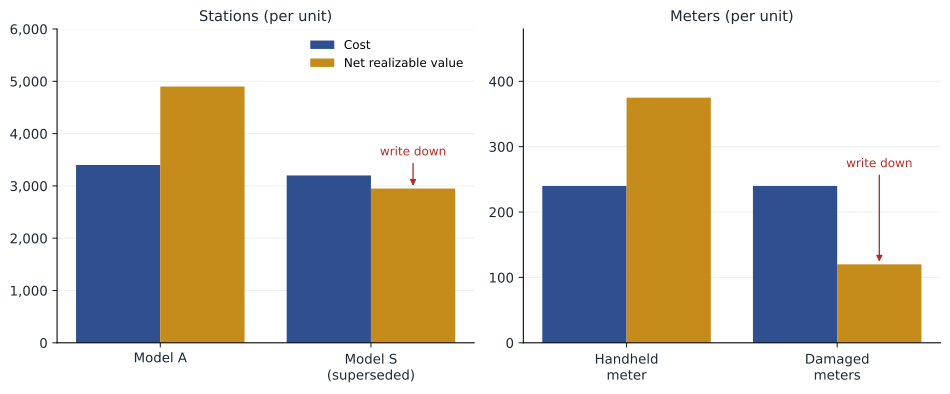
print(f"Total cost {total_cost:,}; carrying amount {total_lcnrv:,}; write-down {total_cost - total_lcnrv:,}")Model A station (current) cost 3,400 NRV 4,900 carry 3,400 Model S station (superseded) cost 3,200 NRV 2,950 carry 2,950 write down Handheld meter cost 240 NRV 375 carry 240 Damaged meters cost 240 NRV 120 carry 120 write down Total cost 766,400; carrying amount 749,200; write-down 17,200
Two items need write-downs. The superseded Model S station can be sold for only $3,300 and costs $350 a unit to refurbish and sell, so its NRV of $2,950 is below its $3,200 cost; the damaged meters' NRV of $120 is half their cost. The write-down totals $17,200 ($10,000 on Model S and $7,200 on the damaged meters), recognized as an expense (usually in cost of sales) in the period. The current models are not written up above cost, and their large margins cannot be used to offset the losses on the other items under item-by-item application.
Reversals of write-downs
Under IAS 2 and ASPE, if the circumstances that caused a write-down no longer exist, or there is clear evidence of an increase in NRV because of changed economic circumstances, the write-down is reversed, but only up to the amount of the original write-down, so that the new carrying amount is the lower of cost and the revised NRV. The reversal is recognized as a reduction of the inventory expense in the period it occurs. If Northlake finds a buyer for the Model S stations at $3,800 next quarter, the $10,000 write-down on any units still on hand is reversed, bringing them back to their $3,200 cost and no higher.
Lower of cost and market: the US rule, for comparison
Canadian students analysing US companies may meet the older 'lower of cost or market' rule, which US GAAP still applies to inventories measured using LIFO or the retail inventory method. Under it, market means current replacement cost, but not more than NRV (the ceiling) and not less than NRV minus a normal profit margin (the floor). The designated market value is the middle of replacement cost, ceiling and floor, and inventory is carried at the lower of cost and that designated market value. IFRS and ASPE do not use this rule.
Worked problem
Designated market value
A LIFO item costs $100. Its replacement cost is $80; selling price $120; costs to sell $15; normal profit margin $20. Apply lower of cost or market.
Show solution
- Ceiling (NRV) = 120 − 15 = $105. Floor = NRV − normal profit = 105 − 20 = $85.
- Replacement cost $80 is below the floor, so the designated market value is the floor, $85.
- Lower of cost ($100) and designated market ($85) = $85. Write down $15 a unit.
- Under LCNRV the comparison would be cost $100 against NRV $105: no write-down.
Answer: Under LCM the item is carried at $85; under LCNRV it would stay at $100.
Purchase commitments
Northlake signs fixed-price contracts to buy rare-earth sensor components months ahead. If the market price falls below the contract price so that the inventory to be received will not be recoverable, the contract may be onerous: under IAS 37 a provision is recognized for the unavoidable costs of meeting the obligation that exceed the economic benefits expected, and the loss is expensed. ASPE requires disclosure of significant commitments and recognition of losses where they are likely and measurable.
Worked problem
Loss on a purchase commitment
In November Northlake commits to buy 10,000 sensing elements at $30 each for delivery in March. At 31 December the market price is $24, and the elements cannot be used in products that will recover the higher cost. Account for the commitment.
Show solution
- Expected loss = 10,000 × (30 − 24) = $60,000.
- At 31 December: recognize a loss of $60,000 and a liability (provision) of $60,000.
- In March, when the elements arrive and $300,000 is paid: debit inventory $240,000 and the liability $60,000; credit cash $300,000.
Answer: Recognize the $60,000 loss in the year the price fell, not when the goods arrive.
Estimating inventory: the gross profit method
Sometimes inventory cannot be counted: interim statements are prepared monthly or quarterly without a count, or inventory is destroyed by fire or flood and an insurance claim must be filed. The gross profit method estimates ending inventory from the historical gross margin. Cost of goods available for sale is computed from the records (opening inventory plus purchases); estimated cost of goods sold is sales multiplied by (1 − gross margin); estimated ending inventory is the difference. The method is only as good as the margin assumption, so it is not acceptable for annual statements, but it is valuable for interim estimates, insurance claims and audit reasonableness checks.
# Gross profit method: estimating inventory destroyed in a flood (illustrative)
opening, purchases, sales = 4_450_000, 3_900_000, 9_600_000
gross_margin = 0.40                  # on sales, from recent years
goods_available = opening + purchases
est_cogs = sales * (1 - gross_margin)
est_ending = goods_available - est_cogs
salvaged = 380_000                   # damaged goods, at net realizable value
print(f"Goods available {goods_available:,}; estimated COGS {est_cogs:,.0f}")
print(f"Estimated inventory at the flood date {est_ending:,.0f}")
print(f"Estimated loss for the insurance claim {est_ending - salvaged:,.0f}")

markup_on_cost = 0.60                # a 60% markup on cost
print(f"A {markup_on_cost:.0%} markup on cost is a {markup_on_cost / (1 + markup_on_cost):.1%} margin on sales")Goods available 8,350,000; estimated COGS 5,760,000 Estimated inventory at the flood date 2,590,000 Estimated loss for the insurance claim 2,210,000 A 60% markup on cost is a 37.5% margin on sales
Northlake's estimated inventory at the flood date is $2,590,000; after deducting $380,000 of salvaged goods at NRV, the insurance claim is for $2,210,000. A common trap is confusing a markup on cost with a margin on sales: a 60 per cent markup on cost is only a 37.5 per cent gross margin, and using the wrong figure would misstate the estimate by hundreds of thousands of dollars.
The retail inventory method
Retailers with thousands of low-value items use the retail inventory method, which tracks goods available at both cost and retail selling prices and applies a cost-to-retail ratio to ending inventory at retail (counted or computed). Under the conventional version, the ratio includes net markups but excludes net markdowns, which approximates the lower of average cost and market by producing a lower ratio. Under the average-cost version, both markups and markdowns are included. IAS 2 permits the retail method for measuring cost if the results approximate cost, typically using a percentage that reflects inventory marked down below its original selling price; ASPE similarly allows it as a measurement technique.
Worked problem
Retail inventory method (conventional)
Northlake's retail shop has opening inventory at cost $40,000 and retail $64,000; purchases at cost $160,000 and retail $256,000; net markups $10,000; net markdowns $20,000; sales $270,000. Estimate ending inventory.
Show solution
- Goods available at cost = 200,000; at retail before markdowns = 64,000 + 256,000 + 10,000 = 330,000.
- Conventional cost-to-retail ratio = 200,000 ÷ 330,000 = 60.6%.
- Ending inventory at retail = 330,000 − 20,000 markdowns − 270,000 sales = $40,000.
- Estimated ending inventory at cost = 40,000 × 60.6% = $24,242.
Answer: Ending inventory is about $24,242 at lower of cost and market (conventional retail).
Inventory errors
Because ending inventory of one year is opening inventory of the next, an inventory error affects two years' income and then reverses. Overstating ending inventory understates cost of goods sold and overstates profit and equity in the year of the error; next year, the overstated opening inventory overstates cost of goods sold and understates profit by the same amount, so retained earnings are correct after two years (ignoring tax). The balance sheet at the end of the first year is wrong; at the end of the second, it is right. A material error discovered later is corrected retrospectively (lesson 1), restating the comparative figures, even if it has already reversed in total.
| Error | Year 1 COGS | Year 1 profit | Year 1 ending equity | Year 2 profit | Year 2 ending equity |
|---|---|---|---|---|---|
| Ending inventory overstated by $50,000 | Understated $50,000 | Overstated $50,000 | Overstated $50,000 | Understated $50,000 | Correct |
| Ending inventory understated by $30,000 | Overstated $30,000 | Understated $30,000 | Understated $30,000 | Overstated $30,000 | Correct |
| Purchase on credit not recorded, goods counted | Understated | Overstated | Correct overall (liability understated) | Depends on recording | Correct once recorded |
Disclosure and analysis
The notes disclose the accounting policies for inventory, including the cost formula, the carrying amount by classification (raw materials, work in progress, finished goods, merchandise), the amount recognized as expense, write-downs and reversals with the circumstances, and inventory pledged as security. IAS 2 requires disclosure of the amount of any reversal and the circumstances that led to it. Inventory turnover (cost of goods sold ÷ average inventory) and days in inventory (365 ÷ turnover) show how efficiently inventory is managed. For Northlake, cost of sales of $36.6 million and average inventory of $4.3 million give a turnover of about 8.5 and about 43 days in inventory. Falling turnover can signal obsolete stock that should be written down, so analysts read turnover and write-down disclosures together.
Common mistakes
MistakeWriting down materials whose finished products will still sell above cost.
InsteadMaterials are written down only if the finished products will not recover their cost.
MistakeOffsetting gains on profitable items against losses on obsolete items.
InsteadApply LCNRV item by item or to groups of similar items, not to whole classes.
MistakeRefusing to reverse a write-down when NRV recovers under IFRS.
InsteadIAS 2 requires reversal up to the original write-down.
MistakeUsing a markup on cost as if it were a gross margin on sales.
InsteadConvert: margin = markup ÷ (1 + markup).
MistakeAssuming an inventory error that has reversed needs no correction.
InsteadCorrect material prior-period errors retrospectively by restating comparatives.
Summary and key terms
- Inventories are carried at the lower of cost and net realizable value, usually item by item.
- NRV is the estimated selling price less costs to complete and sell; it is entity-specific.
- IAS 2 and ASPE require reversal of write-downs, up to original cost, when NRV recovers.
- Losses on firm purchase commitments are recognized when prices fall below the contract price.
- The gross profit method estimates inventory for interim reports and casualty losses; it is not acceptable for annual statements.
- The retail method applies a cost-to-retail ratio; the conventional version excludes markdowns from the ratio.
- Inventory errors affect two years' profit and reverse; material errors are corrected retrospectively.
- Net realizable value
- Estimated selling price in the ordinary course of business less estimated costs of completion and sale.
- Write-down
- A reduction of inventory from cost to a lower net realizable value, recognized as an expense.
- Reversal of write-down
- An increase in carrying amount, up to original cost, when NRV recovers (IFRS and ASPE).
- Onerous contract
- A contract whose unavoidable costs exceed the economic benefits expected from it.
- Purchase commitment
- A non-cancellable agreement to buy goods at a fixed price in the future.
- Gross profit method
- An estimation of ending inventory using a historical gross margin.
- Retail inventory method
- An estimation of inventory cost using the ratio of cost to retail prices.
- Cost-to-retail ratio
- Goods available at cost divided by goods available at retail.
- Inventory turnover
- Cost of goods sold divided by average inventory.
- Markdown
- A reduction of the original retail selling price.
Practice problems
Work each problem on paper first, then reveal the answer to check.
Cost $500; selling price $560; costs to complete and sell $90. Carrying amount?
Show answer
NRV $470; carry at $470, a $30 write-down.
Raw materials cost $20,000, replacement cost $16,000; the finished goods will sell well above cost. Write down?
Show answer
No; materials are not written down while finished goods recover cost.
An item written down from $100 to $80 recovers to an NRV of $110. New carrying amount under IAS 2?
Show answer
$100: reverse the $20 write-down, but not above cost.
Commit to buy 5,000 units at $12; market falls to $10. Loss?
Show answer
$10,000.
Opening inventory $100,000, purchases $400,000, sales $600,000, gross margin 30 per cent. Estimated ending inventory?
Show answer
500,000 − 420,000 = $80,000.
Convert a 25 per cent markup on cost to a margin on sales.
Show answer
20 per cent.
Goods available at cost $90,000, at retail $150,000; markdowns $10,000; sales $110,000. Conventional retail estimate at cost?
Show answer
Ratio 60%; ending retail $30,000; cost $18,000.
Year 1 ending inventory is understated by $20,000. Effect on year 2 profit?
Show answer
Overstated by $20,000.
Cost of sales $24 million; average inventory $3 million. Days in inventory?
Show answer
Turnover 8; about 46 days.
Rerun the LCNRV program with a Model S price of $3,700. What is the total write-down?
Show answer
Model S NRV $3,350 exceeds cost; only the damaged meters' $7,200 write-down remains.
Lesson quiz · 5 questions
Score 60% or more to complete this lesson.
Create a free account to save your progress, take quizzes and earn a certificate.