
ACCT-211 · Lesson 3 of 12 · 28 min
The statement of financial position and the statement of cash flows
The statement of financial position (still widely called the balance sheet) reports what an entity controls and owes at one date; the statement of cash flows explains how cash changed over the period. ACCT-101 prepared simple versions of both. This lesson adds the intermediate layer: the classification rules for current and non-current items, the presentation choices IFRS allows and ASPE simplifies, the notes and disclosures that complete the picture, and the finer points of the cash flow statement, including the classification of interest and dividends, which IFRS 18 has just changed. It ends with a full indirect-method reconciliation for Northlake and the analysis users perform with the two statements.
What the statement shows and its limits
The statement of financial position lists assets, liabilities and equity at the reporting date. It helps users judge liquidity (the ability to pay obligations as they fall due), solvency (the ability to meet long-term obligations), financial flexibility (the ability to raise cash or change plans) and the resources available to generate future cash flows. Its limits are equally important. Many assets are measured at historical cost less depreciation, which may be far from current value. Some valuable resources, such as internally generated brands, customer relationships and a skilled workforce, are not recognized at all. And many amounts rest on estimates: credit losses, inventory write-downs, useful lives, impairment. Reading the statement well means reading the accounting policies and estimates notes alongside it.
Current and non-current classification
IAS 1 (and IFRS 18, which carries these rules forward) requires a current/non-current classification unless a presentation based on liquidity is more reliable and relevant, as it is for banks. An asset is current if the entity expects to realize it, or intends to sell or consume it, in its normal operating cycle; holds it primarily for trading; expects to realize it within twelve months after the reporting period; or it is cash or a cash equivalent not restricted from use for at least twelve months. All other assets are non-current. A liability is current if it is expected to be settled in the normal operating cycle, held primarily for trading, due within twelve months, or the entity does not have the right at the reporting date to defer settlement for at least twelve months. The 2020 and 2022 amendments to IAS 1 clarified that this right must exist at the reporting date and that covenants to be complied with after that date do not affect classification, but must be disclosed. ASPE Section 1510 uses a similar twelve-month or operating-cycle test.
The operating cycle is the average time between buying inputs and collecting cash from customers. For most businesses it is shorter than a year, so the twelve-month test governs. For a winery that ages wine for three years or a shipbuilder with long contracts, the operating cycle can be longer, and inventory or receivables expected to be realized within that longer cycle are still current. Northlake's operating cycle is about four months, so the twelve-month test applies.
| Item | Classification | Reason |
|---|---|---|
| Inventory of sensor stations | Current | Sold within the normal operating cycle |
| Note receivable from a municipality due in 30 months | Non-current, except the portion due within 12 months | Realized after 12 months |
| Cash held in escrow for a lawsuit settlement expected in two years | Non-current (restricted) | Not available for at least 12 months |
| Prepaid insurance for the next 9 months | Current | Consumed within 12 months |
| Bank loan due in 4 years, covenant breached at year end, no waiver | Current | No right to defer settlement for 12 months at the reporting date |
| Contract liability for a 3-year monitoring subscription paid upfront | Split: current for next 12 months of service, non-current for the rest | Settled by performance over time |
Format and order under IFRS and ASPE
IFRS does not prescribe an order, and many Canadian companies follow the European convention of presenting non-current assets first and equity before liabilities, while others present current items first. Minimum line items include property, plant and equipment, investment property, intangible assets, financial assets, inventories, trade and other receivables, cash and cash equivalents, trade and other payables, provisions, financial liabilities, tax assets and liabilities, and equity attributable to owners and to non-controlling interests. ASPE requires fewer line items and has no OCI reserve in equity. Both require comparative figures for the prior period, and IFRS requires a third balance sheet at the beginning of the earliest comparative period when a policy is applied retrospectively or items are restated.
The notes are an integral part of the statements. They describe accounting policies, explain judgements and estimates, break down line items (for example, the components of inventory or property, plant and equipment), disclose commitments and contingencies, related-party transactions and events after the reporting period, and give fair value and risk information. Events after the reporting period are of two types. Adjusting events provide evidence of conditions that existed at the reporting date, such as a customer's bankruptcy in January that confirms a December receivable was impaired; the statements are adjusted. Non-adjusting events reflect conditions that arose after the reporting date, such as a factory fire in February; they are disclosed but not recognized.
Worked problem
Events after the reporting period
Northlake's year ends 31 December; the statements are authorized for issue on 3 March. (a) On 20 January a major customer owing $120,000 at year end files for bankruptcy because of losses it had been suffering all autumn. (b) On 10 February a flood destroys $300,000 of inventory. (c) On 15 February the board declares a dividend. How is each treated?
Show solution
- (a) Adjusting: the bankruptcy confirms the receivable was impaired at 31 December. Increase the loss allowance.
- (b) Non-adjusting: the flood occurred after year end. Disclose the nature and estimated financial effect.
- (c) Non-adjusting: no obligation existed at year end. Disclose the dividend; do not record a liability.
Answer: Only (a) changes the year-end amounts; (b) and (c) are disclosed.
The statement of cash flows: purpose and categories
IAS 7 requires a statement of cash flows classifying flows into operating, investing and financing activities. Cash and cash equivalents include cash on hand, demand deposits and short-term, highly liquid investments readily convertible to known amounts of cash with insignificant risk of changes in value, typically with original maturities of three months or less. Bank overdrafts repayable on demand that fluctuate between positive and negative balances may be included as a component of cash equivalents in Canada. ASPE Section 1540 is similar.
Operating activities are the principal revenue-producing activities and other activities that are not investing or financing: cash from customers, payments to suppliers and employees, and (usually) income taxes. Investing activities are the acquisition and disposal of long-term assets and investments not included in cash equivalents: buying equipment, selling a building, making and collecting loans to others, buying shares of other companies. Financing activities change the size and composition of contributed equity and borrowings: issuing shares, buying back shares, borrowing and repaying loans, paying lease principal. Significant non-cash transactions, such as acquiring equipment with a note or converting debt to shares, are excluded from the statement and disclosed separately.
Interest, dividends and taxes
This is where IFRS has historically given choices. Under IAS 7, interest paid could be operating or financing, interest and dividends received operating or investing, and dividends paid operating or financing, applied consistently. IFRS 18 amends IAS 7 for most companies (those without a main business of investing or providing finance) from 2027: interest paid and dividends paid are classified as financing, and interest received and dividends received as investing. The indirect method must also start from operating profit rather than profit. Income taxes remain operating unless specifically identified with investing or financing. ASPE requires interest and dividends included in net income to be operating, and dividends paid charged to retained earnings to be financing.
| Cash flow | IAS 7 before IFRS 18 | IAS 7 after IFRS 18 (most companies) |
|---|---|---|
| Interest paid | Operating or financing | Financing |
| Interest received | Operating or investing | Investing |
| Dividends received | Operating or investing | Investing |
| Dividends paid | Operating or financing | Financing |
| Income taxes paid | Operating (unless specifically identified) | Operating (unless specifically identified) |
Direct and indirect methods
Operating cash flow can be presented by the direct method, which lists gross receipts from customers and gross payments to suppliers, employees and others, or by the indirect method, which starts from a profit figure and adjusts for non-cash items and changes in working capital. Standard setters encourage the direct method because it shows the actual sources and uses of cash, but almost all companies use the indirect method because it is cheaper to prepare from the accounting records and links profit to cash. IFRS 18 now requires the indirect method to start from operating profit. The indirect adjustments follow a few rules: add back depreciation, amortization and impairment (expenses without a cash outflow); remove gains and add back losses on disposals (the cash proceeds appear in investing); subtract increases in operating current assets and add decreases; add increases in operating current liabilities and subtract decreases.
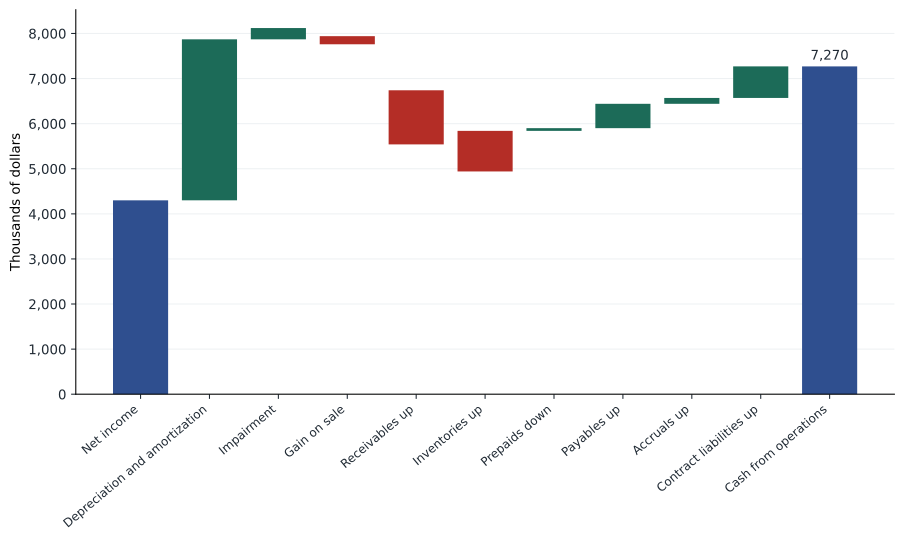
# Indirect method for Northlake (illustrative, thousands of dollars)
net_income = 4_300
noncash = {"Depreciation": 3_150, "Amortization of intangibles": 420,
           "Impairment loss": 250, "Gain on sale of vans": -180}
working_capital = {   # change in balance during the year (+ = increase)
    "Trade receivables": +1_200, "Inventories": +900, "Prepaid expenses": -60,
    "Trade payables": +540, "Accrued liabilities": +130, "Contract liabilities": +700}
liability_items = {"Trade payables", "Accrued liabilities", "Contract liabilities"}

cfo = net_income + sum(noncash.values())
for item, change in working_capital.items():
    effect = change if item in liability_items else -change
    cfo += effect
    print(f"{item:<22} change {change:+6,}  effect on cash {effect:+6,}")
print(f"Cash from operating activities: {cfo:,}")
print(f"Quality of earnings (CFO / net income): {cfo / net_income:.2f}")Trade receivables change +1,200 effect on cash -1,200 Inventories change +900 effect on cash -900 Prepaid expenses change -60 effect on cash +60 Trade payables change +540 effect on cash +540 Accrued liabilities change +130 effect on cash +130 Contract liabilities change +700 effect on cash +700 Cash from operating activities: 7,270 Quality of earnings (CFO / net income): 1.69
Northlake's operating cash flow is $7,270,000, about 1.7 times net income. Depreciation and amortization explain most of the gap. Growth in receivables and inventory absorbed $2.1 million of cash, but customers paying upfront for subscriptions (the increase in contract liabilities) supplied $700,000. A ratio of operating cash flow to net income persistently below 1 can signal aggressive revenue recognition or working capital strain, a point lesson 12 returns to.
Worked problem
Investing and financing sections
During the year Northlake bought equipment for $5,600,000 cash, sold vans with a carrying amount of $320,000 for $500,000, bought a minority stake in a supplier for $260,000, borrowed $2,000,000, repaid $1,500,000 of loans, paid interest of $1,600,000 and paid dividends of $900,000. Classify the flows.
Show solution
- Investing: equipment −5,600,000; proceeds from vans +500,000 (the $180,000 gain was removed from operating activities); investment −260,000. Net investing = −$5,360,000.
- Financing (under IFRS 18 for a non-financial company): borrowing +2,000,000; repayment −1,500,000; interest paid −1,600,000; dividends −900,000. Net financing = −$2,000,000.
- If interest paid is financing, the operating figure must exclude it; under IFRS 18 the reconciliation starts from operating profit, which is before interest.
Answer: Net investing −$5.36 million; net financing −$2.0 million.
Using the two statements together
Analysts combine the statements to assess liquidity and cash generation. The current ratio (current assets ÷ current liabilities) and quick ratio ((cash + short-term investments + receivables) ÷ current liabilities) measure short-term liquidity. The debt-to-equity ratio and interest coverage (earnings before interest and taxes ÷ interest expense) measure solvency. Free cash flow, commonly operating cash flow minus capital expenditures, measures cash available for debt repayment, dividends and acquisitions; it is not defined in the standards, so companies that report it must define it, and under IFRS 18 it may count as a management-defined performance measure only if it is a subtotal of income and expenses, which free cash flow is not. For Northlake, free cash flow is 7,270,000 − 5,600,000 = $1,670,000.
Common mistakes
MistakeClassifying a long-term loan in covenant breach as non-current because the lender has not demanded repayment.
InsteadIf there is no right at the reporting date to defer settlement for twelve months (no waiver), classify it as current.
MistakeAdjusting the statements for a fire after year end.
InsteadA fire after the reporting date is a non-adjusting event; disclose it.
MistakeAdding the gain on sale of equipment to operating cash flow.
InsteadSubtract the gain in the indirect method; the full proceeds appear in investing activities.
MistakeSubtracting an increase in contract liabilities.
InsteadAn increase in an operating liability means cash was received before revenue; add it.
MistakeIncluding the purchase of equipment with a note payable in investing outflows.
InsteadA non-cash transaction is excluded from the statement and disclosed separately.
Summary and key terms
- The statement of financial position supports assessments of liquidity, solvency and flexibility but omits unrecognized resources and relies on estimates.
- Assets and liabilities are current if realized or settled within the operating cycle or twelve months; covenant breaches without a waiver make debt current.
- Adjusting events after the reporting period change the statements; non-adjusting events are disclosed.
- Cash flows are classified as operating, investing or financing; significant non-cash transactions are disclosed separately.
- IFRS 18 standardizes interest and dividends: paid as financing, received as investing, for most companies.
- The indirect method adds back non-cash expenses, removes gains and losses on disposals and adjusts for working capital.
- Free cash flow is not defined by standards and must be defined and reconciled where reported.
- Operating cycle
- The average time between acquiring inputs and collecting cash from customers.
- Liquidity
- The ability to meet obligations as they fall due.
- Solvency
- The ability to meet long-term obligations.
- Adjusting event
- An event after the reporting period that provides evidence of conditions existing at the reporting date.
- Non-adjusting event
- An event after the reporting period indicating conditions that arose after that date.
- Cash equivalent
- A short-term, highly liquid investment readily convertible to known amounts of cash with insignificant risk of value changes.
- Indirect method
- Presentation of operating cash flow by adjusting a profit figure for non-cash items and working capital changes.
- Direct method
- Presentation of operating cash flow as gross receipts and payments.
- Free cash flow
- An undefined, commonly used measure such as operating cash flow less capital expenditures.
- Non-cash transaction
- An investing or financing transaction that does not use cash, disclosed separately.
Practice problems
Work each problem on paper first, then reveal the answer to check.
A loan is due in 3 years but a covenant was breached on 31 December and waived on 15 January. Current or non-current?
Show answer
Current under IFRS: the waiver came after the reporting date.
Is a customer bankruptcy in January, caused by conditions in the autumn, adjusting?
Show answer
Yes.
Northlake buys equipment for a $400,000 note. Where does it appear in the cash flow statement?
Show answer
Not in the statement; it is disclosed as a non-cash investing and financing transaction.
Net income $1,000; depreciation $300; receivables up $200; payables down $50. Compute CFO.
Show answer
1,000 + 300 − 200 − 50 = $1,050.
Equipment with a carrying amount of $80,000 is sold for $65,000. Effects on the indirect method and investing?
Show answer
Add back the $15,000 loss in operating; show $65,000 proceeds in investing.
Under IFRS 18, where are dividends received classified for a manufacturer?
Show answer
Investing.
Compute Northlake's free cash flow if capital expenditures were $6.1 million.
Show answer
7,270,000 − 6,100,000 = $1,170,000.
Why might CFO persistently below net income concern an analyst?
Show answer
It may signal aggressive revenue recognition or working capital strain.
Is a three-month government treasury bill bought one month before year end a cash equivalent?
Show answer
Yes, its original maturity is three months or less.
Rerun the Python program with an inventory increase of 1,500. What is CFO?
Show answer
$6,670,000.
Lesson quiz · 5 questions
Score 60% or more to complete this lesson.
Create a free account to save your progress, take quizzes and earn a certificate.