
ACCT-211 · Lesson 5 of 12 · 34 min
Revenue recognition II: special issues
Lesson 4 applied the five steps to a contract with a fixed price and clear deliverables. Real contracts are messier. Prices depend on volumes or outcomes; customers can return goods; payment comes years after delivery; the entity may be arranging a sale for someone else rather than selling itself; the product may be a licence rather than a physical good; warranties, loyalty points and options for future purchases blur the line between one sale and several. This lesson works through each of these issues with Northlake examples. The answers all come back to the same core principle: recognize revenue when control transfers, at the amount the entity expects to be entitled to.
Variable consideration
Consideration is variable when it can change because of discounts, rebates, refunds, credits, price concessions, incentives, performance bonuses, penalties or similar items, or when the entity's entitlement depends on a future event. The entity estimates variable consideration using whichever of two methods better predicts the amount: the expected value (the probability-weighted sum of possible amounts, suited to a large number of similar contracts or many possible outcomes) or the most likely amount (the single most likely outcome, suited to binary situations such as a bonus that is either earned or not). The method is applied consistently throughout the contract.
The estimate is then subject to a constraint: variable consideration is included in the transaction price only to the extent that it is highly probable (IFRS) or probable (US GAAP, intended to mean the same level of confidence here) that a significant reversal of cumulative revenue recognized will not occur when the uncertainty is resolved. Factors that increase the likelihood of reversal include susceptibility to factors outside the entity's influence (market volatility, weather, third-party judgement), a long period before resolution, limited experience with similar contracts, a practice of offering price concessions and a broad range of possible outcomes. The estimate is updated at each reporting date.
# Variable consideration: expected value vs most likely amount (illustrative)
# A municipality pays a bonus if the network meets an uptime target.
outcomes = {0: 0.30, 20_000: 0.70}           # bonus: probability
expected = sum(v * p for v, p in outcomes.items())
most_likely = max(outcomes, key=outcomes.get)
print(f"Expected value: {expected:,.0f}  Most likely: {most_likely:,}")
# A binary bonus is better estimated by the most likely amount.

# Volume rebate for a distributor: many possible outcomes -> expected value
units_scenarios = {400: 0.25, 550: 0.50, 700: 0.25}
price, rebate_rate, threshold = 1_000, 0.05, 500
def revenue(units):
    rate = rebate_rate if units > threshold else 0.0
    return units * price * (1 - rate)
ev_revenue_per_unit = sum(revenue(u) / u * p for u, p in units_scenarios.items())
print(f"Expected revenue per unit: {ev_revenue_per_unit:,.2f}")
q1_units = 150
print(f"Revenue recognized on {q1_units} units in Q1: {q1_units * ev_revenue_per_unit:,.0f}")
print(f"Refund liability (expected rebate): {q1_units * price - q1_units * ev_revenue_per_unit:,.0f}")Expected value: 14,000 Most likely: 20,000 Expected revenue per unit: 962.50 Revenue recognized on 150 units in Q1: 144,375 Refund liability (expected rebate): 5,625
For the uptime bonus, the most likely amount ($20,000) is the better estimate, because the bonus is binary: an expected value of $14,000 is an amount Northlake can never actually receive. Whether to include it depends on the constraint: if network uptime is largely within Northlake's control and it has a strong track record, the full $20,000 may be included; if weather outages outside its control could easily cause a miss, some or all of it is constrained. For the distributor rebate, with a range of volumes, the expected value gives revenue of $962.50 per unit, so on 150 first-quarter units Northlake recognizes $144,375 and a refund liability of $5,625 for rebates it expects to pay.
Rights of return
When customers can return goods for a refund or credit, the entity does not recognize revenue for the goods it expects to be returned. Instead it recognizes revenue for the amount it expects to keep (applying the variable consideration rules), a refund liability for the amount it expects to refund, and an asset (a right to recover products) for the goods it expects to get back, measured at their former carrying amount less expected recovery costs and any loss in value. Cost of sales is reduced accordingly. Exchanges of one product for another of the same type and price are not returns.
Worked problem
Sales with a right of return
Northlake sells 100 handheld air-quality meters to a retailer at $400 each (cost $240 each) on 30-day return terms. From experience, 5 per cent are returned in good condition, and recovery costs are negligible. Record the sale.
Show solution
- Revenue for 95 units: 95 × 400 = $38,000. Refund liability for 5 units: $2,000. Receivable (or cash) $40,000.
- Cost of sales for 95 units: 95 × 240 = $22,800. Right to recover products for 5 units: $1,200. Inventory reduced by $24,000.
- If actual returns differ, the liability and asset are remeasured and revenue and cost of sales adjusted.
Answer: Revenue $38,000, refund liability $2,000, cost of sales $22,800 and a $1,200 asset for expected returns.
Significant financing components
When the timing of payments agreed in a contract gives either party a significant benefit of financing, the transaction price is adjusted for the time value of money, so that revenue reflects the cash selling price at the time control transfers. The adjustment uses the discount rate that would be reflected in a separate financing transaction between the entity and the customer, reflecting the customer's credit (if the customer is being financed) or the entity's (if the customer pays in advance). Interest income or expense is presented separately from revenue from contracts with customers. As a practical expedient, no adjustment is needed if the period between transfer and payment is one year or less. Factors such as a difference between the promised amount and the cash selling price, and the length of the period, indicate whether financing is significant.
# Significant financing component: deferred payment by a farm cooperative
cash_price, promised, years = 50_000, 55_125, 2
rate = (promised / cash_price) ** (1 / years) - 1
print(f"Implicit annual rate: {rate:.2%}")
balance = cash_price
for y in range(1, years + 1):
    interest = round(balance * rate)
    balance += interest
    print(f"Year {y}: interest income {interest:,}  receivable {balance:,}")
print("Revenue at delivery (cash selling price):", f"{cash_price:,}")Implicit annual rate: 5.00% Year 1: interest income 2,500 receivable 52,500 Year 2: interest income 2,625 receivable 55,125 Revenue at delivery (cash selling price): 50,000
Northlake delivers a sensor network to a farm cooperative that will pay $55,125 in two years; the cash price is $50,000. The implicit rate is 5 per cent, which is consistent with the cooperative's borrowing rate. Revenue of $50,000 is recognized at delivery, and interest income of $2,500 and $2,625 is recognized over the two years as the receivable grows to $55,125. When customers pay in advance by more than a year, the reverse applies: the entity recognizes interest expense and revenue is grossed up, a result many find counter-intuitive but which keeps revenue at the cash selling price.
Principal versus agent
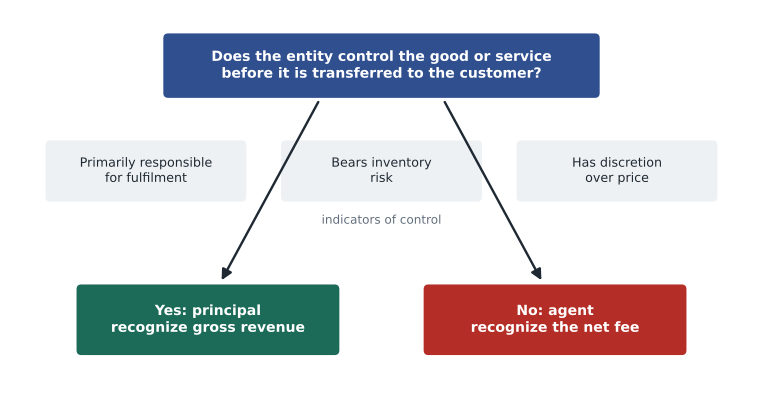
When another party is involved in providing goods or services to a customer, the entity must decide whether it is a principal (it controls the specified good or service before it is transferred and recognizes revenue at the gross amount) or an agent (it arranges for the other party to provide it and recognizes revenue as the net fee or commission). Indicators that the entity controls the good or service, and is therefore a principal, include being primarily responsible for fulfilling the promise, bearing inventory risk before or after transfer, and having discretion in setting the price. No single indicator decides; the assessment is made for each specified good or service.
Worked problem
Gross or net?
Northlake offers customers cellular data plans so stations can transmit readings. (a) For municipal clients, Northlake buys data in bulk from a carrier, bundles it into its monitoring service, sets the price, and is responsible to the client if data fails. (b) On its website, Northlake also refers farmers to a carrier, which signs them up, sets prices and provides support; Northlake receives a 10 per cent commission. How is each recognized?
Show solution
- (a) Northlake controls the data service before it reaches the client: it is primarily responsible, bears the risk of unused bulk data and sets the price. It is a principal and recognizes the full amount billed as revenue, with the carrier's charges as cost of sales.
- (b) Northlake never controls the data plan; it arranges for the carrier to provide it. It is an agent and recognizes only the commission as revenue, when the farmer signs up.
Answer: Principal in (a): gross revenue. Agent in (b): net commission revenue.
Licences of intellectual property
A licence gives the customer rights to the entity's intellectual property, such as software, patents, trademarks, music or film. If the licence is distinct from other goods and services, the entity determines its nature. A right to access the intellectual property as it exists throughout the licence period is satisfied over time. This applies when the entity is expected to undertake activities that significantly affect the intellectual property, the customer is exposed to those effects, and the activities do not themselves transfer a good or service; a sports team logo whose value depends on the team's ongoing performance is the classic example. A right to use the intellectual property as it exists when the licence is granted is satisfied at a point in time, when the customer can use and benefit from it. Functional software or a completed film is typically a right to use. US GAAP frames the test slightly differently, classifying intellectual property as functional or symbolic, but in most cases reaches the same answer. Sales-based or usage-based royalties on licences are recognized only when the later sale or usage occurs, an exception to the variable consideration estimates.
Warranties
A warranty that provides assurance that the product will function as agreed (an assurance-type warranty) is not a separate performance obligation. The entity accounts for it as a cost, recognizing a provision for expected repair costs when the product is sold (under IAS 37 or ASC 460). A warranty that provides a service beyond that assurance (a service-type warranty), such as an extended warranty the customer can buy separately or coverage well beyond the normal defect period, is a separate performance obligation: part of the transaction price is allocated to it and recognized over the coverage period. Factors include whether the warranty is required by law, the length of the coverage and the nature of the tasks promised.
Worked problem
Assurance versus service warranty
Northlake sells a station for $60,000 with a standard one-year warranty against defects, required by its standard terms. The customer also buys a four-year extended warranty for $6,000, which Northlake sells separately. Expected repair costs under the standard warranty are 2 per cent of the station price. Account for the warranties.
Show solution
- Standard warranty: assurance-type. Recognize revenue of $60,000 for the station and a warranty provision of $1,200 (2 per cent), with warranty expense.
- Extended warranty: service-type, a separate performance obligation priced at its standalone price. Record a contract liability of $6,000 and recognize revenue over the four-year coverage period, starting when the standard warranty ends if that is when the service begins.
Answer: One provision for assurance-type costs; one contract liability for the separately priced service warranty.
Customer options, loyalty points and breakage
An option to buy additional goods or services free or at a discount is a separate performance obligation if it provides a material right that the customer would not receive without entering into the contract, such as loyalty points or a discount voucher larger than discounts typically offered to others. Part of the transaction price is allocated to the option based on its standalone selling price, estimated from the discount and the likelihood of exercise, and revenue is recognized when the option is exercised or expires. Breakage, the portion of prepaid rights such as gift cards or points that customers will never exercise, is recognized in proportion to the pattern of rights exercised if the entity expects to be entitled to it; otherwise, when the likelihood of exercise becomes remote. In some provinces, unclaimed property or consumer protection legislation (for example, rules prohibiting expiry dates on most gift cards) limits what can be treated as breakage.
Worked problem
Loyalty points
Northlake gives distributors 1 point per $100 of purchases, redeemable for $5 of future parts. In the year, distributors buy $2,000,000 of goods and earn 20,000 points. Northlake expects 80 per cent of points to be redeemed. Allocate the price.
Show solution
- Standalone selling price of points = 20,000 × $5 × 80% = $80,000.
- Allocate $2,000,000 in proportion: goods 2,000,000 × 2,000,000 ÷ 2,080,000 = $1,923,077; points 2,000,000 × 80,000 ÷ 2,080,000 = $76,923.
- Recognize $1,923,077 of revenue on the goods and a contract liability of $76,923 for points.
- If 6,000 points are redeemed next year, revenue = 76,923 × 6,000 ÷ 16,000 (expected redemptions) = $28,846.
Answer: Goods revenue $1,923,077 now; points revenue as they are redeemed.
Bill-and-hold, consignment and repurchase agreements
In a bill-and-hold arrangement the entity bills the customer but keeps the product until a later date. Revenue is recognized before delivery only if control has transferred, which requires all of: a substantive reason for the arrangement (usually the customer's request, for example because it lacks storage space), the product identified separately as the customer's, the product ready for physical transfer, and the entity unable to use it or direct it to another customer. Consignment is the opposite: goods placed with a dealer who does not control them until sold to an end customer; the consignor recognizes revenue only when the dealer sells. Repurchase agreements, where the entity has an obligation or right to buy the asset back, generally mean control has not transferred, and the arrangement is a lease or a financing rather than a sale.
These arrangements matter because they are where earnings management often hides. Shipping goods to distributors at quarter end with generous return rights or side agreements (channel stuffing), recognizing bill-and-hold sales that the customer did not request, and treating consignment shipments as sales are classic ways to accelerate revenue. Lesson 12 returns to these patterns. CON-320 covers over-time recognition on construction contracts with the cost-to-cost method.
Common mistakes
MistakeUsing the expected value for a single binary bonus.
InsteadUse the most likely amount for binary outcomes; expected value suits many possible outcomes.
MistakeIncluding all variable consideration without applying the constraint.
InsteadInclude only the amount for which a significant reversal is highly probable (probable) not to occur.
MistakeRecognizing full revenue on goods expected to be returned.
InsteadRecognize revenue only for goods expected to be kept; record a refund liability and a right-to-recover asset.
MistakeRecognizing the gross amount when the entity merely arranges a sale.
InsteadIf the entity does not control the good or service before transfer, it is an agent and recognizes the net fee.
MistakeTreating a standard defect warranty as a separate performance obligation.
InsteadAssurance-type warranties are costs with a provision; only service-type warranties are separate obligations.
Summary and key terms
- Variable consideration is estimated by expected value or most likely amount and then constrained.
- Expected returns reduce revenue and create a refund liability and a right-to-recover asset.
- Payment terms longer than one year that give significant financing require adjusting revenue to the cash selling price, with interest presented separately.
- A principal controls the good or service before transfer and reports gross revenue; an agent reports a net fee.
- Licences are right-to-access (over time) or right-to-use (point in time); sales-based royalties are recognized when the sales occur.
- Assurance-type warranties are provisions; service-type warranties are separate performance obligations.
- Material rights such as loyalty points receive an allocation of the price; bill-and-hold revenue requires strict criteria.
- Variable consideration
- Consideration that can change because of discounts, rebates, bonuses, penalties or future events.
- Constraint
- The limit that includes variable consideration only to the extent a significant revenue reversal is highly probable (probable) not to occur.
- Refund liability
- An obligation to refund consideration received, such as for expected returns or rebates.
- Significant financing component
- A financing benefit arising from the timing of payments that requires adjusting the transaction price.
- Principal
- An entity that controls a specified good or service before it is transferred to the customer.
- Agent
- An entity that arranges for another party to provide goods or services and earns a fee.
- Right to access
- A licence satisfied over time because the entity's activities significantly affect the intellectual property.
- Assurance-type warranty
- A warranty that the product will function as agreed; accounted for as a cost provision.
- Material right
- An option giving the customer a benefit it would not receive without the contract, treated as a performance obligation.
- Breakage
- The portion of prepaid rights that customers are not expected to exercise.
Practice problems
Work each problem on paper first, then reveal the answer to check.
A contractor earns a $50,000 bonus if a project finishes early; probability 60 per cent. Which estimation method?
Show answer
The most likely amount ($50,000), subject to the constraint.
Why might a bonus dependent on weather be constrained?
Show answer
Outcomes outside the entity's influence increase the risk of a significant reversal.
Sales of $10,000, cost $6,000, expected returns 10 per cent. Revenue and cost of sales?
Show answer
Revenue $9,000; cost of sales $5,400; refund liability $1,000; asset $600.
A customer pays $106,121 in 3 years for goods with a cash price of $100,000. Implicit rate?
Show answer
About 2 per cent a year.
Give three indicators that an entity is a principal.
Show answer
Primary responsibility for fulfilment; inventory risk; pricing discretion.
Is a licence to a completed film right-to-use or right-to-access?
Show answer
Right-to-use, recognized at a point in time.
A one-year standard warranty is legally required. Separate obligation?
Show answer
No; it is an assurance-type warranty accounted for with a provision.
Gift cards of $100,000 are sold; 5 per cent breakage expected; $40,000 redeemed. Revenue including breakage?
Show answer
Breakage recognized proportionally: 40,000 + 5,000 × 40,000 ÷ 95,000 = $42,105.
List the four bill-and-hold criteria.
Show answer
Substantive reason; product separately identified as the customer's; ready for transfer; entity cannot use or redirect it.
In the rebate program, what revenue per unit results if the 700-unit scenario has probability 0.5 and 400-unit 0?
Show answer
All scenarios exceed 500 units, so revenue is $950 per unit.
Lesson quiz · 5 questions
Score 60% or more to complete this lesson.
Create a free account to save your progress, take quizzes and earn a certificate.