
ACCT-211 · Lesson 7 of 12 · 30 min
Inventory I: cost and cost formulas
Inventory is often a manufacturer's largest current asset, and it links the balance sheet to the income statement: every dollar of cost that is not in ending inventory becomes cost of sales. ACCT-101 introduced periodic and perpetual systems and the FIFO and weighted-average formulas. This lesson goes further. It asks which goods belong in inventory at all, which costs are capitalized into it (including the allocation of production overhead in a factory such as Northlake's), and how the permitted cost formulas work in perpetual and periodic systems. IAS 2, Inventories, governs IFRS reporters and ASPE Section 3031 private enterprises; the two are closely aligned. LIFO, still common in the United States, is prohibited under both, and this lesson explains why. Lesson 8 covers valuation at the lower of cost and net realizable value and estimation methods.
Which goods are included
Inventory includes goods the entity controls, whether or not they are physically on its premises. Three situations cause most errors at year end. Goods in transit belong to whoever holds legal title and control under the shipping terms: under FOB shipping point, title passes to the buyer when the goods leave the seller, so goods in transit at year end are the buyer's inventory; under FOB destination, title passes when the goods arrive, so they remain the seller's. Goods on consignment, placed with a dealer who sells them on the owner's behalf, remain the consignor's inventory until sold. And goods sold under a repurchase agreement or with a right of return remain in, or partly in, the seller's inventory (lesson 5 recorded an asset for goods expected to be returned).
Worked problem
Year-end cut-off
Northlake's count on 31 December lists $4,200,000 of inventory on hand. Also: (a) $150,000 of circuit boards shipped by a supplier FOB shipping point on 29 December arrive on 3 January; (b) $80,000 of stations shipped to a customer FOB destination on 30 December arrive on 4 January; (c) $60,000 of Northlake meters sit at a retailer on consignment; (d) $40,000 of goods in Northlake's warehouse are held for a customer under a valid bill-and-hold arrangement and have been recognized as sold. Correct the inventory.
Show solution
- (a) FOB shipping point: Northlake owns the boards from 29 December. Add $150,000.
- (b) FOB destination: Northlake still owns the stations until arrival. Add $80,000.
- (c) Consigned goods remain Northlake's. Add $60,000.
- (d) Bill-and-hold goods sold under valid criteria belong to the customer. Subtract $40,000 if they were counted.
- Corrected inventory = 4,200,000 + 150,000 + 80,000 + 60,000 − 40,000 = $4,450,000.
Answer: Inventory at year end is $4,450,000.
Which costs are capitalized
The cost of inventory comprises all costs of purchase, costs of conversion and other costs incurred in bringing the inventories to their present location and condition. Costs of purchase include the purchase price, import duties and non-recoverable taxes, transport and handling, less trade discounts and rebates. Recoverable sales taxes such as GST and HST, for which the business claims input tax credits, are excluded. Costs of conversion include direct labour and a systematic allocation of fixed and variable production overhead, such as factory depreciation, maintenance, utilities and supervision.
Fixed production overhead is allocated based on the normal capacity of the production facilities, the production expected on average over several periods under normal circumstances. If actual production is unusually low, unallocated fixed overhead is expensed in the period; it is not loaded onto fewer units, which would overstate their cost. If production is unusually high, the amount allocated per unit is reduced so that inventory is not carried above cost. Costs excluded from inventory and expensed as incurred include abnormal amounts of wasted materials, labour or other production costs; storage costs unless necessary in the production process (such as aging wine); administrative overheads that do not contribute to bringing inventory to its location and condition; and selling costs. Borrowing costs can be included only for inventories that take a substantial period to get ready for sale (IAS 23), which is rare.
# Allocating fixed production overhead at normal capacity (illustrative)
fixed_overhead = 2_400_000          # factory depreciation, supervision, etc.
normal_capacity_units = 8_000       # sensor stations a year on average
actual_units = 6_000                # a slow year
variable_cost_per_unit = 3_100      # materials, direct wages, variable overhead

rate = fixed_overhead / normal_capacity_units
allocated = rate * actual_units
unallocated = fixed_overhead - allocated
print(f"Fixed overhead rate per unit: {rate:,.0f}")
print(f"Allocated to inventory: {allocated:,.0f}; expensed as unallocated: {unallocated:,.0f}")
print(f"Cost per station: {variable_cost_per_unit + rate:,.0f}")
wrong = variable_cost_per_unit + fixed_overhead / actual_units
print(f"(If overhead were spread over actual units: {wrong:,.0f} per station, overstated)")Fixed overhead rate per unit: 300 Allocated to inventory: 1,800,000; expensed as unallocated: 600,000 Cost per station: 3,400 (If overhead were spread over actual units: 3,500 per station, overstated)
In a slow year Northlake produces only 6,000 stations against normal capacity of 8,000. Fixed overhead is allocated at $300 per unit, so $1,800,000 goes into inventory and $600,000 of unabsorbed overhead is expensed immediately. Each station costs $3,400. Spreading the overhead over actual production would have produced a cost of $3,500 a station and pushed idle-capacity cost into inventory, inflating profit in the slow year and depressing it when the goods are sold.
| Cost | Inventory or expense? | Reason |
|---|---|---|
| Freight in on circuit boards | Inventory | Cost of bringing goods to their location |
| Import duty on sensors from overseas | Inventory | Non-recoverable tax on purchase |
| Factory supervisor's salary | Inventory (fixed overhead, at normal capacity) | Production overhead |
| Warehouse rent for finished stations awaiting sale | Expense | Storage after production is complete |
| Materials scrapped after a calibration error | Expense (abnormal waste) | Not a normal cost of production |
| Freight out to customers | Expense (selling or fulfilment cost) | Incurred after the goods are ready for sale |
| Head office accounting department | Expense | Administrative overhead |
| Volume rebate from a supplier | Reduces inventory cost | A reduction of the purchase price |
Cost formulas
IAS 2 permits three cost formulas. Specific identification must be used for items that are not ordinarily interchangeable and for goods produced and segregated for specific projects, such as custom stations built for a particular airport. For other items, the entity uses first-in, first-out (FIFO) or weighted-average cost. The same formula must be used for all inventories of a similar nature and use; different formulas may be justified for inventories with a different nature or use, but not by location or tax considerations alone. ASPE Section 3031 has the same rules. LIFO (last-in, first-out) is prohibited because it does not faithfully represent the flow of inventory and can leave very old costs on the balance sheet.
Under FIFO, the earliest costs are assigned to cost of sales, so ending inventory reflects the most recent purchases. In a period of rising prices FIFO produces lower cost of sales, higher profit and an inventory balance close to current replacement cost. Under weighted average, an average cost per unit is computed, for the whole period in a periodic system, or after each purchase (a moving average) in a perpetual system, and applied to units sold and units on hand. Weighted average smooths price changes and gives results between FIFO and LIFO.
# FIFO, weighted average and LIFO for a sensor component (periodic system)
purchases = [("Opening", 400, 52.0), ("Feb", 600, 55.0), ("Jun", 800, 58.0), ("Oct", 500, 62.0)]
units_sold = 1_700
units = sum(q for _, q, _ in purchases)
cost = sum(q * c for _, q, c in purchases)
ending_units = units - units_sold

def layers_cost(layers, n):
    total, left = 0.0, n
    for _, q, c in layers:
        take = min(q, left); total += take * c; left -= take
        if left == 0: break
    return total

fifo_cogs = layers_cost(purchases, units_sold)
lifo_cogs = layers_cost(list(reversed(purchases)), units_sold)
avg = cost / units
methods = {"FIFO": fifo_cogs, "Weighted average": avg * units_sold, "LIFO": lifo_cogs}
print(f"Goods available: {units:,} units, cost {cost:,.0f}; ending {ending_units} units")
for name, cogs in methods.items():
    print(f"{name:<17} COGS {cogs:>9,.0f}  ending inventory {cost - cogs:>8,.0f}")
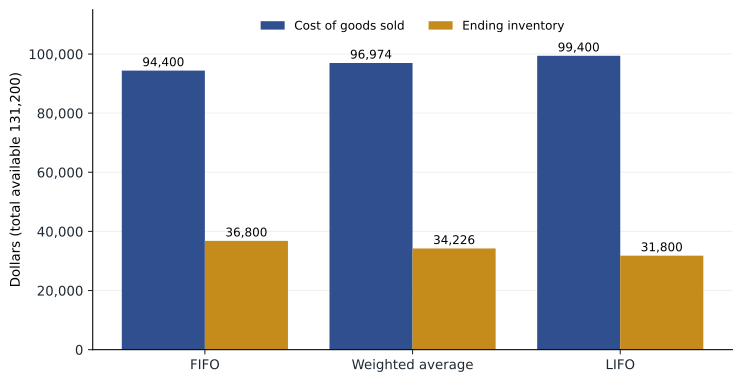
print(f"LIFO reserve (FIFO inventory - LIFO inventory): {(cost - fifo_cogs) - (cost - lifo_cogs):,.0f}")Goods available: 2,300 units, cost 131,200; ending 600 units FIFO COGS 94,400 ending inventory 36,800 Weighted average COGS 96,974 ending inventory 34,226 LIFO COGS 99,400 ending inventory 31,800 LIFO reserve (FIFO inventory - LIFO inventory): 5,000
With prices rising from $52 to $62 a unit, FIFO gives the lowest cost of goods sold ($94,400) and highest ending inventory ($36,800); LIFO the highest cost of goods sold ($99,400) and lowest inventory ($31,800); weighted average falls between, at about $96,974 and $34,226. The $5,000 difference between FIFO and LIFO inventory is the LIFO reserve for this item. Total cost of goods available is the same under every method; the formula only decides how it is split between the income statement and the balance sheet.
Perpetual systems and the moving average
Most manufacturers and retailers today use perpetual systems, updating inventory and cost of sales with each transaction. Under FIFO, periodic and perpetual systems give the same results, because the oldest layers are used first either way. Under weighted average they differ: a perpetual moving average recomputes the unit cost after each purchase, so units sold early in the year carry the average at that time. Under LIFO, perpetual and periodic results also differ, because a perpetual LIFO assigns the latest costs at the time of each sale rather than at year end.
Worked problem
Moving average
Northlake holds 400 units of a component at $52. It buys 600 at $55, sells 700, then buys 800 at $58 and sells 1,000. Compute cost of sales under the moving average.
Show solution
- After the first purchase: 1,000 units, cost 20,800 + 33,000 = $53,800; average $53.80.
- First sale: 700 × 53.80 = $37,660. Remaining 300 units at $53.80 = $16,140.
- After the second purchase: 1,100 units, cost 16,140 + 46,400 = $62,540; average $56.855 (rounded).
- Second sale: 1,000 × 56.855 = $56,855. Remaining 100 units ≈ $5,685.
- Total cost of sales ≈ 37,660 + 56,855 = $94,515.
Answer: Cost of sales is about $94,515 and ending inventory about $5,685.
LIFO in the United States, for comparison
Canadian students often meet LIFO when analysing US competitors, so it is worth understanding. Under LIFO, the latest costs flow to cost of sales and the oldest remain in inventory. In rising prices LIFO lowers taxable income, which is why US companies use it: the US tax code permits LIFO for tax only if it is also used for financial reporting (the LIFO conformity rule). US companies using LIFO disclose a LIFO reserve, the difference between inventory at FIFO (or current cost) and at LIFO, so analysts can convert to FIFO for comparison with IFRS reporters: FIFO inventory = LIFO inventory + LIFO reserve, and FIFO cost of sales = LIFO cost of sales − increase in the LIFO reserve during the year. When a LIFO company sells more units than it buys, old low-cost layers are liquidated, cost of sales falls and profit rises, a LIFO liquidation that can flatter results in a bad year.
Because tracking individual layers for thousands of items is impractical, US companies typically use dollar-value LIFO, which groups items into pools and measures layers in dollars at base-year prices using a price index. Ending inventory at base-year prices is compared with the prior year; an increase is a new layer, valued at the current year's index. The method is more complex than this course needs, but its purpose is simple: to keep LIFO's tax benefit while allowing the product mix within a pool to change.
Worked problem
Converting LIFO to FIFO
A US competitor reports LIFO inventory of $12.0 million, a LIFO reserve of $2.8 million at year end ($2.3 million a year earlier), and LIFO cost of goods sold of $70.0 million. Its tax rate is 25 per cent. Restate on a FIFO basis.
Show solution
- FIFO inventory = 12.0 + 2.8 = $14.8 million.
- FIFO cost of goods sold = 70.0 − (2.8 − 2.3) = $69.5 million; pre-tax income is $0.5 million higher.
- Cumulative tax deferred by using LIFO ≈ 2.8 × 25% = $0.7 million; FIFO retained earnings would be higher by 2.8 × (1 − 0.25) = $2.1 million.
Answer: On a FIFO basis inventory is $14.8 million and cost of goods sold $69.5 million, making the competitor comparable with a FIFO reporter.
Choosing and changing formulas
The choice of formula affects reported profit, taxes (where tax follows the books), ratios and comparability. In Canada, the Income Tax Act allows FIFO, average cost and specific identification but not LIFO for tax purposes, so a Canadian company gains no tax benefit from any particular formula beyond timing differences. A change in cost formula is a change in accounting policy, applied retrospectively with restated comparatives, and must be justified as giving more reliable and relevant information. A change in the estimate of normal capacity, by contrast, is applied prospectively.
Common mistakes
MistakeExcluding goods in transit shipped FOB shipping point from the buyer's inventory.
InsteadUnder FOB shipping point, title passes when goods are shipped; they are the buyer's inventory in transit.
MistakeRemoving consigned goods from the consignor's inventory when they are shipped to the dealer.
InsteadConsigned goods stay in the consignor's inventory until the dealer sells them.
MistakeSpreading fixed overhead over actual production in a slow year.
InsteadAllocate fixed overhead at normal capacity; expense the unabsorbed amount.
MistakeCapitalizing storage of finished goods and freight out into inventory.
InsteadStorage after production and selling costs are expensed.
MistakeUsing LIFO in Canada to reduce taxes.
InsteadLIFO is prohibited under IFRS, ASPE and the Income Tax Act.
Summary and key terms
- Inventory includes goods the entity controls: goods in transit under FOB shipping point belong to the buyer; consigned goods belong to the consignor.
- Inventory cost includes purchase costs, conversion costs and other costs to bring goods to their present location and condition.
- Fixed production overhead is allocated at normal capacity; abnormal waste, storage, administration and selling costs are expensed.
- IAS 2 and ASPE permit specific identification, FIFO and weighted average; LIFO is prohibited.
- In rising prices FIFO gives the lowest cost of sales and highest inventory; LIFO the reverse; weighted average falls between.
- Perpetual and periodic systems give the same FIFO results but different weighted-average and LIFO results.
- US competitors' LIFO figures can be converted to FIFO using the disclosed LIFO reserve.
- FOB shipping point
- Shipping terms under which title passes to the buyer when goods leave the seller.
- FOB destination
- Shipping terms under which title passes when goods arrive at the buyer.
- Consignment
- An arrangement in which goods are held by a dealer who sells them on the owner's behalf.
- Costs of conversion
- Direct labour and allocated production overhead incurred to turn materials into finished goods.
- Normal capacity
- The production expected on average over several periods under normal circumstances.
- FIFO
- A cost formula assigning the earliest costs to cost of sales.
- Weighted-average cost
- A cost formula assigning an average unit cost to units sold and on hand.
- Moving average
- A perpetual weighted average recomputed after each purchase.
- LIFO reserve
- The difference between inventory at FIFO (or current cost) and at LIFO.
- LIFO liquidation
- A reduction in LIFO layers that brings older, typically lower costs into cost of sales.
Practice problems
Work each problem on paper first, then reveal the answer to check.
Goods costing $20,000 are shipped to Northlake FOB destination on 30 December and arrive on 2 January. Whose inventory at 31 December?
Show answer
The supplier's.
Which costs are excluded from inventory: freight in, factory insurance, sales commissions, abnormal scrap?
Show answer
Sales commissions and abnormal scrap.
Fixed overhead $1,000,000; normal capacity 10,000 units; actual 7,000. Allocated and expensed amounts?
Show answer
Allocated $700,000 (at $100 a unit); expensed $300,000.
Opening 100 units at $10; buy 100 at $12; sell 150. Periodic FIFO COGS?
Show answer
100 × 10 + 50 × 12 = $1,600.
Same data, periodic weighted average COGS?
Show answer
Average $11; COGS $1,650.
Same data, periodic LIFO COGS?
Show answer
100 × 12 + 50 × 10 = $1,700.
Why do FIFO results not depend on periodic versus perpetual?
Show answer
The earliest layers are used first under both systems.
A LIFO company reports inventory $5 million and a LIFO reserve of $1.2 million. FIFO inventory?
Show answer
$6.2 million.
Is switching from weighted average to FIFO a change in policy or estimate?
Show answer
A change in policy, applied retrospectively.
Rerun the cost formula program with 1,200 units sold. What is the LIFO reserve?
Show answer
FIFO inventory of 1,100 units costs $65,800; LIFO inventory $59,600; reserve $6,200.
Lesson quiz · 5 questions
Score 60% or more to complete this lesson.
Create a free account to save your progress, take quizzes and earn a certificate.