
TRD-104 · Lesson 7 of 12 · 21 min
Grinders, abrasive wheels and cut-off saws
An abrasive wheel does not cut with teeth. It is made of millions of hard grains held together by a bond, and each grain scrapes off a tiny chip as the wheel spins. That makes grinders and cut-off saws wonderfully versatile: they cut steel, concrete, tile, rebar and threaded rod, grind welds smooth, remove rust and sharpen tools. It also makes them one of the most hazardous tools on site. An abrasive wheel is brittle, and when it breaks at full speed the pieces fly outward with the energy of a bullet. Add sparks, dust, noise and kickback, and it is no surprise that grinders cause many eye, face and hand injuries every year.
On Kingsway Tower, Maya uses an angle grinder with a cut-off wheel to cut threaded rod and strut channel for pipe supports, and the steel erectors and sprinkler fitters use them constantly. Before anyone on Northbridge Mechanical's crew is allowed to use one, Luis walks them through everything in this lesson.
Types of grinders and abrasive tools
- Angle grinder: a hand-held tool with the wheel at right angles to the motor, usually 115 mm to 230 mm, or 4 1/2 to 9 in, in diameter. It takes cut-off wheels, grinding wheels, flap discs, wire wheels and diamond blades.
- Die grinder: a small, high-speed tool for small grinding bits and cut-off wheels in tight places.
- Bench or pedestal grinder: a fixed grinder with a wheel on each end of the motor shaft, used for sharpening and shaping.
- Cut-off saw: a large hand-held saw, often gas-powered, with a 300 to 400 mm, or 12 to 16 in, abrasive or diamond wheel, used for cutting concrete, masonry, pipe and steel.
- Stationary abrasive chop saw: a large wheel on a pivoting arm, for cutting steel stock and pipe.
- Walk-behind and wall saws: diamond-blade saws for cutting slabs and walls, usually water-cooled.
Wheels: types, shapes and markings
Abrasive wheels are not interchangeable, and many grinder accidents start with the wrong wheel. Every wheel is marked with information that must be checked before it goes on a tool:
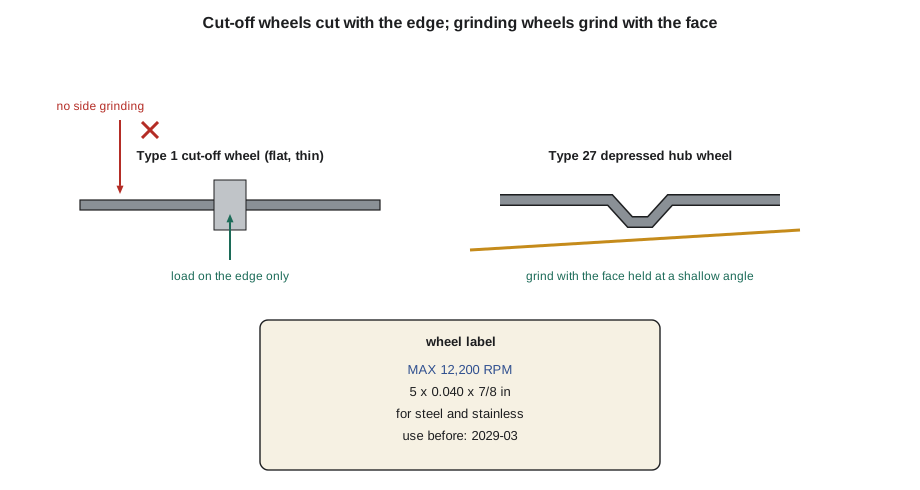
- Maximum operating speed, in revolutions per minute and often also in meters per second. The wheel's maximum speed must be equal to or greater than the grinder's no-load speed. A wheel run faster than its rating can burst.
- Diameter, thickness and arbor hole size, which must match the grinder and its guard.
- The type or shape of wheel. A Type 1 wheel is flat and is used for cutting; a Type 27 wheel has a depressed center so the flange sits below the grinding face and is used for grinding with the face. Type 41 and 42 are flat and depressed-center cut-off wheels in some marking systems.
- The abrasive and bond, and what materials the wheel is for: metal, stainless steel, masonry or concrete.
- An expiry date on many resin-bonded wheels. The resin bond deteriorates with age, heat and moisture, and an expired wheel must not be used.
The single most important rule about wheels: use the wheel only for the job it was designed for. Cut-off wheels are thin and are designed to take load on their edge only. Using the side of a cut-off wheel to grind puts a bending load on it, and it can shatter. Grind with a grinding wheel or flap disc, and cut with a cut-off wheel.
Inspecting and mounting a wheel
Before mounting any abrasive wheel:
- Check that the tool is unplugged or the battery removed.
- Inspect the wheel for cracks, chips, warping, moisture damage and the expiry date. Discard any damaged, dropped or expired wheel.
- For vitrified wheels on bench and pedestal grinders, do a ring test: suspend the wheel on a finger or pin through the hole and tap it lightly with a non-metallic object such as a screwdriver handle. A sound wheel gives a clear ring; a cracked wheel sounds dull. Do not ring test thin resin-bonded cut-off wheels or flap discs; inspect them visually.
- Check the speed: the wheel's maximum speed must be at least the tool's speed, which is stamped on the tool's nameplate.
- Use the flanges supplied with the tool, clean and undamaged, in the right orientation for the wheel type. Do not use paper blotters except where they are part of the wheel.
- Tighten the flange nut with the spanner supplied, not with a hammer and punch.
- Make sure the guard is in place, correctly positioned and securely clamped.
- Stand to the side and run the tool at full speed for about a minute in a safe direction before using a new wheel. Most defective wheels break in the first minute.
Guards
The guard on a grinder is designed to deflect the pieces of a broken wheel away from the operator and to keep fingers off the wheel. It must be positioned between the wheel and the operator.
For portable grinders, the guard typically covers at least half the wheel, so that no more than 180 degrees of the wheel is exposed, and it should be rotated so that the closed side faces the operator. On bench and pedestal grinders, the work rest must be kept within 1/8 in of the wheel to stop work being dragged in between, and the adjustable tongue guard at the top within about 1/4 in. Adjust the rest and tongue guard only when the wheel has stopped, and readjust them as the wheel wears.
OSHA's construction standard for abrasive wheels and tools (29 CFR 1926.303) limits the exposure of portable grinder wheels to 180 degrees, requires wheels to be inspected and ring-tested before mounting, and requires work rests on bench grinders to be kept within 1/8 in of the wheel. The ANSI B7.1 standard on abrasive wheels gives further detail.
Removing the guard to fit a larger wheel, or to get into a tight corner, is one of the most common and most dangerous practices with angle grinders. A 230 mm (9 in) wheel on a 125 mm (5 in) grinder will be overspeed as well as unguarded. Never do it.
Using an angle grinder safely
- Hold the grinder with both hands, using the side handle, and keep a firm stance. Angle grinders can kick back strongly if the wheel pinches in a cut.
- Let the wheel reach full speed before touching the work, and let the tool do the work; forcing it slows the wheel and overheats it.
- Keep the cut straight. Twisting the grinder in a cut pinches the wheel and causes kickback or breakage.
- Support and clamp the work so the cut opens as you go, not closes.
- Direct sparks away from yourself, other workers and anything that can burn. Grinding sparks can travel several meters and smolder in insulation, packaging or sawdust long after the work stops.
- Never put a grinder down until the wheel has stopped. A coasting wheel can catch the floor and send the grinder spinning.
- Do not use wheels that are worn below the size recommended by the manufacturer.
Hot work
Grinding and abrasive cutting are hot work, along with welding and torch cutting. On Kingsway Tower, Stonebridge requires a hot work permit for grinding in most areas: the area is cleared of combustibles or they are covered with fire blankets, a fire extinguisher is at hand, and a fire watch remains during the work and for a set time afterward, often 30 to 60 minutes, because smoldering fires can start long after the sparks stop. Never grind near fuel, solvents, aerosol cans or open containers of flammable liquid.
Protective equipment
The PPE for grinding goes beyond the basic site requirements:
- Safety glasses with side shields and a face shield over them. A face shield alone is not primary eye protection; fragments can come up under it.
- Hearing protection. Grinders and cut-off saws are among the loudest tools on site.
- Leather gloves suitable for the task, but not loose gloves near wire wheels and small rotating parts, where they can be caught.
- Flame-resistant or natural-fiber clothing. Synthetic fabrics can melt when sparks land on them. No loose sleeves.
- Respiratory protection where dust controls are not enough.
Dust from cutting masonry and concrete
Cutting concrete, block, brick and stone with abrasive or diamond wheels produces large amounts of respirable crystalline silica, much more than drilling.
OSHA's silica standard Table 1 sets the controls for handheld power saws, cut-off saws and grinders used on concrete and masonry: integrated water delivery for saws, and a shroud with a dust collection system for grinders, with respirators required for some tasks and durations, such as handheld saw use indoors or for more than four hours a shift outdoors. Dry cutting without controls does not meet the standard.
Water control means a constant flow at the blade, not an occasional spray. The slurry it produces must be cleaned up before it dries and becomes airborne dust.
Gas-powered cut-off saws
Gas cut-off saws bring the hazards of a fuel engine: carbon monoxide, fuel fires and burns from the hot muffler. Never use them indoors, in parking garages or below grade without engineered ventilation and gas monitoring. Several workers in North America have been poisoned by carbon monoxide while using gas saws in enclosed spaces. On Kingsway Tower, gas saws are not allowed in the parking levels; electric or hydraulic saws are used instead. Refuel only with the engine stopped and cool, outdoors, away from ignition sources.
Worked example: wheel speed
Worked problem
Matching a wheel to a grinder
Maya's angle grinder is a 5 in model with a no-load speed of 11 000 rev/min. In the gang box she finds a 5 in cut-off wheel marked 12 200 rev/min, and a 7 in wheel marked 8500 rev/min. Which wheel can she use, and how fast is the edge of the 5 in wheel moving?
Show solution
- 5 in wheel: 12 200 rev/min is above the grinder's 11 000 rev/min. It may be used, with the guard.
- 7 in wheel: 8500 rev/min is below 11 000. It would run overspeed and would not fit under the guard. Never use it.
- Edge speed of the 5 in wheel = pi x (5/12) ft x 11 000 = 14 400 ft/min.
- That equals about 164 mph.
Answer: Only the 5 in wheel. Its edge moves at about 14 400 ft/min, or 164 mph.
The kinetic energy of a wheel fragment grows with the square of the speed, so running a wheel 30 percent overspeed puts about 70 percent more energy into each piece if it breaks, and the stress in the wheel rises the same way. The program below checks wheels against a tool and shows that effect.
import math
tool_rpm = 11000
wheels = [  # (label, diameter in, max rpm)
    ("5 in cut-off", 5, 12200),
    ("5 in grinding", 5, 13300),
    ("7 in cut-off", 7, 8500),
]
for label, d, wmax in wheels:
    edge = math.pi * d * tool_rpm / 12
    ratio = tool_rpm / wmax
    energy = ratio ** 2
    verdict = "OK" if tool_rpm <= wmax else "NO: overspeed"
print(f"{label:16} edge {edge:6.0f} ft/min speed ratio {ratio:4.2f} energy x{energy:4.2f} {verdict}")5 in cut-off edge 14399 ft/min speed ratio 0.90 energy x0.81 OK 5 in grinding edge 14399 ft/min speed ratio 0.83 energy x0.68 OK 7 in cut-off edge 20159 ft/min speed ratio 1.29 energy x1.67 NO: overspeed
An energy ratio above 1 means the wheel is spinning faster than it was designed and tested for. There is no safe amount of overspeed.
Common mistakes
MistakeGrinding with the side of a cut-off wheel.
InsteadCut with cut-off wheels; grind with grinding wheels or flap discs.
MistakeRemoving the guard to fit a bigger wheel.
InsteadUse only wheels sized for the tool and its guard, never above the tool's rating.
MistakeUsing a wheel past its expiry date or after it was dropped.
InsteadInspect every wheel and discard expired, damaged or dropped wheels.
MistakeWearing a face shield without safety glasses.
InsteadWear safety glasses under the face shield.
MistakeGrinding without a hot work permit or fire watch.
InsteadFollow the hot work procedure: clear combustibles, have an extinguisher and keep a fire watch.
MistakeRunning a gas cut-off saw in the parking levels.
InsteadUse electric or hydraulic saws in enclosed areas; carbon monoxide kills.
Summary and key terms
- Abrasive wheels are brittle and can burst; check speed ratings, size, type and expiry before mounting.
- Cut-off wheels cut with their edge only; Type 27 wheels grind with their face.
- Guards must stay on and face the operator; bench grinder rests and tongue guards must be close to the wheel.
- Hold grinders with both hands, keep cuts straight, and never set one down until the wheel stops.
- Grinding is hot work: clear combustibles, keep an extinguisher and a fire watch.
- Control silica from masonry cutting with water or vacuum shrouds; never run gas saws in enclosed areas.
- Abrasive wheel
- A wheel of hard grains held by a bond that removes material by grinding.
- Cut-off wheel
- A thin wheel designed to cut with its edge only.
- Type 27 wheel
- A depressed-center wheel for grinding with its face.
- Ring test
- Tapping a suspended vitrified wheel to listen for cracks before mounting.
- Work rest
- The support for work in front of a bench grinder wheel.
- Tongue guard
- The adjustable top part of a bench grinder guard near the wheel.
- Hot work
- Work that produces sparks, flame or heat that could start a fire.
- Fire watch
- A person assigned to watch for fires during and after hot work.
Practice problems
Work each problem on paper first, then reveal the answer to check.
A grinder runs at 10 000 rev/min. A wheel is marked 8500 rev/min. Can it be used?
Show answer
No. The wheel's maximum speed must be at least the tool's speed.
What is wrong with grinding a weld with the side of a cut-off wheel?
Show answer
Cut-off wheels are not made for side loads and can shatter.
How close should a bench grinder work rest be to the wheel?
Show answer
Within 1/8 in.
Why should a new wheel be run for a minute before use?
Show answer
Most defective wheels break in the first minute; standing aside protects you.
Why is a fire watch kept after grinding stops?
Show answer
Sparks can start fires that break out later.
What is the edge speed of a 4 1/2 in wheel at 11 000 rev/min?
Show answer
pi x (4.5/12) x 11 000 = about 13 000 ft/min, or 147 mph.
Lesson quiz · 5 questions
Score 60% or more to complete this lesson.
Create a free account to save your progress, take quizzes and earn a certificate.