
TRD-104 · Lesson 5 of 12 · 21 min
Drills, drivers, bits and hole saws
If there is one power tool every trade owns, it is the drill. On Kingsway Tower, Maya drills holes for hangers and anchors in concrete, Sam drills through studs for cable, the steel stud crew drives thousands of screws a day, and the sprinkler fitters bore holes through joists and beams. This lesson covers the family of drills and drivers, the bits that go in them, and the hazards of drilling, including two that apprentices rarely think about: dust and hidden services.
The drill family
Several tools look alike but do different jobs:
- Drill/driver: a general-purpose rotating tool with an adjustable clutch. The clutch slips at a set torque so screws are not overdriven or stripped. Used for drilling wood, metal and plastic and driving screws.
- Hammer drill: a drill that adds a rapid hammering action along the axis of the bit, used with masonry bits to drill small holes in brick, block and concrete. The hammer action can be switched off for ordinary drilling.
- Rotary hammer: a heavier tool with a piston-driven hammer that delivers much harder blows than a hammer drill. It uses bits with special shanks, such as SDS-plus and SDS-max, and drills concrete quickly. Many can switch to chisel-only mode for chipping.
- Impact driver: a compact tool that adds short rotational impacts to drive long screws and lag bolts with little reaction torque on the user's wrist. It takes hex-shank bits only.
- Impact wrench: a larger version with a square drive for sockets, used to tighten and loosen nuts and bolts.
- Right-angle drill: a drill with the chuck at 90 degrees, used to bore holes between studs and joists, often with large self-feed bits. It produces very high torque.
- Magnetic drill: a drill on an electromagnetic base that clamps to steel, used with annular cutters to make holes in steel beams and plate.
- Core drill: a large rig, often water-cooled and anchored to the slab, that cuts round cores through concrete for pipe sleeves and penetrations. Coring is usually done only after scanning and with the engineer's approval.
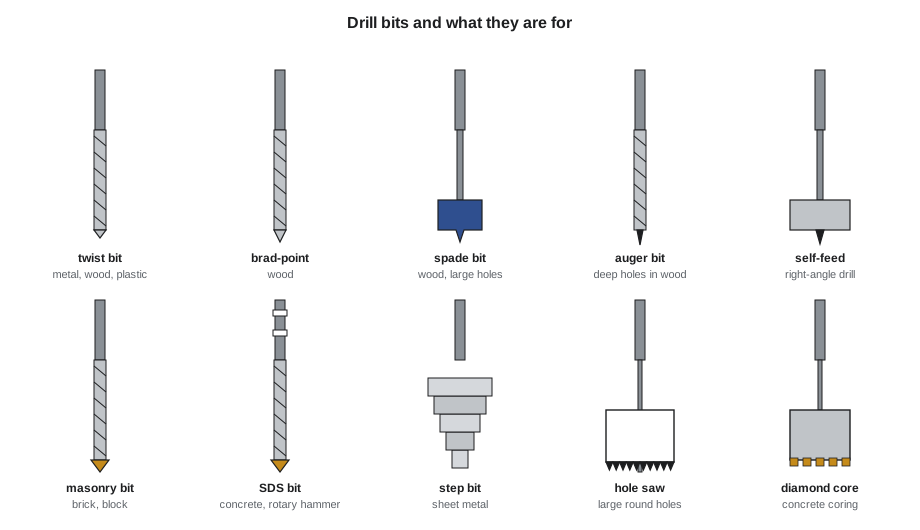
Choosing the right bit
The bit must match the material, the hole size and the tool:
- Twist bits, made of high-speed steel, drill metal, wood and plastic. Cobalt bits drill harder metals such as stainless steel. Titanium-coated bits stay sharp longer in general use.
- Brad-point bits have a sharp point that keeps the bit from wandering in wood.
- Spade bits and auger bits bore larger holes in wood. Self-feed bits, used in right-angle drills, pull themselves into the wood with a screw tip and cut holes up to about 100 mm or 4 in.
- Masonry bits have carbide tips brazed onto the steel. SDS bits are for rotary hammers and have grooves that lock into the chuck and let the bit slide back and forth with the hammer blows.
- Step bits cut a series of hole sizes in thin sheet metal, such as electrical boxes and duct.
- Hole saws, a toothed cup on a pilot bit, cut large round holes in wood, drywall, plastic and thin metal. Bi-metal hole saws cut metal; carbide-grit and diamond hole saws cut tile and masonry.
- Annular cutters, used in magnetic drills, cut a ring and leave a solid slug, which is faster and needs less power than drilling the whole hole.
Using the wrong bit is slow at best and dangerous at worst. A wood bit in steel overheats and snaps; a masonry bit in a drill without hammer action burns out; a hole saw on the wrong material binds and twists the drill out of the user's hands.
Speed, feed and heat
Every bit has a best speed for each material. Large bits and hard materials need slower speeds; small bits and soft materials can run faster. The reason is the speed of the cutting edge at the outside of the bit, called the cutting speed or surface speed. A large bit turning fast has its edge moving very quickly, which generates heat that softens and dulls the steel. Signs of too much speed are smoke, blue or darkened chips, a squealing bit and a dull tip. Feed, the pressure pushing the bit forward, should be steady enough to keep the bit cutting rather than rubbing.
- Mark the hole location with a punch in metal so the bit does not wander, and start small holes with a pilot hole for bits larger than about 10 mm or 3/8 in.
- Use cutting fluid when drilling steel to keep the bit cool and help clear chips.
- Ease off as the bit breaks through. Most bit binding, and the wrist injuries that come with it, happens at breakthrough, when the bit grabs the last thin layer of material.
The worked example at the end of this lesson calculates drill speeds from cutting speeds.
Torque, kickback and the wrist
A drill pushes back. Every bit of torque the drill puts into the bit is felt by the user as a twisting force on the handle. When a large bit or hole saw binds, the drill stops turning and the motor's full torque twists the drill body instead, and the user's wrist and arm with it. Right-angle drills with self-feed bits and large hole saws can break wrists and throw users off ladders. The controls are:
- Use the side handle supplied with the tool, and brace the handle against something solid, or brace your body, so the reaction does not twist you.
- Use tools with a clutch or an electronic anti-kickback feature that stops the motor when the tool suddenly rotates.
- Use the lowest speed that works for large bits, and never lock the trigger on.
- Never drill large holes from a ladder where a kickback could throw you off. Use a platform or scaffold.
- Clamp small workpieces; a sheet of metal caught by a bit spins like a blade.
Drilling into concrete: what is inside
Concrete slabs, walls and columns hide things that can kill a worker or cost a fortune to repair. Before Maya drills even a small hole for an anchor in a concrete slab at Kingsway Tower, she checks the drawings and the site rules, because the slab may contain:
- Reinforcing steel. Hitting a rebar with a masonry bit stops the bit and can damage the steel. Cutting rebar needs the structural engineer's approval.
- Post-tensioned tendons. TRD-101 and TRD-103 explained these: high-strength steel strands tensioned to enormous force. Drilling into one can cause it to break and burst out of the slab. Kingsway Tower's slabs are post-tensioned, and drilling deeper than a set depth needs a scan and a permit from the general contractor.
- Electrical conduit, embedded radiant heating tubes and other services, which can be live or pressurized.
Before any coring or deep drilling, the slab is scanned with ground-penetrating radar or X-ray by a trained technician, and the tendons and conduits are marked on the surface. Depth stops on the drill, or bits with marked depths, keep shallow holes shallow. If you hit metal unexpectedly, stop and report it.
Silica dust
Drilling concrete, brick and block produces respirable crystalline silica, a fine dust that causes silicosis, lung cancer and kidney disease, often years after exposure. TRD-101 introduced it; here are the controls specific to drilling:
OSHA's respirable crystalline silica standard for construction (29 CFR 1926.1153) includes Table 1, which lists specified controls for common tasks. For hand-held and stand-mounted drills, including impact and rotary hammer drills, Table 1 calls for a shroud or cowling with dust collection and a vacuum with a filter of at least 99 percent efficiency and a filter-cleaning mechanism. Hollow vacuum bits are a common way to meet it. Dry sweeping and compressed air are not allowed for silica dust where they would cause exposure; use a HEPA vacuum.
Water also suppresses dust for coring and some other tasks. Whichever control is used, it must actually be working: a vacuum with a full bag or a clogged filter pulls very little.
Drivers and fastening
Driving screws is the most common job for a drill/driver or impact driver. A few habits prevent stripped screws, damaged work and sore wrists:
- Use the right bit for the screw recess, in good condition. A worn bit cams out and damages the head.
- Set the clutch so the screw seats without stripping or breaking. Start low and increase.
- Hold the driver in line with the screw, and press firmly to keep the bit engaged.
- Use magnetic bit holders and screw guides for overhead work so you are not holding small screws near a spinning bit.
- For long lag screws and structural screws, follow the manufacturer's installation instructions, including pilot hole sizes where they are required.
Impact drivers are fast but can overdrive and snap small screws, crush soft materials and strip threads in thin metal. They are not the right tool for every fastener.
Inspection and care
- Check the chuck tightens evenly and holds the bit without slipping. Remove chuck keys before starting, since a flying key is a classic injury.
- Discard bits with cracked, chipped or worn tips, and hole saws with missing teeth.
- Check the side handle, clutch, switch and housing; clear dust from vents.
- Store bits in a case so the cutting edges do not knock against each other.
Worked example: drill speed
Worked problem
How fast should the bit turn?
Maya needs to drill a 1/2 in hole in mild steel for a hanger bracket with a high-speed steel twist bit. A cutting speed of about 80 surface feet per minute is recommended for mild steel with high-speed steel. What spindle speed should she use? What about a 1/4 in bit?
Show solution
- The cutting edge travels the circumference of the bit, pi times the diameter, on each revolution.
- RPM = cutting speed / circumference = (80 x 12 in/min) / (pi x 0.5 in) = 611 rev/min.
- For a 1/4 in bit: 960 / (pi x 0.25) = 1222 rev/min.
- Half the diameter means twice the speed. Round down to the nearest setting the drill has.
Answer: About 610 rev/min for 1/2 in and 1200 rev/min for 1/4 in.
The program below builds a small speed chart for several bit sizes and materials. The cutting speeds are typical starting values; the bit manufacturer's charts govern.
import math
speeds = {'mild steel': 80, 'stainless': 30, 'aluminum': 200}          # typical cutting speeds for high-speed steel bits, ft/min
bits = [0.125, 0.25, 0.375, 0.5, 0.625, 0.75]              # bit diameters, in
print("bit".rjust(6) + "".join(m.rjust(14) for m in speeds))
for d in bits:
    row = f"{d:6}"
    for m, v in speeds.items():
        rpm = 12 * v / (math.pi * d)
        row += f"{rpm:14.0f}"
print(row)bit mild steel stainless aluminum 0.125 2445 917 6112 0.25 1222 458 3056 0.375 815 306 2037 0.5 611 229 1528 0.625 489 183 1222 0.75 407 153 1019
See how quickly the speed falls as the bit gets larger. That is why hole saws and large bits must run slowly, and why running them fast burns them out.
Common mistakes
MistakeDrilling concrete without checking for post-tensioned tendons or conduit.
InsteadCheck the drawings and site rules; scan before coring or deep drilling, and use depth stops.
MistakeRunning a large hole saw at high speed.
InsteadLarge diameters need slow speeds; use the lowest speed that cuts.
MistakeDrilling with the side handle removed.
InsteadUse the side handle and brace against the reaction torque.
MistakeDry sweeping concrete dust.
InsteadUse dust extraction at the bit and a HEPA vacuum for cleanup.
MistakeLeaving the chuck key in the chuck.
InsteadRemove the key before starting; use keyless chucks where possible.
MistakeUsing an impact driver on every fastener.
InsteadUse a drill/driver with a clutch where overdriving or stripping is a risk.
Summary and key terms
- Drill/drivers, hammer drills, rotary hammers, impact drivers and right-angle drills each have their own job.
- Choose the bit for the material: twist, brad-point, spade, auger, masonry, SDS, step, hole saw or annular cutter.
- Larger bits and harder materials need slower speeds; heat and blue chips mean too fast.
- Binding bits throw reaction torque into the wrist; use side handles, anti-kickback features and platforms.
- Concrete may hide rebar, post-tensioned tendons and live conduit; check and scan before drilling.
- Control silica dust with shrouds, vacuum bits and HEPA vacuums, never dry sweeping.
- Clutch
- An adjustable mechanism that slips at a set torque to avoid overdriving screws.
- Hammer drill
- A drill with a light hammering action for small holes in masonry.
- Rotary hammer
- A heavy drill with a piston-driven hammer for drilling concrete, using SDS bits.
- Impact driver
- A tool that drives screws with short rotational impacts.
- Cutting speed
- The speed of the cutting edge at the outside of the bit.
- Hole saw
- A cup-shaped saw on a pilot bit that cuts large round holes.
- Annular cutter
- A hollow cutter that cuts a ring and leaves a solid slug, used in magnetic drills.
- Breakthrough
- The moment a bit exits the far side of the material, when binding is most likely.
Practice problems
Work each problem on paper first, then reveal the answer to check.
Which tool would you use to drill a 5/8 in hole 4 in deep in a concrete wall?
Show answer
A rotary hammer with an SDS bit.
What does the clutch on a drill/driver do?
Show answer
It slips at a set torque so screws are not overdriven.
A bit gives off smoke and blue chips in steel. What is wrong?
Show answer
The speed is too high or the bit is rubbing; slow down and use cutting fluid.
Using a cutting speed of 80 ft/min, what speed suits a 3/4 in bit?
Show answer
960 / (pi x 0.75) = about 410 rev/min.
When is a bit most likely to bind?
Show answer
At breakthrough.
What must happen before coring a post-tensioned slab?
Show answer
The slab must be scanned and the work approved by the general contractor and engineer.
Lesson quiz · 5 questions
Score 60% or more to complete this lesson.
Create a free account to save your progress, take quizzes and earn a certificate.