
TRD-104 · Lesson 11 of 12 · 21 min
Construction materials: wood, steel, concrete, pipe and wire
Tools work on materials, and knowing the materials is part of using tools well. A tradesperson who knows that a 2x4 is not two inches by four inches, that copper pipe comes in three wall thicknesses, that wet concrete burns skin and that a sheet of drywall weighs more than a bag of cement makes better choices and fewer mistakes. This lesson is a quick tour of the common materials on a building site, with the names, sizes and hazards every trade should know. Later trade courses go deeper into each one.
On a single walk through the fourth floor of Kingsway Tower, Maya passes concrete slabs and columns, steel stud walls, plywood backing, copper and plastic pipe, steel conduit, electrical cable and drywall. Each comes with its own sizes, grades and handling rules.
Wood and lumber
Kingsway Tower has a concrete structure, but wood is everywhere: formwork, blocking, backing, temporary stairs and guardrails, and the framing of the rooftop amenity building. Dimension lumber is sawn softwood in standard sizes. Its names are nominal sizes from the days when boards were sawn rough; after drying and planing, the actual size is smaller.
| Nominal name | Actual size (in) | Actual size (mm) |
|---|---|---|
| 2x4 | 1 1/2 x 3 1/2 | 38 x 89 |
| 2x6 | 1 1/2 x 5 1/2 | 38 x 140 |
| 2x8 | 1 1/2 x 7 1/4 | 38 x 184 |
| 2x10 | 1 1/2 x 9 1/4 | 38 x 235 |
| 2x12 | 1 1/2 x 11 1/4 | 38 x 286 |
| 4x4 | 3 1/2 x 3 1/2 | 89 x 89 |
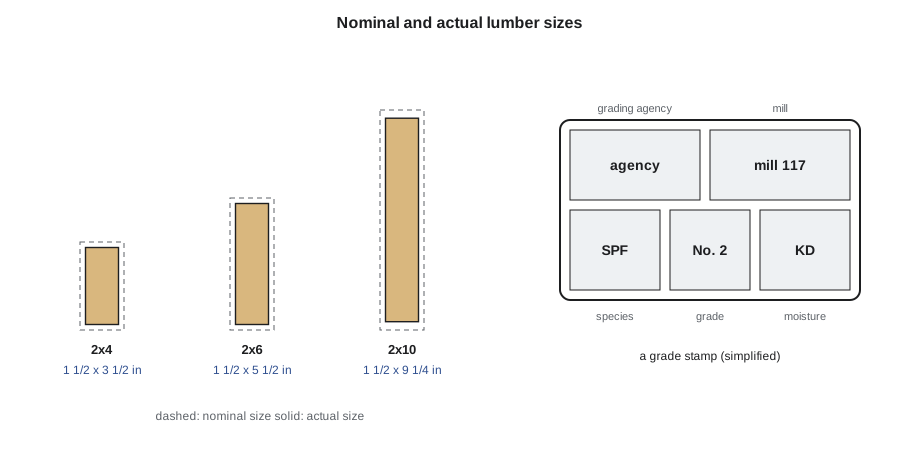
In the United States, dimension lumber is graded under rules approved by the American Lumber Standard Committee, and each piece carries a grade stamp showing the grading agency, the mill, the species (such as SPF, Douglas fir-larch or Southern pine), the grade (such as No. 1, No. 2 or Stud) and the moisture content: S-DRY or KD for dry and S-GRN for green. Structural uses require stamped lumber of the grade on the drawings.
Engineered wood products are made by gluing wood together for strength and consistency: plywood and oriented strand board (OSB) panels for sheathing and backing; laminated veneer lumber (LVL) beams and headers; wood I-joists with thin webs that must never be cut or notched except where the manufacturer allows; glued-laminated timber (glulam); and cross-laminated timber (CLT) panels for walls and floors. Each has its manufacturer's rules for cutting, notching, drilling and fastening, which must be followed because the strength depends on the parts the trades are tempted to cut.
Pressure-treated lumber contains preservatives that resist rot and insects. It is used where wood touches concrete or the ground, or is exposed to weather. Cut ends should be treated with a field preservative, sawdust should be cleaned up rather than burned, and the corrosive preservatives require hot-dip galvanized or stainless fasteners, as Lesson 9 explained. Wear gloves and a dust mask when cutting it, and wash your hands before eating.
Steel
Structural steel is rolled into standard shapes:
- Wide-flange beams and columns, designated by depth and weight: a W12x26 is about 12 in deep and weighs 26 lb per foot.
- Hollow structural sections (HSS), square, rectangular or round tubes, designated by outside dimensions and wall thickness.
- Angles, channels and plates, used for bracing, lintels, supports and connections.
- Strut channel, a light roll-formed channel with a slotted face, used by every mechanical and electrical trade to build pipe racks, trapezes and supports.
Cold-formed steel studs and track, used for interior walls and some exterior walls, are designated by web depth, flange width and steel thickness in mils (thousandths of an inch); for example, 18 mil (about 25 gauge) studs for non-load-bearing interior walls and 33 or 43 mil for heavier walls. Standard designations follow the steel framing industry's naming system, such as 362S162-33.
Reinforcing bars, or rebar, are sized in the United States by numbers in eighths of an inch: a #4 bar is 1/2 in in diameter and a #5 is 5/8 in. They are placed by ironworkers to the structural drawings and must not be cut, bent or moved by other trades without approval.
Steel is heavy, has sharp edges and burrs, and gets slippery when wet or oily. Wear cut-resistant gloves, keep fingers out from under loads being set down, and use blocking so material can be lifted later without trapping hands.
Concrete and masonry
Concrete is a mix of cement, water, sand and coarse aggregate (gravel or crushed stone), often with admixtures and supplementary materials such as fly ash and slag. It is delivered in ready-mix trucks, placed, consolidated with vibrators, finished and cured. Its strength is specified as the compressive strength after 28 days of curing.
Typical strengths on Kingsway Tower are 3500 psi for slabs on grade, 5000 psi for suspended post-tensioned slabs and higher for some columns. Concrete gains strength over weeks, and the formwork and shoring under a slab may not be removed until the engineer says the concrete is strong enough.
Wet concrete, mortar and grout are strongly alkaline, and prolonged contact causes serious chemical burns that can go unnoticed until hours later, especially when concrete gets inside boots or gloves or soaks through knee pads. Wear waterproof gloves and boots, keep concrete off your skin, and wash any contact promptly with clean water. Dry cement powder irritates the eyes and lungs. Cutting and drilling cured concrete and masonry produces silica dust, as Lessons 5 and 7 explained.
Masonry units include concrete block, brick and stone. Concrete block is hollow, with cores that may be filled with grout and rebar in reinforced walls. Its standard size, nominally 8 x 8 x 16 in (actually 7 5/8 x 7 5/8 x 15 5/8 in), lays up on a module with 3/8 in mortar joints.
Gypsum board and insulation
Gypsum board, or drywall, is a gypsum core faced with paper or glass mat. Types include regular, fire-rated (Type X), moisture-resistant, abuse-resistant and shaft-wall boards. A fire-rated wall is a system of studs, board layers, fasteners and sealant tested together, and every penetration through it by pipes, ducts or cables must be sealed with a listed firestop system. The trades that make the holes are responsible for firestopping them on many projects, including Kingsway Tower.
Drywall is heavy: a standard 1/2 in sheet measuring 4 x 8 ft weighs about 50 to 55 lb, and 5/8 in Type X sheets weigh more. Carrying sheets is a common cause of back and shoulder injuries; use carts, lifts and two-person carries.
Insulation materials include mineral wool, glass-fiber batts, rigid foam boards and spray foam. Glass and mineral fibers irritate skin, eyes and lungs; wear long sleeves, gloves, eye protection and a dust mask. Spray polyurethane foam releases isocyanates while it is being applied and curing, and only trained applicators work with it, with other trades kept out of the area for the time the manufacturer specifies.
Pipe and tubing
Maya's trade lives on pipe. Every trade should recognize the common types:
- Copper tube for water: Type K (thickest wall, often for underground), Type L (medium, the usual choice for water distribution in buildings) and Type M (thinnest). The type is printed along the tube and color-coded: green for K, blue for L, red for M. Joined by soldering, brazing or press fittings.
- PEX (cross-linked polyethylene) tubing for water distribution, joined with crimp, expansion or press fittings.
- Plastic drain, waste and vent pipe: PVC and ABS, joined with solvent cement in the right primer and cement for the material. Solvent cements and primers are flammable and give off vapors; use them with ventilation and away from ignition sources.
- Cast iron soil pipe, heavy and quiet, used for drains in many multi-story buildings including Kingsway Tower, joined with no-hub couplings.
- Steel pipe, black or galvanized, in schedules such as Schedule 40 that set the wall thickness, used for gas, sprinklers, hydronic heating and process piping. Joined by threading, welding or grooved couplings.
Nominal pipe sizes, as Lesson 2 noted, are names rather than measurements, and each material has its own actual dimensions.
Electrical conduit and cable
Sam's materials include rigid and intermediate metal conduit, electrical metallic tubing (EMT), flexible conduit, PVC conduit, and cables of many types. Conductors are sized by AWG, as Lesson 4 explained, and insulated with materials rated for temperature and location.
In the United States, common building wire and cable types include NM-B non-metallic sheathed cable for houses and some residential buildings, MC (metal-clad) cable, and single conductors such as THHN/THWN pulled in conduit. On a concrete high-rise like Kingsway Tower most wiring is in conduit or MC cable.
Other trades must not cut, move or use electrical conduit and cable as supports. Hanging a pipe or a tool bag from conduit can pull it loose and damage the conductors inside.
Safety data sheets and labels
Many construction materials are hazardous products: solvent cements, sealants, adhesives, fuels, paints, firestop materials, concrete admixtures and cleaning chemicals. As TRD-101 explained, each has a supplier label and a safety data sheet (SDS) that describes its hazards, the protective equipment needed, first aid and safe storage. Before using an unfamiliar product, read the label and know where the SDS is. Never transfer a chemical to a container without a proper label.
Handling and storing materials
- Know the weight before you lift. Look it up, estimate it or test-lift a corner. Plan two-person or mechanical lifts for heavy or awkward loads.
- Store materials on level ground or floors, on blocking, away from edges, openings and the site's travel routes, and away from guardrails, which must not be loaded.
- Do not overload a floor or a scaffold: stacks of drywall and pallets of block are very heavy and must be placed where the floor can carry them, as the general contractor directs.
- Secure materials against wind on upper floors and roofs. A sheet of plywood caught by the wind becomes a dangerous projectile.
- Keep flammable materials away from heat and hot work, and store compressed gas cylinders upright and secured.
Worked example: how heavy is it?
Worked problem
Planning a carry
Maya needs to carry six 10 ft lengths of 1 in Type L copper tube, two 10 ft lengths of 4 in cast iron pipe and a box of fittings weighing 26 lb from the hoist to a suite on the fourth floor. Type L 1 in copper weighs about 0.66 lb/ft and 4 in no-hub cast iron about 9.8 lb/ft. What does each item weigh, and how should she plan the carry if the site's guideline is to get help for any single lift over about 50 lb?
Show solution
- Copper: 6 x 10 ft x 0.66 lb/ft = 39.6 lb for all six. One carry.
- Cast iron: each length is 10 x 9.8 = 98 lb. Too heavy for one person: use a pipe cart or a two-person carry, one length at a time.
- Fittings box: 26 lb. One carry.
- Total: 39.6 + 196 + 26 = 262 lb, so several trips or a cart are needed.
Answer: Copper and fittings by hand; cast iron by cart or two people. The weights per length are approximate; check the supplier's data.
The program does the same planning for a list of materials and flags anything over the single-person limit.
# weights of material to move, flagged against a one-person lift limit
limit = 50                                   # lb per person per lift
items = [('1 in copper, Type L', 6, 10, 0.66), ('4 in cast iron', 2, 10, 9.8), ('10 ft steel strut', 4, 10, 1.7), ('2x4 lumber, 8 ft', 10, 8, 1.1)]                                   # (name, count, length ft, weight per ft)
total = 0
for name, count, length, w in items:
    each = length * w
    total += each * count
    plan = "one person" if each <= limit else ("two people" if each <= 2 * limit else "cart or hoist")
    print(f"{name:26} {count:2} x {each:6.1f} lb each -> {plan}")
print(f"total {total:.0f} lb")1 in copper, Type L 6 x 6.6 lb each -> one person 4 in cast iron 2 x 98.0 lb each -> two people 10 ft steel strut 4 x 17.0 lb each -> one person 2x4 lumber, 8 ft 10 x 8.8 lb each -> one person total 392 lb
The one-person limit is a site guideline, not a law of nature: awkward loads, carrying up stairs, poor grip and repeated lifting all reduce what is safe. TRD-101 covered safe lifting in more detail.
Common mistakes
MistakeUsing nominal lumber sizes in calculations.
InsteadUse the actual sizes: a 2x4 is 1 1/2 x 3 1/2 in, or 38 x 89 mm.
MistakeCutting or notching I-joists, LVL or trusses without checking.
InsteadFollow the manufacturer's rules or get the engineer's approval.
MistakeLetting wet concrete stay on skin or inside boots.
InsteadWear waterproof gloves and boots and wash off contact promptly.
MistakeLeaving pipe penetrations through fire-rated walls unsealed.
InsteadSeal every penetration with the listed firestop system.
MistakeHanging pipe or tools from electrical conduit.
InsteadNever use conduit or cable as a support.
MistakeStacking materials against guardrails or near floor edges.
InsteadStore materials away from edges, openings and guardrails.
Summary and key terms
- Dimension lumber is named by nominal sizes; actual sizes are smaller. Grade stamps show species, grade and moisture.
- Engineered wood products must be cut and drilled only as their manufacturers allow.
- Structural steel comes in standard shapes; steel studs are designated by size and thickness; rebar is placed only by ironworkers.
- Concrete is specified by compressive strength; wet concrete causes alkali burns.
- Know common pipe and electrical materials, and seal penetrations in fire-rated assemblies.
- Read labels and SDSs, know material weights, and store materials safely.
- Nominal size
- The name of a lumber or pipe size, which differs from its actual dimensions.
- Grade stamp
- The mark on lumber showing agency, mill, species, grade and moisture.
- Engineered wood
- Wood products made by gluing wood layers, strands or veneers together.
- Wide-flange shape
- A structural steel I-shaped section designated by depth and weight.
- Rebar
- Steel reinforcing bar placed in concrete.
- Compressive strength
- The crushing strength of concrete, usually measured at 28 days.
- Firestop system
- A tested set of materials that seals a penetration through a fire-rated assembly.
- Safety data sheet (SDS)
- A document describing a product's hazards, protection and first aid.
Practice problems
Work each problem on paper first, then reveal the answer to check.
What is the actual size of a 2x6 in inches?
Show answer
1 1/2 x 5 1/2 in.
What does KD on a grade stamp mean?
Show answer
The lumber was kiln dried.
Which copper tube type is usually used for water distribution in buildings, and what color is its marking?
Show answer
Type L, blue.
Why is wet concrete hazardous to skin?
Show answer
It is strongly alkaline and causes chemical burns.
What is the diameter of a #5 rebar?
Show answer
5/8 in.
How much do four 10 ft lengths of strut at 1.7 lb/ft weigh?
Show answer
4 x 10 x 1.7 = 68 lb.
Lesson quiz · 5 questions
Score 60% or more to complete this lesson.
Create a free account to save your progress, take quizzes and earn a certificate.