
TRD-104 · Lesson 6 of 12 · 21 min
Saws, blades and guarding
Power saws are among the most dangerous tools on a construction site. A circular saw blade spins at thousands of revolutions per minute, with teeth moving faster than a car on the highway, and it does not tell the difference between a board and a hand. Saw injuries are often severe: deep lacerations, amputated fingers and injuries from kickback, when the saw or the workpiece is thrown back at the user. Almost all of them involve one of three things: a guard that was missing, tied back or not working; a workpiece that was not supported; or a hand in the line of the blade.
Maya does not cut much lumber in her trade, but she uses a reciprocating saw to cut cast iron and plastic pipe, a portable band saw for threaded rod and strut, and occasionally a circular saw for plywood backing. The carpenters, drywallers and steel stud crews on Kingsway Tower use saws all day. Every apprentice needs to understand how saws are guarded and how kickback happens.
Types of power saws
- Circular saw: a hand-held saw with a round blade, used mainly for straight cuts in lumber and plywood. The worm-drive and sidewinder types differ in motor position.
- Track saw: a circular saw that runs on a guide rail for straight, clean cuts in sheet goods.
- Table saw: a stationary saw with the blade projecting through a table; the work is pushed into the blade. Used on site for ripping lumber and sheet goods.
- Chop saw and sliding compound saw: a circular blade on a pivoting arm that is brought down onto the work, for accurate crosscuts and angle cuts in trim, lumber and some metal with the right blade.
- Reciprocating saw: a blade that moves back and forth, used for demolition and rough cuts through wood, metal, pipe and nail-embedded lumber.
- Jigsaw: a small reciprocating blade for curves and cutouts in sheet materials.
- Portable band saw: a continuous blade running on two wheels, used for clean, cool cuts in pipe, conduit, strut and threaded rod.
- Concrete and masonry saws: hand-held cut-off saws, walk-behind floor saws and wall saws with diamond or abrasive blades, covered with abrasive tools in Lesson 7.
How a circular saw is guarded
A portable circular saw has an upper guard that covers the top of the blade and a lower guard, sometimes called the telescoping or retractable guard, that covers the teeth below the base plate. As the saw enters the work, the lower guard is pushed back by the material; when the saw leaves the cut, a spring snaps the guard back over the blade. While the blade coasts to a stop, which can take several seconds, the only thing between the spinning teeth and your leg is that lower guard.
The most dangerous habit with circular saws is pinning the lower guard open with a wedge, a nail or a piece of tape so that it does not drag. It feels faster. It also means the saw, set down while still spinning, can run across the floor or into the user's thigh. A lower guard that sticks, returns slowly or is bent must be fixed before the saw is used. Check it every time: retract it by its lever and let it go. It should snap closed instantly, all the way.
Other circular saw safety points:
- Set the blade depth so it projects no more than about 6 mm or 1/4 in below the material, or roughly one tooth's height. Less exposed blade means less to contact and less kickback force.
- Support the work on both sides of the cut so the kerf does not close and pinch the blade, but so the offcut can fall away freely. Never cut a board supported only at its ends across the middle, where it will sag and pinch.
- Keep the cord behind the saw and clear of the cut line.
- Hold the saw with both hands where it has two handles, and stand to the side of the cut line, not directly behind the saw.
- Wait for the blade to stop completely before lifting the saw out of the cut or setting it down.
- Never reach under the material while cutting.
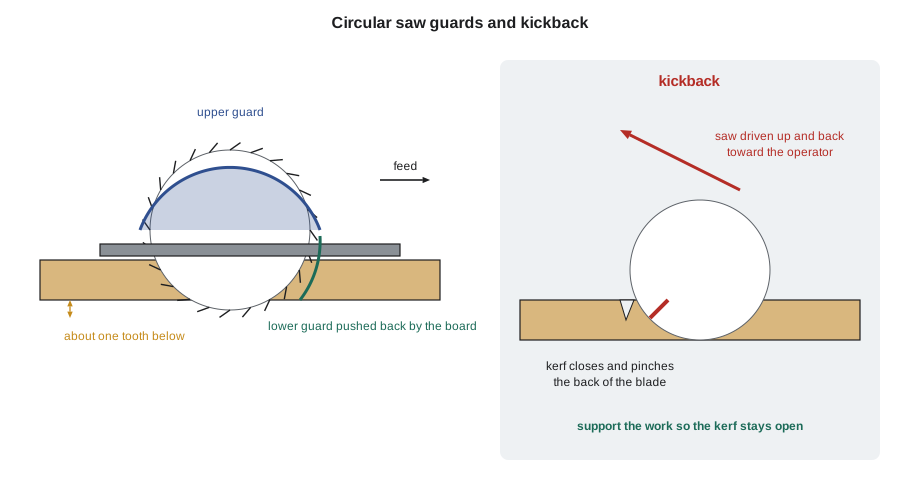
Kickback
Kickback is the sudden, violent reaction when a blade is pinched, binds or catches. On a circular saw, the teeth at the back of the blade are moving up and toward the user. If the kerf closes behind the blade, or the blade is twisted in the cut, those rising teeth bite into the wood and drive the saw up and back out of the cut toward the operator, faster than anyone can react. On a table saw, the rising teeth at the back of the blade can catch the workpiece and throw it back at the operator at high speed.
Common causes of kickback:
- A dull or dirty blade, which needs more force and heats and binds.
- The kerf closing because the work is poorly supported, or because the wood has internal stresses that close the cut.
- Twisting the saw in the cut, or forcing it around a curve.
- Cutting into a knot, nail or embedded object.
- Starting the saw with the blade already touching the work.
- On a table saw, ripping without a riving knife or splitter, or letting the work drift away from the fence.
Defenses against kickback include sharp blades, good support, keeping the saw straight, standing out of line with the blade, and the anti-kickback features of modern saws: electric brakes that stop the blade in a second or two, slip clutches, riving knives that sit behind the blade to keep the kerf open, and anti-kickback pawls on table saws that dig into work moving backward.
Table saws on site
Table saws are responsible for many of the most serious amputations in construction. Their rules are strict:
- Use the blade guard, riving knife and anti-kickback pawls supplied with the saw.
- Use the rip fence for ripping and the cross-cut gauge or a sled for crosscutting. Never cut freehand, and never use the fence and gauge together on the same cut, which traps the offcut and throws it.
- Use push sticks for narrow pieces, keeping hands at least 150 mm or 6 in from the blade.
- Set the blade only slightly higher than the work.
- Stand to the side of the blade, out of the line of a kickback.
Some table saws now have a flesh-detection system that senses contact with skin and stops and drops the blade in milliseconds. These systems greatly reduce injuries but do not replace guards and safe habits, and they can trip on wet material or metal.
Guarding requirements come from the regulations as well as from manufacturers.
OSHA's construction standard for woodworking tools (29 CFR 1926.304) requires portable circular saws to have guards above and below the base plate, with the lower guard returning automatically to cover the blade, and requires guards, spreaders and anti-kickback devices on table saws used for ripping.
Reciprocating saws, jigsaws and band saws
Reciprocating saws are rough and powerful. They are the tool of choice for demolition and for cutting pipe in place, and their main hazards are the blade binding and the saw jumping, and cutting into hidden wiring or pipes behind a surface. Keep the saw's shoe pressed firmly against the work so the blade does not hammer the saw back and forth, and before cutting into a wall, floor or ceiling, confirm what is behind it. Maya once watched a demolition worker on another job cut through a live cable inside a wall with a reciprocating saw; the GFCI tripped and the saw's double insulation held, but the lesson stayed with her.
Jigsaws are lighter but follow the same rules: clamp the work, keep the shoe down, let the blade stop before lifting it out. Portable band saws cut cleanly and with little spark or noise, but their blade is exposed for a short length at the cut. Keep fingers away from the cutting area, never try to stop a coasting blade by hand, and use the saw's built-in work stop to brace the workpiece.
Blades
The blade matters as much as the saw. Each blade is designed for a material and marked with a maximum speed.
- Circular saw blades are described by diameter, number of teeth and tooth shape. Fewer, larger teeth rip quickly along the grain; more, smaller teeth crosscut cleanly. Carbide-tipped blades stay sharp far longer than steel blades.
- Special blades cut steel studs, cement-board siding, plastic or metal. Never use a wood blade on metal; the teeth can break off and fly.
- Reciprocating and jigsaw blades are described by length and teeth per inch, like hacksaw blades. Bi-metal blades cut wood with nails and metal; carbide-grit blades cut tile and cast iron.
- Every blade is marked with a maximum safe speed in revolutions per minute. The saw's no-load speed must never exceed the blade's maximum speed.
- The blade's arbor hole must match the saw's arbor. A blade that does not fit the arbor wobbles and can break.
Install blades with the power off and the battery removed or the cord unplugged, with the teeth pointing in the direction of rotation shown on the saw's guard, and tighten the arbor nut with the wrench supplied.
Dust and noise
Saws generate dust and noise. Wood dust is a respiratory irritant and some wood dust is a known carcinogen; cement-board and masonry saws produce silica dust and need the controls in Lesson 7. Most power saws are loud enough to require hearing protection, and circular saws, cut-off saws and table saws often exceed 100 decibels at the operator's ear. Use dust collection where the saw has a port, cut outdoors or in ventilated areas, and wear hearing protection.
Worked example: blade speed
Worked problem
Is this blade safe on this saw?
A carpenter on Kingsway Tower has a 7 1/4 in circular saw with a no-load speed of 5800 rev/min, and a borrowed 7 1/4 in blade marked maximum 5000 rev/min. Can she use it? How fast are the teeth moving at the saw's speed?
Show solution
- Compare speeds: the saw runs at 5800 rev/min, faster than the blade's maximum of 5000. The blade must not be used on this saw.
- Rim speed = pi x diameter x rev/min = pi x (7.25 / 12) ft x 5800 = 11 008 ft/min.
- Convert to mph: 11 008 ft/min x 60 / 5280 = 125 mph.
- The teeth move at about 125 mph, which is why even a brief contact causes a severe injury and why a blade spinning beyond its rating can fail.
Answer: No. The blade is rated below the saw's speed. At 5800 rev/min the teeth move at about 125 mph.
The program checks a list of blade and tool combinations from the gang box and prints the rim speed of each.
import math
# (tool, tool no-load rpm, blade diameter in in, blade max rpm)
combos = [
    ("circular saw A", 5800, 7.25, 7000),
    ("circular saw A", 5800, 7.25, 5000),
    ("chop saw", 4000, 12, 5000),
    ("track saw", 6800, 6.5, 9000),
]
for tool, rpm, d, bmax in combos:
    rim = math.pi * d * rpm / 1056.0        # rim speed in mph
    ok = "OK" if rpm <= bmax else "DO NOT USE: tool faster than blade rating"
print(f"{tool:15} {rpm:5} rpm, blade {d} in (max {bmax}): rim {rim:5.0f} mph {ok}")circular saw A 5800 rpm, blade 7.25 in (max 7000): rim 125 mph OK circular saw A 5800 rpm, blade 7.25 in (max 5000): rim 125 mph DO NOT USE: tool faster than blade rating chop saw 4000 rpm, blade 12 in (max 5000): rim 143 mph OK track saw 6800 rpm, blade 6.5 in (max 9000): rim 131 mph OK
Blade ratings are printed on the blade near the arbor hole and on wheels for grinders. Check them every time you change a blade.
Common mistakes
MistakePinning the lower guard of a circular saw open.
InsteadNever defeat the guard; repair a sticking guard before use.
MistakeSetting the blade depth far deeper than the material.
InsteadSet the depth to about one tooth, 6 mm or 1/4 in, below the work.
MistakeCutting a board supported only at its ends across the middle.
InsteadSupport the work so the kerf stays open and the offcut can fall free.
MistakeStanding directly behind the saw.
InsteadStand to the side of the cut line, out of the path of a kickback.
MistakeUsing a blade rated below the saw's speed.
InsteadThe tool's no-load speed must not exceed the blade's maximum.
MistakeCutting into a wall without checking for wiring and pipes.
InsteadConfirm what is behind a surface before cutting into it.
Summary and key terms
- Circular saw lower guards must snap closed instantly; never pin them open.
- Kickback happens when the blade is pinched or binds; support work, keep blades sharp and stand aside.
- Table saws need guards, riving knives, push sticks and fences used correctly.
- Reciprocating saws and jigsaws need the shoe held firmly and hidden services checked.
- Match blades to the material, the arbor and the speed; the tool must never run faster than the blade's rating.
- Control dust and wear hearing protection; saws are loud.
- Lower guard
- The retractable guard that covers the blade below a circular saw base plate.
- Kickback
- A sudden violent reaction when a blade binds, throwing the saw or work back at the operator.
- Kerf
- The slot cut by a saw blade.
- Riving knife
- A metal plate behind the blade that keeps the kerf open.
- Anti-kickback pawls
- Toothed fingers on a table saw that dig into work moving backward.
- Push stick
- A stick used to feed narrow pieces past a table saw blade.
- No-load speed
- The speed a tool runs at with nothing being cut.
- Arbor
- The shaft a blade or wheel is mounted on.
Practice problems
Work each problem on paper first, then reveal the answer to check.
What should a circular saw's lower guard do when the saw leaves the cut?
Show answer
Snap closed over the blade instantly.
How deep should a circular saw blade project below the work?
Show answer
About one tooth, roughly 1/4 in.
A 10 in table saw runs at 4800 rev/min. What is the rim speed in mph?
Show answer
pi x (10/12) x 4800 x 60 / 5280 = about 143 mph.
Why should you never cut a board supported at both ends across the middle?
Show answer
It sags and closes the kerf, pinching the blade and causing kickback.
What is a riving knife for?
Show answer
To keep the kerf open behind the blade and reduce kickback.
What two numbers must you compare before mounting a blade?
Show answer
The tool's no-load speed and the blade's maximum speed.
Lesson quiz · 5 questions
Score 60% or more to complete this lesson.
Create a free account to save your progress, take quizzes and earn a certificate.