
TRD-104 · Lesson 1 of 12 · 26 min
Hand tools for cutting, striking and gripping
On her first morning with Northbridge Mechanical at Kingsway Tower, Maya Chen was handed a list. It was not a list of tasks but a list of tools: the hand tools every first-year plumbing apprentice is expected to bring. Luis Ferreira, the journeyperson she works with, went through it with her at the gang box. "You will use these every hour of every day," he said. "Buy good ones, learn what each one is for, and never use one for a job it was not made for." This course is about that idea. It covers the tools, equipment and materials that every trade shares, from a utility knife to a powder-actuated tool, from a wood screw to a concrete anchor, and how to choose, use, inspect and care for them.
This first lesson covers the oldest tools on site: the ones that cut, strike and grip. They are so familiar that people stop thinking about them, and that is exactly why they cause so many injuries. Hand tools are behind a large share of cuts, bruises, eye injuries and strains in construction. Most of those injuries come from three habits: using the wrong tool, using a damaged tool, and using a tool in a way that puts a hand or eye in the line of fire.
Three rules for every hand tool
Before looking at individual tools, Luis gave Maya three rules that apply to all of them. They come up again in every lesson of this course.
- Right tool for the job. A screwdriver is not a chisel or a pry bar. Pliers are not a wrench. A wrench is not a hammer. Using a tool for something it was not designed for damages the tool, damages the work and is the classic setup for a slip and an injury.
- Right condition. Check the tool before you use it. A mushroomed chisel head, a cracked hammer handle, a loose head, a worn wrench jaw or a dull blade all turn a routine task into a hazard. Damaged tools are taken out of service, not used carefully.
- Right position. Before you push, pull, cut or strike, ask where your hand, your body and the tool will go if the tool slips, the work moves or the blade breaks through. Cut away from yourself. Pull a wrench toward you rather than pushing it away. Keep the hand that holds the work out of the path of the blade or the hammer.
Eye protection is required on site at all times on most projects, including Kingsway Tower, and it matters with hand tools as much as with power tools. Chips fly off a struck chisel, a snapped drill bit or a nail that is struck at an angle. Gloves are a different question: cut-resistant gloves are right for handling sheet metal and using a knife, but loose gloves can get caught in rotating power tools. Lesson 12 and TRD-101 cover how to choose gloves for the task.
Cutting tools
Cutting tools include knives, saws, snips, cutters and chisels. They are the leading cause of hand-tool lacerations, and the leading cause of those is a dull or poorly chosen blade, because a dull blade needs more force, and more force means a bigger slip when it lets go.
Utility knives
The utility knife is probably the most used and most misused tool on any site. Every trade uses one: to score drywall, open packaging, trim insulation, cut tape, strip cable sheathing or shave a burr off plastic pipe. Kingsway Tower, like many sites, has a knife policy set by the general contractor, Stonebridge. Anika Shah, the site safety coordinator, explained it at orientation:
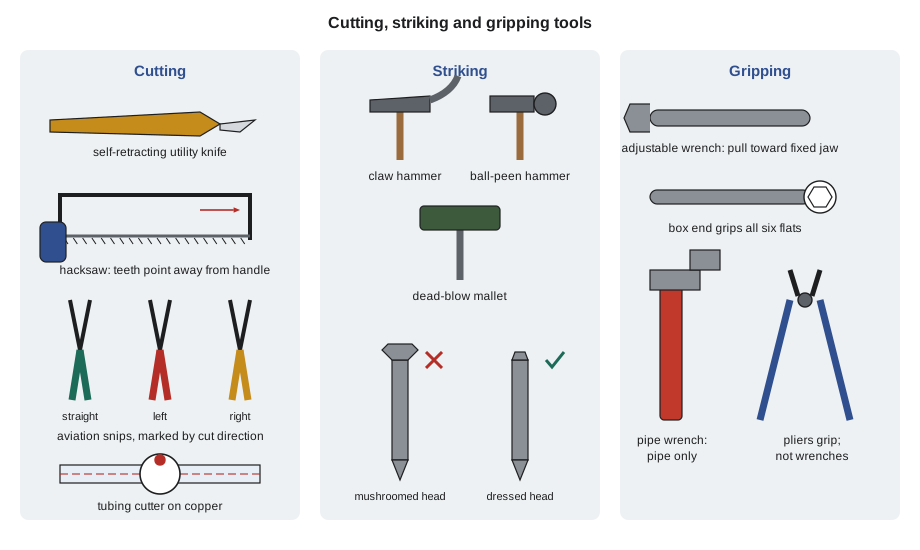
- Only self-retracting or auto-retracting knives are allowed, where the blade springs back into the handle when you release the slide or lift the knife off the material. Fixed-blade box cutters and snap-off knives with long exposed blades are not allowed for general use.
- Change blades often. A fresh blade cuts with less force and is safer. Used blades go into a closed blade bank or sharps container, never loose in a pocket, a bucket or the garbage.
- Cut away from your body and away from the hand holding the material. Keep your free hand behind the blade, not in front of it.
- Cut on a stable surface with the material supported. Never cut toward your thigh or across your lap; leg cuts from utility knives can reach major blood vessels.
- Wear cut-resistant gloves on the hand that holds the material when you do a lot of cutting.
Many injuries happen when a knife is used to pry, to scrape or to open a can of primer. The blade snaps and the hand that was pushing keeps going. If you need to pry, use a pry bar; if you need to scrape, use a scraper.
Hand saws and hacksaws
Hand saws cut wood; hacksaws cut metal and plastic. Saws are rated by the number of teeth per inch, written TPI, which is still the usual way to describe blades in both Canada and the United States. A rough guide is that at least three teeth should be in contact with the material at all times. Too few teeth, and they catch and snag; too many on thick material, and the gullets between the teeth clog.
| Blade | Teeth per inch | Typical use |
|---|---|---|
| Coarse wood saw | 6 to 10 | Fast cutting of framing lumber |
| Fine wood or trim saw | 11 to 15 | Smooth cuts in trim and plywood |
| Hacksaw, coarse | 18 | Thick steel, solid bar, plastic pipe |
| Hacksaw, medium | 24 | General use: pipe, conduit, angle |
| Hacksaw, fine | 32 | Thin-wall tube, sheet metal, EMT conduit |
A hacksaw blade is installed with the teeth pointing away from the handle, so that it cuts on the push stroke. Tension the blade firmly; a loose blade wanders and breaks. Start a cut with light pressure, keep the stroke long and steady, and ease off at the end so the piece does not drop onto your foot. Hold the work in a vise or a pipe stand, not in your hand.
Snips and cutters
Aviation snips cut sheet metal and come in three types, each marked on its handles: one cuts straight, one curves left and one curves right. Tin snips with long straight blades are for straight cuts in light sheet. Cable cutters, bolt cutters, wire strippers and the specialty cutters each trade uses, such as plastic pipe cutters for PEX and PVC, are all designed for one material and one range of sizes. A plastic pipe cutter used on copper will be ruined; a wire cutter used on a hardened bolt will chip and send a fragment flying.
Sheet metal edges are as dangerous as any blade. Cut sheet leaves a burr that slices skin, so handle it with cut-resistant gloves and file or fold the edges when you can.
Chisels and tubing cutters
A wood chisel is pushed by hand or tapped with a mallet; a cold chisel, made of hardened steel, is struck with a hammer to cut or split metal, masonry or concrete. A cold chisel's struck end slowly flattens and spreads into a mushroom shape. The overhanging edge of a mushroomed head can break off when struck and fly like shrapnel. Mushroomed heads are ground back to a slight chamfer, or the chisel is retired. Wear safety glasses when using a chisel, and use a chisel holder or a hand guard on long chisels to keep the holding hand away from the hammer.
Plumbers cut copper tube with a tubing cutter: a sharp wheel that is tightened a little after each turn around the tube. It leaves a square cut and a small burr on the inside, which must be removed with a reamer so it does not restrict flow or cause turbulence that erodes the pipe. A hacksaw cut leaves a rougher, less square end and more burr. Maya spends much of her first week cutting, reaming and cleaning copper for water lines in the fourth-floor suites.
Striking tools
Hammers and mallets deliver force through a hardened face. The face, the handle and the way the head is attached all matter. Each hammer is designed for a type of work:
- Claw hammer: for driving and pulling nails. The face is slightly crowned to reduce bent nails and marks. A framing hammer is heavier with a longer handle and often a milled face that grips the nail head.
- Ball-peen hammer: for striking metal, punches and cold chisels, and for shaping metal. Its face is harder and its edges are chamfered to reduce chipping.
- Sledge and hand drilling hammer: heavy hammers for striking cold chisels, stakes and wedges, or for demolition.
- Dead-blow and soft-face mallets: rubber, plastic or rawhide faces, some filled with shot so they do not bounce. They are used where a steel face would damage the work.
The key safety rule is never to strike one hardened tool with another hardened face it was not designed for. Striking a hammer face against another hammer, or a claw hammer against a cold chisel, can chip the hardened steel and send fragments into an eye. A claw hammer is for nails; a ball-peen or drilling hammer is for chisels and punches. Hammer faces that are chipped, cracked or mushroomed are retired.
Check the handle and head before use. Wooden handles can split, and heads can loosen as the wood dries. A loose head can fly off on the backswing. Composite and steel handles do not loosen in the same way but can crack. Grip near the end of the handle, keep your eye on the target, start a nail with light taps while holding it near the top, and once it holds, take your fingers away.
Pry bars and wrecking bars
A pry bar uses leverage to lift, separate and pull. The longer the bar, the more force it multiplies, which is also why a slipping bar delivers so much energy back toward the user. Seat the bar fully, keep your body out of the line of the bar if it slips, and pull rather than push where possible. Never extend a bar with a pipe or use a screwdriver in its place.
Gripping and turning tools
Wrenches and pliers transmit turning force. They are the tools most often misused, because there always seems to be one in reach.
- Combination and box-end wrenches fit one fastener size. A box end, which surrounds the nut, grips all six flats and is less likely to round the corners or slip than an open end.
- Adjustable wrenches fit a range of sizes. Tighten the jaw fully against the flats and apply force toward the fixed jaw, not the movable one, which is weaker.
- Pipe wrenches have serrated jaws that bite into round pipe and get tighter as you pull. They are for pipe, not for nuts, which they will chew up. Plumbers use them in pairs: one to turn and one to hold back, so the force goes into the joint and not into the rest of the system.
- Pliers grip, bend and cut. Tongue-and-groove pliers adjust to several sizes; locking pliers clamp and stay clamped. Pliers are not a substitute for a wrench on a nut.
Wrenches come in metric sizes, in millimeters, and imperial sizes, in fractions of an inch. On Kingsway Tower Maya meets both: imperial on most fittings, valves and fasteners, and metric on some equipment and imported anchors. A 13 mm wrench on a 1/2 inch nut is close but not exact, and the small gap is enough to round the corners under load. Always use the size that fits.
Never put a pipe or cheater bar on a wrench to get more leverage. The wrench is designed for the force a person can apply with its own handle. A cheater bar can bend or break the wrench, strip the fastener or snap a bolt, and the sudden release throws the user off balance. If a fastener will not turn, use a longer wrench designed for it, penetrating oil or the right power tool.
Screwdrivers and drive bits
Screwdrivers come in many tip types: slotted, Phillips, square (also called Robertson, very common in Canada), star (six-lobe) and hex. Using the wrong size or type cams the tip out of the screw, strips the head and lets the tool slip. Square drive was invented in Canada and grips well enough that the bit rarely slips, which is why it is the default for wood screws and electrical devices on many Canadian sites; in the United States, Phillips and star drives are more common. Insulated screwdrivers, rated and marked for electrical work, are used by electricians like Sam Torres, but insulation is a backup, not permission to work on live circuits.
Ergonomics: the slow injury
Not every hand-tool injury is sudden. Repeated gripping, twisting and pounding over years causes tendinitis, carpal tunnel syndrome and other musculoskeletal disorders. The tool design and the way it is used make a difference:
- Choose handles that fit your hand: thick enough that your fingers do not overlap, and long enough to spread the pressure across the palm.
- Keep the wrist straight. A bent-handle tool may keep the wrist straight in one position and bend it badly in another; choose the tool for the work position.
- Use the right weight. A hammer that is too heavy tires the arm and reduces accuracy; one that is too light needs more blows.
- Alternate tasks and hands where possible, and use power tools for highly repetitive work such as driving hundreds of screws.
Luis tells Maya that the tools a journeyperson owns are chosen over years, and that comfort matters as much as price. Lesson 12 returns to choosing your own kit.
Worked example: sizing a hacksaw blade
Worked problem
Choosing teeth per inch
Maya needs to cut 1/2 inch Type L copper tube with a wall thickness of about 0.040 in, and later some 1 in solid steel bar for a support bracket. Which hacksaw blades should she use if at least three teeth must be in contact with the material?
Show solution
- For a tube, the teeth cut through the wall, so the wall thickness is what matters. It is about 0.040 in.
- Three teeth in 0.040 in means at least 3 / 0.040 = 75 teeth per inch, which no hacksaw has. Use the finest blade, 32 TPI, and keep the blade at a low angle so more teeth bear on the wall.
- For 1 in solid bar, the cut is 1 in long, so three teeth in contact is easy with any blade. The concern is clogging: use a coarse 18 TPI blade, which has bigger gullets to clear the chips.
- Better still for copper tube: use a tubing cutter, which gives a square cut and less burr.
Answer: Fine 32 TPI for thin-wall tube (or a tubing cutter); coarse 18 TPI for thick solid bar.
The program below does the same reasoning for a list of materials: it works out the minimum teeth per inch needed to keep three teeth in contact and picks the finest standard blade that does not risk clogging on thick material.
# choose a hacksaw blade (teeth per inch) for each material thickness
blades = [18, 24, 32]           # standard hacksaw blades, TPI
jobs = {                         # material: thickness of the cut in inches
    "copper tube wall": 0.040,
    "EMT conduit wall": 0.042,
    "steel angle leg": 0.1875,
    "plastic pipe wall": 0.154,
    "solid steel bar": 1.0,
}
for name, t in jobs.items():
    need = 3 / t                 # teeth per inch for three teeth in contact
    ok = [b for b in blades if b >= need]
    if ok:
        pick = min(ok)           # coarsest blade that still keeps 3 teeth in
    elif t < 0.25:
        pick = max(blades)       # thin wall: finest blade, low cutting angle
    else:
        pick = min(blades)
    note = "" if need <= max(blades) else " (thin wall: tilt blade, or use a cutter)"
print(f"{name:18} {t:6.3f} in needs {need:5.1f} TPI -> {pick} TPI{note}")copper tube wall 0.040 in needs 75.0 TPI -> 32 TPI (thin wall: tilt blade, or use a cutter) EMT conduit wall 0.042 in needs 71.4 TPI -> 32 TPI (thin wall: tilt blade, or use a cutter) steel angle leg 0.188 in needs 16.0 TPI -> 18 TPI plastic pipe wall 0.154 in needs 19.5 TPI -> 24 TPI solid steel bar 1.000 in needs 3.0 TPI -> 18 TPI
Real blade choice also depends on the metal's hardness and whether the cut is straight or curved, but the three-teeth rule is a good start.
Common mistakes
MistakeUsing a utility knife to pry or scrape.
InsteadUse a pry bar or scraper. Knife blades snap under side loads.
MistakeStriking a cold chisel with a claw hammer.
InsteadUse a ball-peen or drilling hammer, and dress or retire mushroomed chisel heads.
MistakePutting a cheater bar on a wrench.
InsteadUse a longer wrench made for the job, penetrating oil or a power tool.
MistakeUsing a pipe wrench on a nut or bolt head.
InsteadUse a box-end or combination wrench that fits the flats.
MistakeCutting toward your body or across your lap.
InsteadCut away from yourself on a supported surface, with the free hand behind the blade.
MistakePushing an adjustable wrench against its movable jaw.
InsteadSet the jaw tight and pull with the force toward the fixed jaw.
Summary and key terms
- Use the right tool, in the right condition, in the right position.
- Utility knives cause many cuts; use self-retracting knives, change blades often and dispose of them in a blade bank.
- Match saw teeth per inch to the material; keep at least three teeth in contact where possible.
- Never strike one hardened face with another not designed for it; retire chipped or mushroomed tools.
- Wrenches and pliers must fit the fastener; never use a cheater bar.
- Ergonomic tool choice prevents slow injuries such as tendinitis and carpal tunnel syndrome.
- Self-retracting knife
- A utility knife whose blade retracts automatically when released or lifted off the material.
- Teeth per inch (TPI)
- The number of saw teeth in one inch of blade; finer blades have more.
- Cold chisel
- A hardened steel chisel struck with a hammer to cut metal or masonry.
- Mushroomed head
- The flattened, spread-out struck end of a chisel or punch, which can break off when struck.
- Ball-peen hammer
- A hammer with a hardened face for striking metal, punches and chisels.
- Cheater bar
- A pipe slipped over a wrench handle to gain leverage; not allowed.
- Reamer
- A tool that removes the burr inside a cut pipe or tube.
- Square drive
- A screw drive with a square recess, also called Robertson, common in Canada.
Practice problems
Work each problem on paper first, then reveal the answer to check.
Name the three rules that apply to every hand tool.
Show answer
Right tool for the job, right condition, right position.
Why is a dull utility knife blade more dangerous than a sharp one?
Show answer
It needs more force, so a slip carries more energy.
Which way do hacksaw teeth point?
Show answer
Away from the handle, so the blade cuts on the push stroke.
Why must a mushroomed chisel head be dressed or retired?
Show answer
The spread edge can break off and fly like shrapnel when struck.
Why do plumbers use two pipe wrenches on a joint?
Show answer
One turns and one holds back, so force goes into the joint, not the rest of the piping.
What is wrong with using a 13 mm wrench on a 1/2 inch nut?
Show answer
It is not an exact fit and can round the corners or slip under load.
Lesson quiz · 5 questions
Score 60% or more to complete this lesson.
Create a free account to save your progress, take quizzes and earn a certificate.