
TRD-104 · Lesson 4 of 12 · 22 min
Power tool basics: cords, batteries and electrical safety
Power tools multiply what a person can do. A cordless drill drives a hundred screws in the time a screwdriver drives five; a grinder cuts a steel rod in seconds. They also multiply what can go wrong. This lesson covers the safety features and hazards that all power tools share: how they are powered, how they are protected against electric shock, how batteries should be handled, and the basic rules every apprentice follows before pulling a trigger. The following lessons look at particular tools: drills, saws, grinders and fastening tools.
Sam Torres, the first-year electrical apprentice on Kingsway Tower, spends his days around electricity, but the rules in this lesson apply just as much to Maya, the drywall crew and the general workers. Electrical shocks from damaged cords and tools happen in every trade.
Ways tools are powered
Power tools are classified by their energy source, and each has its own hazards:
- Electric, corded: plugged into a receptacle, usually 120 volts on site. Hazards: shock, damaged cords, tripping.
- Electric, cordless: powered by a rechargeable battery, now most often lithium-ion. Hazards: battery fires, unexpected starts, and less obvious shock hazards when cutting into hidden wiring.
- Pneumatic: driven by compressed air from a compressor, such as nailers, staplers, impact wrenches and chipping hammers. Hazards: whipping hoses, air injected into the skin, noise.
- Hydraulic: driven by fluid under pressure, such as jacks, pipe benders and crimpers. Hazards: high-pressure fluid injection, crushing.
- Fuel-powered: gasoline engines, such as cut-off saws, compactors and generators. Hazards: carbon monoxide, fuel fires, noise. Never run a fuel-powered tool indoors or in an enclosed space without engineered ventilation and gas monitoring.
- Powder- or gas-actuated: fired by a cartridge or fuel cell, covered in Lesson 8.
How electric shock happens
Electric current flows when there is a path. Your body becomes part of the path when you touch something energized while another part of you touches something grounded: a metal stud, a wet slab, a steel deck or a pipe. The current, not the voltage alone, does the harm. As little as a few tens of milliamps across the chest can disturb the heart's rhythm, and at 120 volts a wet hand on a damaged tool can easily pass that much. TRD-101 covered the effects of current on the body; here the point is how tools are designed and used to keep current out of you.
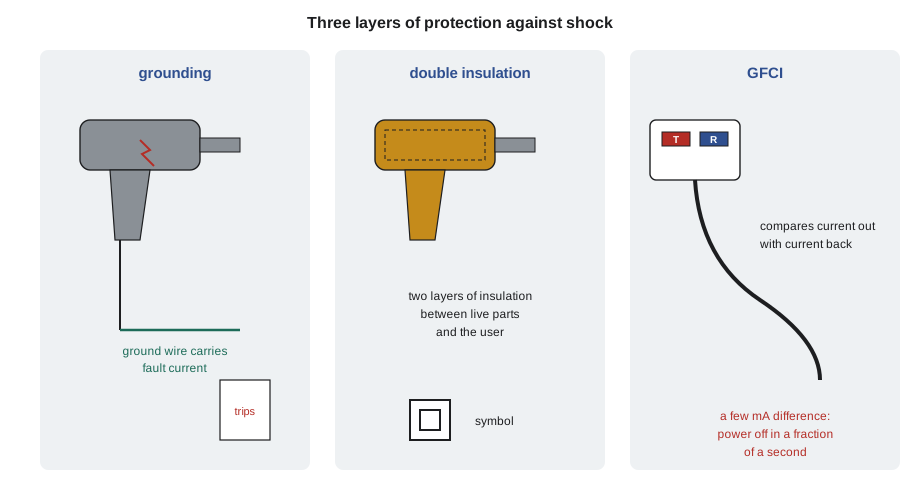
Two features protect the user of a corded tool from a fault inside it:
- Grounding. A three-prong plug has a ground pin that connects the tool's metal housing to ground. If a live wire inside touches the housing, current flows through the ground wire and trips the breaker instead of flowing through the user. Cutting off or bending the ground pin, or using an adapter that drops it, removes that protection.
- Double insulation. Many modern tools have plastic housings and two layers of insulation between the live parts and the user. They are marked with a symbol of a square inside a square and have two-prong plugs. Double insulation protects against a fault inside the tool, but not against a damaged cord, a tool dropped in water or a blade cutting into a live wire.
Ground fault circuit interrupters
A ground fault circuit interrupter, or GFCI, compares the current flowing out on the live wire with the current returning on the neutral. If they differ by more than a few milliamps, some current must be leaking somewhere, possibly through a person, and the GFCI cuts the power in a fraction of a second. It cannot prevent a shock, but it limits how long the current flows, which is what makes the difference between a jolt and a fatal injury.
In the United States, OSHA's construction standard (29 CFR 1926.404) requires employers to protect temporary 120 volt, 15 and 20 amp receptacles used by workers either with ground fault circuit interrupters or with an assured equipment grounding conductor program of regular testing and records. On Kingsway Tower, Stonebridge uses GFCIs on all temporary power. In practice, use a GFCI-protected receptacle or a portable GFCI at the start of every cord, and test it with its test button before use. If it does not trip, tag it and do not use it.
Extension cords
Extension cords on construction sites take a beating: they are walked on, driven over, pinched in doors and dragged across sharp edges. A damaged cord is one of the most common causes of shocks on site. The rules:
- Use only cords rated for heavy or extra-hard use outdoors, with three conductors including a ground, and with intact plugs and connectors.
- Inspect every cord before use: look for cuts, nicks, crushed sections, exposed inner conductors, missing ground pins, and plugs that are cracked or loose. Electrical tape is not an acceptable repair for a damaged jacket on a construction cord; the cord is removed from service, repaired properly by a qualified person or discarded.
- Do not run cords through doorways, holes or windows where they can be pinched, or across traffic routes unless protected or hung overhead. Never hang cords from nails or by their plugs.
- Do not daisy-chain cords to reach farther. Each connection is a point of failure, and the total length increases voltage drop.
- Unplug by pulling the plug, not the cord.
- Keep connections out of water. A GFCI may trip constantly if connections lie in puddles, which is a sign the setup is wrong, not that the GFCI is faulty.
Wire size and voltage drop
Current flowing through a long, thin cord loses voltage along the way, and a tool starved of voltage draws more current, overheats and can burn out its motor. The cord itself also heats up. Cords are sized by wire gauge, using the American Wire Gauge numbers in both Canada and the United States: the smaller the number, the thicker the wire. A 12 AWG cord is thicker than a 14 AWG cord, which is thicker than a 16 AWG cord.
| Cord gauge | Typical length for a 12 to 15 amp tool | Notes |
|---|---|---|
| 16 AWG | Not suitable | Light duty; lamps and small chargers only |
| 14 AWG | Up to about 15 m (50 ft) | Light-to-medium tools |
| 12 AWG | Up to about 30 m (100 ft) | Most site tools: saws, grinders, hammer drills |
| 10 AWG | Longer runs | Heavy loads, long distances |
Electricians calculate voltage drop exactly, and the worked example below shows how. The practical rule for everyone else is to use the shortest cord that reaches, with a gauge at least as heavy as the tool's instructions require, and never to run a heavy tool off a light cord.
Cordless tools and lithium-ion batteries
Cordless tools have taken over much of the work that once needed cords. They remove trip hazards and most cord-related shock hazards, but they bring their own. Lithium-ion batteries store a lot of energy in a small space. A damaged, overheated or poorly charged battery can go into thermal runaway: an internal short heats the cell, which heats the next cell, until the pack vents flammable gas, catches fire or bursts. These fires are hard to put out and can reignite.
Battery rules on Kingsway Tower:
- Use only the manufacturer's batteries and chargers designed for the tool. Cheap replacement batteries and mismatched chargers are a common cause of fires.
- Inspect batteries for cracks, swelling, leaking, melted plastic or a burnt smell. Damaged batteries are removed from service and disposed of through a battery recycling program, not thrown in the garbage.
- Charge batteries in a designated charging area, away from combustible materials and exits, on a non-combustible surface, and not overnight unattended unless the charging area is designed for it.
- Let a hot battery cool before charging it, and do not charge in freezing temperatures unless the charger is designed for it.
- Keep loose batteries away from metal objects such as nails, screws and coins, which can short the terminals. Use the terminal covers.
- Remove the battery before changing a blade, bit or accessory, and before clearing a jam. A cordless tool with its battery in is always live.
Battery capacity is measured in ampere-hours (Ah), and the energy stored in watt-hours (Wh): voltage times ampere-hours. An 20 volt maximum (18 volt nominal), 5 Ah battery stores 90 Wh. Airlines and shipping rules limit batteries by watt-hours, and a few large tool batteries exceed the limits for carry-on luggage, which matters when tradespeople fly to remote jobs.
General rules for all power tools
Whatever the tool, the same rules apply. They come from the manufacturers' instructions, from the regulations and from many years of injury reports:
- Be trained on the tool before you use it, and read the manufacturer's instructions. Some tools, such as powder-actuated tools, need specific certification.
- Inspect the tool before use: guards in place and working, switch working, no cracks in the housing, cords and plugs intact, and the right accessory for the job, rated for the tool's speed.
- Never remove, tie back or wedge a guard. Guards are the most important protection on saws and grinders.
- Disconnect the power or remove the battery before changing blades, bits or wheels, before adjusting, and before clearing jams.
- Keep your finger off the trigger when carrying a tool, and never carry a tool by its cord or hose.
- Secure the work with clamps or a vise so both hands are free to control the tool.
- Keep good footing and balance. Do not overreach, especially on ladders and platforms.
- Dress for the tool: no loose clothing, rings, chains, lanyards or untied hair near rotating parts. Gloves can be caught by drills and grinders; follow the tool's instructions.
- Wear the right protection: eye protection always, face shields for grinding, hearing protection for loud tools, and respirators or dust extraction where silica dust is produced.
- Keep bystanders clear, and never point a tool at another person.
- Report and tag damaged tools. Do not try to fix them yourself unless it is your job and you are qualified.
The dead-man switch, a trigger that stops the tool when released, is required on most hand-held power tools that can cause injury, such as circular saws, drills and grinders. Some tools have a lock-on button for continuous running; it should be used only where the instructions allow, and never on tools that can kick back.
Worked example: voltage drop on an extension cord
Worked problem
Will the cord do?
Sam needs to run a 15 amp, 120 volt hammer drill 100 ft from a temporary panel. He has a 14 AWG cord and a 12 AWG cord, each 100 ft long. The resistance of copper wire is about 2.53 ohms per 1000 ft for 14 AWG and 1.59 ohms per 1000 ft for 12 AWG. The current travels out and back, so the conductor length is 200 ft. How much voltage is lost in each cord, and which should he use if the drop should stay under about 5 percent?
Show solution
- 14 AWG: resistance = 2.53 x 0.200 = 0.51 ohm. Drop = 15 x 0.51 = 7.6 V, which is 6.3 percent of 120 V.
- 12 AWG: resistance = 1.59 x 0.200 = 0.32 ohm. Drop = 15 x 0.32 = 4.8 V, which is 4.0 percent.
- The 14 AWG cord drops more than 5 percent at full load; the 12 AWG cord stays under.
Answer: Use the 12 AWG cord. The thinner cord would starve and heat the drill.
The program below checks several cord gauges and lengths for a given tool current.
# voltage drop on extension cords: V = I * R * (2 * length)
ohms = {16: 4.02, 14: 2.53, 12: 1.59, 10: 1.0}   # ohms per 1000 ft of copper wire
supply = 120.0
amps = 15.0
for length in [50, 100, 150]:                              # one-way cord length in ft
    line = f"{length:4} ft:"
    for gauge, r in ohms.items():
        drop = amps * r * (2 * length) / 1000
        pct = 100 * drop / supply
        flag = "ok" if pct <= 5 else "too much"
        line += f"  {gauge} AWG {drop:4.1f} V ({pct:4.1f}%) {flag:8}"
print(line)50 ft: 16 AWG 6.0 V ( 5.0%) too much 14 AWG 3.8 V ( 3.2%) ok 12 AWG 2.4 V ( 2.0%) ok 10 AWG 1.5 V ( 1.2%) ok 100 ft: 16 AWG 12.1 V (10.1%) too much 14 AWG 7.6 V ( 6.3%) too much 12 AWG 4.8 V ( 4.0%) ok 10 AWG 3.0 V ( 2.5%) ok 150 ft: 16 AWG 18.1 V (15.1%) too much 14 AWG 11.4 V ( 9.5%) too much 12 AWG 7.2 V ( 6.0%) too much 10 AWG 4.5 V ( 3.8%) ok
Real tools draw more current when they start or bog down, so a cord that is marginal on paper is too small in practice.
Common mistakes
MistakeCutting off or bending the ground pin to fit an old receptacle.
InsteadUse a proper grounded receptacle; a missing ground pin removes shock protection.
MistakeRepairing a damaged cord jacket with electrical tape.
InsteadRemove the cord from service and have it repaired properly or replaced.
MistakeChanging a blade with the battery still in the tool.
InsteadRemove the battery or unplug the tool before any adjustment.
MistakeDaisy-chaining several light cords to reach a far corner.
InsteadUse one cord of the right gauge and length, or bring power closer.
MistakeCharging a hot or swollen battery overnight in the gang box.
InsteadLet batteries cool, retire damaged ones and charge only in the designated area.
MistakeAssuming double insulation protects against a cut cord.
InsteadIt only protects against faults inside the tool; use GFCI protection and inspect cords.
Summary and key terms
- Tools are powered by electricity, batteries, air, hydraulics, fuel or cartridges, each with its own hazards.
- Grounding, double insulation and GFCIs protect against electric shock; test GFCIs before use.
- Inspect cords every time; do not tape damaged jackets, daisy-chain cords or remove ground pins.
- Long, thin cords cause voltage drop and overheating; use the right gauge.
- Lithium-ion batteries can go into thermal runaway; use matched chargers, retire damaged packs and charge in a safe area.
- Disconnect power before changing accessories, never defeat guards, and wear the right protection.
- GFCI
- Ground fault circuit interrupter: a device that cuts power when current leaks to ground.
- Double insulation
- Two layers of insulation between live parts and the user, marked with a square inside a square.
- Ground pin
- The third prong on a plug that connects the tool housing to ground.
- Voltage drop
- Voltage lost along a conductor because of its resistance.
- AWG
- American Wire Gauge; smaller numbers mean thicker wire.
- Thermal runaway
- A self-feeding overheating of a battery cell that can lead to fire or bursting.
- Watt-hour
- A unit of stored energy: volts times ampere-hours.
- Dead-man switch
- A trigger that stops the tool when released.
Practice problems
Work each problem on paper first, then reveal the answer to check.
What does a GFCI compare?
Show answer
The current going out on the live wire with the current returning on the neutral.
What does a square-inside-a-square symbol on a tool mean?
Show answer
The tool is double insulated.
Which is thicker, 12 AWG or 14 AWG wire?
Show answer
12 AWG.
How many watt-hours does an 18 volt, 4 Ah battery store?
Show answer
18 x 4 = 72 Wh.
What should you do with a swollen lithium-ion battery?
Show answer
Remove it from service and recycle it through a battery program; do not charge it.
Why must you unplug a tool before changing a blade?
Show answer
To prevent an unexpected start while your hands are near the blade.
Lesson quiz · 5 questions
Score 60% or more to complete this lesson.
Create a free account to save your progress, take quizzes and earn a certificate.