
ROOF-210 · Lesson 5 of 12 · 25 min
Modified bitumen: SBS and APP
▶ Video coming soon A video version of this lesson is on the way.
Crew 2's next job, starting Monday, November 9, was a full re-roof on the Carrick Street building, a two-story office built in 1996 with a dental clinic, an accountant and a physiotherapy practice as tenants. The old roof was a single ply of smooth-surfaced APP modified bitumen, torch-applied over fiberboard on a steel deck. Thirty years of sun had crazed its surface into a pattern of fine cracks, several laps had opened, and the property manager, Celeste Ward, had a bucket under a ceiling tile in the physiotherapy waiting room. The new roof, specified by a roof consultant, was a two-ply SBS system: a self-adhered base sheet and a torch-applied granulated cap sheet, with flameless details at the perimeter and penetrations.
On Friday afternoon, November 6, back at the yard after the Ferncliff repair, Rory helped Dana check the delivery. "Same family of material, completely different animals," she said, tapping a roll of the old APP sheet the consultant had sent for comparison and then a new SBS cap. "Bend that one at this temperature and it cracks. Bend this one and it just bends." This lesson explains what modified bitumen is, how SBS and APP differ, how the sheets are built and classified, and how a two-ply roof is laid out and estimated.
What modified bitumen is
Modified bitumen is asphalt blended in the factory with a polymer that changes how it behaves, then formed into sheets around a reinforcing mat. Plain roofing asphalt is stiff and brittle in the cold and soft in the heat. Adding polymer widens the temperature range over which the bitumen stays flexible and strong. The factory controls the polymer content, the thickness of bitumen on each side of the mat and the surfacing, so every square meter of sheet is the same.
Two polymers dominate:
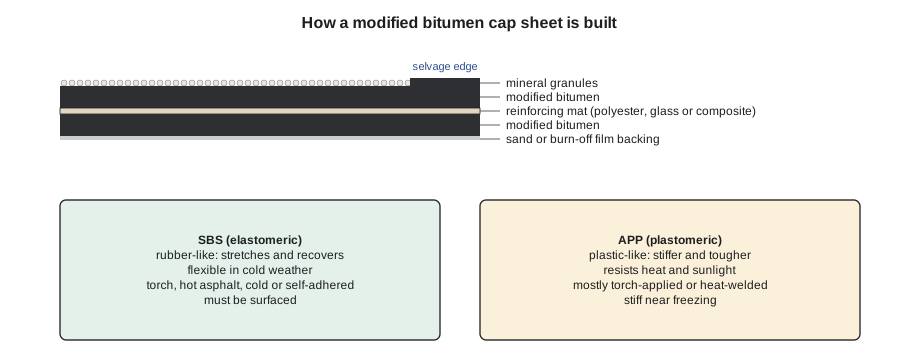
- SBS (styrene-butadiene-styrene) is a synthetic rubber. It makes the bitumen elastomeric: it stretches and recovers like rubber, and it stays flexible in cold weather.
- APP (atactic polypropylene) is a plastic. It makes the bitumen plastomeric: stiffer and tougher, with good resistance to high temperatures and to sunlight, but less flexible in the cold.
SBS and APP compared
| Property | SBS | APP |
|---|---|---|
| Nature | elastomeric (rubber-like) | plastomeric (plastic-like) |
| Cold-weather flexibility | typically flexible to about 0 to −13 °F | typically stiff near freezing or a few degrees below |
| Heat resistance | good | very good; does not flow until much hotter |
| Sunlight | must be surfaced (granules or coating) | better resistance; some APP sheets were sold smooth, but most are surfaced today |
| Installation methods | torch, hot asphalt, cold adhesive, self-adhered | mostly torch or heat-welded; some cold-adhered |
| Hot asphalt | bonds well when mopped | not usually mopped; hot asphalt does not bond well to most APP |
| Where it is common | cold climates, including most of Canada and the northern US | hot, sunny climates; some repairs and older roofs in the north |
For a roof in Columbus, where winter nights drop well below freezing and the roof surface swings 110 °F or more between a January night and a July afternoon, SBS is the usual choice, and nearly all of Ridgecap's mod-bit work is SBS. The old APP roof on Carrick Street was not wrong when it was built, but it is a reminder that an APP sheet that sat in a cold truck can crack if it is bent too sharply, and that repairs to an old APP roof need APP-compatible materials.
Reinforcement
The mat in the middle of the sheet carries tension and holds the bitumen in place. The main types:
- Polyester: a non-woven polyester fabric. It stretches a long way before tearing, resists punctures and survives building movement and repeated foot traffic. It is the usual reinforcement for cap sheets and heavy-duty base sheets.
- Glass fiber: a glass mat. It is very stable, so the sheet does not shrink or grow with temperature, but it stretches little and can tear more easily if the building moves. It is common in base sheets.
- Composite: polyester and glass combined, for stability and strength together.
The reinforcement also decides how the sheet should be handled. A glass-mat sheet folded sharply in cold weather can crack the mat. A polyester sheet can stretch out of shape if it is pulled hard while hot from the torch.
Surfaces and edges
- Mineral granules on the top of cap sheets protect the bitumen from sunlight, add fire resistance and come in colors, including white for reflectivity.
- Sand or a fine mineral on base sheets and the underside of many sheets stops the roll sticking to itself and gives a surface that bonds to adhesive or hot asphalt.
- A thin plastic burn-off film on the underside of torch-grade sheets stops the roll sticking. The torch shrinks and burns it away as the sheet is laid; a visible change in the film's pattern tells the applicator the bitumen is ready.
- A release film or paper protects the adhesive side of self-adhered sheets (lesson 7).
- A selvage edge is a granule-free strip, about 3 to 4 in wide, along one side of a cap sheet. The next sheet laps onto it, so bitumen bonds to bitumen rather than to granules.
Standards and how sheets are classified
In the US, modified bitumen sheets are classified under ASTM standards: D6162, D6163 and D6164 cover SBS sheets with composite, glass-fiber and polyester reinforcement, and D6222, D6223 and D6509 cover APP sheets with polyester, composite and glass reinforcement. Each sets minimum thickness, strength, elongation and low-temperature flexibility, and many standards are divided into grades for granule-surfaced and smooth sheets. Canadian projects use CSA A123.23, which classifies sheets by reinforcement type and surfacing grade.
A specification usually names a product, or lists the standard, type and grade it must meet. Before a delivery goes up on the roof, check the roll labels against the specification: the product name, the standard, and the lot numbers, which the manufacturer's warranty inspector may ask for.
A two-ply system
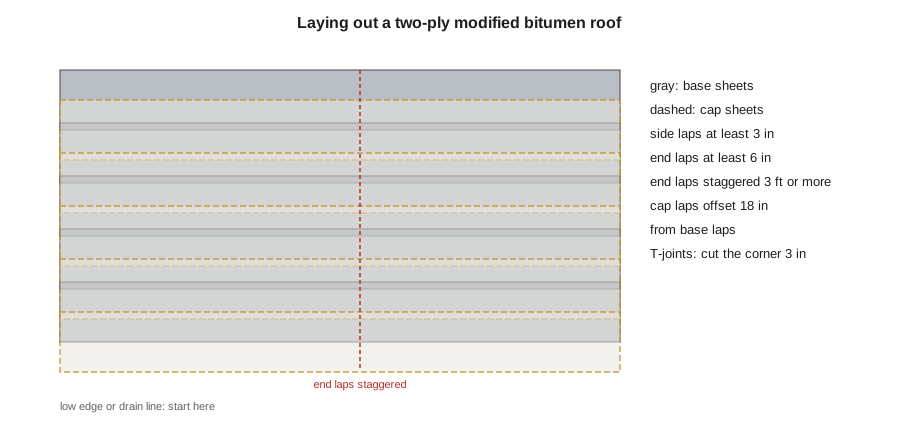
Most new mod-bit roofs are two-ply: a base sheet and a cap sheet. The base gives the second line of waterproofing and a smooth surface for the cap; the cap carries the surfacing. Some specifications add an interply, making three plies, or use BUR plies under a mod-bit cap (a hybrid). The usual layout rules:
- Start at the low point of the roof and lay sheets so that laps run with the water. On most low-slope roofs, sheets run parallel to the low edge or the drain line.
- Side laps of at least 3 in and end laps of at least 6 in, or as the maker requires.
- Stagger end laps in adjacent sheets by at least 3 ft.
- Offset the cap sheet's side laps from the base sheet's side laps, so they never lie on top of each other. Many makers ask for about half a sheet width; Ridgecap's standard offset is 18 in.
- Cut the corner of the end-lap sheet at a T-joint, where an end lap crosses a side lap, about 3 in on the diagonal, so there is no open channel.
- On steeper slopes, the maker may require sheets to run up the slope and be fastened at the top (back-nailed) to stop them sliding.
Rolls and quantities
Rolls are sold by gross area, but the laps use some of every roll. The net coverage is what counts.
Worked problem
Net coverage of a cap roll
A cap roll is 39-3/8 in wide and 32 ft 10 in long. Side laps are 3 in and end laps 6 in. What area does one roll cover once lapped?
Show solution
- Effective width = 39.375 − 3 = 36.375 in = 3.031 ft.
- Effective length = 32.83 − 0.5 = 32.33 ft.
- Net area = 3.031 × 32.33 = 98.0 ft².
- Gross area is 3.281 × 32.83 = 107.7 ft², so laps use about 9.7 ft², about 9 percent.
Answer: Each cap roll covers about 98 ft² of roof, close to one square, which is how many cap sheets are sold.
Worked problem
Rolls for Carrick Street
The Carrick Street roof is 100 ft by 82 ft. Base rolls are 39-3/8 in by 65 ft 7 in and cap rolls 39-3/8 in by 32 ft 10 in, with the same laps. Add 5 percent for cutting waste. Flashings are counted separately. How many rolls of each?
Show solution
- Roof area = 100 × 82 = 8,200 ft².
- Base net per roll = 3.031 × (65.58 − 0.5) = 3.031 × 65.08 = 197.3 ft².
- Base rolls = 8,200 ÷ 197.3 × 1.05 = 43.6, so 44 rolls.
- Cap net per roll = 98.0 ft²; cap rolls = 8,200 ÷ 98.0 × 1.05 = 87.9, so 88 rolls.
Answer: 44 base rolls and 88 cap rolls for the field, before flashings.
The two sites' cap counts differ because the cap rolls are different sizes, about one square in this example. Always figure from the roll actually being bought.
Storing and loading rolls
Modified bitumen rolls are heavy and easy to damage:
- Store rolls on end, on pallets, off the ground. A roll stored on its side flattens, and a flat roll lays out with a permanent wrinkle or dog-leg.
- Cover them with breathable tarps, not plastic, which traps moisture. Keep self-adhered rolls out of direct sun, which can soften the adhesive layer.
- In cold weather, keep the day's rolls warm, at about 50 °F or more for 24 hours before use, as lesson 4 described.
- Do not drop rolls or throw them off the hoist. A dented roll edge makes a crooked lap.
- Spread pallets over the roof structure. The roof must be able to carry the load, and a full pallet is a concentrated load.
Worked problem
A pallet on the roof
A 4 mm SBS cap weighs about 0.95 lb per ft². A pallet holds 25 rolls of 107.7 ft² each, plus 45 lb of pallet. What is the load, and what is it per square foot if the pallet is 44 in by 44 in?
Show solution
- One roll = 107.7 × 0.95 = 102 lb.
- Pallet load = 25 × 102 + 45 = 2,595 lb.
- Footprint = (44 ÷ 12)² = 13.4 ft².
- Pressure = 2,595 ÷ 13.44 = 193 lb per ft².
Answer: Nearly 1.3 tons on about 13 ft², several times a typical roof design load. Dana has the hoist operator set pallets directly over the steel joists near the columns and spread rolls out within the hour.
Reading the old roof
When the crew cut the first test opening on Carrick Street on Monday morning, Rory could see everything the lesson had described. The old APP sheet's smooth surface was crazed and chalky. Its laps were bonded where the torch had heated them well and open where it had not. Under it, the fiberboard was soft and dark near the physiotherapy leak. The new two-ply SBS system would go over a new cover board on new insulation, with granules to protect it from the sun the old sheet had had to face bare.
Reading a roll label
Every roll carries a label or wrapper printed with the information the crew and the inspector need. Rory copied the one from a Carrick Street cap into his notebook:
- Product name and type: base or cap, SBS or APP, and the installation method it is made for, such as torch, cold adhesive, hot asphalt or self-adhered.
- The standard it meets: the ASTM number and, for products sold in Canada too, the CSA A123.23 type and grade.
- Thickness or weight, roll width and length, and gross coverage.
- Lot or batch number and date of manufacture.
- Storage and handling instructions: store on end, protect from moisture and sun, and the minimum temperatures for application.
Mixing products with different installation methods is a common error on busy jobs. A cold-adhesive cap torched by mistake, or a torch cap set in cold adhesive, may bond poorly and is not covered by the warranty. Dana's rule: read the label of every pallet as it comes off the hoist, and keep different products in separate, marked stacks.
Repairing an old APP roof
Ridgecap still repairs APP roofs from the 1990s and 2000s. Repairs use APP-compatible materials, usually a torch-grade APP or a maker-approved repair sheet, after the surface is cleaned and primed. Old APP is stiff in the cold, so repairs are planned for warm weather where possible, and patches are heated gently so the old sheet does not crack as it is bent.
Common mistakes
MistakeTreating SBS and APP as the same.
InsteadSBS is elastomeric and flexible in the cold; APP is plastomeric, stiffer and usually torch-applied. Match repairs to the existing sheet.
MistakeLining up cap laps over base laps.
InsteadOffset cap side laps from base side laps, about 18 in at Ridgecap.
MistakeCounting rolls from gross area.
InsteadUse net coverage after side and end laps, then add waste.
MistakeStoring rolls on their sides.
InsteadStore on end, on pallets, under breathable covers; keep them warm in cold weather.
MistakeLeaving full pallets in one spot on the roof.
InsteadSet pallets over structure and spread the load quickly.
Summary and key terms
- Modified bitumen is asphalt blended with SBS or APP polymer and formed around a reinforcing mat in the factory.
- SBS is rubber-like and flexible in the cold; APP is plastic-like, stiffer and resistant to heat and sunlight.
- Polyester reinforcement stretches and resists punctures; glass is stable; composite combines them.
- ASTM D6162 to D6164 cover SBS sheets and D6222, D6223 and D6509 cover APP sheets; Canada uses CSA A123.23.
- A two-ply roof has side laps of 3 in, end laps of 6 in staggered 3 ft, and cap laps offset from base laps.
- Figure rolls from net coverage, and store and load rolls so they stay round, warm and spread out.
- Modified bitumen
- Asphalt modified with a polymer such as SBS or APP and made into reinforced roofing sheets.
- SBS
- Styrene-butadiene-styrene, a rubber polymer that makes bitumen elastomeric and flexible in the cold.
- APP
- Atactic polypropylene, a plastic polymer that makes bitumen stiffer and resistant to heat.
- Reinforcement
- The polyester, glass or composite mat inside a modified bitumen sheet.
- Selvage edge
- A granule-free strip along the edge of a cap sheet where the next sheet laps.
- Burn-off film
- A thin plastic film on torch-grade sheets that the torch melts away during application.
- Base sheet
- The bottom ply of a multi-ply modified bitumen roof.
- Cap sheet
- The top, surfaced ply of a modified bitumen roof.
Practice problems
Work each problem on paper first, then reveal the answer to check.
A base roll is 39-3/8 in by 49 ft 2 in with 3 in side and 6 in end laps. What is its net coverage?
Show answer
3.031 × (49.17 − 0.5) = 3.031 × 48.67 = 147.5 ft².
How many 98 ft² net cap rolls cover 5,400 ft² with 5 percent waste?
Show answer
5,400 ÷ 98 × 1.05 = 57.9, so 58 rolls.
Which ASTM standard covers SBS sheets reinforced with polyester?
Show answer
ASTM D6164.
Why are cap side laps offset from base side laps?
Show answer
So the laps never lie on top of each other and form a weak line through both plies.
Which polymer would you choose for a cold-climate roof that will be mopped in hot asphalt?
Show answer
SBS.
Lesson quiz · 5 questions
Score 60% or more to complete this lesson.
Create a free account to save your progress, take quizzes and earn a certificate.