
ROOF-210 · Lesson 6 of 12 · 26 min
Torch-applied membranes and torch safety
▶ Video coming soon A video version of this lesson is on the way.
At 7:15 on Wednesday, November 11, Anjali Mukherjee was on the Carrick Street roof before the first torch was lit, going through the hot work permit with Dana. Fire extinguishers at the hoist and at each torch station. Propane cylinders upright, chained to the cart, more than 10 ft from where anyone would torch. The perimeter, curbs and drains already done the day before in flameless self-adhered material. Fire watch assigned. The building's alarm company told. Last torch at 1:30 p.m. "We have one job today," Anjali said to the crew, "and that's to put a cap sheet on this roof without setting fire to it."
Torch application is the fastest way to lay modified bitumen in cold or damp weather, and it gives a strong, fully bonded sheet. It is also the cause of many roof fires, some of which have destroyed whole buildings. This lesson covers the equipment, the technique and, above all, the fire prevention rules that make torching safe.
How torch application works
A torch-grade sheet has a thick layer of bitumen on its underside covered by a thin burn-off film. The applicator plays a large propane flame over the underside of the roll and the surface it is going onto, melting the bitumen into a hot, fluid layer, and pushes the roll forward into the melt. The melted bitumen is the adhesive: when it cools, the sheet is welded to the base sheet or substrate, and the laps are welded to each other.
The equipment
- The torch: a steel burner head on a long wand with a valve, burning propane. Roofing torches put out a large, intense flame; the burner's output is set by the regulator and the valve.
- Multi-burner torch carts, with several heads across the width of the roll, are used on large open areas. They lay sheets fast and evenly but must be handled like a small vehicle.
- Small detail torches are used for laps and touch-up; on Ridgecap jobs, they are not used at flashings, which are done flameless.
- Hoses rated for propane, in good condition, with the correct fittings and no tape repairs. Keep them out of the path of the flame and away from sharp metal edges.
- Regulators matched to the torch, set to the torch maker's pressure.
- Propane cylinders, usually 100 lb, with a safety cap on spare cylinders, stored and used upright.
- A torch stand or holder so a lit torch is never laid on the roof.
- A spark lighter. Never a match or cigarette lighter, which puts a hand in front of the burner.
Before the first light of the day, the operator checks the equipment: the fire code and Ridgecap's rules require hot work equipment to be examined for leaks and defects before each use. Every connection is checked with soap solution or a leak detection liquid, never a flame. Bubbles mean a leak: shut off the cylinder, fix it and test again. If anyone smells propane, all torches go out until the cause is found.
Propane on the roof
Propane is stored as a liquid under pressure. The vapor is heavier than air and settles in low spots, drains, curbs and open roof hatches. The rules:
- Cylinders are always upright and secured, so that only vapor reaches the regulator. A cylinder on its side can send liquid propane into the hose and torch, causing a sudden, uncontrolled flare.
- Keep cylinders at least 10 ft from the torch flame and any other ignition source. OSHA 1926.153 sets out how LP-gas cylinders, regulators and hoses are used and stored on construction sites.
- Never take a cylinder inside a building, and never store spares in stairwells or mechanical rooms. Spent cylinders go back to ground level.
- Never heat a cylinder with the torch or any flame. In cold weather, a single cylinder cannot boil off propane fast enough for a big torch: the pressure drops, the cylinder frosts and the flame weakens. The answer is to use two or more cylinders connected through a proper manifold, or the torch maker's lower setting, not heat.
- Close the cylinder valve at every break and at the end of the day, and let the flame burn off the gas left in the hose before closing the torch valve.
Worked problem
Propane for a day of torching
Two applicators will torch cap sheet for 5.5 hours. Ridgecap's record for this torch is about 9 lb of propane per hour at working output. A 100 lb cylinder is changed when about 20 percent remains, because the pressure falls as it empties. How many cylinders are needed, and how many should go up with a spare?
Show solution
- Propane used = 2 × 9 × 5.5 = 99 lb.
- Usable per cylinder = 100 × 0.80 = 80 lb.
- Cylinders = 99 ÷ 80 = 1.2, so 2 cylinders.
- In cold weather each torch runs on its own pair, so Dana sends up four and keeps one spare at the hoist.
Answer: Two cylinders would do in mild weather; in November, four in use plus a spare. The torch figure is Ridgecap's own record for its equipment; check the torch maker's data for yours.
The technique
Dana had Rory practice on scrap base sheet in the yard on the Friday afternoon before the job, after the delivery check, and again at lunch on Tuesday, before he touched the Carrick Street cap. The steps:
- Unroll the sheet in position, check the side lap line and the end laps, then roll it back from both ends toward the middle, or from one end, so it can be laid without moving it again.
- Light the torch with the spark lighter, pointed away from people, the roll and anything that can burn.
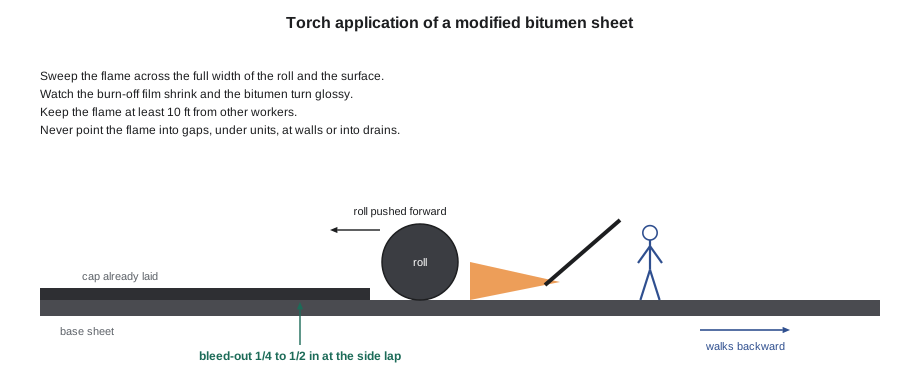
- Heat the underside of the roll and the surface in front of it together, sweeping the flame back and forth across the full width in a steady L or J motion. Watch the burn-off film: when its pattern shrinks and disappears and the bitumen is glossy and fluid, the roll is ready.
- Push the roll forward with a roll hook or a boot, not by hand, keeping it on the lap line. The applicator walks backward, so the torch always faces the work and never points at the roll already laid.
- Watch the side lap. A small, continuous bead of melted bitumen, about 1/4 to 1/2 in, should flow out along the edge. No bead means a cold lap; a large flood means too much heat.
- A second worker follows with a hot trowel or a rounded tool, sealing the bleed-out and pressing the lap, and checking it with a probe once it cools.
- At end laps on granule-surfaced cap sheets, embed the granules first: heat the area of the lower sheet that will be covered until the granules sink into the bitumen, and trowel them flat, so the upper sheet bonds bitumen to bitumen.
Too little heat leaves the sheet unbonded, with voids that become blisters and laps that open. Too much heat burns the bitumen, which loses its polymer properties, can shrink or distort polyester reinforcement and blackens granules. The right heat is steady and even, and it comes with practice under a trained eye.
Worked problem
How much bleed-out
The maker specifies a 3 in side lap with a bleed-out of 1/4 to 1/2 in. On one sheet, Rory measures the bead at five points: 5/16, 3/8, 1/8, 3/8 and 7/16 in. Is the lap acceptable?
Show solution
- Four readings (5/16, 3/8, 3/8 and 7/16 in) are within 1/4 to 1/2 in.
- One reading, 1/8 in, is below the range: that part of the lap may be under-heated.
- Average = (0.3125 + 0.375 + 0.125 + 0.375 + 0.4375) ÷ 5 = 1.625 ÷ 5 = 0.325 in, but the average does not matter: every point must be bonded.
Answer: Not yet. The thin spot is probed and, if it is not fully bonded, re-heated from the top with care and sealed. A lap is only as good as its weakest point.
Where roof fires start
Most torch fires do not start in the open field of the roof. They start where flame can reach something that burns and cannot be seen:
- At perimeters, parapets and walls, where flame enters gaps behind wood blocking, nailers, siding or cants.
- At curbs, rooftop units and penetrations, where gaps lead into the building.
- At roof edges, expansion joints and openings, where flame and heat are drawn into hidden spaces by air pressure differences between inside and outside.
- Over combustible decks and insulation: wood decks, plywood, fiberboard and some foam insulations can smolder under the membrane for hours before a fire breaks out.
A smoldering fire inside a wall or under a membrane may show nothing at the surface until after the crew has left. That is why the rules below concentrate on where torches may and may not be used, and why the fire watch lasts so long after the last torch goes out.
Where torches are not used
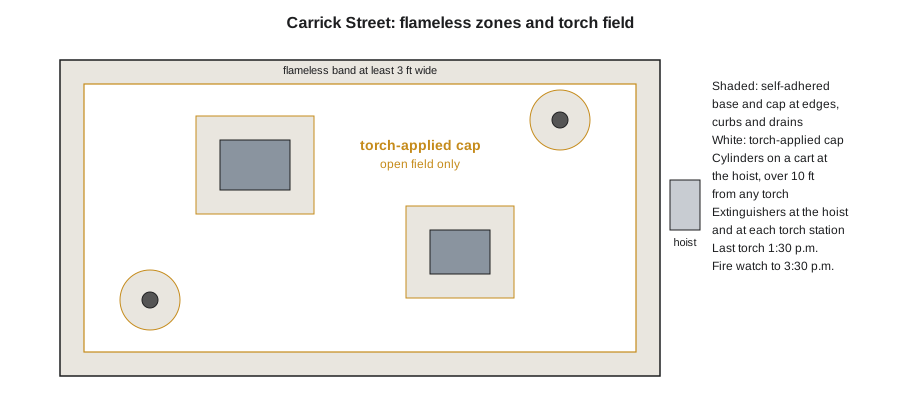
NRCA, the National Roofing Contractors Association, no longer recommends that designers specify torch-applied sheets over combustible decks such as wood decks, plywood and wood plank, even with a thermal barrier, and says torching should be done only by workers trained under its CERTA program (Certified Roofing Torch Applicator). Canadian practice goes further and recommends flameless products for at least 3 ft into the field at all flashings, perimeters and penetrations, a practice called picture framing, which Ridgecap also uses on its Ohio jobs.
Ridgecap's torch rules, which apply to every job:
- Only workers who have completed CERTA training and been signed off by a foreperson may torch.
- No torching over wood decks, wood blocking, fiberboard or any material that has not been confirmed as non-combustible or protected by an approved cover board.
- All flashings, perimeters, curbs, drains and penetrations are done flameless, with self-adhered or cold-applied products, at least 3 ft into the field.
- Never point a flame into a gap, under a unit, behind flashing, into a drain or at a wall.
- Keep the flame at least 10 ft from other workers and away from hoses, cylinders and materials.
- Never lay down a lit torch. Use the stand, and shut the torch off when it is not in use.
- No torching in the last two hours of the shift.
- A fire extinguisher within reach of every torch, and more at the hoist.
The hot work permit and fire watch
Torching is hot work, and the fire code, NFPA 51B and NFPA 241 set rules for it: a permit, combustibles protected, a fire watch during the work and for at least an hour after it ends under NFPA 51B, with further monitoring where the permit requires it. The building owner or its insurer often adds its own hot work permit system and checklist.
| Step | What Ridgecap does |
|---|---|
| Before work | permit signed by the foreperson and, where required, the owner; area inspected; extinguishers placed; alarm company and owner told |
| During work | a fire watch assigned, with an extinguisher, who is not torching and who watches the edges, walls and penetrations |
| Last torch | no later than two hours before the end of the shift |
| After the last torch | the fire watch continues for two hours, walking the roof and checking walls, curbs, edges and the floor below where accessible |
| Final check | an infrared thermometer or thermal camera scan of edges, curbs and walls before the crew leaves; any warm spot is opened and checked |
| Record | permit closed with times, names and the final check signed |
Ridgecap's two-hour fire watch is longer than the minimum in NFPA 51B, and the rule against torching in the last two hours of the shift guarantees the watch can be done without anyone working late. Many insurers and specifications ask for the same two hours.
Worked problem
Planning the torch day
The crew works 7:00 a.m. to 3:30 p.m. with a 30-minute lunch at 11:30. Torching can start at 7:30, after the permit and equipment checks. Under Ridgecap's rules, when is the last torch, how many torching hours are there, and how much cap can two applicators lay at about 3 rolls an hour each, with 98 ft² net per roll?
Show solution
- Last torch = 3:30 p.m. − 2 h = 1:30 p.m.
- Torching time = 7:30 to 1:30 = 6 h, less 0.5 h lunch = 5.5 h.
- Rolls = 2 × 3 × 5.5 = 33 rolls.
- Area = 33 × 98 = 3,234 ft².
Answer: Last torch at 1:30 p.m., 5.5 torching hours and about 3,200 ft² of cap a day, so the 6,000 ft² of open field inside the flameless bands takes about two days. The fire watch runs from 1:30 to 3:30, then the final scan.
If a fire starts
- Shout a warning, shut off the torch and close the cylinder valve if it is safe.
- Use the extinguisher on a small surface fire, aiming at the base of the flame.
- If the fire is in a wall, under the membrane or inside the building, or is more than a small surface fire, call the fire department at once and get everyone off the roof. Do not cut the membrane open to chase a fire.
- Tell the building occupants and pull the fire alarm if the fire may spread.
- Report every fire, however small, to the foreperson and the safety coordinator.
On Carrick Street, the fire watch on Wednesday was Rory's job. He walked the parapets, checked behind each curb and around the drains with the infrared thermometer every 15 minutes, and logged the readings. Nothing was warmer than the sun-warmed granules around it. At 3:30, Anjali checked the log, did her own scan of the parapet caps and signed off the permit.
Common mistakes
MistakeTorching at flashings and perimeters because it is faster.
InsteadDo flashings, perimeters and penetrations flameless at least 3 ft into the field.
MistakeLaying a lit torch on the membrane.
InsteadUse the torch stand and shut the torch off when it is not in use.
MistakeWarming a frosted cylinder with the torch.
InsteadNever heat cylinders; use more cylinders on a manifold.
MistakeEnding the fire watch when the crew packs up.
InsteadKeep the watch going for two hours after the last torch and finish with a thermal scan.
MistakeJudging a lap by the average bleed-out.
InsteadEvery point of the lap must show bleed-out and probe tight.
Summary and key terms
- Torching melts the bitumen on the underside of the sheet and the surface below so they weld together.
- Check equipment for leaks with soap solution before each use; keep cylinders upright, secured and at least 10 ft from flame.
- Sweep the flame across the full roll and surface; look for a continuous bleed-out of 1/4 to 1/2 in at laps.
- Most torch fires start at perimeters, flashings, penetrations and over combustible substrates.
- Do those areas flameless, never torch into gaps or over wood, and keep a fire watch during and after the work.
- Ridgecap: trained torch workers only, no torching in the last two hours, a two-hour fire watch and a final thermal scan.
- Torch-applied
- A modified bitumen sheet bonded by melting its underside bitumen with a propane torch.
- Bleed-out
- The bead of melted bitumen that flows out at a lap when it is heated correctly.
- Granule embedment
- Heating and trowelling cap sheet granules into the bitumen where an end lap will go.
- Picture framing
- Doing perimeters, flashings and penetrations with flameless products before torching the open field.
- Hot work permit
- A written authorization and checklist for work with open flame or high heat.
- Fire watch
- A trained person who watches for fire during and after hot work, with an extinguisher at hand.
- Manifold
- A fitting that connects two or more propane cylinders to supply one torch.
Practice problems
Work each problem on paper first, then reveal the answer to check.
A shift ends at 4:00 p.m. When is the last torch under Ridgecap's rules?
Show answer
2:00 p.m.
Two torches use 9 lb of propane per hour each for 6 hours. How much propane is that?
Show answer
2 × 9 × 6 = 108 lb.
How far into the field does Ridgecap extend flameless products at flashings and perimeters?
Show answer
At least 3 ft.
What does no bleed-out at a side lap tell you?
Show answer
The lap was not heated enough and may not be bonded.
Why must propane cylinders stay upright?
Show answer
So only vapor, not liquid propane, reaches the regulator and torch.
Lesson quiz · 5 questions
Score 60% or more to complete this lesson.
Create a free account to save your progress, take quizzes and earn a certificate.