
ROOF-210 · Lesson 11 of 12 · 23 min
Quality control and inspection
▶ Video coming soon A video version of this lesson is on the way.
At 7:00 on Friday, November 13, before he left for Westlane, Rory stood on the Carrick Street roof with Dana, the roof consultant's field reviewer, Martin Oyelaran, and the membrane manufacturer's technical representative, Joanne Kirsch. Joanne carried a probe, a clipboard and a can of marking paint. "I'm not here to catch you," she told Rory. "I'm here so that in twelve years, when somebody calls about this roof, the company that wrote the warranty already knows how it was built."
A roof is built once and paid for over decades. Most of what makes a bituminous roof last cannot be seen once the next layer covers it: the mopping under a ply, the bond under a cap, the fastener pattern under the insulation. Quality control is how a crew makes sure each hidden step is right before it disappears. This lesson covers what is checked, when, how it is recorded and what the common defects look like.
Quality control and quality assurance
- Quality control (QC) is what the roofer does: the crew's own checks, measurements and records during the work.
- Quality assurance (QA) is what others do to confirm it: the owner's consultant or inspector, the manufacturer's representative and sometimes the building official.
A specification usually lists both: the roofer's daily reports and submittals, and the hold points, the stages at which work stops until an inspector has seen it, such as the deck before insulation, the base sheet before the cap, and flashings before metal goes on. Missing a hold point can mean tearing work back to show it.
Before work starts
| Check | What it means |
|---|---|
| Submittals approved | product data, system approval, warranty form and shop drawings accepted by the consultant |
| Pre-roofing meeting | owner, consultant, general contractor, roofer and manufacturer agree on details, schedule, access and hold points |
| Materials on arrival | labels match the specification; lot numbers recorded; rolls and pails undamaged and stored correctly |
| Deck accepted | sound, fastened, dry and free of debris; drains and curbs at the right heights |
| Weather plan | forecast checked; temporary cut-off materials on site |
| Safety | fall protection, hot work permit, propane and kettle checks in place |
A wet deck or substrate ruins everything above it. Simple field checks help: a strip of plastic taped to the deck overnight shows moisture beading under it; on BUR work, a small pour of hot asphalt on a concrete deck that foams or will not stick after it cools means the surface is too wet. Dry surfaces are part of the specification, and work does not start until they are met.
Weather and the dew point
Bituminous products bond to dry surfaces only. Even when it is not raining, a surface can be wet with condensation if its temperature is at or near the dew point, the temperature at which the air's moisture starts to condense. Steel decks and cover boards cool quickly on clear nights and stay damp well into the morning. Ridgecap's rule, common in coating and roofing specifications, is that the surface must be at least 5 °F above the dew point while adhesives, primers and coatings go down.
Worked problem
Can the crew start?
At 8:30 a.m. on Tuesday, November 10, the hoist thermometer read 46 °F with relative humidity of 85 percent, which gives a dew point of about 42 °F. The surface thermometer on the cover board read 43 °F. Ridgecap requires the surface to be at least 5 °F above the dew point. Can priming start?
Show solution
- Margin = surface − dew point = 43 − 42 = 1 °F.
- Required margin = 5 °F; 1 °F is far below it.
- The surface needs to reach about 42 + 5 = 47 °F, or the air must dry.
Answer: No. The crew waited; by 10:15 the sun had warmed the boards to 52 °F and the humidity had dropped, and the log showed a margin of more than 7 °F when priming began.
Dew point is read from a table or chart, or a digital meter that shows it directly. Ridgecap's forepersons carry a meter that reads air temperature, humidity and dew point, and an infrared thermometer for the surface, and they log all four at the start of work and every two hours.
During the work
What the crew checks depends on the system. Ridgecap's daily QC sheet for bituminous work has these sections:
| System | Checked and recorded |
|---|---|
| Hot asphalt (BUR or mopped mod-bit) | asphalt type and lot; kettle and mop temperatures every 15 to 30 minutes; mopping coverage; ply count; laps; embedment; water cut-offs |
| Cold adhesive | product and lot; air and surface temperatures; yield checks per pail; open time; lap bead; protection from rain |
| Torch-applied | hot work permit; torch operator names; bleed-out at laps; granule embedment; fire watch times; final thermal scan |
| Self-adhered | temperatures and dew point; primer dry; rolling; lap rolling; T-joints; release film removed |
| Mechanically fastened | fastener and plate type; length; pattern and spacing in each zone; pull-out tests; photos of each zone |
| Flashings | heights; corners; bonding; top terminations; drain rings tight |
| All | weather log; areas completed; materials used; photos; deviations and who approved them |
Photographs are part of the record. Each one shows what was checked and where: a tape measure on a lap, a fastener pattern beside a chalked zone line, a thermometer reading at the mop. A phone photo with the date and location stamped and a short caption is worth more than a paragraph written a week later.
Probing laps
Every lap on a mod-bit roof is checked by probing once it has cooled or set. The probe is a blunt, rounded steel tool, never a knife or a screwdriver, run along the lap edge with firm pressure. A good lap resists the probe along its whole length. Where the probe slides in, the lap is open.
- Probe after the lap has cooled; a warm lap can feel soft but be fine.
- Mark every open spot with paint, and repair it the same day: re-heat with a hot-air welder or, in the open field on a torch job, the torch, or seal with the specified cement and a cover strip.
- Probe T-joints and end laps with extra care; they are where most open laps are found.
Test cuts and samples
On BUR work, the specification may require test cuts: a sample cut across the membrane so that its plies and interply asphalt can be counted and weighed. ASTM D3617 describes how built-up roof samples are taken and analyzed. The cut is patched at once with the same number of plies plus extra over the top.
Worked problem
Reading a test cut result
A test cut from the Cedarbrook gym roof in July was sent to a lab. The report said the three interply moppings under the cap averaged 22 lb per square. The specification called for 25 lb per square plus or minus 20 percent. Did the roof pass?
Show solution
- Tolerance = 25 × 0.20 = 5 lb.
- Allowed range = 25 − 5 to 25 + 5 = 20 to 30 lb per square.
- Result 22 lb per square is inside the range.
Answer: Yes. The moppings were on the light side of the range, so Dana reminded the moppers to keep the asphalt at its EVT, since asphalt that is too hot spreads too thin.
On mod-bit roofs, cuts are rarer, but a manufacturer may ask for a small sample or an adhesion check at a suspect area. Any cut is a hole in a new roof, so it is made only where the inspector chooses, and repaired immediately as the maker specifies.
Common defects
| Defect | What it looks like | Usual cause | Fix |
|---|---|---|---|
| Blister | a raised, hollow bubble that may grow in summer | moisture or air trapped under or between plies; dry spots | cut, dry, re-adhere and patch, as the maker specifies |
| Fishmouth | an open, raised edge at a lap | wrinkled or misaligned sheet; cold lap | cut out, set down and cover with a strip |
| Open lap | the probe slides into the lap | under-heating; too little adhesive; dirty lap; cold weather | re-heat or re-seal and cover strip |
| Wrinkle or ridge | a fold or ridge in the sheet | rolls laid cold or straight off a curled roll | cut out and patch |
| Slippage | plies or sheets slid downslope | wrong asphalt type for slope; too much adhesive or asphalt; no back-nailing | often needs removal; prevent with the right materials |
| Bare or burnt granules | exposed bitumen or blackened granules | overheating; scuffing; dragging materials | broadcast matching granules into bitumen or adhesive |
| Bridging | flashing hollow at the inside corner | not pressed into the angle; no cant where needed | cut out and redo |
| Ponding | water standing after 48 hours | deck deflection; poor slope; blocked drains | report; corrected by design and drainage work |
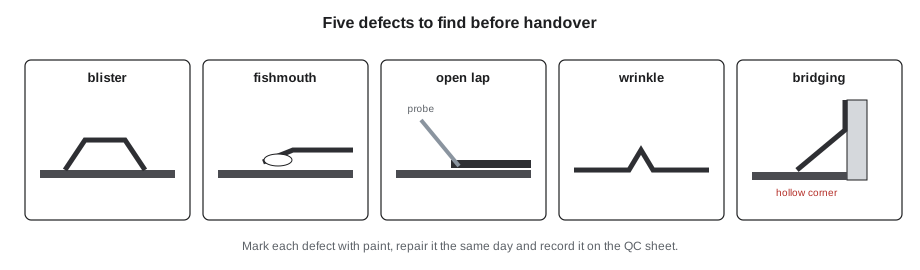
The manufacturer's inspection
Most commercial roofs come with a manufacturer's warranty. To issue it, the manufacturer sends a technical representative to inspect the roof, sometimes during the work and always at the end. The representative walks the whole roof, checks the system against the approved specification, probes laps, looks at every flashing, drain and penetration, and writes a punch list of items to fix. The warranty is issued only once the punch list is done and the paperwork, including the roofer's records, is complete.
On Carrick Street, Joanne's list had four items:
- A T-joint near the hoist where the corner of the middle sheet had not been cut, which Luca cut and sealed.
- A scuffed area of granules where the pallets had been dragged, which got a broadcast of matching granules into hot bitumen.
- One missing bolt in the clamping ring of the east drain, replaced and tightened.
- A short open spot at the top of an end lap, which she found with her probe and marked; it was re-welded with the hot-air tool.
She also asked for the QC sheets, the fire watch logs, the photos of the drains with their rings off and the list of roll lot numbers. Dana had them in a folder. By noon, the punch list was signed off. The manufacturer issued its warranty for the system the following week, after the consultant's final report. "Four items on 8,200 square feet is a good roof," Martin said. "Zero items means somebody didn't look hard enough."
Handing over the roof
- Clean the roof: remove all debris, scrap, fasteners and packaging, and clear drains and scuppers.
- Close out the hot work permit and safety records.
- Assemble the closeout package: warranty, the roofer's own workmanship warranty, as-built notes and photos of hidden work, product data, and the maintenance guide.
- Walk the roof with the owner or property manager, and show them the access route, walkway pads, drains to keep clear and who to call.
- Remove the temporary protection, cut-offs and barricades.
Celeste Ward, the property manager, took the folder, walked the roof with Dana and asked one question: "How do I keep it like this?" Dana's answer was the start of ROOF-330: look at it twice a year, keep the drains clear, keep people on the walkways and call before anyone cuts a hole in it.
Other tests a specification may call for
- Flood testing: plugging drains and filling a section of roof with water to look for leaks. It adds a heavy load, so it is done only when the designer has checked the structure and specified the depth and time.
- Electronic leak detection: low- or high-voltage equipment that finds holes in a membrane by detecting a current path through it. It needs a conductive layer or a suitable deck and is planned before the roof is built.
- Adhesion or pull tests: a small area of cap pulled with a gauge to confirm the bond, usually on adhered and self-adhered systems.
- Infrared moisture surveys: a thermal camera survey at night to find wet insulation, used on existing roofs before a project and sometimes years later (ROOF-330).
Keeping the records
Ridgecap keeps every job's QC file, photos and closeout package for at least the length of the longest warranty on the roof. When a warranty claim, a leak call or a re-roof bid comes in years later, the file is the first thing the estimator opens. The daily report written in the rain in July is what answers a question asked in 2040.
Common mistakes
MistakeStarting adhesive or primer work on a dewy surface.
InsteadCheck that the surface is at least 5 °F above the dew point and dry.
MistakeProbing laps with a knife or screwdriver.
InsteadUse a blunt, rounded probe after the lap has cooled.
MistakeCovering work before a hold point inspection.
InsteadStop at each hold point until the inspector has seen the work.
MistakeKeeping no records until the end of the job.
InsteadRecord temperatures, quantities, patterns and photos every day as the work happens.
MistakeLeaving test cuts open.
InsteadPatch every cut immediately with the specified plies and an extra cover.
Summary and key terms
- Quality control is the roofer's own checking and recording; quality assurance is confirmation by others.
- Check submittals, materials, deck and weather before starting, and respect every hold point.
- Surfaces must be dry and at least 5 °F above the dew point for bonding work.
- Daily QC records cover temperatures, coverage, plies, laps, fasteners, fire watch and photos.
- Probe every lap with a blunt probe; test cuts check plies and asphalt weights on BUR.
- The manufacturer's inspection and punch list come before the warranty; hand over a clean roof with a full closeout package.
- Quality control (QC)
- The roofer's own checks and records during the work.
- Quality assurance (QA)
- Inspection and confirmation of the work by the owner's consultant, the manufacturer or others.
- Hold point
- A stage at which work stops until an inspector has seen it.
- Dew point
- The temperature at which moisture in the air begins to condense on a surface.
- Lap probe
- A blunt, rounded steel tool used to check that laps are sealed.
- Test cut
- A sample cut from a membrane to count plies and measure bitumen.
- Punch list
- A list of items to be fixed before the work is accepted.
- Closeout package
- The documents handed to the owner at the end of a job, including warranties and maintenance information.
Practice problems
Work each problem on paper first, then reveal the answer to check.
The dew point is 39 °F and the surface reads 42 °F. Can priming start under Ridgecap's rule?
Show answer
No: the margin is 3 °F, less than 5 °F.
A specification calls for 25 lb per square of interply asphalt plus or minus 20 percent. What is the range?
Show answer
20 to 30 lb per square.
What tool is used to check laps, and when?
Show answer
A blunt, rounded probe, after the lap has cooled or set.
Name two common causes of blisters.
Show answer
Moisture or air trapped under or between plies, and dry spots in the mopping or adhesive.
What must happen before a manufacturer issues the warranty?
Show answer
The inspection punch list is completed and the paperwork is submitted.
Lesson quiz · 5 questions
Score 60% or more to complete this lesson.
Create a free account to save your progress, take quizzes and earn a certificate.