
ROOF-210 · Lesson 4 of 12 · 25 min
Cold-applied systems
▶ Video coming soon A video version of this lesson is on the way.
Glen Pelham's estimate for the Ferncliff repair had assumed hot asphalt. Then Dana walked the roof with the bakery's maintenance manager, Teodor Lisowski, and counted three large makeup air units and a row of oven exhaust stacks within 50 ft of the north drains. "Those units pull outside air into a room full of bread," Teodor said. "Last time somebody ran a kettle next door, we threw out a morning's production because the dough smelled like a road crew." The bakery also wanted no open flame near its gas lines and stacks. By Wednesday evening, the job had become a cold-applied repair.
Cold-applied roofing uses adhesives, cements and coatings that are liquid at ordinary temperatures, so no kettle and no torch are needed. This lesson covers the kinds of cold-applied products, how cold-process built-up and modified bitumen roofs are installed, how much adhesive they use, how they cure and what can go wrong.
Why cold-applied
Cold-applied systems solve problems that hot work creates:
- No open flame and no kettle: lower fire risk on sensitive buildings, wood decks and occupied sites.
- Less odor than hot asphalt, especially with low-odor and solvent-free adhesives, which matters near air intakes, schools, hospitals and food plants.
- Small crews and simple equipment: a pail, a squeegee and a roller can do a repair.
- No burn hazard from hot bitumen.
They also have limits. Adhesives must cure, which takes time and depends on temperature and humidity. Most have a minimum application temperature. They cost more per square than hot asphalt on big roofs. Some contain flammable solvents, so "cold" does not mean "no fire risk". And the quality of the bond depends on spreading the right amount, evenly, every time.
Kinds of cold-applied products
| Product | What it is | Typical use |
|---|---|---|
| Solvent-based (cutback) asphalt adhesive | asphalt dissolved in a petroleum solvent, often with fibers and polymers | setting plies and mod-bit sheets; the traditional cold adhesive |
| SBS-modified cold adhesive | a cutback with SBS polymer for strength and flexibility | modified bitumen base and cap sheets |
| Solvent-free or low-VOC adhesive | polymer-based or emulsion adhesives with little or no solvent | odor-sensitive buildings; where VOC limits are tight |
| Asphalt emulsion | asphalt dispersed in water with clay or chemical emulsifiers | coatings, cold-process BUR, resaturants; must not freeze |
| Roof cement (plastic cement) | a thick, fibered cutback applied with a trowel | small repairs, setting metal flanges, sealing laps |
| Liquid-applied flashing | reinforced resins such as PMMA or polyurethane | complex penetrations and details |
| Primer | thin asphalt in solvent or water | preparing concrete, metal and some boards for bonding |
Every one of these products comes with a technical data sheet and a safety data sheet. The data sheet gives coverage rates, temperature limits, cure times and compatible substrates; the safety data sheet gives the hazards, PPE and first aid. Under OSHA's Hazard Communication Standard, the label and safety data sheet must be available on site, and workers must be trained on them.
The amount of solvent a product may contain is regulated. The US EPA's national rule on architectural coatings sets VOC limits for roof coatings, and some states and air districts set tighter ones; the label states the VOC content and the category. A specification may also call for low-VOC products for green building ratings or occupant comfort.
Cold-process built-up roofing
A cold-process BUR is laid the same way as a hot one, with felts shingled to give three or four plies, but each ply is set in a coat of cold adhesive applied with a notched squeegee, a brush or a spray rig. Glass felts are pressed into the wet adhesive with a broom or roller so they are embedded along their full width. The top ply is then surfaced with a cold-applied flood coat and gravel, a coating, or a granulated cap sheet.
Because the adhesive must lose its solvent or water to cure, the plies take days to weeks to reach full strength, compared with minutes for hot asphalt. During that time the membrane is soft, so traffic is kept off it and heavy materials are not stored on it.
Cold-applied modified bitumen
Many SBS modified bitumen sheets are made for cold adhesive. The base sheet is laid into adhesive spread on the substrate, the cap is laid into adhesive spread on the base, and the laps are sealed. Depending on the maker, cap sheet laps are sealed with adhesive that squeezes out at the edge, a lap cement, a self-adhered selvage edge or a hot-air welder.
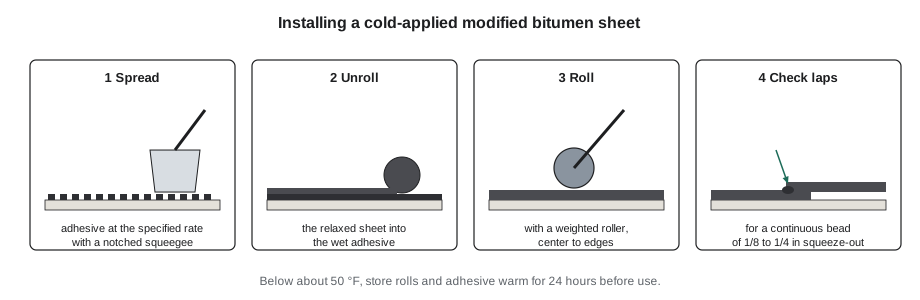
Ridgecap's routine for cold-applied mod-bit:
- Condition the rolls. Below about 50 °F, store rolls in a heated space for at least 24 hours so they unroll flat, and bring them up a few at a time. Adhesive is stored warm too: below that temperature it thickens and goes on too heavy.
- Cut each roll to length and let it relax, unrolled, before setting it. A sheet laid straight off a cold roll keeps its curl and wrinkles.
- Spread the adhesive at the maker's rate with a notched squeegee whose notch size the maker specifies, in a uniform coat with no bare spots or puddles.
- Lay the sheet into the wet adhesive within the open time the maker gives. Some adhesives want the sheet laid at once; a few want a short flash-off first.
- Roll the sheet with a weighted roller, working from the center to the edges, to push out air and bring adhesive into full contact.
- At every side and end lap, look for a small, continuous bead of adhesive squeezing out. No bead means a dry lap.
- Seal T-joints, where three sheets meet, as the maker specifies; many call for cutting the corner of the middle sheet at an angle.
- Protect the work from rain until the adhesive has skinned. Fresh cold adhesive can be washed out by a downpour.
How much adhesive
Coverage rates are given per unit area, usually in gallons per square (100 ft²). A rate that seems small adds up fast across a roof.
Worked problem
Adhesive for the Ferncliff repair
The 1,300 ft² repair (13 squares) will be a two-ply SBS system set in cold adhesive. The maker's rate is 2 gal per square under the base and 2 gal per square under the cap, with 10 percent extra for laps, flashings and waste. Adhesive comes in 5 gal pails. How many pails?
Show solution
- Rate for both plies = 2 + 2 = 4 gal per square.
- Volume = 13 × 4 = 52 gal.
- With 10 percent extra: 52 × 1.10 = 57.2 gal.
- Pails = 57.2 ÷ 5 = 11.4, so 12 pails.
Answer: Twelve pails of SBS cold adhesive, plus lap cement and primer for the tie-ins.
Spreading too little leaves voids and unbonded areas. Spreading too much is just as bad with solvent-based adhesives: the solvent under a thick coat cannot escape, so the adhesive stays soft for weeks, the sheet can slide on slopes, and trapped solvent can form blisters. The notched squeegee is what keeps the rate right, so crews check it with a simple yield test.
Worked problem
A yield check
Rory spreads one full 5 gal pail under the base sheet. It covers four strips, each 17.5 ft long and 39-3/8 in (3.28 ft) wide. The target is 2 gal per square. Is he spreading too heavy or too light, and by how much?
Show solution
- Area = 4 × 17.5 × 3.28 = 229.6 ft², or 2.296 squares.
- Actual rate = 5 ÷ 2.296 = 2.18 gal per square.
- Compared with the target: 2.18 ÷ 2 = 1.09, about 9 percent heavy.
Answer: Rory is about 9 percent heavy. That is close on a cool day, when adhesive spreads thicker, but Dana has him switch to the squeegee with the smaller notch the maker allows and repeat the check on the next pail. A result far from the target, such as half or double, usually means a measuring mistake or the wrong squeegee, so the first step is always to re-measure.
Temperature, weather and cure
Cold adhesives are sensitive to temperature at every stage:
- Storage: most must be kept above freezing, and water-based products must never freeze. Ridgecap keeps adhesives in the heated shop in winter and takes only the day's pails to site in an insulated box.
- Application: most makers set a minimum air and surface temperature, often about 40 to 50 °F, and require a dry surface. Dew and frost on a morning roof stop work until the surface is dry.
- Curing: solvent-based adhesives cure as solvent evaporates; water-based ones as water evaporates, which is slow in cold, humid weather. Cure may take a few days in summer and much longer in late fall.
- Rain: a sudden shower on fresh adhesive can wash it out or emulsify water-based products. Watch the forecast and stop early.
Worked problem
Working window on a November day
The forecast for Thursday, November 5, in Columbus was a low of 36 °F overnight, sun from 9 a.m., a high of 52 °F at 2 p.m. and sunset at 5:21 p.m. The adhesive needs at least 40 °F and a dry surface, and the crew wants to stop applying adhesive 1-1/2 hours before sunset so the last sheets skin before dew. If the roof surface dries by about 10:30, how long is the working window?
Show solution
- Start: 10:30 a.m., when the surface is dry and the air is well above 40 °F.
- Stop: 5:21 p.m. − 1:30 = 3:51 p.m.
- Window = 10:30 to 3:51 = 5 hours 21 minutes.
Answer: A window of about 5-1/4 hours. Dana plans to tear out and dry-in the repair area on Thursday morning while the deck dries, set new insulation and cover board, and lay the base sheet in the afternoon window; the cap goes on Friday.
Solvent safety
Solvent-based adhesives, primers and cements are flammable, and their vapors are heavier than air. They can collect in low spots, inside curbs and in open roof drains. On a cold-applied job:
- No smoking, torches, grinders or other ignition sources near open pails or fresh adhesive.
- Keep lids on pails when not pouring, and store pails out of the sun.
- Keep adhesive and vapor out of drains, air intakes and openings into the building. At Ferncliff, the bakery shut down its three makeup air units from 10 a.m. to 4 p.m. on both days so solvent vapor would not be drawn in, and Dana put plastic over the intake hoods during that time.
- Wear chemical-resistant gloves and safety glasses; follow the safety data sheet for respirators in confined or poorly ventilated areas.
- Keep an extinguisher on the roof, as for any roofing job.
- Put solvent-soaked rags in a closed metal can; they can heat and ignite on their own.
Tying into the old roof
The Ferncliff repair had to join a 42-year-old gravel BUR on every side. The tie-in sequence Dana used:
- Scrape the gravel back at least 12 in beyond the edge of the cut-out, down to the flood coat.
- Cut out the wet plies and insulation to sound, dry material, and check the steel deck at the drains for rust.
- Replace insulation and cover board to the same height as the surrounding roof, so the new membrane runs flat into the old.
- Prime the exposed old flood coat so the adhesive bonds.
- Set the base sheet so it laps onto the primed old surface by at least 6 in, then the cap so it laps 3 in past the base.
- Seal the edge of the cap with a trowelled bead of compatible cement, then re-gravel the scraped border in a cold-applied flood coat.
By Friday afternoon, the two drains sat in a patch of new granule-surfaced cap sheet, with a 12 in border of fresh gravel tying it into the old roof. The bakery's intakes were back on at 4:15, and nobody inside smelled anything.
Liquid-applied flashings
Some details are too awkward for sheets: a cluster of conduits, an odd-shaped steel support, a pipe hard against a wall. For these, many makers offer liquid-applied flashing systems, usually a resin such as PMMA (polymethyl methacrylate) or polyurethane, applied in a base coat, embedded with a reinforcing fleece, then covered with a top coat. They bond to clean, primed bitumen, metal and masonry and cure into a seamless, flexible flashing with no flame. They are not a cure-all: they need careful surface preparation, exact mixing with catalyst where two-part, and a temperature and cure window of their own, and some PMMA resins have a strong odor while curing. On Ridgecap jobs they are used only where the membrane maker lists them as part of the warranted system.
Common mistakes
MistakeThinking cold-applied means no fire risk.
InsteadSolvent-based adhesives and primers are flammable; keep ignition sources away and lids on.
MistakeSpreading adhesive by eye.
InsteadUse the maker's notched squeegee and check the rate with a yield test.
MistakeSpreading extra adhesive to be safe.
InsteadToo much traps solvent, slows cure and lets sheets slide; use the specified rate.
MistakeLaying sheets straight off a cold roll.
InsteadCondition rolls warm, cut to length and let them relax before setting.
MistakeWorking on a frosty or dewy surface.
InsteadWait until the surface is dry and above the maker's minimum temperature.
Summary and key terms
- Cold-applied systems avoid kettles and torches, cut odor and burn risk, and suit sensitive buildings.
- Products include solvent-based, SBS-modified, solvent-free and emulsion adhesives, roof cements, liquid flashings and primers.
- Cold-process BUR and cold-applied mod-bit are laid like hot systems but set in adhesive spread at a specified rate.
- Check coverage with a yield test: pails used ÷ area covered.
- Temperature controls storage, application and cure; keep products warm and work only on dry, warm-enough surfaces.
- Solvent vapors are flammable and heavier than air; keep them out of drains, intakes and away from ignition.
- Cold adhesive
- A bituminous or polymer adhesive applied at ordinary temperature to set roofing plies and sheets.
- Cutback
- Asphalt dissolved in a solvent so it is liquid at ordinary temperature.
- Emulsion
- Asphalt dispersed in water; it cures as the water evaporates.
- Coverage rate
- The amount of a liquid product applied per unit area.
- Open time
- The time after spreading during which an adhesive will still bond a sheet laid into it.
- Yield test
- A check of actual coverage made by measuring the area one container covers.
- Solvent entrapment
- Solvent trapped under a sheet by too heavy a coat of adhesive, causing slow cure and blisters.
- Tie-in
- The joint where new roofing meets and seals to existing roofing.
Practice problems
Work each problem on paper first, then reveal the answer to check.
A cold adhesive is specified at 2.25 gal per square. How many 5 gal pails cover 30 squares with 10 percent extra?
Show answer
30 × 2.25 × 1.1 = 74.25 gal; 74.25 ÷ 5 = 14.85, so 15 pails.
One 5 gal pail covered 2.6 squares. What rate was applied?
Show answer
5 ÷ 2.6 = 1.92 gal per square.
Why must water-based emulsions never freeze?
Show answer
Freezing breaks the emulsion, and the product will not cure or bond properly.
What does a continuous bead of adhesive at the lap edge show?
Show answer
That the lap is fully set in adhesive with no dry spots.
Name two reasons the Ferncliff repair was done cold.
Show answer
Fumes would be drawn into the bakery's air intakes, and the owner did not want open flame near its stacks and gas lines.
Lesson quiz · 5 questions
Score 60% or more to complete this lesson.
Create a free account to save your progress, take quizzes and earn a certificate.