
ROOF-210 · Lesson 3 of 12 · 24 min
Hot asphalt and kettle operation
▶ Video coming soon A video version of this lesson is on the way.
On Wednesday, November 4, it rained, and Marco Lindell spent the morning in the yard with Rory and the kettle. Marco had run Ridgecap's kettles for sixteen years, and at Cedarbrook school in July he had kept one going for five straight weeks. "A kettle is the most dangerous thing we own," he said, slapping the steel lid. "It's a tank of liquid at over 400 degrees, sitting on a propane fire, on a public street. If you treat it like a barbecue, it will hurt somebody. Today you learn to treat it like what it is."
Hot-applied asphalt is still the standard way to build a built-up roof and to set many modified bitumen base sheets and insulation boards. This lesson covers the equipment, the temperatures that matter, how a kettle is loaded and run, how hot asphalt gets to the roof, and the burns, fire and fumes that come with it. Only a trained, competent operator runs a Ridgecap kettle, and the Ohio Fire Code, which adopts the International Fire Code, requires a knowledgeable attendant whenever a kettle is in use. This lesson is the classroom part of that training; Marco's sign-off on the job is the rest.
The equipment
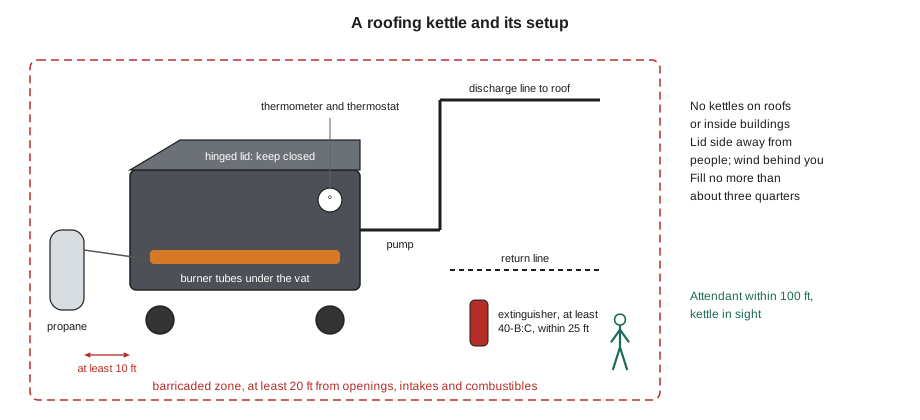
- The vat holds the asphalt. Ridgecap's main kettle holds 400 gal; its small one, 120 gal, is used for repairs. The vat is insulated, with a tight-fitting lid that closes to keep heat in, keep fumes down and smother a fire.
- The burner fires into tubes or flues that run through or under the vat, heating the asphalt without the flame touching it. It is fed by propane through a regulator and hose.
- The thermometer and, on modern kettles, a thermostat that cycles the burner keep the temperature in the working range. Marco checks the kettle gauge against a hand-held probe thermometer every morning.
- The pump moves asphalt through an insulated pipe or hose to the roof, with a return line that lets it circulate back to the vat so it does not cool and plug the line.
- On larger jobs, hot asphalt comes in bulk from a refinery or terminal in an insulated, heated tanker truck that parks on site and pumps to the roof. Tankers avoid handling kegs but bring their own rules about location and burners.
- On the roof, hot asphalt goes into a lugger (an insulated cart), a mop cart or mechanical spreader, or buckets for detail work.
Temperatures that matter
Rory had heard of EVT in the spring without knowing what it meant. Marco wrote the temperatures on the kettle in chalk from the label on a keg of Type III asphalt.
| Temperature | What it is | Why it matters |
|---|---|---|
| Softening point | where the asphalt starts to flow (lesson 2) | decides the asphalt type and slope it suits |
| Equiviscous temperature (EVT) | the temperature at which the asphalt has the right runniness for the application method | apply at the EVT, within about 25 °F either side, at the point of application |
| Finished blowing temperature (FBT) | the temperature at which the asphalt was finished at the refinery | heating above it for long changes the asphalt and lowers its softening point |
| Flash point | where vapor above the asphalt can ignite from a spark or flame | never heat to or near it; stay well below |
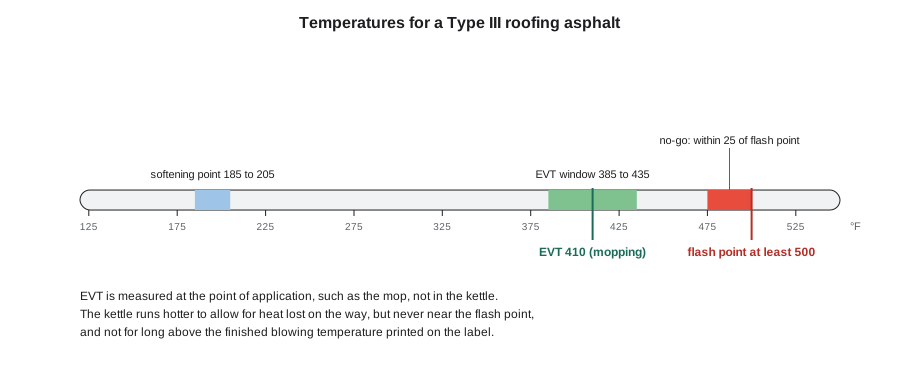
The EVT depends on the asphalt and the method. A label might give one EVT for mopping by hand and a higher one for a mechanical spreader, which lays a thinner film. For a typical Type III asphalt, one maker gives about 410 °F for mopping and 430 °F for a mechanical spreader. The key words are at the point of application: the asphalt cools on its way from the kettle to the mop, so the kettle runs hotter than the EVT, but never hotter than the label allows.
What goes wrong at the wrong temperature:
- Too cold: the asphalt is thick, goes on too heavy, skins over before the felt meets it and does not bond. The result is blisters, slippage and wasted asphalt.
- Too hot: the asphalt goes on too thin, ages in the kettle and loses softening point, fumes heavily and comes closer to its flash point. Long overheating can lower the softening point enough that a roof slides in summer.
- Far too hot: at or near the flash point, vapor above the vat can ignite. A kettle fire is the most serious emergency a roofing crew has.
The asphalt labels Ridgecap buys state the flash point; for ASTM D312 asphalts it is at least 500 °F, and Ridgecap's rule is that no kettle ever reads within 25 °F of the flash point on the label. Most maker and industry guidance says the same.
Worked problem
Checking the application window
The label gives an EVT of 410 °F for mopping, with a window of 25 °F either side. At the mop cart Rory measures 370 °F. The kettle reads 450 °F. What is the window, is the asphalt in it, and what should change?
Show solution
- Window = 410 − 25 to 410 + 25 = 385 to 435 °F.
- Measured at the mop: 370 °F, which is 15 °F below the bottom of the window.
- The kettle is 450 − 370 = 80 °F hotter than the mop: the asphalt is losing heat on the way.
- Raising the kettle risks overheating; first shorten the time in the lugger, insulate or circulate the line, and cover the cart.
Answer: The window is 385 to 435 °F and the asphalt at the mop is 15 °F too cold. The fix is to lose less heat on the way, not simply to turn the kettle up.
Setting up the kettle
Where the kettle goes is the first safety decision of a hot job. The Ohio Fire Code (based on the International Fire Code) sets out rules for asphalt kettles in its construction chapter; Ridgecap's rules add to them.
- On the ground, never on the roof and never inside a building. The code forbids kettles inside a building or on a roof.
- Away from building openings, air intakes and combustibles. The code requires at least 20 ft from combustible materials, combustible building surfaces and building openings. An air intake that sucks in asphalt fumes fills a building with smell and complaints.
- Inside a barricaded zone, with cones and tape or fencing, so the public and vehicles cannot reach it, and never blocking exits, fire lanes or entrances.
- On level, firm ground with the wheels chocked and the hitch supported.
- The propane cylinder at least 10 ft from the burner (the code allows less only for a properly shielded container), with the supply line routed so hot asphalt cannot reach it if something spills or fails.
- A portable extinguisher rated at least 40-B:C within 25 ft of the kettle, and one rated at least 3-A:40-B:C on the roof, as the fire code requires. OSHA 1926.150 separately requires a 10-B extinguisher within 50 ft wherever more than 5 lb of flammable gas is in use.
- Downwind of the building and the public where possible, and with the lid side away from where people walk.
Loading and running the kettle
Solid asphalt arrives in kegs, paper cartons of 100 lb, or in bulk. Marco's loading routine:
- Check that the kettle is not empty and cold with a crust: start a cold kettle slowly, with the burner on low, so asphalt melts around the flues before the bulk heats. Heating a solid block quickly can trap melted asphalt under a crust and make it erupt.
- Strip the paper from each keg on the ground; paper in the kettle burns and clogs the pump.
- Make sure kegs and the vat are dry. Water or snow in hot asphalt turns instantly to steam, makes it foam and boil over, and throws hot asphalt out of the vat. In wet or winter weather, kegs are stored covered and wiped dry.
- Split kegs into pieces with an axe or keg splitter, wearing a face shield, and lower them in by hand or with a loading tray. Never drop or throw a piece in; it splashes.
- Do not fill the vat above the maker's line, usually about three quarters full, so the asphalt has room to expand and the lid closes.
- Keep the lid closed except when loading. Open it standing to the side, with the wind at your back, and never lean over the vat.
- Read the thermometer at least every 15 minutes and log it. Never leave a lit kettle unattended. The code requires an attendant within 100 ft with the kettle in sight, with no ladder or other obstacle on the way.
Worked problem
How many kegs fill the kettle
The main kettle holds 400 gal and is filled no more than three quarters full. Hot asphalt weighs about 7.5 lb per gallon. How many 100 lb kegs make a full working load?
Show solution
- Working volume = 400 × 0.75 = 300 gal.
- Weight = 300 × 7.5 = 2,250 lb.
- Kegs = 2,250 ÷ 100 = 22.5, so 22 kegs, topping up as the level drops.
Answer: About 22 kegs fill the kettle to its working level. On a busy mopping day the crew might use two or three loads.
Getting hot asphalt to the roof
Most burns happen while hot asphalt is moving: being pumped, carried, hoisted or poured. The rules:
- Pipes carrying hot asphalt up the building are securely fastened and supported, with joints tight and the line clear of ladders and walkways. The top of the pipe has a valve or a goose-neck over the lugger, and nobody stands under it.
- Never carry hot asphalt up a ladder. Buckets go up on a hoist or by the pump line, never by hand.
- Fill buckets no more than about three quarters, and carry them at your side, not in front of you.
- Keep luggers and mop carts on planks or walk boards on new insulation, and roll them slowly; a wheel dropping into a gap tips the load.
- Use signals agreed before work starts between the kettle attendant and the roof: pump, stop and circulate. A radio is better than shouting.
- Flush and drain the line at the end of the day or keep it circulating, so asphalt does not set in it overnight. A plugged line cleared by heating with a torch can burst.
Burns
Hot asphalt at 400 °F or more sticks to skin, keeps burning while it cools and cannot be wiped off. Everyone near hot work wears:
- A long-sleeved shirt and long pants of heavy cotton or flame-resistant cloth, with sleeves down and pant legs over the boots, not tucked in.
- Leather or heat-resistant gloves with gauntlet cuffs.
- Safety glasses, with a face shield at the kettle and when loading or pouring.
- Work boots, laced high, and a hard hat.
First aid for an asphalt burn, as Marco teaches it:
- Cool the burn right away under cool, clean running water for at least 20 minutes. Cooling stops the asphalt and the skin under it from burning deeper.
- Do not try to peel off asphalt stuck to the skin, and do not use solvents, fuel or cleaners on it. Medical staff remove it later.
- Remove rings, watches and loose clothing near the burn if they are not stuck.
- Cover loosely with a clean, non-stick dressing, and get medical attention for anything larger than a small spot, any burn to the face, hands, feet or joints, and any burn to the eyes. For eyes, flush with water continuously on the way to care.
- Report every burn to the foreperson and the safety coordinator.
Fire
If asphalt in a kettle catches fire, the response is practiced, not improvised:
- Shut off the burner and the propane at the cylinder, if it can be reached safely.
- Close the lid to smother the fire. Most kettle fires go out when the lid closes.
- Use a dry chemical extinguisher on any fire outside the vat. Never use water on burning asphalt: it turns to steam and spreads the fire.
- Move people away, call the fire department, and keep everyone back until it is out.
Fumes
Hot asphalt gives off fumes that irritate the eyes, nose and throat and cause headaches. Asphalt fume has an occupational exposure limit set by the ACGIH, which OSHA does not enforce as a limit but which Ridgecap follows, and the workers closest to the kettle and the mop get the highest exposure. Ways to keep it down:
- Run the kettle at the lowest temperature that gives the right EVT at the mop.
- Keep the lid closed.
- Set the kettle downwind and away from air intakes; work with the wind at your back.
- Use low-fuming asphalts where the specification allows; they have additives that form a skin on the hot surface and cut fumes.
- Wash before eating, drinking or smoking.
Fumes are also why some buildings cannot have hot asphalt work at all, or only at certain times. At Cedarbrook in July, the school was empty but the daycare in the next block was not, and Marco set the kettle at the far end of the parking lot with the fumes blowing toward the playing fields. At the Ferncliff bakery, the next lesson shows how a building's air intakes changed the whole repair method.
Common mistakes
MistakeHeating the kettle as hot as it will go to save time.
InsteadRun at the label's range so the asphalt is at its EVT at the mop and never near the flash point.
MistakeDropping wet kegs into hot asphalt.
InsteadKeep kegs dry; water causes violent foaming and boil-over.
MistakeOpening the lid and leaning over the vat.
InsteadOpen it standing to the side with the wind at your back, wearing a face shield.
MistakePutting water on a kettle fire.
InsteadShut off the fuel, close the lid and use a dry chemical extinguisher.
MistakePeeling asphalt off a burn.
InsteadCool with running water for at least 20 minutes, leave the asphalt and get medical care.
Summary and key terms
- Only a competent, trained operator runs a kettle, and it is never left unattended.
- Apply asphalt at its EVT, within about 25 °F either side, at the point of application.
- Never heat near the flash point or for long above the finished blowing temperature.
- Set the kettle on the ground, away from openings, intakes and combustibles, barricaded, with propane at a safe distance and extinguishers at hand.
- Most burns happen while asphalt is being moved; use hoists and pumps, not ladders, and fill buckets three quarters.
- Cool asphalt burns with running water for at least 20 minutes and do not remove the asphalt.
- Kettle
- A heated, insulated tank used to melt and hold roofing asphalt.
- Equiviscous temperature (EVT)
- The temperature at which an asphalt has the right viscosity for its application method.
- Finished blowing temperature (FBT)
- The temperature at which the asphalt was finished at the refinery; it should not be exceeded for long.
- Flash point
- The lowest temperature at which vapor above a liquid can ignite from a spark or flame.
- Keg
- A paper carton of solid roofing asphalt.
- Lugger
- An insulated wheeled cart used to carry hot asphalt on the roof.
- Boil-over
- Violent foaming of hot asphalt caused by water or moisture entering the kettle.
Practice problems
Work each problem on paper first, then reveal the answer to check.
An asphalt's EVT for mopping is 425 °F with a 25 °F window. What is the range?
Show answer
400 to 450 °F.
The flash point on a label is 525 °F. What is the highest kettle reading Ridgecap's rule allows?
Show answer
525 − 25 = 500 °F.
A 120 gal kettle is filled three quarters full of asphalt at 7.5 lb per gal. How many 100 lb kegs is that?
Show answer
120 × 0.75 × 7.5 = 675 lb; 675 ÷ 100 = 6.75, about 7 kegs.
What extinguisher must be within 25 ft of a kettle under the fire code?
Show answer
One rated at least 40-B:C.
Why should water never be used on a kettle fire?
Show answer
It flashes to steam and throws burning asphalt.
Lesson quiz · 5 questions
Score 60% or more to complete this lesson.
Create a free account to save your progress, take quizzes and earn a certificate.