
ROOF-210 · Lesson 7 of 12 · 22 min
Self-adhered membranes
▶ Video coming soon A video version of this lesson is on the way.
By the end of Monday, November 9, the Carrick Street tear-off was finished, and the new vapor retarder, insulation and gypsum cover board were down and primed over the whole roof, with two crews working from opposite ends. On Tuesday morning there was frost on the cover board and the thermometer on the hoist read 34 °F. Dana sent the crew to the heated trailer for coffee. "Self-adhered base wants 40 degrees and a dry surface," she said. "It's a sticker, not a weld. A sticker on frost is a sticker on nothing." By 10:15 the sun had dried the boards, the air was 43 °F, and Rory and Luca Moretti began laying base sheet.
Self-adhered (SA) modified bitumen sheets carry a layer of sticky, pressure-sensitive bitumen on their underside, protected by a release film. They need no heat, no flame and no liquid adhesive. This lesson covers what SA sheets are, where they are used, how they are installed and what limits them.
What a self-adhered sheet is
An SA sheet is a modified bitumen sheet, usually SBS, made with a special compound on its underside that stays tacky at ordinary temperatures. A silicone-coated release film or paper covers the adhesive and is peeled off as the sheet is laid. Many SA sheets have a split release film, in two halves along the length, so each half can be peeled separately. Cap sheets have granules on top and a selvage edge, often itself self-adhered, for the side lap.
Self-adhered products in roofing include:
- SA base sheets for two-ply modified bitumen roofs.
- SA cap sheets, granule-surfaced, for flameless roofs and for picture framing around torch-applied fields.
- SA flashing sheets for walls, parapets and curbs.
- SA vapor retarders and air barriers laid on decks.
- SA underlayments for steep-slope roofs, the ice barrier membranes of ROOF-130.
SA modified bitumen sheets are tested to the same kinds of standards as other mod-bit sheets. ARMA, the Asphalt Roofing Manufacturers Association, notes that SA sheets may meet the physical property requirements of ASTM D4601, D1970 and D6162 to D6164 (and CSA A123.23 in Canada), depending on the product. The maker's data sheet lists which.
Why use self-adhered sheets
- No flame: no fire risk from the membrane itself, so SA sheets go where torching is not allowed or not wise: over wood, at perimeters, curbs and penetrations, near combustible walls.
- No kettle and little odor: suited to occupied buildings, schools and hospitals.
- Consistency: the adhesive layer has a factory-controlled thickness, so there is no mopping or spreading rate to get wrong.
- Speed and small crews: no equipment to set up and no cure time for the bond to start working.
- Fewer hazards: no hot bitumen, no propane, no solvent cleanup for the sheet itself.
The limits
"Self-adhered sheets are wonderful," Dana told Rory, "until you forget what they can't do."
- Temperature. Air, substrate and product must all be at or above the maker's minimum, typically about 40 to 50 °F. Below that, the adhesive is too stiff to wet the surface. Some makers offer cold-weather grades rated lower, down to about 14 °F for some products, and special primers.
- Surface. There is no liquid bitumen to fill hollows and gaps. The substrate must be smooth, firm, clean, dry and free of dust, frost and loose granules. Any ridge, step or debris holds the sheet off the surface and leaves a channel.
- Primer. Many substrates, such as concrete, wood, gypsum cover boards, metal and old bitumen, must be primed with the maker's primer, and the primer must be dry or tacky as the maker says before the sheet goes on.
- Compatibility. Some substrates cannot take SA sheets or their primers: solvent-based primers can attack expanded and extruded polystyrene, and some SA compounds should not touch certain plastics. Follow the maker's list of approved substrates.
- No second chances. The bond is immediate. A sheet laid crooked cannot simply be lifted and moved; it is cut out or patched.
- Sun. Rolls left in direct sun soften, stick to themselves and can dog-leg. Keep them shaded and covered with breathable tarps.
- Laps. End laps on granule-surfaced sheets, and T-joints, need extra care: the maker may require heat welding with a hot-air tool, a compatible mastic or a self-adhered strip.
Priming
Primer is a thin bitumen solution that soaks into the surface, binds dust and gives the adhesive a surface it can grip. Rory had expected it to be quick; it was the slowest part of Monday.
- Apply primer by brush, roller or sprayer at the maker's rate, in a thin, even coat with no puddles.
- Let it dry to the condition the maker specifies, often until it is dry to the touch or slightly tacky. Solvent left in a thick or wet coat can attack the SA compound and lower the bond.
- Prime only what can be covered the same day or the next, so dust does not settle on primed surfaces.
- Solvent-based primers are flammable; the solvent safety rules of lesson 4 apply.
Worked problem
Primer for Carrick Street
The 8,200 ft² of gypsum cover board on Carrick Street will be primed at 1 gal per 160 ft², with 5 percent extra for walls and curbs. Primer comes in 5 gal pails. How many pails?
Show solution
- Primer = 8,200 ÷ 160 = 51.25 gal.
- With 5 percent extra: 51.25 × 1.05 = 53.8 gal.
- Pails = 53.8 ÷ 5 = 10.8, so 11 pails.
Answer: Eleven pails of primer. Some cover boards are made with a primed or coated face that the SA maker accepts without primer; on this job, the specification called for priming.
Laying the sheets
The routine Rory and Luca followed on Tuesday:
- Check the temperature: air, surface and the rolls themselves. Rolls come from the heated trailer a few at a time.
- Snap chalk lines for the side laps, starting at the low edge.
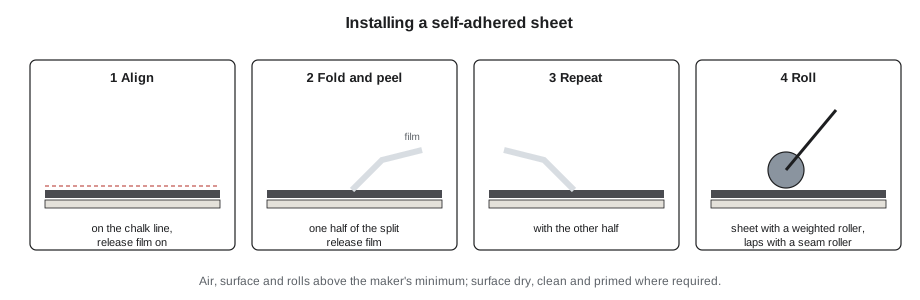
- Cut the sheet to length and lay it out on the line, release film still on. Let it relax for a few minutes if it came off a tight roll.
- Fold back one half of the sheet lengthwise. Peel that half of the split release film, keeping it low and pulling it back at an angle so the sheet settles onto the surface along the line without wrinkles.
- Fold back the other half and repeat.
- Roll the whole sheet immediately with a weighted roller, the weight the maker specifies, working from the center out, overlapping each pass. Then roll the laps with a hand seam roller, firmly, along their full length.
- Lap the next sheet onto the selvage line, at least the maker's side lap, usually 3 in. End laps are at least 6 in and staggered at least 3 ft.
- Seal T-joints and end laps as the maker requires: cut the corner of the middle sheet, apply mastic or heat-weld, and roll.
With a split release film, the sheet stays where it was aligned while the first half bonds, so the second half follows the same line. Peeling the whole film off at once and trying to place the sheet sticky side down is how SA sheets end up crooked.
| Check | What to look for |
|---|---|
| Bond | no hollow sound when tapped, no bubbles, sheet in full contact |
| Laps | rolled tight, no wrinkles, no fishmouths, edges sealed |
| T-joints | corners cut, sealed as the maker specifies |
| Wrinkles | cut out and patched, not flattened over |
| Release film | all removed; film left under a lap means no bond |
| Cleanliness | no dust, granules or debris trapped under the sheet |
Hot-air welding the laps
Some SA cap sheets call for end laps, or all laps in cold weather, to be heat-welded with an electric hot-air tool. A hot-air welder blows a stream of very hot air into the lap while a silicone roller presses it closed. It melts the bitumen like a torch does, but with no open flame, so it is accepted in many places where torches are not. It can still scorch materials and start a fire if held still against something combustible, so it is used with care, never pointed into gaps, and unplugged when not in use.
Picture framing with self-adhered sheets
On Carrick Street, the SA cap went down in a band at least 3 ft wide around the whole perimeter, along the parapet base and around each curb and drain, before the torch crew started on the open field (lesson 6). The torch-applied field sheets lapped onto the SA band, with the torch kept well back from its inner edge and the joint sealed as the maker specified.
Worked problem
SA cap for the perimeter band
The Carrick Street roof is 100 ft by 82 ft. The flameless perimeter band is 3 ft wide. Curbs and drains add another 150 ft² of band. SA cap rolls cover 98 ft² net each. With 10 percent waste for cutting around details, how many rolls?
Show solution
- Band along the edges = 2 × 3 × (100 + 82) = 1,092 ft².
- The four corners are counted twice: subtract 4 × 3 × 3 = 36 ft², leaving 1,056 ft².
- Add curbs and drains: 1,056 + 150 = 1,206 ft².
- Rolls = 1,206 ÷ 98 × 1.10 = 13.5, so 14 rolls.
Answer: Fourteen rolls of SA cap for the flameless band, plus the SA flashing sheets for the parapet faces (lesson 10).
Cold weather and self-adhered sheets
November is the edge of the SA season in central Ohio. The routine that made it work on Carrick Street:
- Rolls and primer stored overnight in a heated trailer and brought up in small batches.
- Work started only once the surface was dry and the air above the maker's minimum; the hoist thermometer and a surface thermometer were read and logged every hour.
- Laps given extra rolling, and end laps and T-joints heat-welded with the hot-air tool, as the maker's cold-weather guide allows.
- Work stopped early enough that each day's sheets were rolled and sealed before the temperature fell and dew formed.
- A cold-weather grade of SA flashing was used on the north parapet, which never saw sun.
By Tuesday at 3:00 p.m., the base sheet covered the whole roof. Dana walked it tapping with the handle of her knife and listening, and found one hollow spot, about the size of a dinner plate, where a granule from the old roof had been trapped under the sheet. She cut it out, primed, patched it with a piece of base and rolled it. "That's the thing about stickers," she said. "They show you every crumb."
Self-adhered sheets on the deck
Self-adhered sheets are often the first layer on the deck as well as the last on the roof. At Carrick Street and Cedarbrook, an SA vapor retarder went straight onto the primed steel deck. On a fluted deck, the sheet spans the flutes and bonds to the top flanges, so the deck must be clean and the laps must fall on a flange or be supported. The SA retarder is the building's air and vapor seal, so its laps, its seal to the walls and its seals around penetrations matter as much as the membrane's. Every hole through it, such as a drain bowl or pipe, is sealed with the maker's accessories before insulation goes on top.
When self-adhered is the wrong choice
- On a wet, dusty or uneven substrate that cannot be fixed in time: SA sheets will not bond, and a liquid-applied or adhered system may suit better.
- Over substrates the maker does not list, such as some polystyrene boards and old coatings.
- In cold weather without a cold-rated product and a way to keep rolls and primer warm.
- Where the specification requires a different system for the warranty or fire rating.
The choice is the designer's, but a crew that sees a problem, such as a dusty deck, a new product or a cold week ahead, raises it before laying the first sheet, not after.
Common mistakes
MistakeLaying SA sheets on a frosty or dewy surface.
InsteadWait until the surface is dry and air, surface and rolls are above the maker's minimum.
MistakePeeling the whole release film and placing the sheet sticky side down.
InsteadAlign the sheet, then peel one half of a split film at a time.
MistakeSkipping the roller because the sheet stuck.
InsteadRoll every sheet with the specified weighted roller and every lap with a seam roller.
MistakeCovering wet primer.
InsteadLet primer dry to the condition the maker specifies; trapped solvent weakens the bond.
MistakeLeaving rolls in the sun.
InsteadShade and cover SA rolls; sun softens the adhesive and deforms the roll.
Summary and key terms
- SA sheets carry a pressure-sensitive adhesive under a release film; no heat, flame or liquid adhesive is needed.
- They suit flameless details, occupied buildings and picture framing around torch-applied fields.
- Air, surface and product must be above the maker's minimum, typically about 40 to 50 °F.
- Substrates must be smooth, clean and dry, and often primed; primer must dry before the sheet goes on.
- Align, peel one half of a split film at a time, and roll the sheet and laps firmly.
- Seal end laps and T-joints as the maker specifies, by mastic, SA strip or hot-air welding.
- Self-adhered (SA)
- A membrane with a pressure-sensitive adhesive on its underside that bonds without heat or liquid adhesive.
- Release film
- The silicone-coated film or paper protecting the adhesive side of an SA sheet.
- Split release film
- A release film in two lengthwise halves so each half can be peeled separately.
- Primer
- A thin bitumen solution applied to a substrate to improve adhesion.
- Hot-air welder
- An electric tool that blows hot air into a lap to melt and seal it without open flame.
- Seam roller
- A small hand roller used to press laps closed.
- Weighted roller
- A heavy roller used to press a membrane into full contact with the surface.
Practice problems
Work each problem on paper first, then reveal the answer to check.
A primer covers 150 ft² per gallon. How many 5 gal pails cover 6,000 ft²?
Show answer
6,000 ÷ 150 = 40 gal; 40 ÷ 5 = 8 pails.
An SA sheet maker sets a minimum of 45 °F. At 9 a.m. the air is 47 °F but the surface is frosty. Can work start?
Show answer
No. The surface must be dry and above the minimum.
Why is a split release film used?
Show answer
So the sheet stays aligned while one half bonds, and the second half follows the same line.
A flameless band 3 ft wide runs around a 90 ft by 50 ft roof. What is its area?
Show answer
2 × 3 × 140 = 840 ft², less 4 × 3 × 3 = 36 ft² of double-counted corners: 804 ft².
Name two substrates that usually need primer under SA sheets.
Show answer
Concrete, wood, gypsum cover board, metal or old bitumen.
Lesson quiz · 5 questions
Score 60% or more to complete this lesson.
Create a free account to save your progress, take quizzes and earn a certificate.