
PWR-240 · Lesson 6 of 12 · 21 min
Control loops and plant control systems
▶ Video coming soon A video version of this lesson is on the way.
On Friday, October 2, 2026, the district hot water supply temperature at Cantwell would not settle. Since the switch from summer to winter operation two days earlier, it had been swinging 5 °F above and below its set point every six minutes or so, and customers at the end of the loop had begun to notice. Wendeline Achterberg, the controls specialist from Sallow Creek Controls, the contractor that services the plant's control system, came in to look at it with Lorne Fitzwilliam and Tamar Ellingsen. She pulled up a trend of the temperature and the controller's output on the same screen. "See how the valve is chasing the temperature, and the temperature is chasing the valve?" she said. "The loop was tuned in summer, when the plate exchangers were lightly loaded and responded slowly. Now they respond faster and the controller is too aggressive for them. It isn't broken. It's just tuned for a different plant."
This lesson explains how automatic control works: the parts of a control loop, on-off and modulating control, proportional, integral and derivative action, tuning, and the control strategies used on boilers and plant systems, including cascade, feedforward, three-element drum level control and combustion control. The next lesson covers the distributed control systems that carry these loops and the alarms they raise.
The control loop
Every automatic control loop has the same basic parts:
- The process, the thing being controlled: the water in a drum, the steam in a header, the temperature leaving an exchanger.
- The measuring element and transmitter, which measure the process variable (PV) and send a signal to the controller.
- The controller, which compares the process variable with the set point (SP), the desired value, and calculates an output.
- The final control element, usually a control valve, damper or variable speed drive, which acts on the process in response to the output.
The difference between set point and process variable is the error. In a closed loop (feedback) system the controller keeps measuring the result of its own action and adjusting, so the loop corrects itself for disturbances it cannot see directly: a change in load, a change in fuel heating value, a fouled exchanger. In an open loop the output is set without measuring the result, like a burner set to a fixed firing rate regardless of steam pressure.
A controller is either direct acting, increasing its output as the process variable rises, or reverse acting, decreasing its output as the process variable rises. The choice depends on the valve: a heating valve that opens on increasing signal needs a reverse-acting controller, so that a rising temperature closes it. Getting the action wrong produces a loop that drives itself to one extreme, a fault that shows up immediately after commissioning or a valve replacement.
On-off control
The simplest controller is on-off, or two-position: the output is fully on below the set point and fully off above it. To stop the final element cycling rapidly around the set point, an on-off controller has a differential, a dead band between the switch-on and switch-off points. A low-pressure boiler's pressure control, a sump pump's float switch and a compressor's load and unload pressure switches are on-off controls. The process variable cycles continually between the two limits, which is acceptable where the process can tolerate it.
Proportional action
A proportional controller moves its output in proportion to the error. The relationship is set by the gain, K<sub>c</sub>, or by its inverse, the proportional band (PB): the percentage change in the process variable, as a fraction of the transmitter span, that drives the output through its full 0 to 100 in 100 range.
A proportional band of 50 in 100 is a gain of 2; a band of 200 is a gain of 0.5. A narrow band, or high gain, gives a fast, strong response but can make the loop oscillate. A wide band, or low gain, is stable but sluggish.
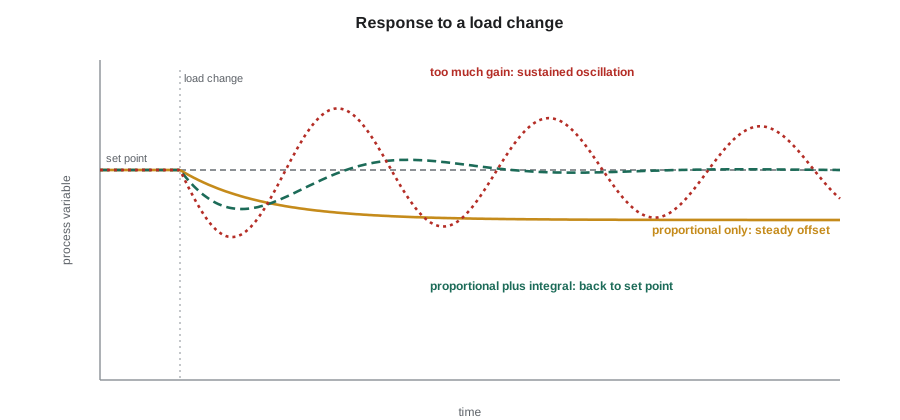
Proportional action alone has a weakness: offset. Because the output can only change if there is an error, a proportional-only controller settles with a steady error whenever the load differs from the value at which it was set up. A larger load needs a larger output, and a larger output needs a larger error to produce it.
Worked problem
Proportional response and offset
The hot water supply temperature transmitter has a span of 32 to 302 °F, and the controller has a proportional band of 50 in 100. If the temperature is 5.4 °F below set point, by how much does the proportional action change the output?
Show solution
- Gain:
- \[K_c = \frac{100}{50} = 2\]
- Error as a fraction of span, which is 270 °F:
- \[\frac{5.4}{270} \times 100 = 2 \text{ in } 100\]
- Output change:
- \[2 \times 2 = 4 \text{ in } 100\]
Answer: The output changes by 4 in 100 of its range. If the load needs a further 4 in 100 of valve opening to hold the temperature, a proportional-only controller would settle with a permanent offset of about that size; integral action is what removes it.
Integral and derivative action
Integral action, also called reset, adds to the output in proportion to the error multiplied by time. As long as any error persists, the integral term keeps moving the output, so it eventually removes the offset. Integral action is set either as an integral time (minutes per repeat), the time it takes the integral action to repeat the proportional action for a steady error, or as its inverse, repeats per minute. A short integral time is strong integral action. Too much integral action makes a loop oscillate slowly and overshoot.
A controller whose output is held at a limit, for example a valve that is fully open but still not achieving the set point, keeps integrating the error and pushes its internal output far beyond 100 in 100. When the error finally reverses, the output takes a long time to come back, and the process overshoots badly. This is integral windup; modern controllers have anti-windup limits that stop the integration when the output saturates.
Derivative action, or rate, adds to the output in proportion to the rate of change of the error. It anticipates where the process is heading and helps on slow processes with long lags, such as large temperature loops. It is set as a derivative time in minutes. Derivative action amplifies noise, so it is rarely used on flow or pressure loops, whose signals are noisy, and many plant loops run with no derivative at all.
A controller with all three is a PID controller. In everyday plant terms: proportional reacts to how big the error is now, integral to how long it has lasted, and derivative to how fast it is changing.
Tuning a loop
Tuning means choosing the gain, integral time and derivative time to suit the process. A well-tuned loop returns to set point after a disturbance quickly, with little overshoot and no sustained oscillation. Tuning methods range from rules of thumb, through the Ziegler–Nichols methods, which raise the gain until the loop oscillates steadily and calculate settings from the gain and period found, to software that fits a model to a step test and calculates settings.
Wendeline used a step test. With Lorne's agreement and the loop in manual, she moved the three-way valve on plate exchanger 1 by 5 in 100 and recorded how the supply temperature responded: a dead time of about 40 seconds, then a rise that reached two-thirds of its final change after about 3 minutes. From those numbers she reduced the controller's gain from 2.5 to 1.2 and lengthened the integral time from 2 to 4 minutes. Back in automatic, the next load change produced one small overshoot and the temperature settled within ten minutes. She recorded the old and new settings on the loop's tuning record and in the management of change log, because tuning changes are changes to the plant.
Before anyone retunes a loop, it is worth checking that the problem is really tuning. Many loops that seem to need retuning have a mechanical fault: a sticking valve stem, a worn positioner, a valve that is oversized and works only in the first few percent of its travel, or a faulty transmitter. A valve that sticks and then jumps, called stiction, produces a characteristic sawtooth oscillation that no tuning will fix.
Manual, automatic and bumpless transfer
Every controller can be switched between automatic, where it calculates its own output, and manual, where the operator sets the output directly. Operators take loops into manual to deal with instrument faults, as with boiler 1's drum level in lesson 5, during start-up, and for testing. A good controller makes bumpless transfer: in manual the set point tracks the process variable, or the controller initializes its output, so that switching back to automatic does not jolt the valve.
A loop left in manual is a common cause of trouble. The plant's shift turnover should list every loop that is in manual and why, and the control system should highlight them.
Control valves and fail-safe action
Most control valves in a plant are pneumatically operated. A diaphragm actuator converts the air pressure, typically 3 to 15 psi, into stem movement against a spring, and a positioner compares the controller's signal with the stem position and adjusts the air pressure to put the stem exactly where it is wanted. An I/P converter, or a digital positioner, turns the 4–20 mA signal into air pressure.
Every valve is chosen to move to its safe position if the air or the signal fails. An air-to-open valve, which closes on loss of air, is fail-closed; an air-to-close valve is fail-open. A burner's fuel control valve fails closed. A boiler feedwater control valve is usually chosen to fail open or to fail in its last position, because starving a boiler of water is the greater danger. The fail action is marked on the valve and on the drawings, and the operator should know it for every critical valve.
Control strategies
Single feedback loops are not enough for many plant processes, which have large disturbances or slow responses. The common enhancements are:
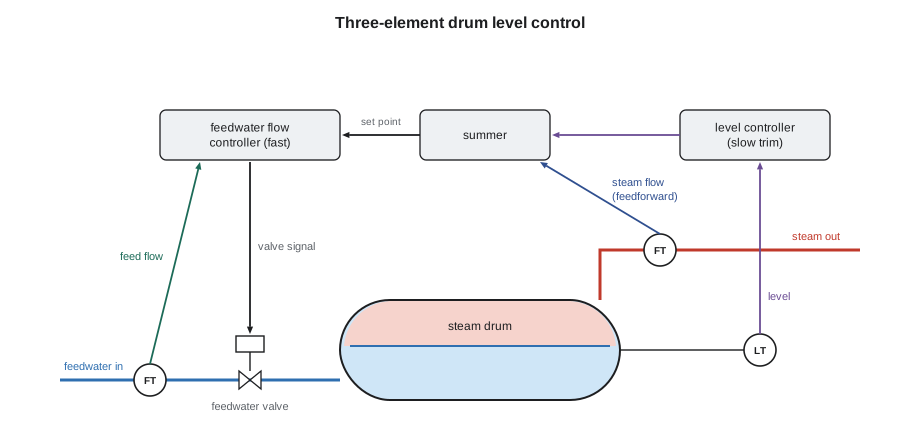
- Cascade control: the output of a master controller becomes the set point of a slave controller. A drum level controller can set the set point of a feedwater flow controller, which corrects for changes in feedwater pressure before they upset the level.
- Feedforward control: a measured disturbance is used to change the output before the process variable is affected. Steam flow is fed forward to the feedwater valve, so that the feed follows the load immediately.
- Ratio control: one flow is held in proportion to another, such as fuel and air.
- Split-range control: one controller output operates two final elements in sequence, such as a heating valve over the first half of the range and a cooling valve over the second.
- Override or selector control: the lower or higher of two controller outputs is chosen, so that a constraint, such as a maximum pressure, can take over from the normal controller.
Three-element drum level control
PWR-220 lesson 5 introduced the three elements Cantwell uses on all three steam boilers. Single-element control, using drum level alone, struggles on watertube boilers because of swell and shrink. When steam demand rises suddenly, the drum pressure falls, the water boils more vigorously, the steam bubbles in the risers expand and the level appears to rise, even though more water is leaving as steam. A level-only controller responds by cutting the feed, exactly the wrong action. When demand falls, the bubbles collapse and the level shrinks, and the controller overfeeds.
Three-element control uses:
- Steam flow as a feedforward signal: the feedwater demand starts by matching the steam leaving.
- Feedwater flow as the measured variable of a fast inner loop, which corrects for changes in feed pressure.
- Drum level as the slow trimming signal from a master level controller, which corrects for blowdown, leaks and measurement differences.
The result is that the feed follows the load closely and the level controller only makes small corrections. If a steam or feedwater flow transmitter fails, the controller falls back to single-element level control, which is why boiler 3 ran on single-element control on October 16 while its steam flow transmitter was being calibrated.
Combustion control
Combustion control holds the steam header pressure by adjusting the firing rate and keeps the fuel and air in the right proportion at every rate. A master pressure controller sends a firing rate demand to the burners. The two common arrangements are:
- Parallel positioning: the firing rate demand positions the fuel valve and the air damper together, through a mechanical jackshaft or separate actuators with characterized curves. Cantwell's burners are of this type. It is simple, but the air-fuel ratio depends on the valve and damper characteristics staying as they were set up.
- Metering or fully metered control: fuel flow and air flow are measured and controlled in separate loops, with cross-limiting so that air leads fuel on an increase and fuel leads air on a decrease, keeping the mixture on the excess air side during load changes.
Oxygen trim measures the oxygen in the flue gas and makes small corrections to the air, holding excess air close to the optimum as fuel properties, air temperature and wear change. Boiler 1 is the first of Cantwell's boilers to get oxygen trim; Halvard Rosemund commissioned it later in October, as PWR-220 lesson 6 described.
Combustion control is separate from the burner management system (BMS), which handles purge, ignition, flame supervision and safety shutdowns. The BMS is a safety system and overrides the combustion controls; operators never bypass it to keep a burner running.
After Wendeline left, Tamar watched the hot water supply temperature through the afternoon. It rose and fell with the customers' demand, but each time the controller brought it back without the long swings of the morning. In the log, Lorne noted the new tuning, the reason and the management of change number, and asked the day shift to keep an eye on the trend through the first cold snap.
Common mistakes
MistakeExpecting a proportional-only controller to return exactly to set point.
InsteadProportional action leaves an offset when the load changes; integral action removes it.
MistakeRetuning a loop that oscillates without checking the valve.
InsteadStiction, worn positioners and oversized valves cause oscillations that tuning cannot fix.
MistakeLeaving a loop in manual at shift change without telling anyone.
InsteadEvery loop in manual is listed at turnover with the reason, and returned to automatic when the reason is cleared.
MistakeAssuming a rise in drum level after a load increase means the boiler is overfed.
InsteadThat is swell; three-element control uses steam flow so that the feed rises with the load.
MistakeTreating the burner management system as part of combustion control.
InsteadThe BMS is a separate safety system that overrides the combustion controls and is never bypassed.
Summary and key terms
- A control loop measures a process variable, compares it with the set point and acts through a final control element.
- On-off control cycles within a differential; proportional control responds in proportion to error but leaves an offset.
- Integral action removes offset; derivative action anticipates change; tuning balances speed against stability.
- Control valves are chosen to fail to their safe position; positioners place the stem accurately.
- Cascade, feedforward, ratio, split-range and selector control handle disturbances and constraints.
- Three-element drum level control overcomes swell and shrink; combustion control holds pressure and air-fuel ratio, with the BMS as a separate safety layer.
- Set point
- The desired value of a process variable.
- Proportional band
- The change in process variable, as a percentage of span, that moves a proportional controller's output through its full range.
- Offset
- The steady error left by a proportional-only controller after a load change.
- Integral action
- Controller action that changes the output in proportion to the error integrated over time, removing offset.
- Integral windup
- The build-up of a controller's integral term while its output is at a limit, causing overshoot.
- Cascade control
- An arrangement in which a master controller sets the set point of a slave controller.
- Feedforward control
- Control action based on a measured disturbance before it affects the process variable.
- Swell and shrink
- The apparent rise and fall of drum level caused by expansion and collapse of steam bubbles during load changes.
Practice problems
Work each problem on paper first, then reveal the answer to check.
A controller has a proportional band of 25 in 100. What is its gain?
Show answer
Kc = 100 ÷ 25 = 4.
A temperature transmitter has a span of 0 to 400 °F and a proportional-only controller has a gain of 1.5. What output change results from an 8 °F error?
Show answer
Error = 8 ÷ 400 = 2 in 100 of span; output change = 1.5 × 2 = 3 in 100.
Why does a feedwater control valve on a boiler often fail open rather than closed?
Show answer
Starving the boiler of water is the greater danger; a fail-open valve keeps water going in, and the high level alarms and the operator deal with overfeed.
Lesson quiz · 5 questions
Score 60% or more to complete this lesson.
Create a free account to save your progress, take quizzes and earn a certificate.