
PWR-240 · Lesson 4 of 12 · 23 min
Electrical safety in plants
▶ Video coming soon A video version of this lesson is on the way.
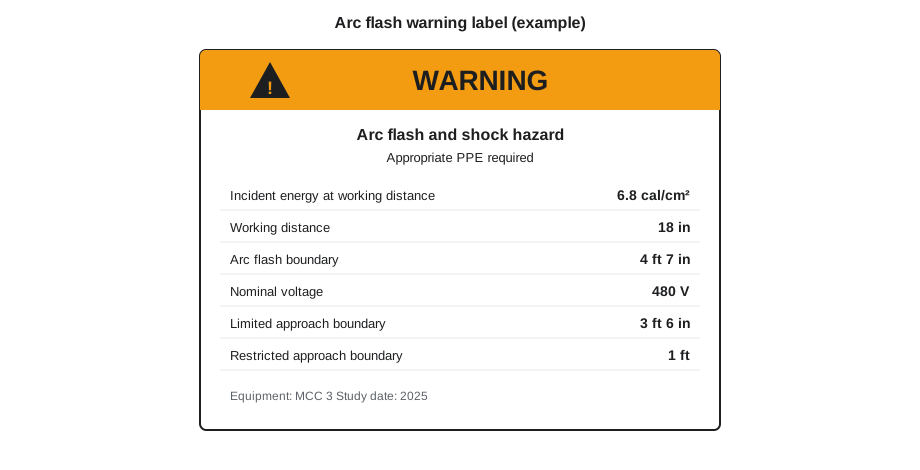
On Saturday, September 26, 2026, the cooling tower fan stopped in the middle of the afternoon. The control system showed its starter tripped, and Lorne Fitzwilliam took Tamar Ellingsen to MCC 3 in the pump gallery. Before he touched the bucket's operating handle, he stopped her in front of the label on the door. It was orange and black, headed WARNING, and gave an incident energy of 6.8 cal/cm² at a working distance of 455 mm (18 in), an arc flash boundary of 1.4 m (4 ft 7 in) and the voltage, 480 V. "Resetting a breaker through a closed, latched door on healthy equipment is normal operation," Lorne said. "Opening that door with the bus live is not. What's behind it could put you in hospital, and the label tells you exactly how badly." He reset the handle from the side, standing clear of the door, and the fan started. Then he asked Ruaridh Brasseur to check the fan motor, because a breaker that trips for no obvious reason has a reason.
Electricity kills people in plants every year, and it injures many more through shock, burns and falls. This lesson covers what electric current does to the body, the shock and arc flash hazards, the standards that govern electrical safety in the workplace, approach boundaries and the electrical safety program, establishing an electrically safe work condition, personal protective equipment, and the limits on what a power engineer may do. It does not teach electrical work; it teaches the operator to recognize the hazards and keep clear of them.
What current does to the body
The harm done by an electric shock depends mainly on the current passing through the body, the path it takes and how long it flows. Voltage matters because it drives the current through the body's resistance, which is low inside the body and high at dry skin. Wet or sweaty skin, a cut, or a firm grip on a conductor lowers the resistance sharply. For a hand-to-hand or hand-to-foot path, a body resistance of about 1,000 Ω is a common figure for wet conditions.
Worked problem
Current through the body
Estimate the current through a body resistance of 1,000 Ω from a 120 V lighting circuit and from a 480 V motor circuit.
Show solution
- From Ohm's law:
- \[I_{120} = \frac{120}{1{,}000} = 0.12 \text{ A} = 120 \text{ mA} \qquad I_{480} = \frac{480}{1{,}000} = 0.48 \text{ A} = 480 \text{ mA}\]
Answer: Both are far above the level at which current through the chest can cause ventricular fibrillation. Ordinary lighting voltage can kill.
Typical effects of 60 Hz current for a second or so are well established. Around 1 mA can just be felt. Above about 10 mA, muscles contract and a person may be unable to let go of a conductor, which lengthens the exposure. Above about 50 to 100 mA through the chest, the heart can go into ventricular fibrillation, an uncoordinated quivering that stops the blood flow and kills within minutes unless a defibrillator restores the rhythm. Higher currents burn tissue along the path, often internally where the damage cannot be seen. A person who has had a shock should always be checked medically, even if they feel fine.
If someone is in contact with a live conductor, do not touch them. Cut the power at the breaker or disconnect if you can do it quickly; if not, use a dry, non-conducting object to separate them from the source. Then call for help, begin CPR if they are not breathing, and use the plant's automated external defibrillator.
Arc flash and arc blast
An arc flash is a release of energy through the air between conductors, or between a conductor and ground, when the insulation between them fails or is bridged: a dropped tool, a loose part, a rodent, dust and moisture, or a test probe slipping. The arc burns at temperatures several times hotter than the surface of the sun, vaporizes copper, which expands many thousands of times in volume, and throws out molten metal, intense light and a pressure wave. The arc blast can throw a worker across a room, rupture eardrums and collapse lungs. Most serious electrical burns in plants come from arc flash, not from shock.
The energy an arc delivers to a worker is described by its incident energy, in calories per square centimeter (cal/cm²) or joules per square centimeter (J/cm²), at a stated working distance. An incident energy of about 1.2 cal/cm² (5 J/cm²) on bare skin is enough to cause a second-degree burn. The distance from the equipment at which the incident energy falls to that level is the arc flash boundary.
Incident energy depends on the available fault current, the voltage, the gap between conductors and, above all, on how long the arc lasts, which is set by how fast the upstream protective device clears the fault. That is why the arc flash study for Cantwell's switchgear, carried out by an engineering firm in 2025, starts from the fault current calculated in lesson 3 and the settings of every breaker. A breaker that is slow because it has not been maintained can let through far more energy than the label shows.
Worked problem
Reading the label
The MCC 3 label shows 6.8 cal/cm² at the working distance. Convert this to J/cm², and say what it means for a worker without arc-rated clothing.
Show solution
- Convert, using 1 cal = 4.184 J:
- \[6.8 \times 4.184 = 28.5 \text{ J/cm}^2\]
- Compare with the onset of a second-degree burn, about 1.2 cal/cm² or 5 J/cm²: the label value is more than five times that.
Answer: An arc at this MCC could deliver about 28.5 J/cm² at the working distance, enough to set ordinary clothing alight and cause severe burns. Anyone inside the 1.4 m (4 ft 7 in) arc flash boundary while the equipment is in an abnormal condition needs arc-rated protection rated above 6.8 cal/cm².
The standards
In the United States, the consensus standard for workplace electrical safety is NFPA 70E, *Standard for Electrical Safety in the Workplace*, now in its 2024 edition. It sets out the electrical safety program, risk assessment, approach boundaries, the electrically safe work condition and the selection of protective equipment. OSHA's electrical safety-related work practices rules, in 29 CFR 1910 Subpart S, and its lockout/tagout standard, 29 CFR 1910.147, carry the force of law; NFPA 70E is the accepted way of meeting them, and OSHA inspectors refer to it.
Electrical installations are a separate matter. In Ohio they are governed by the National Electrical Code as adopted by the state and by the City of Columbus, with permits and inspections through the building department. Electrical work must be done by qualified electricians, usually working for a licensed electrical contractor. A boiler operator's or stationary engineer's license does not authorize electrical work.
Qualified persons and approach boundaries
The standards draw a firm line between qualified persons, who have the training and knowledge to recognize and avoid the hazards of particular equipment and tasks, and unqualified persons, who do not. A person can be qualified for some tasks and not others. At Cantwell, Ruaridh is qualified for work on the MCCs and switchboards; the operators are trained to operate breakers and starters under normal conditions, to read labels and to keep out of the boundaries, but not to work on or near exposed live parts.
Around exposed energized conductors the standards define approach boundaries:
- The limited approach boundary, for the shock hazard: unqualified persons may not cross it unless a qualified person accompanies them and advises them of the hazards.
- The restricted approach boundary, closer in, where there is a real risk of shock from an inadvertent movement: only qualified persons, with shock protection and a plan, may cross it.
- The arc flash boundary, set by the incident energy, which may be inside or outside the shock boundaries: anyone inside it while an arc flash hazard exists must wear arc flash protection.
The distances depend on the voltage and, for the arc flash boundary, on the incident energy at the equipment. They are given on equipment labels and in the plant's electrical safety program, and an operator learns them from those, not from memory.
Normal operation and the risk assessment
Most of what an operator does with electrical equipment is normal operation: switching a breaker, pressing a start button, resetting an overload, reading a meter through a closed door. The standards accept that normal operation does not expose the operator to an arc flash hazard, provided all of these are true:
- The equipment is properly installed and properly maintained.
- All doors are closed and latched, and all covers are in place and secured.
- There is no evidence of impending failure: no arcing sounds, burning smell, scorch marks, bulging, overheating or water where it should not be.
If any one of those is not true, the task is no longer normal operation. A breaker that has tripped twice, a cabinet door that will not latch, a humming or buzzing that was not there yesterday, or a burning smell in the MCC room changes the task: the operator stands back, does not operate the equipment, and calls the electrician. Lorne's caution at MCC 3 came from that list. The cooling tower fan breaker had tripped once with no known cause, so he reset it once, standing to the side, and then asked for the motor to be checked rather than trying again.
For any task beyond normal operation, the plant's electrical safety program requires a risk assessment: what are the hazards, how likely is an incident, how severe could it be, and what controls will be used. The first choices in the hierarchy of risk controls are always to eliminate the hazard, by de-energizing, or to reduce it by engineering, such as remote racking or switching from outside the arc flash boundary. Protective equipment is the last line of defense, not the first.
The electrically safe work condition
The safest way to work on electrical equipment is to make it dead first and prove it. The standards call this establishing an electrically safe work condition. The steps are:
- Identify every possible source of supply from up-to-date drawings, the single-line diagram and labels, including back-feeds, generators, capacitors and control voltages from other panels.
- Interrupt the load current with the normal switching device, then open the disconnecting device for each source.
- Where possible, look to confirm that every blade of a disconnect is fully open or that a drawout breaker is fully racked out.
- Release stored energy: discharge capacitors, block or release springs and other stored mechanical energy.
- Apply lockout devices and tags under the plant's written procedure: each worker applies a personal lock.
- Test for absence of voltage with an adequately rated tester, on each phase-to-phase and phase-to-ground combination, checking the tester on a known live source before and after the test.
- Where induced voltages or stored energy could reappear, apply temporary protective grounds.
Until all of these are done, the equipment is treated as live. The test before touch is the step that saves lives when a drawing is wrong, a breaker contact has welded or someone has fed the circuit from somewhere unexpected. It is done by a qualified person; an operator's role is usually to switch and lock out the equipment under the plant's procedure, while the electrician verifies absence of voltage.
Lockout of electrical equipment fits into the plant's general lockout program from PWR-110 lesson 5 and PWR-230 lesson 12. A pump that is to be opened is isolated electrically at its MCC bucket and mechanically at its valves, and the electrical isolation is locked like any other. Pressing the stop button, or opening a local stop switch at the motor, is never an isolation: control circuits can fail or be operated remotely.
Personal protective equipment
Where work on or near live parts is justified, the standards specify shock protection, such as rubber insulating gloves with leather protectors, rated for the voltage and tested at set intervals, and insulated tools, and arc flash protection: arc-rated clothing, face shield or arc flash suit hood, hard hat, safety glasses, hearing protection, and leather footwear.
Arc-rated clothing carries an arc rating in cal/cm², the incident energy it can withstand before the wearer is likely to suffer a second-degree burn. Protection is chosen either from the incident energy on the label, by wearing clothing rated at least that high, or from the PPE category method in the standard's tables, which assigns categories 1 to 4 to common tasks and equipment. Ordinary clothing of polyester, nylon or other meltable fibers must not be worn under arc-rated clothing, because it melts into the skin.
Everyday electrical safety for operators also covers the simple things: portable tools in good condition with intact cords, ground fault circuit interrupters (GFCIs) on portable equipment and in wet areas, extension cords rated for the load and never run through doorways or water, temporary lighting kept clear of steam leaks and spray, and housekeeping in electrical rooms. Electrical rooms are not storage rooms: the working space in front of switchgear must be kept clear so that a worker can stand there and escape quickly.
What the operator may and may not do
Each plant's electrical safety program sets out exactly what operators are trained and authorized to do. At Cantwell the list is typical:
| Operators may | Operators may not |
|---|---|
| Start and stop motors from pushbuttons and the control system | Open MCC buckets, panel covers or switchgear doors with the bus live |
| Operate breakers and disconnects through closed, latched doors on healthy equipment | Operate equipment showing signs of impending failure |
| Reset an overload or breaker once after finding no obvious cause | Reset a protective trip repeatedly, or reset a lockout relay |
| Lock out MCC buckets and disconnects under the lockout procedure | Test for absence of voltage, unless trained and authorized for it |
| Read meters, labels and the single-line diagram | Change fuses, overload settings or relay settings |
| Report electrical faults and abnormal conditions at once | Carry out electrical repairs or modifications |
Ruaridh found the cooling tower fan motor's winding resistance balanced and its insulation good, but the terminal box gasket had failed and water from the tower spray had got in. He dried and resealed it, logged it, and added the terminal box to the quarterly inspection. Lorne entered the trip, the reset and the finding in the log, and Pilar Quenneville took the failed gasket to the next joint health and safety committee meeting as an example of a near miss: the next operator to reset that breaker might have done it with water in the box.
Common mistakes
MistakeAssuming low voltages like 120 V are safe.
InsteadCurrents of 50 to 100 mA through the chest can be fatal; 120 V can drive that through wet skin.
MistakeTreating a stop button or a local stop switch as an isolation.
InsteadIsolation means opening and locking the disconnecting device and proving absence of voltage.
MistakeSkipping the check of the tester on a known live source.
InsteadTest the tester before and after; a dead tester reads zero on a live circuit.
MistakeOperating a breaker when the cabinet door will not latch or there is a burning smell.
InsteadThat is no longer normal operation; stand back and call the electrician.
MistakeWearing a polyester shirt under arc-rated clothing.
InsteadMeltable fabrics stick to the skin and deepen burns; wear natural or arc-rated fibers underneath.
Summary and key terms
- Shock harm depends on current, path and time; around 50 to 100 mA through the chest can cause fibrillation.
- Arc flash causes most serious electrical burns; incident energy and the arc flash boundary are on equipment labels.
- NFPA 70E sets out workplace electrical safety and OSHA Subpart S gives it legal force; the NEC governs installations, and electrical work is for qualified electricians.
- Unqualified persons stay outside the limited approach boundary unless escorted; only qualified persons enter the restricted boundary.
- Normal operation is safe only with equipment properly installed and maintained, doors closed and latched, and no sign of impending failure.
- An electrically safe work condition means isolate, lock out, release stored energy and test before touch.
- Arc flash
- A release of energy through the air between conductors, producing extreme heat, light and molten metal.
- Incident energy
- The heat energy an arc flash delivers to a surface at a given working distance, in cal/cm² or J/cm².
- Arc flash boundary
- The distance from an arc source at which the incident energy falls to about 1.2 cal/cm², the onset of a second-degree burn.
- Qualified person
- A person trained to recognize and avoid the electrical hazards of particular equipment and tasks.
- Electrically safe work condition
- A state in which equipment has been isolated, locked out, tested for absence of voltage and, where needed, grounded.
- Arc rating
- The incident energy that arc-rated clothing can withstand before a second-degree burn is likely.
Practice problems
Work each problem on paper first, then reveal the answer to check.
Convert an incident energy of 12 cal/cm² to J/cm².
Show answer
12 × 4.184 = 50.2 J/cm².
A label shows 3.1 cal/cm². Is arc-rated clothing with an arc rating of 8 cal/cm² adequate if work within the boundary is needed?
Show answer
Yes; its rating exceeds the incident energy. The task still needs a risk assessment and authorization.
An operator notices that an MCC bucket door will not latch. May the operator use that bucket's handle to start the motor?
Show answer
No. With a door that will not latch, the conditions for normal operation are not met; the electrician must be called.
Lesson quiz · 5 questions
Score 60% or more to complete this lesson.
Create a free account to save your progress, take quizzes and earn a certificate.