
PWR-240 · Lesson 10 of 12 · 23 min
Maintenance planning
▶ Video coming soon A video version of this lesson is on the way.
On Sunday, October 18, 2026, Fenella Thorncroft came in for two hours on a quiet afternoon to walk down the jobs on the coming week's maintenance schedule, and Tamar Ellingsen went with her. At each job Fenella stopped and checked the same things against the work order on her tablet: was the equipment where the order said, could it be isolated the way the job plan said, were the parts in the stores cage, was there room to work, and would the scaffold, the crane or the confined space rescue equipment be needed. At the cooling tower fan she found that the job plan for the terminal box inspection said a stepladder would do, but the box was 10 ft up beside the fan stack, beyond safe ladder reach. "That's why I walk them," she said. "If I'd scheduled it as written, Ruaridh would have turned up Wednesday, found he needed a lift, and lost half a day. A badly planned job costs more than the job."
PWR-230 lesson 12 compared maintenance strategies and covered isolating and returning auxiliaries to service. This lesson takes the planner's view: how work is identified and requested, how work orders are prioritized and planned, how schedules are built and agreed with operations, how the computerized maintenance management system holds it all together, how spare parts and outages are managed, and how a plant measures whether its maintenance is working.
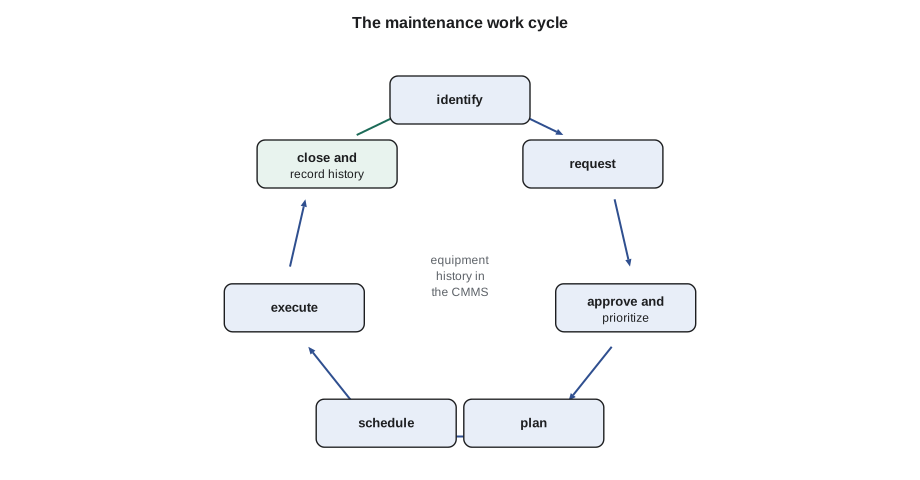
The maintenance work cycle
Every piece of maintenance work at Cantwell follows the same cycle:
- Identify: someone sees a need, from a round, an alarm, an inspection, a preventive maintenance task coming due, or a trend in the monthly report.
- Request: the need is entered as a work request in the maintenance system, with the equipment, the problem and who reported it.
- Approve and prioritize: the planner and the chief engineer, or the shift engineer out of hours, decide whether the work is needed and how urgent it is.
- Plan: the planner works out the scope, the steps, the trades, the hours, the parts, the tools, the isolation and the permits.
- Schedule: the job is placed in a week's schedule, agreed with operations, and in a day's plan.
- Execute: the crew does the work under the right permits, with operations releasing and accepting the equipment.
- Close: the crew records what was found, what was done, the parts used and the hours; operations tests and accepts the equipment; the history is updated.
The cycle is the same for a three-minute filter change and a three-week boiler outage; only the size of each step changes. Skipping steps is where trouble starts. A job done without a work order leaves no history; a job done without planning wastes time; a job closed without recording what was found loses the evidence the next planner needs.
Work requests and priorities
Anyone in the plant can raise a work request, and operators raise most of them. A good request says which equipment, using its tag number, what is wrong, when it was noticed and how it was found. "Feed pump 2 outboard bearing running hot, 78 °C by IR gun at 14:00, was 62 °C last week" can be planned; "pump noisy" cannot.
Each approved request becomes a work order with a priority. Cantwell uses four:
| Priority | Meaning | Typical response |
|---|---|---|
| 1 Emergency | Immediate risk to people, plant or supply | Start now, call out the crew if needed |
| 2 Urgent | Will become an emergency or cause damage if left | Within 24 to 48 hours, ahead of the schedule |
| 3 Routine | Needed, but no immediate risk | Planned and scheduled within weeks |
| 4 Opportunity | Can wait for an outage or a convenient time | Done when the equipment is down for other reasons |
Priorities are set by the consequence of not doing the work, not by who asked or how loudly. A plant where most work orders are marked emergency or urgent is not prioritizing; it is reacting. Good practice aims for a small share of emergency and urgent work and a large share of planned routine work, because planned work is safer, cheaper and better done.
Planning a job
Planning decides what will be done and how; scheduling decides when. A planner prepares a job plan for each work order that covers:
- The scope: exactly what is to be done, and what is not.
- The steps, in order, with references to procedures, drawings and manufacturers' manuals.
- The trades or skills needed, how many people and how many hours.
- The parts and materials, with stock numbers, checked against the stores or ordered.
- The tools and equipment: special tools, lifting gear, scaffolds, test instruments.
- The isolation: the lockout points, the draining and venting, and the permits needed.
- The hazards and precautions, from a job hazard analysis.
- The post-maintenance test and acceptance criteria: how operations will know the equipment is fit to return to service.
Fenella's habit of walking down every job before it is scheduled is called a job walk-down, and it catches most of the problems that wreck a schedule: access, isolation points that do not match the drawings, parts that are not the right ones, and work that is bigger than the request suggested. Once the plan is complete and the parts are in hand, the job is ready to schedule. Parts and materials for a scheduled job are often gathered in advance into a kit, labeled with the work order number.
For repetitive work such as preventive maintenance, the job plan is written once as a standard job and reused, improving each time the crew finds something missing.
Scheduling
Cantwell's maintenance crew is Fenella and three tradespeople, plus contractors. Each Thursday Fenella builds the next week's schedule from the jobs that are ready, the preventive maintenance due, and the crew's available hours, leaving some room for the urgent work that will inevitably arrive. On Friday morning she reviews it with Grazyna Wolanski and the shift engineers, because every job needs operations to release equipment: a boiler off line, a pump on standby, a cooling tower fan stopped. Operations' agreement is what makes a schedule real.
Each day, the crew lead and the shift engineer confirm that day's jobs, the permits and the isolations. The shift engineer prepares the equipment, hands it over under lockout, and receives it back after the post-maintenance test.
A schedule is measured by schedule compliance: the share of scheduled work that was actually done in the week. Low compliance usually means jobs were not truly ready, emergencies displaced planned work, or operations could not release the equipment.
Worked problem
Planned hours and backlog
Cantwell's maintenance backlog, the planned and approved work not yet done, totals 640 crew-hours. The crew has 4 people, each with about 32 productive hours a week after meetings, travel, breaks and training. How many crew-weeks of backlog is that, and what does it suggest?
Show solution
- Available crew-hours a week:
- \[4 \times 32 = 128 \text{ h}\]
- Backlog in weeks:
- \[\frac{640}{128} = 5 \text{ weeks}\]
Answer: Five weeks of backlog. A backlog of about two to four weeks is often treated as healthy: enough to schedule efficiently, not so much that routine work waits months. Five weeks suggests either adding contractor help or reviewing the backlog for jobs that are no longer needed.
Preventive maintenance
Preventive maintenance (PM) tasks are generated automatically by the maintenance system, by calendar interval or by run hours. At Cantwell the PM program includes weekly boiler and generator checks, monthly safety device tests, quarterly oil sampling and vibration readings, annual boiler inspections and safety valve tests, and the many tasks added from lessons and incidents, such as the quarterly capacitor bank inspection Ruaridh Brasseur added in lesson 1.
PM tasks should be reviewed regularly. A task that never finds anything may be too frequent; a failure that a PM should have caught means the task, its interval or its method needs changing. Each change to the PM program is a small engineering decision and should be recorded with its reason.
Worked problem
Preventive maintenance compliance
In September, 186 preventive maintenance work orders came due at Cantwell. By the end of the month, 171 had been completed within their allowed window. What was the PM compliance?
Show solution
- Compliance:
- \[\frac{171}{186} = 0.92\]
Answer: About 92 in 100. Many plants aim for 90 in 100 or better for routine PM and 100 in 100 for safety-critical tasks, such as low water cutoff tests and safety valve tests, which must never be skipped or deferred without the chief engineer's written decision.
The computerized maintenance management system
A computerized maintenance management system (CMMS) is the database that holds the plant's maintenance work. At Cantwell it holds:
- The equipment register: every asset with its tag number, location, nameplate data, drawings and manuals, arranged in a hierarchy from plant to system to equipment to component.
- Work requests and work orders, with their priority, status, plans and history.
- Preventive maintenance schedules and standard jobs.
- Stores: spare parts, stock levels, suppliers and costs.
- History: what failed, when, why, what was done and what it cost.
The CMMS is only as good as what is put into it. A work order closed as "done" with no details adds nothing to the history; one closed as "replaced outboard bearing, found inner race spalled, grease dark and dry, relubrication interval too long for duty" tells the planner what to change. Operators help most by writing clear requests, and by recording run hours and readings where the system uses them to trigger PM.
Spare parts and stores
A part that is not in stores when it is needed can turn a two-hour job into a two-week outage. Spare parts are classified by how critical they are:
- Critical spares are held regardless of cost, because the equipment cannot run without them and the lead time is long: feed pump mechanical seals, burner flame scanners, safety valve springs, a spare motor for the forced draft fans.
- Routine spares are held in stock with a minimum and maximum level, reordered when stock falls to the minimum.
- Non-stock items are bought when needed.
The reorder point for a stocked item allows for the usage during the supplier's lead time plus a safety stock:
Worked problem
A reorder point for filter cartridges
Cantwell uses about 6 instrument air filter cartridges a month, roughly 1.5 a week. The supplier's lead time is 4 weeks and Fenella keeps a safety stock of 4. What is the reorder point?
Show solution
- Usage during the lead time:
- \[1.5 \times 4 = 6\]
- Add the safety stock:
- \[6 + 4 = 10\]
Answer: Reorder when stock falls to 10 cartridges. The maximum is set so that the order quantity is economical without tying up too much money or space.
Outages
Some work can be done only when a boiler or a system is shut down: internal inspections, tube replacements, refractory repairs, major valve overhauls. These are gathered into planned outages, scheduled for low-load periods. A district heating plant does most of its boiler outages in summer, one boiler at a time, keeping enough capacity for the summer steam load and a margin for a forced outage of another unit.
An outage is a project, planned months ahead with its own scope list, schedule, contractors, permits, budget and risk review. Scope is frozen some weeks before the outage, with a process for adding emergent work found once the boiler is opened. The planned 2027 replacement of the most deeply pitted floor tubes in boiler 3, decided after the tube leak and pitting report described in PWR-220, will be handled this way, with ultrasonic thickness testing of the rest of the floor tubes added to the same outage.
After any outage the return to service follows the plant's procedures: work orders closed, permits canceled, locks removed in the right order, tests carried out, and the equipment accepted by operations and recorded in the log.
Measuring maintenance
A plant measures its maintenance with a small set of indicators, reviewed monthly:
- Planned work as a share of all maintenance hours, against reactive or breakdown work.
- Schedule compliance and PM compliance.
- Backlog in crew-weeks.
- Mean time between failures and availability for critical equipment, as calculated in PWR-230 lesson 12.
- Maintenance cost per unit of heat delivered, and against the budget.
- Safety: incidents and near misses during maintenance work.
No indicator tells the whole story by itself. High PM compliance with rising failures means the PMs are the wrong ones; low backlog with poor reliability may mean work is not being identified. The point of measuring is to start conversations, not to replace them.
Back in the maintenance office, Fenella changed the cooling tower job plan to call for the plant's scissor lift and a fall protection check, moved the job from Wednesday to Thursday to suit Ruaridh, and marked it ready. Then she showed Tamar the week's schedule: 103 planned hours of the crew's 128, with the rest held for whatever would break. "Something always does," she said.
Common mistakes
MistakeDoing a quick job without a work order.
InsteadRaise a work order for every job so the history and costs are captured.
MistakeMarking most work orders as urgent.
InsteadSet priority by the consequence of not doing the work; most work should be planned routine work.
MistakeScheduling jobs that have not been walked down and kitted.
InsteadOnly jobs that are fully planned, with parts and access confirmed, are ready to schedule.
MistakeClosing a work order with only "done".
InsteadRecord what was found, what was done, the parts and the hours.
MistakeDeferring a safety-critical PM task to make room for other work.
InsteadSafety device tests are not deferred without the chief engineer's written decision.
Summary and key terms
- Maintenance work follows a cycle: identify, request, prioritize, plan, schedule, execute and close with history.
- Priorities depend on the consequence of not doing the work; planned work should far outweigh reactive work.
- A job plan covers scope, steps, trades, hours, parts, tools, isolation, hazards and the post-maintenance test; walk-downs catch problems.
- Schedules are agreed with operations, who release and accept the equipment; compliance shows how realistic they are.
- The CMMS holds the equipment register, work orders, PM, stores and history; it is only as good as its data.
- Critical spares are held regardless of cost; reorder points allow for lead time and safety stock; outages are planned as projects.
- Work order
- An authorized instruction to carry out maintenance work, with its priority, plan and record.
- Job plan
- The planner's description of a job: scope, steps, resources, parts, isolation, hazards and tests.
- Walk-down
- An inspection of a job in the field before scheduling, to confirm the plan is workable.
- Backlog
- Approved maintenance work not yet done, often expressed in crew-weeks.
- Schedule compliance
- The share of scheduled maintenance work actually completed in the period.
- CMMS
- A computerized maintenance management system that holds equipment, work, stores and history records.
- Critical spare
- A spare part held in stock because its absence would cause a long outage of essential equipment.
Practice problems
Work each problem on paper first, then reveal the answer to check.
A crew of 5 has 30 productive hours each per week. The backlog is 450 hours. How many crew-weeks is that?
Show answer
450 ÷ 150 = 3 crew-weeks.
Of 120 jobs scheduled in a month, 96 were completed. What is the schedule compliance?
Show answer
96 ÷ 120 = 0.80, or 80 in 100.
A gasket is used at 2 a week, lead time 3 weeks, safety stock 5. What is the reorder point?
Show answer
2 × 3 + 5 = 11.
Lesson quiz · 5 questions
Score 60% or more to complete this lesson.
Create a free account to save your progress, take quizzes and earn a certificate.