
PWR-240 · Lesson 11 of 12 · 21 min
Environmental regulations for plants
▶ Video coming soon A video version of this lesson is on the way.
On Sunday, November 1, 2026, Lorne Fitzwilliam gave Tamar Ellingsen the first-of-the-month job that most new operators never see: compiling the plant's environmental summary for October. They pulled the gas and fuel oil totals from the meters, the generator's run hours from its controller, the refrigerant log for the chiller, the blowdown temperature checks from the round sheets and the cooling tower records. On the round before lunch, Tamar found something that was not on any sheet: about half a gallon of diesel in the drip tray under the generator's fuel filter, from a fitting that had started to weep. The tray had caught it all. Lorne showed her how to soak it up with absorbent pads from the spill kit, bag the pads for disposal as oily waste, and raise a work order for the fitting. "Contained in the tray, nothing on the floor, nothing near a drain," he said. "That's a maintenance job and a log entry. If it had reached the floor drain it would have been a phone call to the government, and you'd need to know which number."
A plant like Cantwell burns large amounts of fuel, discharges water, stores oil and chemicals and holds refrigerant. Each of these is regulated to protect air, water and land. This lesson covers the main environmental rules that apply to a heating plant: air approvals and emission limits, greenhouse gas reporting, wastewater and blowdown, fuel storage and spills, refrigerants, waste, noise, and the operator's part in compliance.
Why operators need to know
Environmental compliance is often managed by the chief engineer or a corporate environmental group, but the day-to-day work that keeps a plant compliant is done by operators: running burners within their tuned settings, keeping records, testing water, watching for leaks and spills, and responding correctly when something escapes. An operator who knows why a rule exists is far more likely to notice when the plant is about to break it.
In the United States, the main federal laws are the Clean Air Act, the Clean Water Act, the Resource Conservation and Recovery Act for waste and the Oil Pollution Act provisions for oil storage, administered by the Environmental Protection Agency (EPA). In Ohio, most permits are issued and enforced by the Ohio Environmental Protection Agency (Ohio EPA), which carries out the federal programs and adds its own rules, and the City of Columbus sets the rules for discharges to its sewers.
Air: approvals and permits
Under the Clean Air Act and Ohio's rules in OAC Chapter 3745-31, new and modified air sources need a permit-to-install (PTI) before construction, and most need a permit-to-install and operate (PTIO) or, for the largest, a Title V operating permit. Small natural gas–fired units below the state's exemption sizes do not need permits, but Cantwell's three steam boilers, which can also fire fuel oil, are permitted sources. The permit lists the equipment, sets emission limits for pollutants such as nitrogen oxides and particulate, and requires records and reports.
Federal New Source Performance Standards also apply to many plant boilers. Subpart Dc of 40 CFR Part 60 covers steam generating units with a heat input between 10 and 100 million Btu/h built after June 9, 1989; for a boiler firing only natural gas, its main requirement is a record of the fuel burned. Fuel oil firing brings sulfur and opacity requirements. The area source boiler rule, 40 CFR Part 63 Subpart JJJJJJ, does not apply to boilers that meet its definition of gas-fired, which allows oil firing only during gas curtailment, gas supply emergencies and limited periodic testing. A boiler that fires oil outside those limits loses the exemption and becomes subject to the rule's tune-up and energy assessment requirements. Firing oil is therefore a decision the chief engineer makes, and the operator records.
The most important thing an operator does for air quality is run the burners well. A burner with too little air makes carbon monoxide and soot; one with too much air wastes fuel and makes more nitrogen oxides at high flame temperatures. The combustion tests in PWR-210 lesson 9 and the oxygen trim on boiler 1 serve the permit as much as they serve efficiency. Smoke from a stack is visible evidence of a problem, and any visible emission should be investigated at once and recorded.
Emergency generators and engines
The 400 kW standby diesel set has its own air rules. As an emergency stationary engine, it is covered by federal rules for reciprocating engines, 40 CFR Part 60 Subpart IIII for newer engines and Part 63 Subpart ZZZZ, which allow unlimited operation in a real emergency but limit maintenance and readiness testing to 100 hours a year and require a non-resettable hour meter and records of every run. The monthly NFPA 110 test, the yearly load test and every real emergency run are logged with their hours and reasons.
Greenhouse gases
Burning natural gas produces carbon dioxide: about 53 kg for each million Btu of gas. Plants above set thresholds must report their greenhouse gas emissions each year.
Worked problem
Cantwell's yearly CO₂ emissions
Cantwell burned about 360,000 million Btu of natural gas in 2025. Using an emission factor of 53.06 kg CO₂ per million Btu, estimate its CO₂ emissions and compare them with EPA's reporting threshold of 25,000 metric tons of CO₂ equivalent a year.
Show solution
- Emissions:
- \[360{,}000 \times 53.06 = 19.1 \times 10^6 \text{ kg} = 19{,}100 \text{ t CO}_2\]
Answer: About 19,100 metric tons, below the 25,000 ton threshold of EPA's Greenhouse Gas Reporting Program, so Cantwell is not required to report under that program, though it tracks the figure for its owner and its customers. A growing load or a change in fuel could take it over the threshold, which is why the number is calculated every year.
The figures come straight from the gas meter readings the operators record. Accurate meter readings, and records of any fuel oil burned, are the basis of the report.
Water: blowdown and wastewater
A heating plant discharges boiler blowdown, softener regeneration brine, cooling tower bleed, floor drain water and sometimes water from draining boilers and systems. Most of it goes to the municipal sanitary sewer, which leads to the city's treatment plant. Sewer use rules limit what may go down the drain: temperature, pH, oil and grease, suspended solids and specific chemicals.
The City of Columbus sets those limits for Cantwell through its sewer use rules, and the plant's compliance binder lists them. The most important one for a boiler plant is temperature: blowdown at boiler temperature would damage the sewer and endanger sewer workers, so it is cooled first. At Cantwell the continuous blowdown passes through the flash tank and the make-up heat exchanger, and the bottom blowdown goes to a blowdown tank where it is mixed with cold water to bring it below 140 °F before it reaches the sewer.
Worked problem
Cooling water for blowdown
Water leaves the blowdown tank at 212 °F at a rate of 4,400 lb/h during bottom blowdown. How much city water at 50 °F must be mixed with it to bring the discharge down to 140 °F?
Show solution
- Heat lost by the blowdown equals heat gained by the cold water (same specific heat):
- \[m_b (T_b - T_m) = m_c (T_m - T_c)\]
- Solve for the cold water flow:
- \[m_c = 4{,}400 \times \frac{212 - 140}{140 - 50} = 3{,}520 \text{ lb/h}\]
Answer: About 3,520 lb/h of cold water. The tank's temperature-controlled cooling valve does this automatically; the operator checks on the round that the discharge thermometer is below the limit and that the valve is working.
Water treatment chemicals are chosen partly for what happens when they reach the sewer, and any change of chemical program goes through the water treatment supplier and the chief engineer. Storm drains are a different matter: they lead directly to a river or lake without treatment, so nothing but rain may go into them. Operators should know which drains in and around the plant go to the sanitary sewer and which go to the storm system; at Cantwell the storm drains in the yard are painted with a yellow fish symbol.
Fuel storage and spills
Cantwell stores fuel oil in its 5,300 gallon backup tank and diesel in the generator's 530 gallon base tank. Because its total aboveground oil storage is more than 1,320 US gallons, the plant must have a Spill Prevention, Control and Countermeasure (SPCC) plan under 40 CFR Part 112, describing its containment, inspection, training and spill response. Ohio's fire code and the State Fire Marshal's rules also cover tank installation.
Good practice for any oil storage includes secondary containment big enough to hold the tank's contents, regular inspection of tanks, piping and containment, a supervised fill with the operator watching the level and the overfill alarm, drip trays under filters and pumps, and a spill kit within reach. Rainwater collected in an outdoor containment area must be checked for an oil sheen before it is drained.
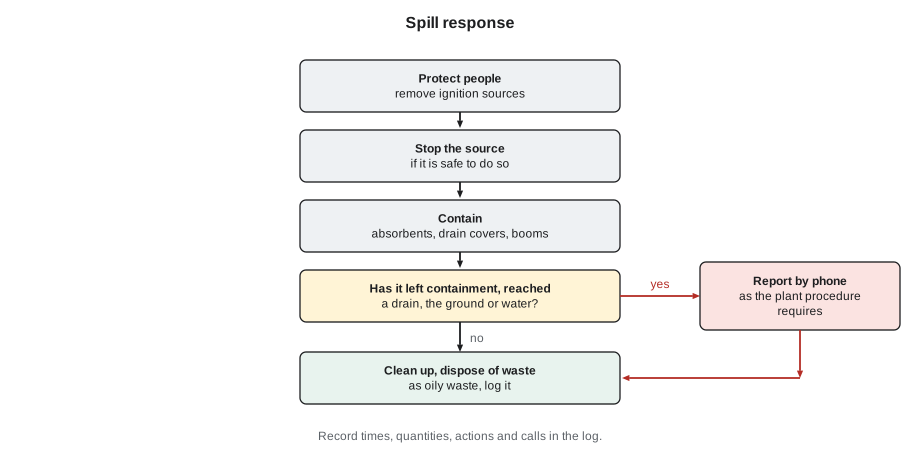
A release of oil or a hazardous substance that reaches water, a storm drain, the sewer or the ground must be reported. Ohio EPA's emergency spill hotline is 1-800-282-9378. Federal law also requires a report to the National Response Center, at 1-800-424-8802, for any oil discharge that causes a sheen on water and for releases of hazardous substances above their reportable quantities, and the plant's SPCC plan and emergency procedures say who makes each call. Diesel caught in a drip tray, as on November 1, has not been released; diesel on a floor that drains to the sewer, or on the ground outside, has.
The spill response sequence is the same everywhere: protect people, stop the source if it is safe to do so, contain the spill with absorbents or booms and block drains, report it as required, clean it up, and record it.
Refrigerants
The chiller holds 209 lb of R-134a. Under section 608 of the Clean Air Act, refrigerant may not be knowingly vented, work on the equipment must be done by EPA-certified technicians, and refrigerant must be recovered. EPA's rules under the American Innovation and Manufacturing Act extend leak repair requirements to appliances containing 15 lb or more of HFC refrigerants such as R-134a, with records of additions and leak rate calculations. Cantwell's refrigerant log records every addition, recovery and leak test, and the yearly total of refrigerant added is a direct measure of leakage.
Operators do not service the chiller, but they read its pressures and the machinery room refrigerant monitor on every round, as PWR-230 lesson 10 described, and an unexplained alarm or a fall in charge is reported.
Waste, noise and other obligations
Waste oil, oily absorbents, spent chemicals, fluorescent lamps and batteries are not ordinary garbage. Under RCRA and Ohio's hazardous waste rules, the plant determines whether each waste is hazardous, manages it according to its generator category and ships it with licensed carriers on manifests, while used oil and universal wastes such as lamps and batteries have their own simpler rules. Noise from fans, transformers, cooling towers and the generator is controlled through the City of Columbus noise ordinance.
Cooling towers, covered in PWR-230 lesson 9, carry public health obligations for Legionella control as well as environmental ones. Asbestos in old insulation, which many plants still have, is managed under its own rules and is never disturbed without an assessment.
| Area | Main Ohio and federal rules | What the operator does |
|---|---|---|
| Air | Ohio EPA PTI/PTIO, NSPS Dc, Subpart JJJJJJ | Keep burners tuned, record fuel use and visible emissions |
| Standby engine | Subparts IIII and ZZZZ | Log every run and its hours |
| Greenhouse gas | EPA GHGRP threshold check | Record accurate meter readings |
| Wastewater | Columbus sewer use rules | Check blowdown temperature and pH, keep storm drains clean |
| Oil storage | SPCC plan, 40 CFR Part 112 | Inspect tanks and containment, supervise fills |
| Spills | Ohio EPA hotline, National Response Center | Contain, report when required, clean up, record |
| Refrigerants | Clean Air Act section 608, AIM Act rules | Watch charge and monitors, report leaks |
| Waste | RCRA, Ohio hazardous waste rules | Segregate and label waste, never put it in the trash or drains |
The environmental summary
By the end of the shift Tamar had the October summary ready for Grazyna Wolanski: gas burned, no fuel oil burned, generator run time of 1.2 hours for the monthly test, no refrigerant added, all blowdown discharge checks below the limit, cooling tower readings within range, and one contained diesel weep with its work order number. Lorne read it through and pointed out that she had taken the gas total from the meter reading at 07:00 on November 1 but the September close from midnight; the plant's monthly figures run midnight to midnight. She recalculated from the historian's midnight reading and corrected the total, with a single line and her initials.
Common mistakes
MistakeWashing a small oil spill down a floor drain.
InsteadAbsorb it, bag the waste as oily waste, and check where the drain goes; a spill to a drain may need to be reported.
MistakeAssuming any drain outside the building goes to the sewer.
InsteadStorm drains go straight to rivers and lakes; nothing but rain may enter them.
MistakeFiring fuel oil in a gas boiler for convenience.
InsteadOil firing can change the plant's permit and regulatory status; it is the chief engineer's decision and is recorded.
MistakeDischarging bottom blowdown without checking the cooling.
InsteadBlowdown must be cooled below the sewer limit; check the discharge thermometer and the cooling valve.
MistakeLeaving a tank fill unattended.
InsteadSupervise every fill, watch the level and the overfill alarm, and have the spill kit at hand.
Summary and key terms
- Ohio air sources need a PTI and usually a PTIO; NSPS Dc covers many boilers, and Subpart JJJJJJ excludes gas-fired boilers that fire oil only within its limits.
- Good burner tuning and accurate fuel records are the operator's main contribution to air compliance.
- EPA's Greenhouse Gas Reporting Program applies at 25,000 metric tons CO₂e a year.
- Blowdown is cooled below the sewer temperature limit; storm drains take only rain.
- Oil storage above 1,320 gallons needs an SPCC plan; releases are reported to Ohio EPA and, where required, the National Response Center.
- Refrigerant releases are prohibited and leaks repaired; hazardous waste is segregated and shipped properly.
- Permit-to-install and operate
- The Ohio EPA permit that authorizes construction and operation of an air emission source and sets its conditions.
- Secondary containment
- A dike, tray or double wall that holds a spill from a tank or equipment.
- SPCC plan
- A Spill Prevention, Control and Countermeasure plan required for facilities storing more than 1,320 gallons of oil above ground.
- Blowdown tank
- A vessel that receives boiler blowdown and cools it before it is discharged.
- Storm drain
- A drain that carries rainwater directly to a watercourse without treatment.
Practice problems
Work each problem on paper first, then reveal the answer to check.
A plant burns 520,000 million Btu of natural gas a year at 53.06 kg CO₂ per million Btu. Is it above EPA's reporting threshold?
Show answer
520,000 × 53.06 = 27,600 metric tons; above 25,000, so yes.
Blowdown at 203 °F, 3,300 lb/h, is to be cooled to 131 °F with water at 59 °F. How much cooling water is needed?
Show answer
3,300 × (203 − 131) ÷ (131 − 59) = 3,300 lb/h.
Diesel from a filling hose reaches a yard catch basin that drains to a creek. What must happen?
Show answer
Stop the flow, contain and block the drain, report immediately to Ohio EPA and the National Response Center, clean up and record.
Lesson quiz · 5 questions
Score 60% or more to complete this lesson.
Create a free account to save your progress, take quizzes and earn a certificate.