
MELU-212 · Lesson 9 of 12 · 18 min
Contracts and mechanics' liens in Idaho
▶ Video coming soon A video version of this lesson is on the way.
Electrical contractors carry more financial risk than most trades realize. Sawtooth Ridge buys switchgear, wire and fixtures weeks before it is paid, pays its crew every Friday, and waits thirty to sixty days, sometimes longer, for a general contractor to pay its invoices. Most customers pay. When one does not, the company's protection comes from two places: a well-written contract and Idaho's mechanics' lien law. This lesson covers both, along with the residential disclosure rule that can make or break a lien on a house and the bond claims that replace liens on public work.
Contract basics
A contract is an agreement the law will enforce: an offer, an acceptance, and something of value exchanged, called consideration. Electrical contracts can be oral in Idaho for many purposes, but an oral contract is hard to prove and impossible to read in a dispute. Sawtooth Ridge puts every job in writing, even small ones, using a short form for service work and a full subcontract or prime contract for larger jobs.
A sound electrical contract answers the questions that cause disputes. What exactly is in the scope, and what is excluded? Which drawings, specifications and code edition govern? What is the price, and how are changes priced? When are payments due, how much is held back as retainage, and when is retainage released? Who obtains and pays for the permit? What happens if the schedule slips, and who bears the cost of delays caused by others? How are disputes resolved, and does the losing side pay the other's attorney fees? A master who prepares bids and layouts needs to read these clauses as carefully as the drawings.
| Clause | Why it matters to an electrical contractor |
|---|---|
| Scope and exclusions | Prevents arguments over who furnishes fixtures, low-voltage work or utility charges |
| Change orders | Requires written approval and pricing before extra work |
| Payment terms and retainage | Sets when money arrives and how much is held back |
| Pay-if-paid or pay-when-paid | Shifts or delays the risk of the owner not paying the general contractor |
| Delay and schedule | Allocates the cost of waiting on other trades |
| Dispute resolution and fees | Decides between court and arbitration and who pays lawyers |
Change orders
Most contract disputes start with changes. The owner moves a wall, adds outlets or swaps fixtures, and the crew does the work on a verbal request. At the end of the job, the extra work is not in the contract and no one remembers agreeing to a price. Sawtooth Ridge's rule is that no extra work starts without a signed change order, except in an emergency, and even then the crew lead sends a text or email that day describing the change and the request. Written change orders also matter for liens, because a lien claim must state the amount owed after credits and offsets.
The right to a lien
Idaho's mechanics' lien law is in Title 45, Chapter 5 of the Idaho Code, under the heading of liens of mechanics and materialmen. Section 45-501 gives a lien to every person who performs labor upon, or furnishes materials to be used in, the construction, alteration or repair of a building or other structure, whether at the request of the owner or of the owner's agent, such as a general contractor. A lien is a claim against the property itself: if the debt is not paid, the property can be sold through a court proceeding to satisfy it. That is powerful leverage, because the owner cannot sell or refinance cleanly while a valid lien stands.
Liens are a statutory right, and the statute is strict. Miss a deadline, leave out a required statement, or file the wrong amount, and the lien can fail. Idaho courts also award attorney fees to the prevailing party in a lien case under 45-507(7), so a weak lien can cost the contractor the other side's legal bill.
Filing the claim of lien
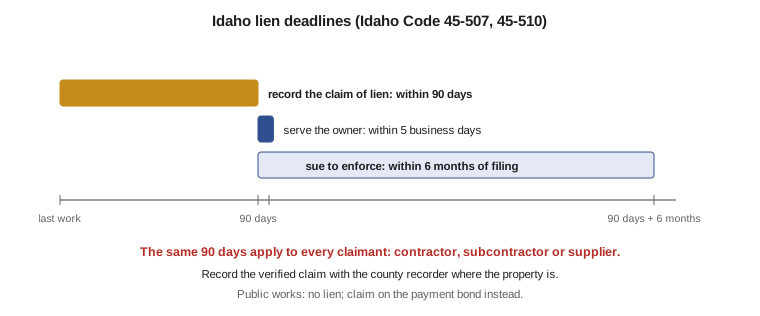
Under Idaho Code 45-507, a claimant must file a claim of lien with the county recorder in the county where the property is located, within 90 days after completing the labor or services or furnishing the last materials. The same 90 days apply to every claimant, whether the general contractor, a subcontractor like Sawtooth Ridge, or a supplier. The claim must state the amount owed after deducting all credits and offsets, the name of the owner or reputed owner if known, the name of the person who hired the claimant or to whom the materials were furnished, a description of the property sufficient to identify it, and, for work covered by the residential disclosure law, proof that the disclosure was given and acknowledged. The claim must be verified under oath by the claimant, its agent or its attorney, stating that the claimant believes the claim is just.
Filing is not the last step. The claimant must serve a true copy of the claim on the owner or reputed owner, either personally by an authorized officer or by certified mail to the owner's last known address, no later than five business days after filing.
Enforcing the lien
A recorded lien does not last forever. Under 45-510, the lien binds the property for only six months after the claim is filed unless the claimant starts proceedings in a proper court within that time to enforce it. A payment on account or an extension of credit with a stated expiration date, endorsed on the lien record, restarts the six months from the payment or from the end of the extension. If the claimant wins a final judgment, the judgment lien lasts ten years from the date the judgment becomes final.
from datetime import date, timedelta

def add_business_days(d, n):
    while n:
        d += timedelta(days=1)
        if d.weekday() < 5:   # ignores holidays; check the calendar
            n -= 1
    return d

def add_months(d, m):
    y, mo = divmod(d.month - 1 + m, 12)
    import calendar
    day = min(d.day, calendar.monthrange(d.year + y, mo + 1)[1])
    return date(d.year + y, mo + 1, day)

last_work = date(2026, 8, 14)
file_by = last_work + timedelta(days=90)
filed = date(2026, 10, 30)
print("Record the claim by:", file_by)
print("Filed on time:", filed <= file_by)
print("Serve the owner by:", add_business_days(filed, 5))
print("Start a suit to enforce by:", add_months(filed, 6))Record the claim by: 2026-11-12 Filed on time: True Serve the owner by: 2026-11-06 Start a suit to enforce by: 2027-04-30
The calculator shows Marisol's checklist for the potato storage building, where the general contractor stopped paying after the owner disputed a change order. Sawtooth Ridge's last work was August 14, so the claim had to be recorded by November 12. Wes recorded it on October 30, mailed it to the owner by certified mail the same day, well inside the five business days, and calendared the six-month enforcement deadline. The calculator ignores holidays; real deadlines should be checked against the calendar and, when money is significant, by a lawyer.
The residential disclosure
Idaho Code 45-525 adds a consumer protection layer for residential property, defined as property with one to four dwelling units. A general contractor, meaning a contractor with a direct agreement over 2,000 dollars with a homeowner or residential purchaser, must give a written disclosure before entering the contract and keep the owner's signed acknowledgment. The disclosure tells the owner of the right to require lien waivers from subcontractors at the owner's expense, the right to proof of general liability insurance, including completed operations, and workers compensation, the opportunity to buy an extended title insurance policy covering certain unrecorded liens, and the right to require a surety bond up to the project's value at the owner's expense.
The general contractor must also give the owner, within a reasonable time before closing or final payment, a signed list of the subcontractors, material suppliers and rental equipment providers with direct contracts over 500 dollars, with their business names, addresses and phone numbers. Failing to provide complete disclosures is an unlawful and deceptive act under the Idaho Consumer Protection Act. Emergency repairs to an electrical, plumbing or water system requested by the owner are exempt. And because 45-507 requires proof of disclosure in a lien claim for work covered by 45-525, a general contractor that skipped the disclosure may find its lien on a house in trouble.
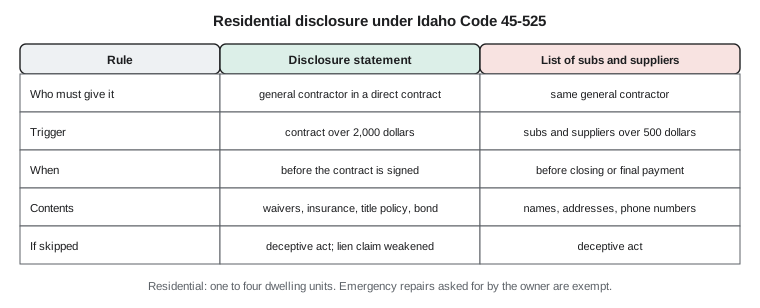
When Sawtooth Ridge contracts directly with a homeowner for a remodel over 2,000 dollars, it is the general contractor for this purpose, and Wes includes the disclosure and acknowledgment in the contract packet. When it works as a subcontractor to a home builder, the builder owes the disclosure, and Sawtooth Ridge appears on the builder's list.
Lien waivers
Owners and lenders often require lien waivers before releasing payments. A conditional waiver gives up lien rights only when a stated payment actually clears; an unconditional waiver gives them up immediately. A contractor that signs an unconditional waiver before the check clears can lose its lien right for that amount. Sawtooth Ridge signs conditional waivers with each pay application and unconditional waivers only after the funds are in its account, and it reads every waiver form to see what period and amount it covers.
Public works and bonds
Mechanics' liens do not attach to public property such as schools, city buildings and state facilities. Instead, Idaho's public contracts bond law requires contractors on public works contracts above the thresholds it sets to furnish a payment bond, and unpaid subcontractors and suppliers claim against that bond. Claimants who did not contract directly with the prime contractor generally must give written notice within a set period after their last work, commonly 90 days, before they can sue on the bond. Read the bond statute and the bond itself as soon as a public job is awarded, and calendar the notice deadline at the start of the job rather than when payment stops.
Priority and lenders
A lien matters most when the property has other claims against it, such as a construction loan. Priority decides who is paid first if the property is sold. Idaho's lien statutes contain priority rules that generally favor mechanics' liens over encumbrances recorded after work on the project began, which is why lenders inspect a site before recording a construction loan and ask for lien waivers with every draw. The details are technical and turn on dates and recording order, so a contractor facing a lender or a foreclosure should get legal advice rather than rely on a summary.
Using the lien wisely
A lien is leverage, not a weapon to use in anger. Before recording one, Sawtooth Ridge asks three questions. Is the amount right, after every credit, offset and disputed change? Is the deadline real, counted from the true last day of contract work rather than a later warranty visit or punch-list trip, which may not extend the period? And is the debt worth the cost of a possible suit, including the risk of paying the other side's attorney fees if the lien fails? A lien for a correct amount, recorded on time and served properly, usually brings a check. A padded or late lien can bring a counterclaim.
Good records make all of this easier. The job file that Lesson 7 described, with signed change orders, daily logs, delivery tickets and pay applications, is the evidence a lien claim stands on. When Marisol takes over as supervising electrician, protecting the company's payment rights will be part of her job too.
Common mistakes
MistakeThinking subcontractors get a shorter or longer filing period than the general contractor.
InsteadIdaho gives every claimant 90 days after the last work to record a claim of lien.
MistakeRecording the lien and forgetting to serve the owner.
InsteadServe a copy on the owner within five business days after filing.
MistakeWaiting a year to sue.
InsteadThe lien lapses six months after filing unless an enforcement suit is started.
MistakeFiling a lien against a public school.
InsteadLiens do not attach to public property; claim against the payment bond.
MistakeSkipping the disclosure on a direct residential remodel over 2,000 dollars.
InsteadSection 45-525 requires it, and the lien claim must include proof of it.
Summary and key terms
- Put every job in a written contract with clear scope, changes, payment and dispute terms.
- Section 45-501 gives liens to those who perform labor or furnish materials for construction, alteration or repair.
- Record a verified claim of lien with the county recorder within 90 days after the last work.
- Serve the owner within five business days after filing; sue to enforce within six months.
- Residential direct contracts over 2,000 dollars need the 45-525 disclosure.
- Public works use payment bonds instead of liens.
- Claim of lien
- The verified document recorded with the county recorder to perfect a mechanic's lien.
- Reputed owner
- The person who appears to own the property from public records or circumstances.
- Retainage
- Part of each payment held back until the job is finished.
- Conditional lien waiver
- A waiver that takes effect only when a stated payment is received.
- Payment bond
- A surety bond that guarantees payment to subcontractors and suppliers, used on public works.
Practice problems
Work each problem on paper first, then reveal the answer to check.
Sawtooth Ridge's last work on a shop was March 2. By when must it record a claim of lien?
Show answer
Within 90 days, by May 31.
A claim of lien was filed on a Friday. When must the owner be served?
Show answer
No later than five business days after filing, by the following Friday if there are no holidays.
The claim was filed on October 30. If no suit is filed by when does the lien lapse?
Show answer
Six months after filing, April 30, unless extended by an endorsed payment or credit.
Does a subcontractor to a home builder give the 45-525 disclosure?
Show answer
No; the general contractor with the direct contract does.
What replaces a lien on a county courthouse project?
Show answer
A claim on the contractor's payment bond.
Lesson quiz · 5 questions
Score 60% or more to complete this lesson.
Create a free account to save your progress, take quizzes and earn a certificate.