
MELU-212 · Lesson 4 of 12 · 18 min
The exam format and the references allowed
▶ Video coming soon A video version of this lesson is on the way.
A master exam is an open book test, but that does not make it easy. The book is large, the clock is short, and the questions are written so that a candidate who knows roughly where to look will run out of time. Marisol has taken open book tests before; her journeyman exam was one. What she wanted to know this time was how the master exam is built, what she can bring into the room, and how to prepare her references so they work for her under time pressure. This lesson answers those questions for both exams Idaho accepts, and it is careful to separate what the bulletins say from what candidates report.
Two exams, one standard
As Lesson 3 explained, Idaho accepts a passing score on either the Idaho master electrician exam developed by DOPL with PSI, offered since July 1, 2026, or the national NASCLA master electrician exam. Both test the same core: the National Electrical Code, electrical theory and calculations, and the safety and project knowledge a master is expected to have. They differ in emphasis, in the references allowed and in how closely they follow Idaho practice. The board's stated purpose in building the Idaho exam was to test the knowledge Idaho electricians actually use, based on a job task analysis by Idaho subject matter experts, and to stop testing material that rarely comes up in Idaho work.
This course had the full NASCLA bulletin but not the full bulletin for the new Idaho exam. The NASCLA details below are verified; the Idaho exam details are described generally, and you must read the current Idaho bulletin before you study.
The NASCLA master exam
PSI's bulletin for the NASCLA electrical exams describes the master electrician exam, used for electrical contractors and unlimited masters in participating states, this way: 100 scored questions plus 10 unscored experimental questions mixed in, 270 minutes, and a passing score of 75. The unscored questions look like any others, so treat every question as if it counts. The code questions are based only on the NEC editions the bulletin lists, and Idaho's NASCLA exams were set to the 2023 NEC from August 1, 2025.
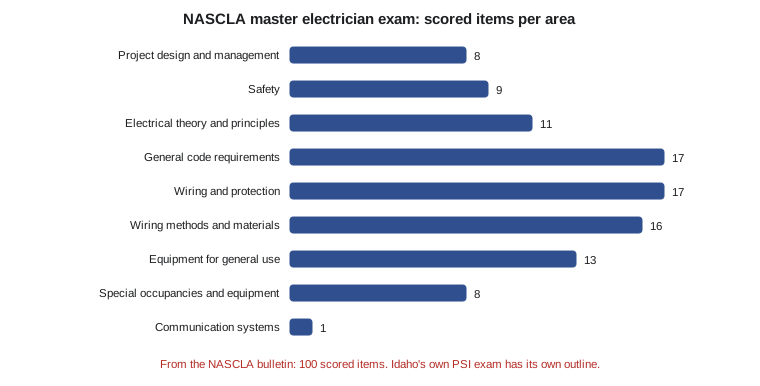
The bulletin lists the content by area, with the number of scored items in each. General code requirements and wiring and protection carry 17 items each, wiring methods and materials 16, equipment for general use 13, electrical theory and principles 11, safety 9, project design and management 8, special occupancies, special equipment and special conditions 8, and communication systems 1. Look at what that means: more than half the exam is the first four chapters of the NEC and the theory behind them, while the special occupancies that take up so much of the book carry only a handful of questions.
NASCLA references
The NASCLA exam is unusual in how many references it allows. The bulletin lists the National Electrical Code or the NEC Handbook in the listed edition; OSHA's construction standards in 29 CFR 1926 and general industry standards in 29 CFR 1910; NFPA 70E; ANSI/ASHRAE/IES Standard 90.1; the Project Management Institute's guide to the project management body of knowledge; the NASCLA contractors guide to business, law and project management; Ugly's Electrical References; and a book on electrical theory for NEC applications. Two code indexes may be brought at the candidate's own risk. At the test site PSI hands out a plan set and a diagram packet for questions that require reading drawings. Highlighting, underlining and permanent tabs are allowed; handwritten notes, loose papers and removable sticky notes are not.
A candidate does not need every listed book to pass, and carrying nine books into a timed exam has a cost. The code book is essential. The OSHA standards and NFPA 70E answer most safety questions, and the project management and business guides answer the project design questions. Many candidates bring the code book, a theory or formula reference, and the safety references, and accept that a few project management questions will be answered from experience.
| Reference | Use on the NASCLA master exam |
|---|---|
| NEC (listed edition) or NEC Handbook | Most questions: general requirements, wiring, equipment, special occupancies |
| 29 CFR 1926 and 1910 | Safety questions on construction and maintenance work |
| NFPA 70E | Electrically safe work practices, approach boundaries, arc flash |
| ASHRAE/IES 90.1 | Energy code questions on lighting power and controls |
| Project management and NASCLA business guide | Project design and management questions |
| Ugly's and a theory text | Formulas, conversions and theory |
| Plan set and diagrams (provided) | Questions that require reading drawings |
The Idaho master exam
The Idaho exam developed with PSI was built from a job task analysis: Idaho electricians and inspectors listed the tasks a master performs and how often, and the questions follow that list. It is based on the 2023 NEC as adopted in Idaho, the edition Lesson 5 covers. Its candidate bulletin sets the number of questions, the time limit, the passing standard and the references. Do not assume they match the NASCLA figures. The old DOPL-written exams, which the Idaho exam replaces in spirit, used a passing score of 75 and allowed the code book, an index or two and a pocket reference, with no handbooks; the new exam's rules may be similar or different.
Candidates who take the Idaho exam should expect more weight on the parts of the NEC Idaho electricians use daily: services, feeders and branch circuits; grounding and bonding; wiring methods; motors and their controllers; and dwelling calculations. They should also expect the Idaho amendments to matter, because an exam built on the Idaho-adopted code can ask about rules that Idaho changed, such as where ground-fault protection is required or how surge protection applies to dwellings.
How code questions are written
Master exam questions are usually four-option multiple choice. A typical code question gives a situation and asks for a minimum size, a maximum number, a required location or the rule that permits or prohibits something. The wrong options are chosen with care: a value from the right table but the wrong column, a rule from the general article when a specific article modifies it, or the answer for a dwelling when the question is about a commercial building. Calculation questions combine several steps, such as a load calculation followed by a conductor size and an overcurrent device rating.
The best preparation is the habit of finding the controlling rule. Read the question, decide which chapter and article governs, check whether a later chapter modifies the general rule, find the specific section and then read the options. Chapters 5 through 7 of the NEC modify Chapters 1 through 4, and Chapter 8 stands largely on its own, a structure MELU-101 teaches in detail.
Preparing the code book
Tabs are the single most useful thing a candidate can add to a code book. Permanent tabs at each article that the outline weights heavily, plus tabs at the tables used most often in calculations, save seconds on every lookup. Highlighting is allowed on the NASCLA exam; highlight sparingly, so the color still means something. Check the Idaho bulletin for its rules on tabs and highlighting before marking your book, and buy the edition the bulletin names.
Marisol tabbed her 2023 NEC by article in the order of the outline, then added a second color for the conductor ampacity, conduit fill, box fill, motor current and dwelling calculation tables. She practiced with the tabbed book for six weeks so that her hands knew where things were.
Pacing
On the NASCLA exam, 270 minutes for 110 questions is a little under two and a half minutes per question, counting the unscored items. Some questions take twenty seconds and some take six minutes. The arithmetic below shows why pacing checkpoints help.
# Pacing on a NASCLA-style master exam (110 items incl. unscored, 270 minutes)
items, minutes = 110, 270
per_item = minutes / items
print(f"Average: {per_item:.2f} minutes per item")
for share in (0.25, 0.5, 0.75):
    done = round(items * share)
    print(f"After {done} items, about {done * per_item:.0f} minutes should have passed")
# Reserve the last 20 minutes for flagged items and checks
print(f"Working pace with a 20-minute reserve: {(minutes - 20) / items:.2f} minutes per item")Average: 2.45 minutes per item After 28 items, about 69 minutes should have passed After 55 items, about 135 minutes should have passed After 82 items, about 201 minutes should have passed Working pace with a 20-minute reserve: 2.27 minutes per item
These figures are for the NASCLA exam. For the Idaho exam, plug in the question count and time from its bulletin. Lesson 12 turns this arithmetic into a three-pass plan for exam day.
Pacing also depends on the mix. The NASCLA outline puts most of its weight on code lookups, which a well-tabbed candidate answers quickly, while calculations take longer. Marisol found that she averaged about ninety seconds on lookup questions and four minutes on calculations, so the time she saved on lookups paid for the calculations. A candidate whose lookups are slow has no such cushion, which is why tabbing and index practice come first in the study plan.
The contractor exam is separate
Idaho's contractor license requires its own exam, a business and law exam that tests contracting, employment, tax, lien and safety law for a business. That exam is taken for the company's license, not for the master license, and it uses its own reference manual. Lesson 8 covers it. Candidates who expect business and law questions on the master exam will find a few in the NASCLA project management area, but the master exam is mainly a code and theory test.
Indexes, pocket references and practice tests
A good index can be faster than tabs for rare topics. The NEC's own index at the back of the book is detailed, and the commercial keyword indexes allowed at the candidate's risk on the NASCLA exam list topics under the words electricians actually use. The risk is that an index from the wrong edition points to the wrong section, so match the edition exactly. A pocket reference such as Ugly's is useful for formulas, conversions and motor and transformer data, but its tables summarize the code and are not the code; when a question asks what the NEC requires, confirm the answer in the NEC itself.
Practice tests are where the references become tools. Marisol took her first full practice exam under exam conditions in the second week of her study plan, before she felt ready, and logged every miss by cause: did not know where to look, found the wrong rule, misread the question, made a calculation error, or ran out of time. The log told her that most of her misses were lookups, not knowledge, which sent her back to tabbing and index drills rather than to rereading theory. She took a new practice exam every two weeks and watched the lookup misses fall. Lesson 12 returns to this method.
One caution about practice material: many commercial question banks were written for other states or older editions, and some include questions that were never on any real exam. Use them for speed and lookup practice, and check any answer that surprises you against the code itself.
Common mistakes
MistakeAssuming the Idaho PSI exam has the same question count, time and passing score as the NASCLA exam.
InsteadEach exam has its own bulletin; read the Idaho bulletin for its rules.
MistakeBringing handwritten notes in a code book to a NASCLA exam.
InsteadHighlighting, underlining and permanent tabs are allowed; written notes and loose papers are not.
MistakeSpending most study time on special occupancies.
InsteadOn the NASCLA outline, general requirements, wiring and protection and wiring methods carry far more items.
MistakeSkipping unscored questions because they do not count.
InsteadUnscored items look like scored ones; answer every question.
MistakeExpecting the master exam to cover the contractor business and law content.
InsteadThe contractor exam is separate and uses its own reference manual.
Summary and key terms
- Idaho accepts the Idaho master exam developed with PSI and the NASCLA master exam.
- NASCLA: 100 scored items plus 10 unscored, 270 minutes, passing score 75, many references allowed.
- Idaho's NASCLA exams use the 2023 NEC; the Idaho exam is built on the 2023 NEC as adopted in Idaho.
- General code requirements, wiring and protection and wiring methods carry the most NASCLA items.
- Tab the code book by the outline and practice with the tabbed book.
- The contractor business and law exam is a separate exam for the company license.
- Unscored item
- A trial question mixed into the exam that does not count toward the score.
- Job task analysis
- A study of the tasks a licensee performs, used to decide what an exam tests.
- Open book
- An exam that allows listed references in the room.
- Permanent tab
- A tab fixed to the page of a reference, allowed on the NASCLA exam.
- Plan set
- Drawings handed out at the test site for questions that require reading plans.
Practice problems
Work each problem on paper first, then reveal the answer to check.
How many scored items are on the NASCLA master exam?
Show answer
100, plus 10 unscored.
Which content areas carry 17 items each on the NASCLA outline?
Show answer
General code requirements and wiring and protection.
May a NASCLA candidate bring a code book with highlighted passages?
Show answer
Yes; highlighting, underlining and permanent tabs are allowed.
Where do you find the Idaho exam's passing standard?
Show answer
In its current candidate bulletin.
Which reference answers most NASCLA safety questions?
Show answer
The OSHA standards in 29 CFR 1926 and 1910 and NFPA 70E.
Lesson quiz · 5 questions
Score 60% or more to complete this lesson.
Create a free account to save your progress, take quizzes and earn a certificate.