
MELU-212 · Lesson 7 of 12 · 18 min
Duties and responsibilities of the Master Electrician License holder
▶ Video coming soon A video version of this lesson is on the way.
A license is a permission, but it is also a list of obligations. When Marisol earns her master license, she will be allowed to plan, lay out and design electrical installations anywhere in Idaho. If Sawtooth Ridge later designates her as its supervising electrician, she will also answer for every installation the company makes. This lesson sorts out those two roles, explains the supervision and apprentice rules that shape every crew, and walks through the conduct that can cost a licensee money or a license.
What the master license allows
Idaho Code 54-1003A defines a master electrician as a person who has the qualifications to plan, lay out or design the installation of electrical wiring or equipment. The journeyman definition covers personally performing or supervising the physical work. The definitions overlap in practice: a master can do and supervise physical work, and since July 1, 2025 every master also holds a journeyman license. What the master license adds is the recognized authority to plan and design. When Sawtooth Ridge lays out the service, feeders and panel schedules for a design-build shop building, a master's name belongs on that layout.
The license does not make a master an engineer. Projects that the Idaho engineering law requires to be designed by a licensed professional engineer still need one, and many commercial projects come with engineered drawings that the contractor must follow. A master's design authority is the authority to plan installations the electrical law covers, and the master is responsible for doing that planning to the adopted code.
The supervising electrician
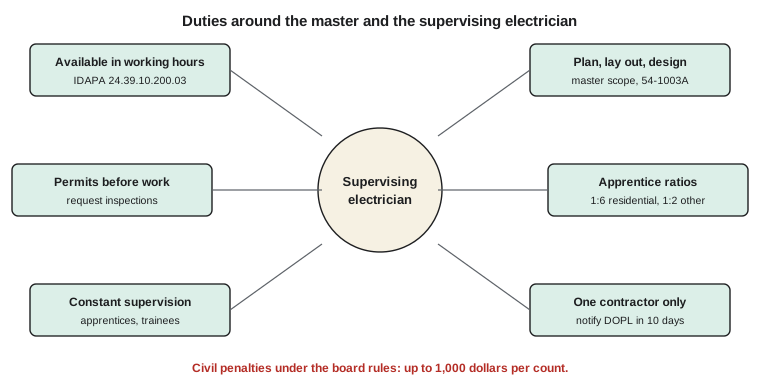
The board rules require every electrical contractor and limited electrical contractor to designate one supervising electrician. Section 200 of IDAPA 24.39.10 says the supervising electrician must be available during working hours and is responsible for the contractor's installations. The same person may not serve as supervising electrician for another contractor or use multiple licenses to represent more than one contractor. If the relationship ends, the contractor must notify DOPL in writing within ten business days, and it may not buy permits or make installations until a new qualified supervising electrician is designated. A person whose contractor license was revoked may not serve as a supervising electrician for one year.
The supervising electrician's license must match the contractor's work. Section 200 says a contractor's allowable scope matches the scope of its licensed employee: a contractor whose supervising electrician holds only a limited installer license in signs is a sign contractor, not a general electrical contractor. For an electrical contractor, the supervising electrician is a licensed journeyman or master.
Who may do the work
Idaho Code 54-1010(1) says all installations made by an electrical contractor must be done by a licensed residential, journeyman or master electrician, or by a person under the direct supervision of such a licensee within the scope of the supervisor's license. Under 54-1010(2), an individual owner of an electrical contracting business must employ a full-time journeyman with more than 2,000 hours of documented experience as a licensed journeyman or master, though an owner who meets the requirements may serve in that role personally. Contractors must provide a list of their journeymen when DOPL or its agent asks.
Apprentices must be registered with DOPL, and working as an apprentice without a current registration is unlawful. Apprentices, trainees and provisional journeymen must work under constant on-the-job supervision and training by a licensed electrician of the right class. Constant supervision means a licensed person is on the same site directing the work, not reachable by phone from across town.
Apprentice ratios
Idaho Code 54-1010(3) sets the ratios. In a residential setting, one residential, journeyman or master electrician may supervise no more than six apprentices. In any other setting, one journeyman or master may supervise no more than two apprentices. No ratio applies to an apprentice with at least 6,000 hours of work experience who is enrolled in or has completed a board-approved career technical education program. Limited electrical installer trainees have no ratio. Subsection (5) bars cities, counties and other local bodies from adopting different or stricter supervision requirements, so these ratios apply statewide.
| Setting | Who may supervise | Maximum apprentices per supervisor |
|---|---|---|
| Residential (one and two family, townhouses, up to three stories) | Residential, journeyman or master | 6 |
| All other settings | Journeyman or master | 2 |
| Apprentice with 6,000+ hours in an approved program | Licensed supervisor still required | No ratio applies |
| Limited installer trainee | Qualified limited installer | No ratio applies |
Ratios are a daily planning problem. On the potato storage building, a commercial job, Marisol had two journeymen and five apprentices. Two of the apprentices had more than 6,000 hours and were enrolled in an approved program, so no ratio applied to them. The other three needed supervision at no more than two per journeyman, which the two journeymen could cover, but only if both stayed on site. When one journeyman was pulled to a service call, an apprentice had to move to another job for the afternoon.
import math

def supervisors_needed(apprentices, setting):
    """Licensed supervisors needed for apprentices subject to a ratio (Idaho Code 54-1010(3))."""
    per = 6 if setting == "residential" else 2
    ratioed = [a for a in apprentices if not (a["hours"] >= 6000 and a["approved_program"])]
    return math.ceil(len(ratioed) / per), len(ratioed)

crew = [{"hours": 7200, "approved_program": True}, {"hours": 6400, "approved_program": True},
        {"hours": 3100, "approved_program": True}, {"hours": 1500, "approved_program": True},
        {"hours": 900, "approved_program": False}]
for setting in ("commercial", "residential"):
    need, n = supervisors_needed(crew, setting)
print(f"{setting}: {n} apprentices under a ratio -> at least {need} licensed supervisors on site")commercial: 3 apprentices under a ratio -> at least 2 licensed supervisors on site residential: 3 apprentices under a ratio -> at least 1 licensed supervisors on site
Even the exempt apprentices still work for the contractor under its supervising electrician, and the 54-1010(1) rule still requires that the work be done by licensees or under their direct supervision. The exemption lifts the ratio, not the duty to supervise.
Permits, inspections and records
The supervising electrician is the person DOPL expects to see the permit rules followed: permits bought before work, inspections requested as each stage is ready, nothing covered without approval, corrections made by the deadline. The board's penalty section lists failing to obtain permits or request inspections and missing correction deadlines as violations. The rules do not prescribe a records system, but a supervising electrician who cannot show which licensee did which work, and when, is in a weak position if DOPL asks.
Sawtooth Ridge keeps a simple file for each job: the permit, the inspection results and correction notices, the crew list by date with each person's license or registration number, design notes and load calculations, and the final approval. Wes also keeps a company list of every license and registration with its expiration date, reviewed monthly. An apprentice registration that lapses is the most common way an Idaho contractor ends up with an unregistered worker on site.
Conduct that draws discipline
The board rules authorize civil penalties of up to 1,000 dollars for each separate count or offense, and they list the main violations: working without a license, working outside the scope of a limited license, knowingly employing unlicensed persons, inadequate supervision, failing to obtain permits or request inspections, missing correction deadlines, misrepresenting fees, improper advertising, and ignoring lawful orders of the board or DOPL. The electrical law also allows suspension or revocation of a license after notice and a hearing, and some violations are criminal misdemeanors.
The most damaging conduct is license lending: letting a company use a license to buy permits or qualify for a contractor license when the licensee does not actually supervise the work. In Idaho the supervising electrician must be available during working hours and may represent only one contractor, so a master who rents a name to a company across the state while working full time elsewhere violates the rules on their face. Penalties fall on the licensee and the contractor, and the licensee's career can end.
| Violation (IDAPA 24.39.10 section 300) | Example |
|---|---|
| Working without a license | An unregistered helper pulling wire alone |
| Knowingly employing unlicensed persons | Keeping a worker on after his registration lapsed |
| Inadequate supervision | Three apprentices on a commercial job with one journeyman |
| Failing to obtain permits or request inspections | Covering a basement before inspection |
| Missing correction deadlines | Ignoring a yellow sticker for a month |
| Improper advertising | Advertising electrical work without a contractor license |
A day in the role
Dale described his week as supervising electrician to Marisol this way. On Monday he reviews the job board with Wes: permits needed, inspections requested, corrections open, and which licensees are where. He checks that every crew meets its ratio and that no apprentice is working alone. During the week he visits jobs, answers calls from crew leads, signs off on layouts, and talks to inspectors. On Friday he reviews any correction notices and the next week's schedule. None of it is dramatic. The point of the role is that one licensed person knows what the company is doing and answers for it.
Changing the supervising electrician
Sawtooth Ridge's plan is for Marisol to become the supervising electrician after she has held the master license for a few months. The change is a paperwork step with real consequences. The company submits the designation to DOPL in the form DOPL requires, naming Marisol and her license. Dale's designation ends at the same time. Because a supervising electrician may represent only one contractor, Marisol cannot already be designated for any other company. Because the company may not buy permits or make installations without a qualified supervising electrician, the timing should leave no gap: the new designation should be in place before or on the day the old one ends.
An unplanned change is harder. If a supervising electrician quits without notice or dies, the contractor must notify DOPL within ten business days and stop buying permits and making installations until a new qualified person is designated. Companies with only one licensee who could serve are exposed to that risk, which is one reason Dale wants Marisol qualified well before he retires.
Responsibility after the job
The supervising electrician's responsibility does not end at the final inspection. A defect discovered a year later can lead to a complaint to DOPL, a correction order, a civil claim by the owner and, if someone was hurt, much more. Good design notes, inspection records and crew lists are what let a master show that the work was done to the code in force, by the right people, under proper supervision. Dale keeps job files for at least the period in which a customer might bring a claim, which Lesson 9 discusses, and Marisol plans to keep that habit.
Personal responsibility also cuts the other way. A master who is asked to cut corners, such as by skipping a permit to save a customer money, or by sending an apprentice alone to finish a job, is the person whose license is at risk. Saying no in those moments is part of the job description.
Common mistakes
MistakeThinking a city can require one journeyman per apprentice on residential jobs.
InsteadIdaho Code 54-1010(5) preempts local supervision rules that differ from the state's.
MistakeTreating an exempt apprentice as needing no supervision at all.
InsteadThe 6,000-hour exemption lifts the ratio, not the duty to work under a licensee.
MistakeServing as supervising electrician for two companies.
InsteadA supervising electrician may represent only one contractor.
MistakeWaiting a month to tell DOPL the supervising electrician quit.
InsteadNotify DOPL in writing within ten business days, and stop buying permits until a new one is designated.
MistakeAssuming a master's design authority replaces an engineer.
InsteadProjects that require an engineer still need one; the master plans installations under the electrical law.
Summary and key terms
- The master license covers planning, layout and design; a master also holds a journeyman license.
- Every contractor designates one supervising electrician, available during working hours and responsible for installations.
- Notify DOPL within ten business days if the supervising electrician leaves.
- Apprentice ratios: six per supervisor residential, two in other settings; none for 6,000-hour apprentices in approved programs.
- Local governments may not set different supervision rules.
- Civil penalties reach 1,000 dollars per count, and licenses can be suspended or revoked.
- Supervising electrician
- The licensee a contractor designates as responsible for its installations.
- Constant supervision
- On-site direction of an apprentice or trainee by a licensed electrician.
- Ratio
- The maximum number of apprentices one licensed supervisor may oversee.
- Scope
- The kinds of work a license allows; a contractor's scope follows its licensed employee's.
- License lending
- Letting a license qualify work the licensee does not actually supervise.
Practice problems
Work each problem on paper first, then reveal the answer to check.
On a commercial job with three ratioed apprentices, how many journeymen or masters must be on site?
Show answer
At least two, at two apprentices per supervisor.
On a residential job with six ratioed apprentices, how many supervisors are needed?
Show answer
One residential, journeyman or master electrician.
Dale retires on March 3. When must Sawtooth Ridge tell DOPL?
Show answer
In writing within ten business days, and it cannot buy permits until a new supervising electrician is designated.
Can Marisol serve as supervising electrician for Sawtooth Ridge and her brother's company?
Show answer
No; a supervising electrician may represent only one contractor.
What is the maximum civil penalty per count under the board rules?
Show answer
1,000 dollars.
Lesson quiz · 5 questions
Score 60% or more to complete this lesson.
Create a free account to save your progress, take quizzes and earn a certificate.