
MELU-212 · Lesson 12 of 12 · 26 min
Practice exam review and test-day strategy
▶ Video coming soon A video version of this lesson is on the way.
Six weeks before her exam date, Marisol took a full practice exam on a Saturday morning at the kitchen table, with her tabbed code book, a calculator and a kitchen timer set to the exam's time limit. She scored 68. She was not discouraged; she had expected something like that, and the point of the exercise was not the score but the list of misses. This lesson shows how she turned that list into a study plan, how she reviewed the Idaho-specific material, and how she handled exam day. The method works for either exam Idaho accepts.
Why practice exams come first
Many candidates study for months and take a practice exam only at the end, to see whether they are ready. That wastes the most useful tool they have. A practice exam taken early shows where the time actually goes. In an open book exam, most misses are not about knowledge; they are about finding the right rule fast enough and reading the question carefully enough. Those skills improve only with timed practice.
Marisol's rule was a full timed practice exam every two weeks, with targeted drills in between. She used a mix of commercial question banks and the practice questions at the end of the HSM University core courses, and she checked every surprising answer against the code itself, since some commercial questions are written for other editions or contain errors.
The error log
After each practice exam, Marisol went through every missed or guessed question and recorded the cause in one of five categories: she did not know where to look; she found a rule but the wrong one; she misread the question; she made a calculation error; or she ran out of time. The categories point to different fixes. Not knowing where to look calls for tabbing and index drills. Finding the wrong rule calls for practice with the code's structure, especially how later chapters modify earlier ones. Misreading calls for slowing down on the question stem. Calculation errors call for worked problems and a consistent method. Running out of time calls for the pacing plan below.
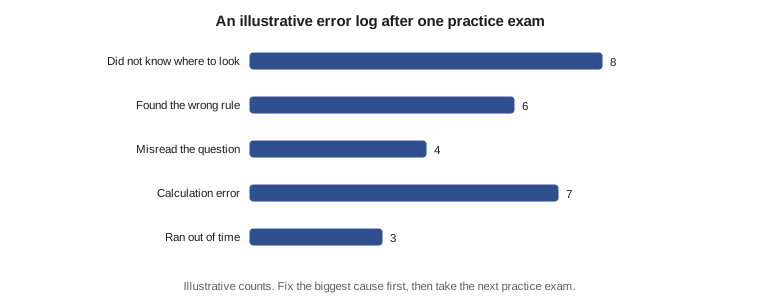
Her first log showed more misses from lookups and calculations than from anything else. She spent the next two weeks on tabbing, on index drills in which she gave herself thirty seconds to find a topic, and on calculations: dwelling and commercial load calculations, conductor ampacity with adjustment and correction, voltage drop, motor branch circuits and feeders, and conduit and box fill. Her second practice exam came in at 74, and her lookup misses had halved.
# Marisol's practice exam log (illustrative)
logs = {
    "week 0": {"where to look": 8, "wrong rule": 6, "misread": 4, "calculation": 7, "time": 3},
    "week 2": {"where to look": 4, "wrong rule": 5, "misread": 4, "calculation": 4, "time": 2},
    "week 4": {"where to look": 3, "wrong rule": 3, "misread": 2, "calculation": 3, "time": 1},
}
for week, log in logs.items():
    misses = sum(log.values())
    worst = max(log, key=log.get)
print(f"{week}: {misses} misses, score about {100 - misses}; biggest cause: {worst}")week 0: 28 misses, score about 72; biggest cause: where to look week 2: 19 misses, score about 81; biggest cause: wrong rule week 4: 12 misses, score about 88; biggest cause: where to look
Reviewing the Idaho material
The Idaho exam developed with PSI is built on the Idaho-adopted code and Idaho practice, and the NASCLA exam includes safety and project management areas. Either way, a master candidate in Idaho should be able to answer questions about the state's licensing, permit, lien and safety rules quickly, both because they may appear on the exam and because they are part of the job. Marisol made a one-page sheet of the Idaho numbers she needed to know cold.
| Topic | Idaho rule | Lesson |
|---|---|---|
| Master eligibility | Four years working as a licensed journeyman | 2 |
| Journeyman routes | 8,000 apprentice hours with a four-year program, or 16,000 hours | 2 |
| NEC in force | 2023 NEC with Idaho amendments, from July 1, 2024 | 5 |
| Permit timing and life | Buy before work; expires 365 days after purchase | 6 |
| Apprentice ratios | Six per supervisor residential; two in other settings | 7 |
| Supervising electrician change | Notify DOPL in writing within ten business days | 7 |
| Contractor insurance | 300,000 dollars liability; workers compensation if applicable | 8 |
| Liens | Record within 90 days; serve within 5 business days; sue within 6 months | 9 |
| Residential disclosure | Direct contracts over 2,000 dollars | 9 |
| Injury reports | OSHA 8 or 24 hours; Industrial Commission 10 days; worker notice 60 days | 10 |
| Renewal | Final month; revival within one year; no CE required since 2025 | 11 |
Worked practice questions
The questions below show the kind of reasoning the exam rewards. Each is followed by the thinking that leads to the answer.
Worked problem
A ratio question
Sawtooth Ridge has a commercial job with one master and one journeyman on site and four apprentices, none with 6,000 hours. How many apprentices may work there?
Show solution
- The job is a non-residential setting, so the ratio in Idaho Code 54-1010(3) is two apprentices per journeyman or master.
- Two licensed supervisors are on site: the master and the journeyman.
- Two supervisors times two apprentices each is four.
Answer: Four apprentices, as long as both licensed supervisors stay on site.
Worked problem
A lien question
A supplier delivered the last load of wire to a house on June 10. It records a claim of lien on September 12. Is the claim timely?
Show solution
- Idaho Code 45-507 gives every claimant 90 days after furnishing the last materials.
- Ninety days after June 10 is September 8.
- September 12 is after September 8.
Answer: No; the claim is four days late.
Worked problem
A permit fee question
A tenant finish has a total wiring cost of 60,000 dollars. What is the DOPL permit fee under the tiers in Lesson 6?
Show solution
- The cost falls in the second tier, from 10,000 to 100,000 dollars.
- The fee is 260 dollars plus 1 dollar for every 100 dollars above 10,000.
- 60,000 minus 10,000 is 50,000; 50,000 divided by 100 is 500; 260 plus 500 is 760.
Answer: 760 dollars.
Worked problem
A load calculation step
A feeder serves a continuous load of 120 amperes and a noncontinuous load of 40 amperes. What minimum overcurrent device rating does the general rule require before rounding up to a standard size?
Show solution
- The general rule for feeder overcurrent protection, in Article 215 with Article 240, requires the device to be rated at least the noncontinuous load plus 125 of every 100 amperes of continuous load.
- 125 of every 100 amperes of 120 amperes is 150 amperes.
- 150 plus 40 is 190 amperes; check Article 240 for the next standard size and any exceptions.
Answer: 190 amperes before rounding; confirm in the code book.
Building a study calendar
Marisol had about sixteen weeks from the day she decided to the exam date. She divided them into three blocks. In the first six weeks, she worked through the core course material on the NEC chapters with the heaviest weight, one or two articles per evening, with a timed practice exam at the start and the end of the block. In the next six weeks, she concentrated on calculations and on the Idaho material, with practice exams every two weeks and drills between them. In the last four weeks, she did mixed review driven entirely by her error log, with a final full practice exam six days out.
She protected the calendar. Five evenings a week, an hour and a half each, and a longer session on Saturday mornings. Dale moved her off the two jobs with the longest drives for the last month, and her family knew that Saturday mornings belonged to the code book. The total, a little over 150 hours, is typical of what candidates who pass report. More hours help less than better hours; an hour of timed drills on weak areas is worth several hours of rereading strong ones.
A pacing plan
Open book exams punish perfectionism. A candidate who refuses to move on from a hard question can lose five easy ones at the end. Marisol used a three-pass plan. On the first pass, she answered every question she could answer quickly, from knowledge or a lookup she knew by heart, and flagged the rest. On the second pass, she worked the flagged questions that needed lookups and calculations. On the third pass, with the time she had saved, she checked her calculations and her answers to any question with a word like except or not in it.
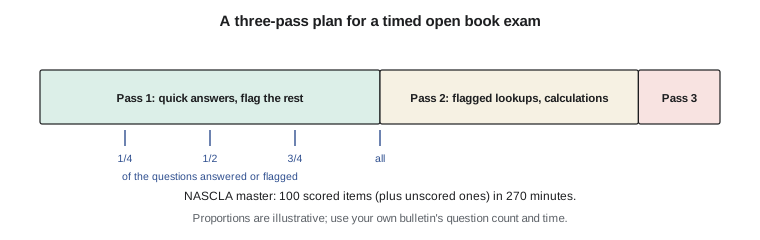
She set checkpoints. On the NASCLA format, with 110 items in 270 minutes, she wanted the first pass finished by about the two-hour mark, with every question either answered or flagged. If she reached a quarter of the questions much later than planned, she sped up and flagged more aggressively. On the Idaho exam she used the same plan with the question count and time from its bulletin. She never left a question blank, because there is no penalty for guessing on these exams; a flagged question that she could not reach got her best guess before time ran out.
Reading questions carefully
Many misses are reading errors. Underline, mentally or on the scratch paper provided, the facts that change the answer: dwelling or commercial, continuous or noncontinuous, copper or aluminum, the temperature rating of terminations, indoor or outdoor, minimum or maximum, and words like except, not and unless. Read every option before choosing; the first option that looks right is often a distractor written for the candidate who stops reading. When two options seem right, look for the more specific rule that governs the situation.
The last week
Marisol did not cram in the final week. She took one last timed practice exam six days out, reviewed her error log and her Idaho sheet, and spent the remaining evenings on short lookup drills. She rechecked the bulletin for allowed references and confirmed that her tabs and highlighting met the rules. Two days out, she confirmed her appointment, drove past the test center so she knew where to park, and packed her references, approved calculator with fresh batteries, and photo ID. The night before, she stopped studying at dinner time.
Exam day
She arrived thirty minutes early, as the bulletin advised, checked in with her ID, stored her phone and bag, and took her references to the testing room after the proctor inspected them. She worked the plan: first pass, second pass, checks. When a question about well pump conductors stumped her, she remembered Lesson 5's point about Idaho's Article 682 amendment, flagged it, and came back with a calmer head. She finished the third pass with eleven minutes left and used them to recheck two calculations.
If the result is a pass, the score report goes to DOPL with the application, as Lesson 3 described. If it is a fail, the score report's breakdown by content area becomes the start of a new error log. Either way, the habits built in the months of preparation, finding rules fast, reading carefully and checking the arithmetic, are the habits of a good master.
After the license
Passing the exam is the start of the next stage. Marisol's master license will let her plan and design installations under her own name. When Sawtooth Ridge designates her as supervising electrician, she will answer for every installation the company makes, for the ratios on every crew and for the permits on every job. And as the code and Idaho's rules keep changing, she will keep learning whether or not a rule requires it. That is what the license stands for.
Common mistakes
MistakeTaking the first practice exam only at the end of study.
InsteadTake one early; the error log it produces shapes the whole study plan.
MistakeTreating every miss as a knowledge gap.
InsteadMost open book misses are lookup, reading or calculation errors, each with its own fix.
MistakeSpending ten minutes on one hard question in the first pass.
InsteadFlag it and move on; return in the second pass.
MistakeLeaving questions blank at the end.
InsteadThere is no penalty for guessing; answer every question.
MistakeCramming new material the night before.
InsteadReview the error log and the Idaho sheet, then rest.
Summary and key terms
- Take a timed practice exam early and log every miss by cause.
- Fix the biggest cause first: lookups, wrong rules, misreading, calculations or time.
- Know the Idaho numbers cold: eligibility, code edition, permits, ratios, insurance, liens, reports and renewal.
- Use a three-pass plan with checkpoints and flags.
- Read every option and watch for words like except and not.
- Confirm references, ID and the appointment in the last week, and rest the night before.
- Error log
- A record of practice exam misses sorted by cause.
- Distractor
- A wrong answer option written to look right.
- Flag
- A mark on a question to return to on a later pass.
- Checkpoint
- A planned point to compare progress with the clock.
- Three-pass plan
- Answering quick questions first, then flagged lookups, then checks.
Practice problems
Work each problem on paper first, then reveal the answer to check.
Marisol's log shows nine lookup misses and two calculation misses. What should she drill first?
Show answer
Tabbing and index drills for faster lookups.
On a NASCLA-format exam, when should the first pass end in Marisol's plan?
Show answer
At about the two-hour mark, with every question answered or flagged.
A claim of lien for last work on April 1 is recorded on June 25. Is it timely?
Show answer
Yes; 90 days after April 1 is June 30.
A residential job has one journeyman and seven ratioed apprentices. Is that allowed?
Show answer
No; the residential ratio is six per supervisor.
Is there a penalty for guessing on these exams?
Show answer
No; answer every question.
Lesson quiz · 5 questions
Score 60% or more to complete this lesson.
Create a free account to save your progress, take quizzes and earn a certificate.