
MELU-212 · Lesson 1 of 12 · 20 min
How electrical licensing works in Idaho
▶ Video coming soon A video version of this lesson is on the way.
Marisol Etcheverry has worked in the electrical trade in eastern Idaho for twelve years. She started in 2014 as a registered apprentice with a commercial shop in Idaho Falls, finished a four-year related instruction program at night while she logged her on-the-job hours, and in 2019 passed the journeyman exam and received her Idaho journeyman electrician license. For the last five years she has run crews for Sawtooth Ridge Electric, LLC, an eighteen-person contractor on the north side of Idaho Falls that wires light commercial buildings, farm and food processing plants and a steady stream of custom homes. The company is invented for this course, but the questions it faces are real. Its owner, Dale Brandvold, has held an Idaho master electrician license for more than twenty years and is the company's designated supervising electrician. Dale is sixty-three and wants to step back from the daily work. He has asked Marisol to earn her master license so that the company has a second person qualified to plan and design installations and, in time, to take over as supervising electrician. This course follows her from her first question to exam day.
This is the Idaho course in the HSM University master electrician exam prep series. The core courses, MELU-101 through MELU-107, teach the National Electrical Code skills that every master-level exam tests: navigating the code, load calculations, conductors and overcurrent protection, grounding and bonding, motors and transformers, special occupancies, and business and law. This course adds what is specific to Idaho. Idaho is a state with one statewide system: a single board writes the rules, a single state agency issues the licenses, and one license is good in every county from Bonners Ferry to Preston.
Two cautions apply to every lesson. First, licensing rules change, and Idaho's have changed a good deal since 2024: the agency was reorganized, the exam provider changed, continuing education for journeymen and masters was dropped from the rules in 2025, and the board has begun moving licenses to two-year terms. The facts in this course were checked in November 2026 against Title 54, Chapter 10 of the Idaho Code, the Idaho Electrical Board rules in IDAPA 24.39.10, the pages and forms of the Division of Occupational and Professional Licenses, the board's published meeting minutes, the NASCLA candidate bulletin, the lien statutes in Title 45 and the workers compensation law in Title 72. The lessons say so when a fact could not be confirmed. Before you apply, pay a fee or book an exam, check the current pages yourself. Second, electrical codes are copyrighted. This course cites code articles and sections by number and explains them in plain words, but it never reproduces their text, tables or figures. Keep your own copy of the code your exam uses open beside you.
One state system
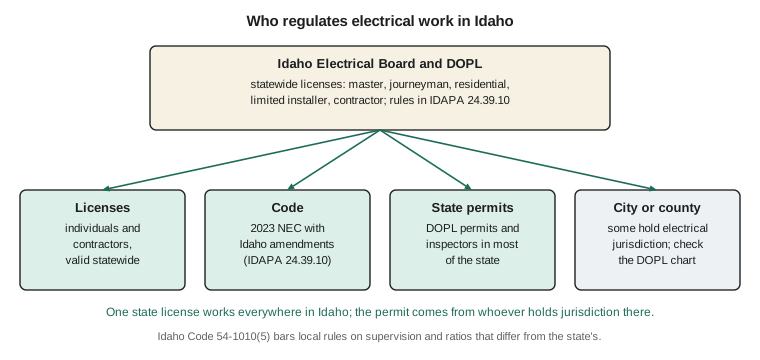
Idaho regulates electrical work through Title 54, Chapter 10 of the Idaho Code, usually called the Idaho electrical law. The law creates the Idaho Electrical Board, a board of people from the trade, the utilities and the public, which writes rules and advises on licensing and discipline. The day-to-day work of the board is done by the Division of Occupational and Professional Licenses, known as DOPL, which took over the work of the former Division of Building Safety in a 2023 reorganization. DOPL accepts applications, issues licenses and registrations, sells electrical permits, employs the state electrical inspectors and investigates complaints.
The board's rules sit in the Idaho Administrative Code at IDAPA 24.39.10, the rules of the Electrical Board. They set the experience hours for each license, the contractor and supervising electrician rules, the civil penalties, the permit and inspection fees and, in section 600, the adoption of the National Electrical Code with Idaho's amendments. Idaho rules are reviewed by the Legislature each session, and a rule takes effect only if the Legislature lets it stand, so a rule change often lands on July 1.
The licenses
Idaho Code 54-1003A defines the licenses, and 54-1007 says how each is earned. For individuals there are five working licenses and two registrations. The master electrician is defined as a person qualified to plan, lay out or design the installation of electrical wiring and equipment. The journeyman electrician personally performs or supervises the physical work of installing wiring. The residential electrician works in a residential setting, which the law defines as one and two family dwellings, townhouses and multi-family structures up to three stories. The limited electrical installer works only within a restricted category such as signs, irrigation sprinklers, well pumps, refrigeration or solar photovoltaic systems. A provisional journeyman license covers a person with enough experience who has not yet passed the exam. Apprentices and limited installer trainees register rather than hold a license, and they work under constant supervision.
For businesses there are two licenses: the electrical contractor license and the limited electrical contractor license. A contractor license is issued to a business, not a person, and every contractor must designate one supervising electrician. The law also recognizes an electrical facility employer account for a company that employs licensed electricians to work on premises it owns, such as a mine, a mill or a large food plant.
| License or registration | Main scope | Where the rule is |
|---|---|---|
| Master electrician | Plan, lay out or design installations; also holds a journeyman license | 54-1003A, 54-1007(3) |
| Journeyman electrician | Perform or supervise the physical installation work | 54-1003A, 54-1007(2), (4) |
| Residential electrician | Work in one and two family dwellings and buildings up to three stories | 54-1003A, 54-1007(5) |
| Limited electrical installer | Work only within a restricted category | 54-1003A; IDAPA 24.39.10 |
| Apprentice (registration) | Learn the trade under constant supervision | 54-1007(2), 54-1010(3) |
| Electrical contractor | A business that contracts for electrical work, with a supervising electrician | 54-1003A, 54-1007(1) |
Master and journeyman: what the master adds
In many states the master license is the license a contractor needs. Idaho is different, and the difference matters on the exam. The person a contractor designates as its supervising electrician must hold a license that matches the work, and the board rules allow a journeyman to fill that role for most contractors. The master license is the credential for planning, layout and design, and it is the top rung of the individual ladder. Idaho Code 54-1007(3) requires four years as a licensed journeyman before a candidate may earn it, and since July 1, 2025 a master automatically receives a journeyman license at no extra cost, so a master never has to renew two licenses separately.
Sawtooth Ridge could keep operating with a journeyman as its supervising electrician, but Dale wants more than that. The company's design-build work, where it lays out service equipment and feeders for a building before an engineer is involved, rests on his master license. Customers and general contractors also ask for a master on bids for larger jobs. Marisol's master license protects that work and makes her the obvious successor.
Statewide reach and local inspection
Because the license is issued by the state, it is valid anywhere in Idaho. A city cannot require Marisol to take its own exam or buy its own electrician license, and Idaho Code 54-1010(5), added in 2023, goes further: it bars cities, counties and other local bodies from adopting any supervision or apprentice requirement that differs from or exceeds the state's.
Permits and inspections are another matter. In most of the state, DOPL sells the electrical permit and a state electrical inspector does the inspections. The Legislature has also allowed several cities and counties to take on electrical jurisdiction and run their own permit and inspection programs, and DOPL publishes a chart that shows which office has jurisdiction at a given location. A city or county building permit never replaces the electrical permit, so the first question on every job is whose electrical permit it needs. Idaho Code 54-1001C adds one more twist: a city that wants the state to inspect for it can ask in writing, and DOPL can provide inspections at cost under the city's own ordinance. Lesson 6 covers permits and inspections in detail.
Wes Tanaka, the office manager at Sawtooth Ridge, keeps a jurisdiction sheet for every place the company works. Most jobs around Idaho Falls, Rigby and Blackfoot run on DOPL permits. A job inside a city with its own electrical program runs on that city's permit and inspector, under the same state-adopted code. The sheet lists the permit portal, the inspection request method and any city registration the company keeps current.
The authorities in this course
The course concentrates on a small set of authorities. The first is the Idaho Electrical Board, which writes the rules. The second is DOPL, which licenses, permits, inspects and enforces. The third is the Idaho Legislature, which writes Title 54, Chapter 10, reviews the board's rules each year and writes the mechanics' lien law in Title 45, Chapter 5. The fourth is the Idaho Industrial Commission, which administers workers compensation under Title 72. The fifth is federal OSHA, which enforces workplace safety for private employers because Idaho has no state plan. The testing companies, NASCLA and PSI, appear in Lessons 3 and 4.
The exam picture
For years DOPL wrote and gave its own electrical exams at its offices. In 2024 Idaho switched to the national NASCLA journeyman and master electrician exams delivered by PSI. Pass rates fell sharply, the board heard complaints that the national exam did not match Idaho practice, and DOPL worked with PSI and Idaho subject matter experts to build new Idaho journeyman and master exams. Under the board's April 2026 decision, the division stopped offering the NASCLA exams after the 2026 fiscal year, which ended June 30, 2026, and now offers the Idaho exam developed with PSI. Passing NASCLA scores continue to be accepted. Lessons 3 and 4 cover booking and the exam format, including what is and is not known about the new Idaho exam.
Enforcement
The board and DOPL enforce the electrical law through licenses, permits and penalties. The board rules list the violations that can draw a civil penalty of up to 1,000 dollars per count, including working without a license, working outside a limited scope, knowingly employing unlicensed people, inadequate supervision, failing to buy permits or request inspections and ignoring correction deadlines. The law also allows license suspension and revocation after a hearing, and some violations are misdemeanors. Work done without a permit draws an enforcement permit at double the normal fee. The exam is more likely to ask who has which power, or which act is a violation, than to ask for a fee, and fees change. Check the current rule before relying on a number.
Dale has told Marisol that the best protection is dull paperwork: current licenses for everyone on the crew, apprentice registrations that never lapse, the right ratio of apprentices to licensed electricians, permits bought before the first wire is pulled, inspections called on time and a file for every job. Lesson 7 returns to these habits.
How this course is organized
The lessons follow Marisol's path. Lesson 2 covers eligibility for the master license, Lesson 3 the application and booking process, and Lesson 4 the exam format and references. Lesson 5 explains Idaho's adoption of the NEC and its amendments, and Lesson 6 permits and inspections. Lesson 7 covers the duties of the master and the supervising electrician, Lesson 8 contractor licensing, insurance and bonding, and Lesson 9 contracts and mechanics' liens. Lesson 10 covers safety law, OSHA and workers compensation, Lesson 11 renewal, continuing education and reciprocity, and Lesson 12 a practice review and test-day strategy. Every lesson ends with a quiz that mixes multiple choice, true or false, number, ordering and matching questions, and the course ends with a final exam.
The calculator below shows the first planning Marisol did. Dale wants to step back in about eighteen months. Marisol needs time to confirm her journeyman years, book and sit the exam, possibly retake it, apply for the master license, and give the company time to change its supervising electrician if Dale chooses to.
# Marisol's planning check (illustrative months)
months_until_dale_steps_back = 18
steps = {
    "confirm four years as a licensed journeyman": 0,
    "study for the master exam": 4,
    "book and sit the exam": 1,
    "retake allowance, if needed": 2,
    "apply to DOPL for the master license": 1,
    "company changes its supervising electrician": 1,
}
needed = sum(steps.values())
for step, months in steps.items():
    print(f"{step}: {months} months")
print(f"Total: {needed} months; margin: {months_until_dale_steps_back - needed} months")confirm four years as a licensed journeyman: 0 months study for the master exam: 4 months book and sit the exam: 1 months retake allowance, if needed: 2 months apply to DOPL for the master license: 1 months company changes its supervising electrician: 1 months Total: 9 months; margin: 9 months
Her journeyman license dates from 2019, so the four-year requirement in Idaho Code 54-1007(3) was met in 2023 and costs her no time. The margin of nine months gives room for a second retake, a slow application review or a busy season at the company.
Common mistakes
MistakeAssuming each Idaho city licenses its own electricians.
InsteadIdaho licenses electricians statewide through DOPL; one license is valid everywhere in Idaho.
MistakeThinking a contractor must have a master as its supervising electrician.
InsteadThe contractor designates one supervising electrician whose license matches the work; the master license is the credential for planning, layout and design.
MistakeTreating a city building permit as covering the electrical work.
InsteadA city or county building permit never replaces the electrical permit from the office with electrical jurisdiction.
MistakeBelieving a city may set a stricter apprentice ratio.
InsteadIdaho Code 54-1010(5) bars local supervision and ratio rules that differ from or exceed the state's.
MistakeRelying on a study guide from before 2025.
InsteadThe exam provider, the continuing education rules and the license terms have all changed since 2024; check current DOPL pages.
Summary and key terms
- Idaho has one statewide electrical licensing system under Title 54, Chapter 10.
- The Idaho Electrical Board writes rules in IDAPA 24.39.10; DOPL licenses, sells permits, inspects and enforces.
- The master license covers planning, layout and design and requires four years as a licensed journeyman.
- Every contractor designates one supervising electrician.
- Most permits and inspections are DOPL's; some cities and counties hold electrical jurisdiction.
- Check current statutes, rules and DOPL pages before relying on any detail.
- DOPL
- The Idaho Division of Occupational and Professional Licenses, which administers the electrical law.
- Idaho Electrical Board
- The board that writes the electrical rules and advises on licensing and discipline.
- IDAPA 24.39.10
- The rules of the Idaho Electrical Board in the Idaho Administrative Code.
- Supervising electrician
- The licensed electrician a contractor designates as responsible for its installations.
- Electrical jurisdiction
- The authority to issue electrical permits and inspect at a location, held by DOPL or by a city or county program.
Practice problems
Work each problem on paper first, then reveal the answer to check.
Does Marisol need a separate license to work in Boise after earning her license in Idaho Falls?
Show answer
No; an Idaho license is valid statewide, though the job needs a permit from whoever holds electrical jurisdiction there.
Who issues Idaho electrical licenses?
Show answer
DOPL, acting under the electrical law and the board's rules.
How long must a candidate hold a journeyman license before earning the master license?
Show answer
At least four years, under Idaho Code 54-1007(3).
Can a city in Idaho require a contractor to keep one journeyman for every apprentice on residential jobs?
Show answer
No; 54-1010(5) preempts local supervision and ratio rules that differ from the state's.
What does a master receive along with the master license?
Show answer
A journeyman license, at no extra cost, under the 2025 amendment to 54-1007(3).
Lesson quiz · 5 questions
Score 60% or more to complete this lesson.
Create a free account to save your progress, take quizzes and earn a certificate.