
MELU-212 · Lesson 6 of 12 · 18 min
Permits, inspections and the inspection authority
▶ Video coming soon A video version of this lesson is on the way.
On a Monday in March, Sawtooth Ridge had seven jobs moving at once: two custom homes, a potato storage building, a tenant finish in a strip center, a dairy's new milking parlor, a service upgrade at a church and a well pump replacement. Each needed an electrical permit, each would see an inspector at least twice, and each had a slightly different path through the system. Wes keeps those paths straight, but as a master and a future supervising electrician, Marisol has to understand them well enough to plan the work around them. This lesson covers who issues electrical permits in Idaho, how DOPL's permit and inspection rules work, what the fees look like, and how to handle corrections, energizing and disputes.
Who holds jurisdiction
In most of Idaho, DOPL holds electrical jurisdiction. It sells the electrical permit, its electrical inspectors inspect the work, and the board's rules in IDAPA 24.39.10 section 500 govern permits, inspections and fees. The Legislature has also allowed several cities and counties to hold electrical jurisdiction and run their own electrical permit and inspection programs, enforcing the state-adopted code. DOPL publishes a chart that shows, by location, whether DOPL or a local program has jurisdiction. Idaho Code 54-1001C adds that a city can ask DOPL in writing to inspect within the city, in which case DOPL inspects at cost under the city's ordinance or building code.
Two rules follow. First, the electrical permit comes from whoever holds electrical jurisdiction at the job's location, and a city or county building permit never replaces it. Second, a contractor's state license is valid in every jurisdiction, but a local program may require registration, its own permit forms and its own inspection request system. Wes's jurisdiction sheet, introduced in Lesson 1, is how Sawtooth Ridge keeps track.
Buying the permit
Section 500 of the board rules says all electrical permits must be purchased before work is commenced. The total permit fee must be paid before the final inspection. Licensed electrical contractors can buy DOPL permits online, and homeowners can buy permits for work on their own primary or secondary residence and its outbuildings, but not for commercial buildings. The permit holder is responsible for the installation and for requesting inspections, so the contractor that buys the permit owns the job in the eyes of the inspector.
Work started without a permit draws an enforcement permit at double the normal fee, and failing to obtain a permit is one of the violations the board's civil penalty section lists. The double fee is the least of it: a crew that wired a building without a permit may have to open walls so the inspector can see the work.
| Rule (IDAPA 24.39.10 section 500) | What it requires |
|---|---|
| Purchase before work | Buy the permit before work begins; pay the full fee before the final |
| No concealment | Do not cover wiring until the inspector approves it for cover, subject to a statutory exception |
| Request inspections | The permit holder requests an inspection as each installation is completed |
| Expiration | Permits expire 365 days after purchase; one renewal of a year is available for a fee |
| Transfer | Needs written, notarized authorization from the original permit holder and a fee |
The inspection cycle
The permit holder requests a DOPL inspection when each part of the installation is ready, by phone through the inspection request line or online through DOPL's permit system. Requests for the next day are accepted until 7 p.m. Mountain time, and cancellations follow the same cutoff. The homeowner must be present only if the property is occupied. The inspector checks the work against the adopted code and leaves a colored sticker that tells the next person on site where things stand: an orange job identification sticker, a yellow correction notice, a green approval for cover, a white final approval and a silver approval for an outside final.
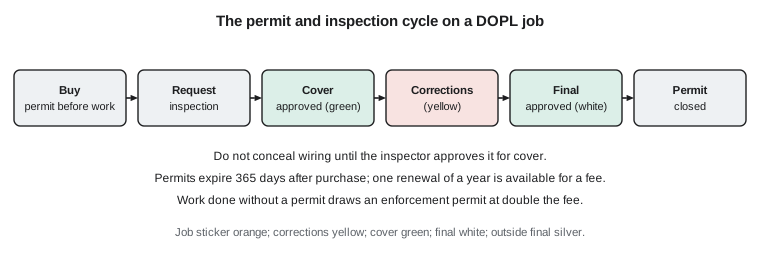
The key rule is concealment. Wiring and equipment may not be covered until the inspector approves it for cover. A drywall crew that closes walls before the green sticker forces the electrical contractor to open them, at someone's cost, and the contractor that allowed it has violated the rule. Idaho Code 54-1005(3) contains a narrow exception, so read it before relying on it, but the everyday rule on a jobsite is simple: no cover without approval.
Corrections
When the inspector finds a violation, the correction notice lists it and sets a time to fix it. The board's penalty section lists missing a correction deadline as a violation, and failing to respond to a correction notice is one of the grounds for a reinspection fee. The professional response is quick: fix the item, request a reinspection, and keep a record of what was changed. When the correction is wrong, the response is still prompt, but it is a conversation with the inspector backed by the code section, as Lesson 5 described.
Marisol keeps a short correction log on every job: the date, the inspector's note, the code section, what the crew did and the date of reinspection. Over a year, the log shows patterns. Sawtooth Ridge found that most of its corrections came from two things: box fill on residential jobs with many smart devices, and labeling of panels and disconnects. Both were fixed with a crew meeting.
Fees
DOPL's fees are in section 500 of the board rules. For a new one-family dwelling the fee is set by floor area, starting at 130 dollars for up to 1,500 square feet and rising in steps of 65 dollars to 325 dollars for 3,501 to 4,500 square feet, plus 65 dollars for each additional 1,000 square feet or part of it above that. A new two-family dwelling is 260 dollars, and multi-family buildings pay 130 dollars per building plus 65 dollars per unit. Work on an existing dwelling is 65 dollars per inspection.
Commercial and industrial permits are priced by the total wiring cost. Up to 10,000 dollars, the fee is 60 dollars plus 2 dollars for every 100 dollars of wiring cost. From 10,000 to 100,000 dollars, it is 260 dollars plus 1 dollar for every 100 dollars above 10,000. Above 100,000 dollars, it is 1,160 dollars plus 50 cents for every 100 dollars above 100,000. Small jobs of 500 dollars or less with no service change pay 10 dollars. Requested inspections and reinspections are 65 dollars, virtual inspections for contractors 45 dollars, plan checks 65 dollars per hour with a one-hour minimum, permit renewal 65 dollars and permit transfer 45 dollars.
def commercial_fee(wiring_cost):
    """DOPL commercial and industrial permit fee as summarized in this lesson (check the current rule)."""
    if wiring_cost <= 500:
        return 10.0
    if wiring_cost <= 10_000:
        return 60 + 0.02 * wiring_cost
    if wiring_cost <= 100_000:
        return 260 + 0.01 * (wiring_cost - 10_000)
    return 1_160 + 0.005 * (wiring_cost - 100_000)

for job, cost in [("church service upgrade", 18_500), ("strip center tenant finish", 42_000), ("dairy milking parlor", 236_000)]:
print(f"{job}: wiring cost {cost:,} -> permit {commercial_fee(cost):,.2f}")church service upgrade: wiring cost 18,500 -> permit 345.00 strip center tenant finish: wiring cost 42,000 -> permit 580.00 dairy milking parlor: wiring cost 236,000 -> permit 1,840.00
The tiers are built so the fee is continuous at the break points: 60 dollars plus 2 dollars per 100 on 10,000 dollars is 260 dollars, where the second tier starts, and 260 dollars plus 1 dollar per 100 on 90,000 dollars is 1,160 dollars, where the third starts. A question that asks for a permit fee is really an arithmetic question about which tier applies. Fees change, so on a real job use the current rule.
Energizing before final
Normally the utility connects a new service only after the inspector releases it. Section 200 of the board rules allows a power supplier to energize a service before a passed inspection, at a contractor's request and with a copy of the permit, only to preserve life or property or to provide temporary construction service. The contractor that asks assumes full responsibility for the installation. Sawtooth Ridge used that rule once, in a January cold snap, to restore power to a farm shop with livestock water heaters after a fire damaged the old service. Wes put the request, the permit copy and the reason in the job file.
Permit life, transfer and closing
A DOPL permit expires 365 days after purchase and can be renewed once for another year for a fee. Long projects therefore need a calendar reminder. If a contractor leaves a job, another contractor can take it over only with written, notarized authorization from the original permit holder and a transfer fee. Without that, the new contractor buys a new permit. When a job is canceled, close or void the permit rather than leave an open permit under the company's name.
Open permits matter because they follow the contractor. An inspector who sees a string of old permits never finaled may look more closely at the company's other work, and a customer who later sells a house with an open permit will call the contractor. Wes runs a monthly report of open permits older than ninety days and asks the crew lead on each one why it is still open.
Exemptions and homeowner work
Not every electrical task needs a licensed contractor or a permit. Idaho Code 54-1016 lists exemptions, and the board rules say that maintenance and repair count as electrical contracting unless an exemption applies. The exemptions are narrow and specific, so read the statute before relying on one. The most common exception in practice is the homeowner permit for a person's own residence. A homeowner permit does not let the homeowner hire unlicensed help, and it is not valid for commercial buildings or rental work that falls outside the homeowner rules.
Plan review and virtual inspections
DOPL offers plan checks for a fee of 65 dollars for the first hour or less and 65 dollars for each additional hour or part of an hour. A plan check is not required for every job, but on a large or unusual installation it can catch problems before the crew builds them. Marisol asked for one on the dairy's milking parlor, where wet and corrosive locations, equipment bonding and the large motor loads all raised questions. The review cost two hours of fees and saved a change order that would have cost far more.
The fee table also lists virtual inspections for contractors and specialty contractors. On small jobs, such as a service replacement or a single circuit, an inspector may accept photos or a live video walk-through instead of a site visit. Virtual inspections save travel for both sides in a large rural state, but they work only when the contractor shows the inspector everything the inspector would have looked at in person. A shaky video that skips the panel interior is a reinspection fee waiting to happen.
Working with inspectors
Inspectors in Idaho cover large territories, and a good relationship with them is worth real money. Have the work ready when the inspection is requested; a reinspection fee applies when work is not ready or the directions to the site are wrong. Leave the permit and plans where the inspector can find them. Meet the inspector on larger jobs, and walk the job together when possible. Take corrections as information, not as insults, and when you disagree, say so with the code section in hand. Marisol has noticed that the inspectors who know Sawtooth Ridge's work spend less time on its jobs, which is the best reward for doing it right.
Common mistakes
MistakeBuying the permit after the rough-in is done.
InsteadAll electrical permits must be purchased before work begins.
MistakeLetting drywall go up before the green sticker.
InsteadWiring may not be concealed until the inspector approves it for cover.
MistakeAssuming a city building permit covers the electrical work.
InsteadThe electrical permit comes from whoever holds electrical jurisdiction.
MistakeTaking over another contractor's permit with a phone call.
InsteadA transfer needs written, notarized authorization from the original permit holder.
MistakeLetting a permit run past a year on a long job.
InsteadPermits expire 365 days after purchase; renew in time.
Summary and key terms
- DOPL holds electrical jurisdiction in most of Idaho; some cities and counties run their own programs.
- Permits must be bought before work and paid in full before the final.
- Do not conceal work until it is approved for cover.
- The permit holder requests each inspection; stickers show the status.
- Fees follow section 500: dwellings by floor area, commercial by wiring cost.
- A power supplier may energize before final only to protect life or property or for temporary construction service.
- Electrical jurisdiction
- The authority to issue electrical permits and inspect at a location.
- Approval for cover
- The inspector's release, shown by a green sticker, that lets wiring be concealed.
- Enforcement permit
- A permit bought after work began without one, at double the normal fee.
- Permit transfer
- Moving a permit to a new contractor with the original holder's notarized authorization.
- Homeowner permit
- A permit for work on a person's own residence and outbuildings.
Practice problems
Work each problem on paper first, then reveal the answer to check.
Can Sawtooth Ridge start the church service upgrade on Monday and buy the permit Wednesday?
Show answer
No; the permit must be bought before work begins.
What color sticker means the wiring may be covered?
Show answer
Green.
What is the DOPL permit fee for a new 2,200 square foot one-family dwelling?
Show answer
195 dollars, from the second floor-area step.
How long is a DOPL permit valid?
Show answer
365 days after purchase, renewable once for a year.
When may a utility energize before final inspection?
Show answer
At the contractor's request with a permit copy, only to protect life or property or for temporary construction service.
Lesson quiz · 5 questions
Score 60% or more to complete this lesson.
Create a free account to save your progress, take quizzes and earn a certificate.