
MELU-212 · Lesson 5 of 12 · 18 min
The NEC as adopted in Idaho and state amendments
▶ Video coming soon A video version of this lesson is on the way.
Every Idaho electrical job is wired to one code: the National Electrical Code as adopted by the Idaho Electrical Board, with the amendments the board wrote into its rules. That sounds simple, and compared with states where each city adopts its own edition, it is. But an Idaho master has to know three things that a national exam does not teach: which edition is in force, how Idaho changed it, and how a change of edition reaches the field. Marisol learned the third point the hard way in 2024, when Sawtooth Ridge had a house permitted under the old edition and finished under the new one. This lesson covers all three.
How Idaho adopts the code
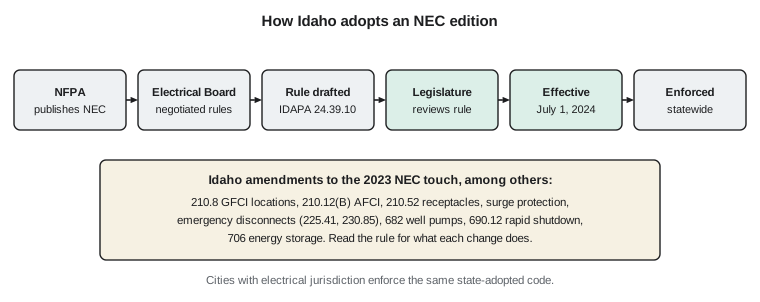
The NEC is written by the National Fire Protection Association, which publishes a new edition every three years. It has no legal force in Idaho until the state adopts it. Idaho's electrical law gives the Electrical Board the power to adopt the code by rule, and the board does so in section 600 of its rules, IDAPA 24.39.10. The process starts with negotiated rulemaking: the board holds public meetings where contractors, unions, inspectors, utilities and manufacturers propose and argue over amendments. DOPL then publishes a proposed rule, takes written comments, and submits the final rule to the Legislature, which reviews administrative rules each session. A rule the Legislature lets stand takes effect on the date it states, often July 1.
The 2023 NEC, with Idaho amendments, took effect in Idaho on July 1, 2024. It replaced the 2017 edition. Idaho did not adopt the 2020 edition, which is why DOPL's 2024 exam bulletin still listed the 2017 NEC as the exam reference. The board's April 2026 minutes record approval of negotiated rulemaking for the 2027 legislative session limited to identifying additional exemptions or exceptions to the 2023 NEC, so in late 2026 Idaho was still on the 2023 edition and was looking at more amendments to it rather than at the 2026 edition. Check DOPL's electrical pages for the current status.
One code, statewide
Section 600 adopts the code for the whole state. DOPL's inspectors enforce it, and the cities and counties that hold electrical jurisdiction enforce the same state-adopted edition with the same amendments; they do not adopt their own editions. Idaho Code 54-1010(5) shows the Legislature's attitude toward local variation in the trade, at least on supervision and ratios, and DOPL's practice is one code everywhere. For a contractor that works across the state, that is a real advantage: a crew that wires a shop in Rexburg to the Idaho code can wire the same shop in Nampa the same way.
The rules also say a copy of the adopted code is available at DOPL's offices. That is a reminder that the code is incorporated by reference: the rule does not print the NEC, it points to it. Electricians buy their own copies from NFPA or a distributor.
The Idaho amendments
Idaho's amendments to the 2023 NEC are mostly relaxations of new requirements that the board judged too costly for the benefit in Idaho, plus a few additions. The list below follows section 600 in the order of the code. It describes each amendment in general terms only; for the exact wording, read the rule itself, which DOPL publishes free online.
| NEC section | Subject | General effect of the Idaho amendment |
|---|---|---|
| 210.8 | Ground-fault protection for personnel | Revises or removes several listed locations, including some unfinished basement, sink and laundry locations |
| 210.12(B) | Arc-fault protection, dwellings | Applies, but in one and two family dwellings only to circuits supplying bedrooms |
| 210.52, 210.52(E)(3) | Dwelling receptacle outlets | Allows certain below-countertop receptacles; requires an outlet on qualifying balconies, decks and porches of 20 square feet or more |
| 215.18, 225.42, 230.67 | Surge protection | Applies, with exceptions for dwelling units |
| 225.41, 230.85 | Emergency disconnects | Permitted for one and two family dwellings under listed conditions |
| 682 | Submersible well pumps | Idaho rules on HDPE chases, splices, ground-fault protection and public swimming and marine areas |
| 690.12 | PV rapid shutdown | Exempts certain detached structures and off-grid systems |
| 706.5, 706.15(B) | Energy storage systems | Listing required except lead-acid batteries; dwelling exception for disconnect location in off-grid systems |
Why the amendments matter on a job
Consider three Sawtooth Ridge jobs from 2025. The first was a custom home outside Ammon. Under the national 2023 NEC, arc-fault protection reaches most dwelling living areas. Under the Idaho amendment to 210.12(B), the arc-fault requirement in a one or two family dwelling applies only to the bedroom circuits, so the panel schedule had arc-fault breakers on the bedroom circuits and standard breakers elsewhere, except where ground-fault protection was required. A crew used to working in a neighboring state with full arc-fault requirements would have overbuilt the job; a crew that misread the amendment as removing arc-fault protection altogether would have failed the rough-in.
The second was a farm well. Idaho's Article 682 amendment covers submersible well pumps, including how conductors in high-density polyethylene chases are run and spliced and when ground-fault protection applies. Agricultural wells are common work in eastern Idaho, so this amendment is far more important to Sawtooth Ridge than a national exam would suggest.
The third was a ground-mounted solar array on a detached shop with no occupied space. The Idaho amendment to 690.12 exempts certain detached structures from the rapid shutdown requirement, which changed the equipment list and the cost. The project file shows the amendment by number, so that the inspector and the customer could see why the design differed from a similar job in another state.
Equipment approval
Section 200 of the board rules adds a requirement that shapes every job: electrical equipment must be listed by a nationally recognized testing laboratory, or field evaluated under NFPA 791 by a body that meets NFPA 790. The rule cites the 2012 editions of those two standards. Unlisted equipment, such as an imported control panel built for another market, must be field evaluated and labeled before an inspector will approve it. The cost of a field evaluation can be large, so a master who designs an installation should confirm listing before the equipment is ordered.
The edition on the exam and the edition on the job
Exam and job editions do not always match. NASCLA's exams are tied to the editions listed in its bulletin, and Idaho's NASCLA exams moved to the 2023 NEC on August 1, 2025, more than a year after the 2023 code took effect in the field. The Idaho exam developed with PSI uses the 2023 NEC as adopted in Idaho. When a new edition comes into force, an exam may lag behind it. Always study the edition the bulletin names, and answer exam questions from that edition, even if your daily work follows another.
There is also a subtle point about amendments on exams. A national exam tests the code as NFPA published it. An Idaho exam built on the Idaho-adopted code can test the amended rule. A question about arc-fault protection in a dwelling might have different correct answers on the two exams. Read the bulletin to know which code your exam uses.
Which edition applies to a given job
On the job, the edition in force when the permit is bought generally governs, and an installation permitted under one edition is usually inspected under that edition even if a new one takes effect before the final. The Ammon house mentioned at the start of this lesson was permitted in June 2024 under the 2017 NEC and finished in August, after the 2023 code took effect. The inspector applied the 2017 edition because the permit predated the change. A permit bought in July for an identical house next door fell under the 2023 edition with Idaho's amendments. If an edition changes mid-project, ask the inspector before the rough-in which edition applies, and put the answer in the job file.
from datetime import date

ADOPTIONS = [  # (effective date, edition) as summarized in this lesson
    (date(2024, 7, 1), "2023 NEC with Idaho amendments"),
]
PRIOR = "2017 NEC with Idaho amendments"

def edition_for(permit_date):
    current = PRIOR
    for effective, edition in ADOPTIONS:
        if permit_date >= effective:
            current = edition
    return current

for d in (date(2024, 6, 20), date(2024, 7, 15), date(2026, 3, 2)):
print(d, "->", edition_for(d))2024-06-20 -> 2017 NEC with Idaho amendments 2024-07-15 -> 2023 NEC with Idaho amendments 2026-03-02 -> 2023 NEC with Idaho amendments
The little function above is the logic Wes uses on the jurisdiction sheet: the permit date decides the edition. Confirm the rule with DOPL or the local inspector on any job that straddles an adoption date.
Reading the amendment, not the rumor
Every code change produces rumors. In 2024, Marisol heard that Idaho had dropped arc-fault protection, that surge protection was gone for houses, and that emergency disconnects were banned. None of those was quite right. The amendments narrowed arc-fault protection, kept surge protection with dwelling exceptions, and permitted emergency disconnects under conditions. The only reliable source is section 600 itself. A master who designs and lays out installations, which is the scope of the Idaho master license, needs to read amendments at the source and explain them to crews.
Interpretations and disagreements
The code is written in general terms, and two competent people can read a section differently. In Idaho the inspector with jurisdiction makes the first call. When a contractor disagrees, the first step is a calm conversation with the inspector, backed by the section number and, if possible, the NEC Handbook commentary or a published interpretation. If that fails, the contractor can ask the inspector's supervisor at DOPL or at the local program to review the decision, and beyond that the electrical law and DOPL's procedures provide for a hearing. Most disputes end at the first step, and a contractor who argues every correction loses goodwill it will need later.
The authority having jurisdiction also has some room under the code itself. NEC Article 90 lets the authority having jurisdiction approve equipment and materials, grant special permission where the code allows it, and permit alternative methods that give equivalent safety. In Idaho that authority is DOPL or the local program. A master who wants to use an unusual method should ask in writing before the work, describe the method and the reasoning, and keep the written answer in the job file.
Taking part in rulemaking
The Idaho amendments exist because people from the trade showed up. The board's negotiated rulemaking meetings are open, and contractors, inspectors, union and open-shop representatives, utilities and manufacturers can propose changes and comment on drafts. A master who sees a rule causing real problems in the field can bring evidence to those meetings: costs, failures, inspection data and examples from jobs. Dale has attended several meetings over the years, and he wants Marisol to go to the next round. The 2026 round, aimed at the 2027 session, is limited to further exceptions to the 2023 NEC, so it is a chance to fix problems with the current code rather than to debate the next edition.
The master's design role
The Idaho master license is defined around planning, layout and design, and that is where code adoption matters most. When Marisol lays out a service for a new machine shop, she chooses the service size from a load calculation under Article 220, sizes feeders and branch circuits under Articles 210, 215 and 240, selects the grounding electrode system under Article 250, and picks wiring methods suitable for the environment. Every one of those choices must follow the code in force in Idaho, with its amendments. A design built to the national text without checking section 600 can be wrong in either direction: overbuilt where Idaho relaxed a rule, or noncompliant where Idaho added one, as with well pumps. Design notes that cite section numbers make inspections faster and protect the contractor if a question comes up after the job is closed.
Common mistakes
MistakeAssuming each Idaho city adopts its own NEC edition.
InsteadThe board adopts one edition with amendments for the state; local programs enforce it.
MistakeBelieving Idaho dropped arc-fault protection in dwellings.
InsteadThe amendment keeps arc-fault protection for bedroom circuits in one and two family dwellings.
MistakeStudying the edition your crew uses instead of the one in the bulletin.
InsteadExam questions are based on the edition the bulletin names.
MistakeOrdering unlisted equipment and hoping it passes.
InsteadEquipment must be listed or field evaluated under NFPA 791.
MistakeApplying the new edition to a job permitted before it took effect.
InsteadThe edition in force when the permit was bought generally governs; confirm with the inspector.
Summary and key terms
- The Electrical Board adopts the NEC by rule in IDAPA 24.39.10 section 600.
- The 2023 NEC with Idaho amendments took effect July 1, 2024, statewide.
- Amendments narrow or relax several 2023 requirements and add Idaho rules for well pumps.
- Equipment must be NRTL listed or field evaluated under NFPA 791.
- The exam uses the edition its bulletin names; a job generally uses the edition in force when the permit was bought.
- Read amendments in the rule itself, not in summaries.
- Incorporation by reference
- Adopting a published code by citing it in a rule rather than printing its text.
- Negotiated rulemaking
- Public meetings where an agency and stakeholders work out a proposed rule.
- Section 600
- The part of IDAPA 24.39.10 that adopts the NEC and lists Idaho's amendments.
- NRTL
- A nationally recognized testing laboratory that lists and labels equipment.
- Field evaluation
- Testing and labeling of unlisted equipment on site under NFPA 791.
Practice problems
Work each problem on paper first, then reveal the answer to check.
Which NEC edition took effect in Idaho on July 1, 2024?
Show answer
The 2023 NEC with Idaho amendments.
Does a city with its own electrical program enforce a different edition?
Show answer
No; it enforces the state-adopted code.
In a one-family dwelling under the Idaho amendment, which circuits need arc-fault protection?
Show answer
Circuits supplying bedrooms.
An imported panel has no NRTL listing. What is needed?
Show answer
A field evaluation under NFPA 791 by an approved body before inspection.
Where do you read the exact text of the Idaho amendments?
Show answer
In IDAPA 24.39.10 section 600, published by the state.
Lesson quiz · 5 questions
Score 60% or more to complete this lesson.
Create a free account to save your progress, take quizzes and earn a certificate.