
MELU-212 · Lesson 10 of 12 · 18 min
Workplace safety law and OSHA for electrical contractors
▶ Video coming soon A video version of this lesson is on the way.
In eighteen years, Sawtooth Ridge has had one injury that still keeps Dale up at night: a journeyman who reached into a panel he believed was dead and took a shock that knocked him off a ladder. He recovered, but the investigation showed that the panel had been fed from two sources and that nobody had tested it before work. Since then, Dale has treated safety as part of the license, not an extra. This lesson covers the safety law that applies to an Idaho electrical contractor: who enforces it, which federal standards matter most for electrical work, how injuries are recorded and reported, and how Idaho's workers compensation system works.
Who enforces safety law in Idaho
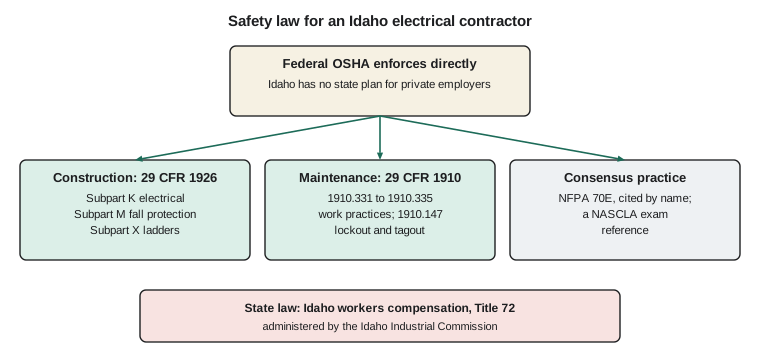
The federal Occupational Safety and Health Act lets each state choose whether to run its own OSHA-approved state plan. Idaho has not adopted a state plan for private employers, so federal OSHA enforces workplace safety for private businesses in Idaho directly, through its area office in Boise. An Idaho electrical contractor therefore deals with federal standards, federal inspectors and federal penalties. Idaho does offer a free, confidential on-site consultation program for small businesses, operated with federal funding through a state university program, which can help a contractor find and fix hazards without citations.
State law still plays two parts. The Idaho electrical law and the adopted NEC govern how installations must be built, which protects the people who later use them. The Idaho workers compensation law in Title 72 governs what happens when a worker is hurt on the job. Both run alongside OSHA, not in place of it.
The construction standards
Most of Sawtooth Ridge's work is construction, so the federal construction standards in 29 CFR Part 1926 apply. Subpart K, sections 1926.400 through 1926.449, covers electrical safety on construction sites: installation requirements for temporary wiring, ground-fault protection for employees using cord-and-plug tools, safety-related work practices, and the lockout and tagging of circuits under 1926.417. Subpart M covers fall protection, which on construction sites generally applies at six feet. Subpart X covers ladders and stairways, and Subpart CC covers cranes when equipment is hoisted near lines. Subpart V covers power transmission and distribution work, which applies to line contractors.
OSHA's general duty clause adds a backstop: an employer must keep the workplace free of recognized hazards likely to cause death or serious harm, even where no specific standard applies. Arc flash hazards are often cited under the general duty clause or the work practice standards, with NFPA 70E used as evidence of what a reasonable employer recognizes.
The general industry standards
When an electrician works in an existing plant, such as the food processing plants that dot eastern Idaho, much of the work is maintenance rather than construction, and the general industry standards in 29 CFR Part 1910 apply. Sections 1910.331 through 1910.335 set electrical safety-related work practices: training, de-energizing before work, lockout and tagging, and the use of protective equipment and insulated tools. Section 1910.147 covers the control of hazardous energy for machinery and equipment, and 1910.269 covers electric power generation, transmission and distribution. The line between construction and maintenance is not always sharp, so a master should know both parts.
| Standard | Subject | Typical electrical contractor use |
|---|---|---|
| 29 CFR 1926 Subpart K | Electrical safety in construction | Temporary power, ground-fault protection, work practices |
| 29 CFR 1926.417 | Lockout and tagging of circuits | De-energizing circuits during construction work |
| 29 CFR 1926 Subpart M | Fall protection | Work on roofs, lifts and open edges |
| 29 CFR 1910.331 to 1910.335 | Electrical safety-related work practices | Service and maintenance in existing facilities |
| 29 CFR 1910.147 | Control of hazardous energy | Machinery and equipment lockout in plants |
| NFPA 70E | Electrical safety in the workplace | Shock and arc flash risk assessment, boundaries, PPE |
NFPA 70E
NFPA 70E is a consensus standard, not a federal regulation, but it has become the practical rulebook for electrical safety. It sets the process for establishing an electrically safe work condition, defines approach boundaries for shock and the arc flash boundary, and explains how to select personal protective equipment by risk assessment. The NASCLA master exam lists the 2024 edition of NFPA 70E as a reference, and many Idaho owners write it into their contracts. The single most important rule in 70E is the one the injured journeyman's crew skipped: verify the absence of voltage with a properly rated tester before treating any circuit as dead, and test the tester before and after.
Sawtooth Ridge's written electrical safety program follows 70E. It requires lockout and tagging, absence-of-voltage testing, energized work permits for the rare jobs that cannot be de-energized, arc flash labels on equipment the company installs, and annual training. Marisol is responsible for the program as crew lead and will be more so as supervising electrician.
Recordkeeping
Under 29 CFR Part 1904, employers with more than ten employees in industries that are not partially exempt must keep records of work-related injuries and illnesses. Construction contractors, including electrical contractors, are not in the partially exempt list, so Sawtooth Ridge, with eighteen employees, keeps the OSHA 300 log of recordable cases, an incident report for each case, and the annual 300A summary, which it posts from February 1 through April 30 each year. Records are kept for five years. Employers with ten or fewer employees during the whole previous year are generally exempt from keeping the routine records but must still report serious events.
Safety performance is often measured by the total recordable incident rate, which scales recordable cases to 200,000 hours, the hours that 100 full-time workers would work in a year. Customers and general contractors ask for this rate in prequalification forms.
def incident_rate(cases, hours):
    """Recordable cases per 200,000 hours worked (OSHA's standard base)."""
    return cases * 200_000 / hours

employees, hours_each = 18, 2_050
hours = employees * hours_each
for year, cases in [(2024, 2), (2025, 1), (2026, 0)]:
print(f"{year}: {cases} recordable cases, rate {incident_rate(cases, hours):.2f}")2024: 2 recordable cases, rate 10.84 2025: 1 recordable cases, rate 5.42 2026: 0 recordable cases, rate 0.00
One case in a small company moves the rate a lot. With about 37,000 hours a year, a single recordable case gives Sawtooth Ridge a rate of about 5.4, while a large company with the same number of cases would show a tiny rate. Prequalification reviewers who understand that look at several years and at the causes, not just the number.
Reporting serious events to OSHA
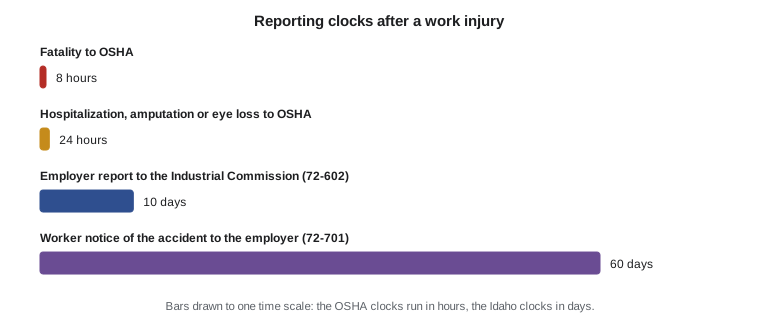
Under 29 CFR 1904.39, every employer, regardless of size, must report a work-related fatality to OSHA within eight hours of learning of it, and an in-patient hospitalization, an amputation or the loss of an eye within twenty-four hours. Reports go to the OSHA area office by phone or in person, to OSHA's national hotline, or through OSHA's online reporting tool. These clocks run whether or not the employer thinks it was at fault.
Idaho workers compensation
Idaho's workers compensation law, Title 72 of the Idaho Code, is administered by the Idaho Industrial Commission. Most employers with employees must carry workers compensation insurance or qualify as self-insured, and the electrical contractor license itself requires proof of workers compensation if applicable. In exchange for no-fault benefits, covered employees generally cannot sue their employer for a work injury; workers compensation is their exclusive remedy against the employer. Benefits include medical care, income benefits for time lost and for lasting impairment, and death benefits for dependents.
The reporting rules are short and firm. Under Idaho Code 72-602, an employer must file a written report of an injury or occupational disease with the Industrial Commission as soon as practicable, but no later than ten days after the injury, when it requires treatment by a physician or causes the worker to miss one day of work or more. Supplemental reports follow if disability lasts beyond sixty days and when it ends. An employer who willfully fails to file a required report commits a misdemeanor. In practice, the employer tells its insurance carrier at once, and the carrier often files the report, but the duty is the employer's.
The worker has a clock too. Under 72-701, an injured worker must give the employer notice of the accident as soon as practicable, and no later than sixty days after it, with a claim for compensation following within the period the statute sets. A crew lead who hears of an injury should report it to the office the same day, so the employer's ten-day clock can be met and the worker's claim is not put at risk.
After an incident
When an injury happens, the first duties are care and safety: get medical help, make the area safe and protect the scene. Then the reporting clocks start: OSHA within eight or twenty-four hours for serious events, the carrier immediately, and the Industrial Commission within ten days. Then comes the investigation, which should look for causes rather than blame. Dale's shock incident led to three changes at Sawtooth Ridge: a rule that every panel is tested before work regardless of what the drawings say, a label on every panel with multiple sources, and a short safety talk at the start of every job about where the power comes from.
Training and qualified persons
OSHA's electrical standards distinguish qualified persons, who have training to work on or near exposed energized parts and to recognize and avoid the hazards, from unqualified persons, who must stay clear. A licensed journeyman is not automatically a qualified person in OSHA's sense; qualification comes from specific training in the equipment and hazards involved, documented by the employer. NFPA 70E requires retraining at set intervals and an annual check of each qualified person's use of the safety procedures. Apprentices can be qualified for some tasks and not others, which should match the supervision rules in Lesson 7.
Sawtooth Ridge keeps a training record for each employee: the date, the topic, the trainer and the person's signature. It covers 70E, lockout and tagging, fall protection, ladders, aerial lifts, first aid and CPR, and any site-specific training a customer requires. When an OSHA inspector or a customer's safety manager asks how the company knows its people are qualified, the record is the answer.
OSHA inspections and citations
OSHA inspects after serious incidents and complaints, under national and regional emphasis programs, and at random on construction sites. An inspector presents credentials, holds an opening conference, walks the site and interviews workers, and closes with a conference describing apparent violations. Citations, if any, follow in writing, with proposed penalties and abatement dates. Penalty amounts are adjusted for inflation each year, and the largest apply to willful and repeat violations. An employer has fifteen working days from receipt to contest a citation, and many cases are settled in an informal conference with the area director.
On a multi-employer construction site, more than one contractor can be cited for the same hazard: the employer whose workers were exposed, the employer that created the hazard, the employer responsible for correcting it, and the controlling employer, often the general contractor. An electrical contractor that leaves an open panel or an unprotected floor opening for other trades can be cited even if none of its own workers was near it.
Common mistakes
MistakeAssuming Idaho has its own state OSHA plan for private employers.
InsteadFederal OSHA enforces directly in Idaho.
MistakeReporting a hospitalization to OSHA a week later.
InsteadIn-patient hospitalizations, amputations and eye losses must be reported within 24 hours.
MistakeWaiting for the carrier to decide whether to file the Idaho injury report.
InsteadThe employer must file within ten days; the carrier usually files on its behalf, but the duty is the employer's.
MistakeTreating NFPA 70E as optional because it is not a regulation.
InsteadOSHA uses 70E as evidence of recognized hazards, and contracts often require it.
MistakeThinking a construction contractor is exempt from OSHA recordkeeping.
InsteadConstruction is not partially exempt; employers with more than ten employees keep the 300 log.
Summary and key terms
- Federal OSHA enforces workplace safety for private employers in Idaho.
- 29 CFR 1926 Subpart K and 1910.331 to 1910.335 set electrical safety rules; NFPA 70E is the practical standard.
- Report fatalities within 8 hours and hospitalizations, amputations and eye losses within 24 hours.
- Contractors with more than ten employees keep the OSHA 300 log and post the 300A summary.
- Idaho workers compensation is administered by the Industrial Commission under Title 72.
- Employers report qualifying injuries within 10 days; workers give notice within 60 days.
- State plan
- An OSHA-approved state program for workplace safety; Idaho has none for private employers.
- General duty clause
- The OSH Act requirement to keep the workplace free of recognized serious hazards.
- Recordable case
- A work-related injury or illness that must be entered on the OSHA 300 log.
- Exclusive remedy
- The rule that workers compensation generally replaces a covered worker's lawsuit against the employer.
- Industrial Commission
- The Idaho agency that administers workers compensation.
Practice problems
Work each problem on paper first, then reveal the answer to check.
Who inspects a Sawtooth Ridge jobsite for workplace safety violations?
Show answer
Federal OSHA.
A journeyman is admitted to the hospital overnight after a fall on Tuesday morning. When must OSHA be told?
Show answer
Within 24 hours of the employer learning of it.
An apprentice misses two days after a cut that needed stitches. When must the Idaho report be filed?
Show answer
As soon as practicable, and no later than ten days after the injury.
What is the incident rate for one recordable case in 40,000 hours?
Show answer
5.0 per 200,000 hours.
Which standard sets the arc flash boundary and PPE selection process?
Show answer
NFPA 70E.
Lesson quiz · 5 questions
Score 60% or more to complete this lesson.
Create a free account to save your progress, take quizzes and earn a certificate.