
MELU-212 · Lesson 11 of 12 · 18 min
Renewal and continuing education
▶ Video coming soon A video version of this lesson is on the way.
Earning the master license is a milestone; keeping it is a habit. Dale has renewed his Idaho licenses more than a dozen times, through four changes of the agency's name, two changes in the renewal cycle and several rounds of continuing education rules. He has one piece of advice for Marisol: never let the expiration date surprise you. This lesson covers how Idaho electrical licenses are renewed and revived, the change to two-year terms that DOPL has begun, what happened to continuing education in 2025 and why it still matters, and how reciprocity and work in other states fit in.
License terms
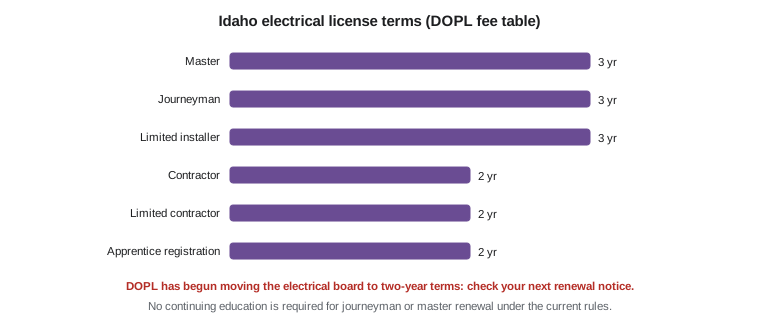
DOPL's electrical fee table, as published in 2026, lists the master and journeyman licenses on three-year terms, the limited installer license on a three-year term, the contractor and limited contractor licenses on two-year terms, apprentice registrations on two-year terms and the provisional journeyman on a six-month term. The renewal fee listed for a master license is 45 dollars and for a contractor license 200 dollars. Under the 2025 amendment to 54-1007(3), a master license renewal also renews the journeyman license that comes with it, so a master no longer pays to renew two licenses.
Those terms are in transition. DOPL's electrical board page announced in October 2026 that the division has begun transitioning the electrical board to biennial licensure, meaning two-year terms. The page did not say exactly how existing licenses will move to the new cycle or whether fees will change. A licensee should read every renewal notice carefully over the next few years, because the expiration date on the next license may not be three years out.
Renewal and revival
Idaho Code 54-1013 sets the renewal window. A license or registration may be renewed during the final month of its licensing period. If it is not renewed, it expires, and it may be revived within one year after the last day of that final month by meeting the renewal requirements and paying the revival fee. DOPL's fee table lists reinstatement fees for each license. After the one-year revival period, the license cannot simply be revived; the former licensee must reopen it under the current application process, which for a master can mean meeting current requirements again.
An expired license is not a license. During the gap between expiration and revival, the holder may not work under it, and a contractor whose supervising electrician's license has expired is in the same position as one with no supervising electrician. A contractor's renewal also requires current proof of the 300,000 dollars of liability insurance and workers compensation if applicable, so an insurance lapse can block a renewal.
from datetime import date
import calendar

def windows(expires):
    """Renewal month and revival deadline under Idaho Code 54-1013 as summarized here."""
    first_of_final_month = expires.replace(day=1)
    last_day = expires.replace(day=calendar.monthrange(expires.year, expires.month)[1])
    revival_end = last_day.replace(year=last_day.year + 1)
    return first_of_final_month, last_day, revival_end

for who, exp in [("Marisol, master (3-year term)", date(2029, 12, 31)),
                 ("Sawtooth Ridge, contractor (2-year term)", date(2027, 6, 30))]:
    start, end, revive = windows(exp)
print(f"{who}: renew {start} to {end}; revival possible until about {revive}")Marisol, master (3-year term): renew 2029-12-01 to 2029-12-31; revival possible until about 2030-12-31 Sawtooth Ridge, contractor (2-year term): renew 2027-06-01 to 2027-06-30; revival possible until about 2028-06-30
The function assumes a license that expires at the end of a month. Check the actual date on the license, and treat the revival period as a safety net, not a plan: working even one day on an expired license is a violation.
What happened to continuing education
For many years, Idaho journeymen and masters had to complete continuing education to renew. Under the rules in force through 2024, the requirement was 24 hours per three-year renewal cycle from approved providers, including 8 hours on changes to the electrical code and 16 hours on code-related or industry-related subjects, with a few hours of credit allowed for attending board or rulemaking meetings. Idaho Code 54-1013 still refers to continuing education requirements set by the board for journeymen and masters.
In 2025 that changed. When the Legislature reviewed the board's rules, the House Business Committee amended them to remove the continuing education requirement, and the rules took effect as amended. The board's May 2025 minutes record that the rules passed with continuing education removed and are final and in effect, that employers can still require it, that it remains a requirement for DOPL's electrical inspectors, and that DOPL plans to offer a code update course every year. Under the current rules, therefore, no continuing education is required to renew an Idaho journeyman or master license.
The question is not settled. Industry groups have asked the board to restore continuing education, and the board has said it can revisit the topic only through negotiated rulemaking. A secondary source reports that at a July 2026 rulemaking meeting, contractor and union representatives asked for it to come back. Any new requirement would have to go through the rulemaking and legislative review process described in Lesson 5. Check DOPL's current renewal instructions before each renewal.
| Period | Journeyman and master continuing education | Source |
|---|---|---|
| Through 2024 | 24 hours per three-year cycle: 8 code update, 16 code or industry related | Former board rules |
| From 2025 | None required for renewal; employers may require it; DOPL offers an annual code update course | Board rules as amended in 2025 |
| Inspectors | Still required for DOPL electrical inspectors | Board minutes, May 2025 |
| Future | Restoration requested by industry groups; would require new rulemaking | Board minutes and secondary reports |
Why keep learning anyway
Dropping a requirement does not drop the need. The code changes every three years, Idaho's amendments change with it, and the master license is a license to plan and design. A master who stopped learning in 2025 will lay out installations to a code that no longer applies. Inspectors still take continuing education and will know the current rules. Customers, general contractors and insurers increasingly ask what training a contractor's people have. And some other states, which matter for reciprocity and out-of-state work, still require continuing education to renew.
Sawtooth Ridge's policy, which Marisol helped write, is that every licensee takes DOPL's annual code update course or an equivalent and at least eight more hours of training a year, chosen from code, safety and business topics. The company pays for the classes and counts them as work hours. The policy also keeps everyone's records ready in case Idaho restores a requirement or a licensee applies in another state.
There is also a practical test of whether a master is keeping up: the inspection results on the company's jobs. A rising number of corrections after a code change is a sign that someone's knowledge has fallen behind the code in force. Marisol plans to review Sawtooth Ridge's correction log each quarter and use it to choose the next training topic for the crews, which ties the company's learning to the problems it actually has in the field.
Keeping DOPL informed
Renewal notices go to the address and email DOPL has on file, and the email address is required on the application under Idaho Code 67-2609. A licensee who moves or changes email should update DOPL promptly. A contractor that changes its name, ownership structure, address or supervising electrician must tell DOPL, and the supervising electrician change has its own ten-business-day deadline. Wes keeps a calendar with every license, registration and insurance expiration for the company and its people, with reminders ninety, sixty and thirty days ahead.
Apprentice registrations
Apprentice registrations are renewed on two-year periods. Hours worked while a registration has lapsed do not count toward the journeyman license, so a lapse costs the apprentice real time as well as exposing the contractor to a violation for employing an unregistered worker. Industry summaries report a limit on how many registration periods an apprentice may hold; check DOPL's current rule if an apprentice is approaching the end of a long registration history.
Reciprocity
Idaho Code 54-1007(6) lets DOPL, on the board's recommendation, enter reciprocal agreements with states whose licensing standards are at least equal to Idaho's, and license electricians from those states without a written exam. Lesson 2 described the verification form a reciprocal master applicant needs. The agreements are reviewed from time to time; the board's 2025 minutes record a review of reciprocal agreements and changes in other states' laws, prompted partly by the new automatic journeyman license for masters. DOPL publishes the current list.
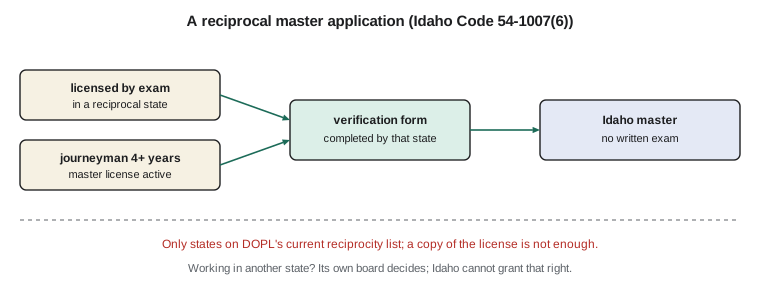
Reciprocity runs both ways in principle, but Idaho cannot grant its licensees the right to work in another state. Sawtooth Ridge takes occasional jobs in western Wyoming and northern Utah. For each, the question is what that state requires, whether it has an agreement with Idaho, and whether it requires continuing education that Idaho no longer does. Marisol's plan is to earn her Idaho master license first and then apply for any out-of-state license the company needs, using the Idaho license and her training records as the foundation.
Inactive status and stepping back
Idaho Code 54-1013 provides an inactive status for electrical and limited electrical contractors: the license is placed on inactive status for a fee capped at 150 dollars, issued for one year, and can be reactivated for a 30-dollar processing fee with proof of the required insurance. An inactive contractor may not contract or buy permits. The option suits a company that pauses work, for example while an owner recovers from surgery or while the business is being sold, and wants to avoid starting over with a new application.
Individual licenses work differently. A master who stops working, as Dale eventually will, can simply let the license expire and lose the right to work under it. Dale plans instead to keep renewing for a few years after he steps back, so that he can fill in as supervising electrician if Marisol is ever unavailable and so that the company's design work has a second master behind it. The renewal fee is small; the flexibility is worth more.
Renewal and discipline
Renewal is not automatic in every case. DOPL can decline to renew, or renew subject to conditions, when a licensee has unpaid civil penalties, an open disciplinary matter or a failure to meet a requirement such as insurance for a contractor. A licensee who has been disciplined should read any order carefully, because orders often set conditions that must be met before the next renewal. An honest answer to any renewal question about discipline or criminal history matters as much as on the original application.
A renewal checklist
Marisol's checklist for each renewal is short. Confirm the expiration date and the renewal month, which may change during the move to two-year terms. Confirm DOPL has her current address and email. Check whether any continuing education requirement has been restored and, if so, gather certificates. Renew online early in the renewal month, pay the fee, and save the confirmation. Check DOPL's license lookup a few days later to see the new expiration date. For the company, add one step: send current insurance certificates with the contractor renewal and confirm the supervising electrician designation is still correct.
Common mistakes
MistakeAssuming 24 hours of continuing education are still required to renew.
InsteadThe 2025 rule amendment removed the requirement for journeymen and masters; check for any later change.
MistakeWorking during the revival year as if the license were active.
InsteadAn expired license may be revived within a year, but the holder may not work under it until it is.
MistakeExpecting a three-year term on every new license.
InsteadDOPL has begun moving the electrical board to two-year terms.
MistakeRenewing the master and the journeyman separately.
InsteadSince July 2025 a master renewal also renews the journeyman license.
MistakeAssuming an Idaho license allows work in a neighboring state.
InsteadEach state's own board decides; reciprocity depends on its rules and agreements.
Summary and key terms
- DOPL's 2026 fee table lists three-year master and journeyman terms and two-year contractor terms; a move to two-year terms has begun.
- Renew during the final month; revive within one year after it; later, reopen under current rules.
- No continuing education is required for journeyman or master renewal under the rules as amended in 2025.
- Employers may require training, inspectors still need it, and restoration has been requested.
- Contractor renewal needs current insurance proof.
- Reciprocity depends on DOPL's current agreements; work in another state depends on that state.
- Renewal
- Extending a license for a new term before it expires.
- Revival
- Restoring an expired license within one year after its final month by meeting renewal requirements and paying a fee.
- Biennial licensure
- A system of two-year license terms.
- Code update course
- Training on changes in a new code edition, which DOPL plans to offer each year.
- Reciprocal agreement
- An agreement under which states license each other's electricians without a written exam.
Practice problems
Work each problem on paper first, then reveal the answer to check.
Marisol's master license expires at the end of December 2029. When can she renew it?
Show answer
During December 2029, the final month of the period.
If she misses it, how long can she revive it?
Show answer
Within one year after the last day of that final month.
How many continuing education hours does she need to renew under the current rules?
Show answer
None, though Sawtooth Ridge's policy and good practice call for training.
Can Sawtooth Ridge renew its contractor license with a lapsed liability policy?
Show answer
No; renewal requires proof of 300,000 dollars of liability insurance.
Who decides whether Marisol may work as a master in Wyoming?
Show answer
Wyoming's licensing authority, under its own rules and any agreement with Idaho.
Lesson quiz · 5 questions
Score 60% or more to complete this lesson.
Create a free account to save your progress, take quizzes and earn a certificate.