
MCAT-120 · Lesson 9 of 12 · 31 min
Acids and bases: pH, titrations and buffers
▶ Video coming soon A video version of this lesson is on the way.
Devika had missed a pH question on the Sunday Session's first mini diagnostic, and she brought it back to start this session. It had asked for the pH of a 0.010 M solution of a weak acid, and she had answered 2, the pH of a strong acid at that concentration. 'That miss is the most common acid-base error I see,' Thandiwe said. 'The fix is one question you ask before any calculation: strong or weak? If it is strong, the concentration of the acid is the concentration of protons. If it is weak, you need Ka, and the pH will be higher than you think.' She promised a set of habits that would make acid-base questions among the most dependable points on the test.
This lesson covers the definitions of acids and bases, the autoionization of water, pH and pOH, strong and weak acids and bases, Ka, Kb and pKa, the pH of weak acid solutions, conjugate pairs and salts, polyprotic acids, buffers and the Henderson-Hasselbalch equation, titrations and indicators. On the AAMC outline these topics belong to content category 5A (the unique nature of water and its solutions). Amino acid charge, blood pH and drug absorption passages all rely on them.
Definitions of acids and bases
Three definitions are tested. Arrhenius acids produce H⁺ in water and Arrhenius bases produce OH⁻. Brønsted-Lowry acids donate protons and bases accept them, a definition that works outside water and includes ammonia as a base even though it contains no hydroxide. Lewis acids accept electron pairs and Lewis bases donate them, the broadest definition, which covers metal ions binding ligands and boron trifluoride reacting with ammonia. Every Arrhenius acid is a Brønsted-Lowry acid, and every Brønsted-Lowry acid is, in a sense, a Lewis acid, because the proton it gives up accepts an electron pair.
In a Brønsted-Lowry reaction, an acid becomes its conjugate base and a base becomes its conjugate acid. In CH₃COOH + H₂O ⇌ CH₃COO⁻ + H₃O⁺, acetic acid and acetate form one conjugate pair, and water and hydronium form the other. Free protons do not exist in water; H⁺ is shorthand for H₃O⁺. Substances that can act as either acid or base, such as water, bicarbonate and amino acids, are amphoteric (or amphiprotic).
Water, pH and pOH
Water autoionizes slightly: 2 H₂O ⇌ H₃O⁺ + OH⁻. At 25 °C the ion product of water, Kw, equals 1.0 × 10⁻¹⁴. In pure water [H₃O⁺] = [OH⁻] = 1.0 × 10⁻⁷ M, and the solution is neutral. Kw increases with temperature because autoionization is endothermic, so neutral water at body temperature has a pH slightly below 7. The MCAT normally assumes 25 °C.
Each pH unit is a factor of 10 in proton concentration, so a solution at pH 3 has ten times the proton concentration of one at pH 4 and a thousand times that of one at pH 6. To estimate a logarithm without a calculator, write the concentration as m × 10⁻ⁿ; the pH lies between n − 1 and n, and is n − log m. Useful values are log 2 ≈ 0.3, log 3 ≈ 0.48 and log 5 ≈ 0.7. A concentration of 2 × 10⁻⁴ M therefore has a pH of about 4 − 0.3 = 3.7.
Strong acids and bases
Strong acids ionize completely in water. The six to know are hydrochloric (HCl), hydrobromic (HBr), hydroiodic (HI), nitric (HNO₃), sulfuric (H₂SO₄, first proton) and perchloric (HClO₄). Strong bases include the hydroxides of group 1 metals (NaOH, KOH) and the heavier group 2 hydroxides (Ca(OH)₂, Ba(OH)₂). For strong acids the proton concentration equals the acid concentration; for strong bases the hydroxide concentration equals the base concentration times the number of hydroxides per formula unit.
Worked problem
pH of strong acid and base solutions
Find the pH of (a) 0.010 M HCl and (b) 0.005 M Ba(OH)₂.
Show solution
- (a) HCl ionizes completely, so [H₃O⁺] = 1.0 × 10⁻² M and pH = 2.
- (b) Each Ba(OH)₂ gives two OH⁻, so [OH⁻] = 0.010 M and pOH = 2.
- pH = 14 − 2 = 12.
Answer: (a) pH 2; (b) pH 12.
Very dilute strong acids are a classic trap. A 1.0 × 10⁻⁸ M HCl solution does not have a pH of 8, which would be basic. The protons from water's own ionization (10⁻⁷ M) dominate, so the pH is just under 7.
Weak acids and bases
Weak acids ionize only partly, and the extent is described by the acid dissociation constant Ka. Larger Ka means a stronger acid. Because Ka values span many powers of ten, they are usually reported as pKa = −log Ka; lower pKa means a stronger acid. Weak bases are described by Kb and pKb. For any conjugate pair, Ka × Kb = Kw, so pKa + pKb = 14. The stronger the acid, the weaker its conjugate base.
| Acid | Approximate pKa | Conjugate base |
|---|---|---|
| Hydrochloric acid, HCl | About −7 (strong) | Cl⁻ (negligible base) |
| Phosphoric acid, H₃PO₄ (first proton) | 2.1 | H₂PO₄⁻ |
| Acetic acid, CH₃COOH | 4.8 | Acetate |
| Carbonic acid, H₂CO₃ (apparent, with dissolved CO₂) | 6.1 | HCO₃⁻ |
| Dihydrogen phosphate, H₂PO₄⁻ | 7.2 | HPO₄²⁻ |
| Ammonium, NH₄⁺ | 9.3 | NH₃ |
| Water | 15.7 (or 14, depending on convention) | OH⁻ |
Acid strength depends on how stable the conjugate base is. Across a row of the periodic table, acidity of H–X increases with the electronegativity of X (HF is more acidic than H₂O, which is more acidic than NH₃). Down a group, acidity increases with the size of X, because a larger atom spreads the negative charge and forms a weaker bond to hydrogen; HI is a stronger acid than HF. Resonance, electron-withdrawing groups near the acidic proton and greater s character all stabilize the conjugate base and increase acidity. Oxyacids with more oxygens are stronger: HClO₄ is stronger than HClO₃, which is stronger than HClO.
pH of a weak acid solution
For a weak acid HA at initial concentration C with Ka small, an ICE table gives Ka ≈ x² ÷ C, where x is the proton concentration. So [H₃O⁺] ≈ the square root of (Ka × C). The same approach with Kb gives the hydroxide concentration of a weak base solution.
Worked problem
pH of a weak acid
What is the pH of 0.10 M acetic acid, Ka = 1.8 × 10⁻⁵?
Show solution
- [H₃O⁺] ≈ √(Ka × C) = √(1.8 × 10⁻⁵ × 0.10) = √(1.8 × 10⁻⁶).
- √1.8 ≈ 1.34, and √10⁻⁶ = 10⁻³, so [H₃O⁺] ≈ 1.3 × 10⁻³ M.
- pH ≈ 3 − log 1.3 ≈ 3 − 0.1 = 2.9.
- Check: 1.3 × 10⁻³ is about 1.3 percent of 0.10, so the approximation holds.
Answer: pH about 2.9, compared with pH 1 for 0.10 M HCl. Only about 1 percent of the acetic acid is ionized.
Salts, hydrolysis and polyprotic acids
Salts can change the pH of water. The conjugate base of a weak acid is itself a weak base, so sodium acetate solutions are basic. The conjugate acid of a weak base is a weak acid, so ammonium chloride solutions are acidic. Ions from strong acids and strong bases (Na⁺, K⁺, Cl⁻, NO₃⁻) have negligible effect, so sodium chloride solutions are neutral. Small, highly charged metal ions such as Al³⁺ and Fe³⁺ make water acidic, because they polarize the water molecules bound to them and release protons.
Polyprotic acids give up more than one proton, each with its own Ka, and each successive Ka is smaller, usually by a factor of 10⁴ to 10⁵, because it is harder to remove a proton from a negatively charged species. Phosphoric acid has pKa values of about 2.1, 7.2 and 12.3. At physiological pH, the dominant species are H₂PO₄⁻ and HPO₄²⁻, which together form an important intracellular buffer.
Buffers and the Henderson-Hasselbalch equation
A buffer resists changes in pH when small amounts of acid or base are added. It contains a weak acid and its conjugate base in comparable amounts: the weak acid neutralizes added base, and the conjugate base neutralizes added acid. The Henderson-Hasselbalch equation gives a buffer's pH from the ratio of base to acid.
When [A⁻] equals [HA], the log term is zero and pH equals pKa. Each factor of 10 in the ratio changes the pH by one unit. Buffers work best within about one pH unit of the pKa, where neither component is scarce. Buffer capacity, the amount of acid or base a buffer can absorb, depends on the absolute concentrations; a 1.0 M buffer resists change much better than a 0.01 M buffer with the same ratio and the same pH. Diluting a buffer does not change its pH, because the ratio is unchanged, but it does lower its capacity.
Worked problem
The bicarbonate buffer of blood
Blood plasma has a bicarbonate concentration of about 24 mM and a carbonic acid concentration (including dissolved CO₂) of about 1.2 mM. The apparent pKa is 6.1. Estimate the pH.
Show solution
- Ratio [HCO₃⁻] ÷ [H₂CO₃] = 24 ÷ 1.2 = 20.
- log 20 = log 2 + log 10 ≈ 0.3 + 1 = 1.3.
- pH ≈ 6.1 + 1.3 = 7.4.
Answer: pH about 7.4, the normal value. The buffer works well despite its pKa of 6.1 because the lungs adjust CO₂ and the kidneys adjust bicarbonate, an open system that keeps the ratio near 20.
Titrations
In a titration, a solution of known concentration (the titrant) is added to an analyte until the reaction is complete, at the equivalence point, where moles of acid equal moles of base (adjusted for the number of protons). At that point, moles of titrant equal moles of analyte, so the analyte's concentration can be calculated: for a monoprotic acid and a base with one hydroxide, M(acid) × V(acid) = M(base) × V(base).
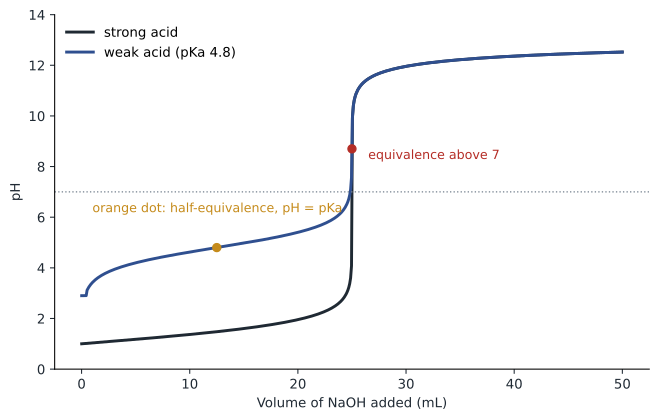
The shape of the titration curve depends on the strengths involved. For a strong acid titrated with a strong base, the pH starts low, rises slowly, then jumps steeply through the equivalence point at pH 7. For a weak acid titrated with a strong base, the curve starts higher, has a flat buffer region, and the equivalence point lies above pH 7 because the conjugate base is present at equivalence. For a weak base titrated with a strong acid, the equivalence point lies below 7. Halfway to the equivalence point, half the weak acid has been converted to its conjugate base, so [A⁻] = [HA] and pH = pKa. That half-equivalence point is the standard way to read pKa from a titration curve, and it is the middle of the buffer region.
Polyprotic acids show one equivalence point for each proton and one buffer region around each pKa. An amino acid such as glycine, titrated from low pH, shows two buffer regions, near pKa values of about 2.3 (carboxyl) and 9.6 (amino), and passes through its isoelectric point, the pH at which its net charge is zero, halfway between them, at about 6.0.
Indicators
An acid-base indicator is a weak acid whose acid and conjugate base forms have different colors. It changes color over a range of about one pH unit either side of its pKa. To mark an equivalence point accurately, choose an indicator whose color change falls in the steep part of the curve, near the equivalence pH. Phenolphthalein, which changes from colorless to pink around pH 8 to 10, suits weak acid-strong base titrations. Methyl orange, which changes around pH 3 to 4.5, suits weak base-strong acid titrations. The endpoint is where the indicator changes color; a good indicator makes the endpoint coincide with the equivalence point.
Passage-style practice
Passage. A student titrated 25.0 milliliters of an unknown weak monoprotic acid with 0.100 M NaOH and recorded the pH. The curve showed a single steep rise centered at 20.0 milliliters of NaOH. At 10.0 milliliters the pH was 4.2, and at the equivalence point it was 8.6. Data invented for this course.
Practice problems
Work each problem on paper first, then reveal the answer to check.
What is the concentration of the unknown acid? (Skill 4: data-based reasoning)
Show answer
Moles of NaOH at equivalence = 0.100 × 0.0200 = 0.00200 mole, so the acid is 0.00200 ÷ 0.0250 = 0.080 M.
What is the pKa of the acid? (Skill 4)
Show answer
4.2, the pH at 10.0 milliliters, which is the half-equivalence point.
Why is the pH at equivalence above 7? (Skill 1: knowledge of scientific concepts)
Show answer
At equivalence the solution contains the conjugate base of a weak acid, which hydrolyzes to produce hydroxide.
Would methyl orange or phenolphthalein be the better indicator? (Skill 2: scientific reasoning)
Show answer
Phenolphthalein, whose color change around pH 8 to 10 falls in the steep part of the curve near 8.6.
Which mixture would make the best buffer at pH 4.5 using this acid? (Skill 2)
Show answer
A mixture with somewhat more conjugate base than acid, about two parts base to one part acid, since 4.5 is 0.3 above the pKa of 4.2 and log 2 ≈ 0.3.
Common mistakes
MistakeTreat a weak acid like a strong acid when calculating pH.
InsteadFor a weak acid, [H₃O⁺] ≈ √(Ka × C), so the pH is higher than for a strong acid of the same concentration.
MistakeThe equivalence point is always at pH 7.
InsteadOnly strong acid-strong base titrations reach pH 7 at equivalence; weak acids give higher values, weak bases lower.
MistakeDiluting a buffer changes its pH.
InsteadDilution keeps the base-to-acid ratio, so pH stays nearly the same; capacity falls.
MistakeA lower pKa means a weaker acid.
InsteadLower pKa means larger Ka and a stronger acid.
MistakeThe endpoint and the equivalence point are the same thing.
InsteadThe equivalence point is stoichiometric; the endpoint is the indicator's color change, which should be chosen to match it.
Summary and key terms
- Brønsted-Lowry acids donate protons and bases accept them; Lewis acids accept electron pairs; conjugate pairs differ by one proton.
- Kw = 1.0 × 10⁻¹⁴ at 25 °C; pH = −log[H₃O⁺]; pH + pOH = 14; each pH unit is a factor of 10.
- Strong acids ionize completely; weak acids follow Ka, and [H₃O⁺] ≈ √(Ka × C); Ka × Kb = Kw.
- Conjugate stability (electronegativity, size, resonance, induction) sets acid strength.
- Buffers combine a weak acid and its conjugate base; pH = pKa + log([A⁻]/[HA]); best within one unit of pKa.
- At the half-equivalence point of a weak acid titration pH = pKa; indicators are chosen to change color near the equivalence pH.
- Brønsted-Lowry acid
- A proton donor.
- Conjugate base
- The species left after an acid donates a proton.
- Amphoteric
- Able to act as an acid or a base.
- pKa
- The negative logarithm of the acid dissociation constant; lower values mean stronger acids.
- Buffer
- A solution of a weak acid and its conjugate base that resists changes in pH.
- Buffer capacity
- The amount of acid or base a buffer can absorb before its pH changes significantly.
- Equivalence point
- The point in a titration at which moles of titrant equal moles of analyte.
- Half-equivalence point
- The point at which half the analyte has reacted; for a weak acid, pH = pKa.
- Indicator
- A weak acid whose acid and base forms differ in color.
Practice problems
Work each problem on paper first, then reveal the answer to check.
What is the pH of a solution with [OH⁻] = 1 × 10⁻⁵ M?
Show answer
pOH = 5, so pH = 9.
The pKa of an acid is 5. What is the pKb of its conjugate base?
Show answer
14 − 5 = 9.
Is a solution of sodium fluoride acidic, basic or neutral?
Show answer
Basic, because F⁻ is the conjugate base of the weak acid HF.
A buffer contains 0.20 M acetic acid and 0.020 M acetate (pKa 4.8). What is its pH?
Show answer
4.8 + log(0.1) = 3.8.
Which is the stronger acid, HClO₂ or HClO?
Show answer
HClO₂, because the extra oxygen stabilizes the conjugate base.
What is the net charge of glycine at pH 1?
Show answer
About +1: both the amino and carboxyl groups are protonated.
Lesson quiz · 5 questions
Score 60% or more to complete this lesson.
Create a free account to save your progress, take quizzes and earn a certificate.