
MCAT-120 · Lesson 4 of 12 · 37 min
Stoichiometry and reactions
▶ Video coming soon A video version of this lesson is on the way.
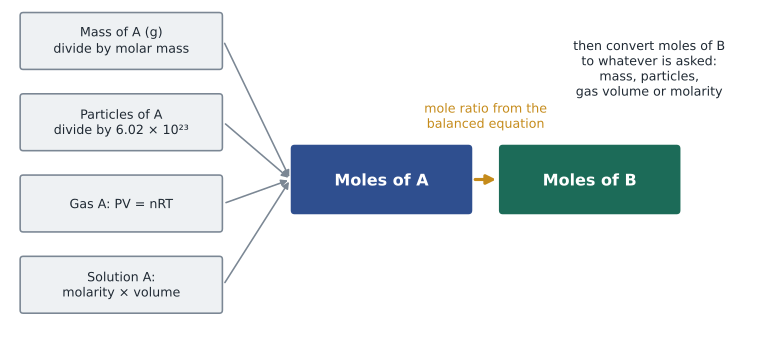
Thandiwe began with Devika's error log. Of her nine content misses in Chem/Phys on the diagnostic, four had been stoichiometry questions she understood but did slowly. 'You know the chemistry,' Thandiwe said. 'What you need is a track to run on. Every stoichiometry problem is the same journey: grams to moles, moles to moles through the balanced equation, moles back to whatever the question asks for. Once the track is automatic, you can spend your time on reading the passage.' Devika wrote "grams, moles, ratio, moles, answer" on a sticky note and put it on her monitor.
This lesson covers the mole and molar mass, percent composition and empirical formulas, balancing equations, limiting reagents and percent yield, concentration units and dilution, and the main reaction types: combination, decomposition, displacement, combustion, precipitation, acid-base and redox. These skills run under almost every Chem/Phys calculation and many Bio/Biochem passages. They are not one AAMC content category of their own; they support categories 4E, 5A and 5E. The MCAT gives you no calculator, so this lesson also practices estimation and scientific notation.
The mole and molar mass
A mole is 6.022 × 10²³ particles, Avogadro's number. One mole of an element has a mass in grams equal to its atomic mass in atomic mass units, so one mole of carbon-12 atoms has a mass of exactly 12 grams. The molar mass of a compound is the sum of the atomic masses of its atoms: water is about 2(1) + 16 = 18 grams per mole, glucose (C₆H₁₂O₆) is 6(12) + 12(1) + 6(16) = 180 grams per mole, and sodium chloride is about 23 + 35.5 = 58.5 grams per mole.
Here n is the number of moles, m the mass in grams, M the molar mass and N the number of particles. Equivalents extend the idea to reactions that transfer protons, electrons or charge. One mole of sulfuric acid, H₂SO₄, can donate two moles of protons, so it supplies two equivalents of acid; one mole of Ca²⁺ supplies two equivalents of positive charge. Normality is equivalents per liter. Passages about blood electrolytes sometimes report concentrations in milliequivalents per liter for this reason.
Percent composition and empirical formulas
Percent composition by mass is each element's share of the molar mass. In water, hydrogen contributes 2 of 18 grams per mole, about 11 percent, and oxygen about 89 percent. An empirical formula gives the simplest whole-number ratio of atoms; a molecular formula gives the actual numbers. Glucose has the molecular formula C₆H₁₂O₆ and the empirical formula CH₂O. To find an empirical formula from mass percentages, assume a 100-gram sample, convert each element's grams to moles, divide by the smallest number of moles, and round (or multiply to clear fractions).
Worked problem
Empirical formula from percent composition
A compound is 40.0 percent carbon, 6.7 percent hydrogen and 53.3 percent oxygen by mass. Its molar mass is about 90 grams per mole. What are its empirical and molecular formulas?
Show solution
- Assume 100 grams: 40.0 grams of C, 6.7 grams of H and 53.3 grams of O.
- Convert to moles: C 40.0/12 ≈ 3.33; H 6.7/1 = 6.7; O 53.3/16 ≈ 3.33.
- Divide by the smallest (3.33): C 1, H about 2, O 1. Empirical formula CH₂O, mass 30 grams per mole.
- The molar mass is 90, three times 30, so multiply by 3.
Answer: Empirical formula CH₂O; molecular formula C₃H₆O₃, which matches lactic acid.
Balancing chemical equations
A balanced equation has the same number of atoms of each element on both sides and the same total charge. Coefficients, not subscripts, are changed to balance it, because changing a subscript changes the substance. A practical order is to balance elements that appear in only one compound on each side first, leave free elements (such as O₂) for last, and finish by checking every element and the total charge.
Worked problem
Balancing the combustion of glucose
Balance C₆H₁₂O₆ + O₂ → CO₂ + H₂O.
Show solution
- Carbon: six on the left, so put 6 in front of CO₂.
- Hydrogen: twelve on the left, so put 6 in front of H₂O.
- Oxygen on the right: 6 × 2 + 6 × 1 = 18. Glucose supplies 6, so O₂ must supply 12, which is 6 O₂.
Answer: C₆H₁₂O₆ + 6 O₂ → 6 CO₂ + 6 H₂O, the overall equation of cellular respiration.
The coefficients of a balanced equation give mole ratios, not mass ratios. In the glucose equation, one mole of glucose consumes six moles of oxygen and produces six moles each of carbon dioxide and water. That ratio of carbon dioxide produced to oxygen consumed, 1.0 for glucose, is the respiratory quotient used in physiology passages. Fats have a respiratory quotient near 0.7 because they contain much less oxygen per carbon.
The stoichiometry track
A stoichiometry problem asks how much of one substance is involved when a given amount of another reacts. Convert the given quantity to moles, use the mole ratio from the balanced equation to find moles of the target, and convert those moles to the units requested. Dimensional analysis, writing units on every number and canceling them, prevents most errors.
Worked problem
Mass of product from a mass of reactant
How many grams of carbon dioxide form when 90 grams of glucose are completely oxidized?
Show solution
- 90 grams ÷ 180 grams per mole = 0.50 mole of glucose.
- The ratio is 6 mol CO₂ per mol glucose, so 0.50 × 6 = 3.0 moles of CO₂.
- CO₂ has a molar mass of 44 grams per mole: 3.0 × 44 = 132 grams.
Answer: 132 grams of carbon dioxide, more than the mass of glucose, because oxygen from the air is incorporated.
Limiting reagents and yield
When reactants are not present in the exact ratio of the equation, one runs out first. That limiting reagent determines the maximum amount of product, the theoretical yield. The others are in excess. To identify the limiting reagent, convert each reactant to moles and divide by its coefficient; the smallest result identifies the limiting reagent. A common mistake is to compare grams, or to compare moles without dividing by the coefficients.
Percent yield compares the amount actually obtained with the theoretical yield. Yields below 100 percent reflect side reactions, incomplete reactions or losses during purification. A yield above 100 percent signals an error, usually a product that is still wet or contaminated.
Worked problem
Finding the limiting reagent
Ammonia forms by N₂ + 3 H₂ → 2 NH₃. A reactor holds 28 grams of N₂ and 9 grams of H₂. Which reactant limits the reaction, and what is the theoretical yield of ammonia? If 34 grams of ammonia is actually obtained, what is the percent yield?
Show solution
- Moles: N₂ = 28 ÷ 28 = 1.0 mole; H₂ = 9 ÷ 2 = 4.5 moles.
- Divide by coefficients: N₂ 1.0 ÷ 1 = 1.0; H₂ 4.5 ÷ 3 = 1.5. Nitrogen gives the smaller number, so it limits.
- 1.0 mole of N₂ makes 2.0 moles of NH₃, which is 2.0 × 17 = 34 grams.
- 34 grams obtained out of 34 possible is 100 percent; in a real reactor it would be lower.
Answer: N₂ is limiting; the theoretical yield is 34 grams of ammonia. Hydrogen is left over: 1.5 moles remain.
Concentration and dilution
Concentration units appear constantly in passages. Molarity (M) is moles of solute per liter of solution. Molality (m) is moles of solute per kilogram of solvent; it does not change with temperature because it uses mass, which is why it appears in colligative property equations (lesson 10). Mass percent is grams of solute per 100 grams of solution. Mole fraction is moles of one component divided by total moles. Parts per million suits trace contaminants. Normality, mentioned above, counts reactive equivalents.
| Unit | Definition | Typical use |
|---|---|---|
| Molarity (M) | Moles of solute per liter of solution | Most lab and passage calculations |
| Molality (m) | Moles of solute per kilogram of solvent | Boiling point and freezing point changes |
| Mass percent | Grams of solute per 100 grams of solution | Saline and dextrose solutions |
| Mole fraction (X) | Moles of component ÷ total moles | Vapor pressure (Raoult's law), gas mixtures |
| Normality (N) | Equivalents per liter | Acid-base and redox titrations |
| Parts per million | Grams of solute per million grams of solution | Trace contaminants such as lead in water |
When a solution is diluted, the moles of solute stay the same while the volume grows, so the product of concentration and volume is constant. The same relationship lets you work out how to prepare a working solution from a stock.
Worked problem
Preparing a working solution
A laboratory has a 2.0 M stock solution of sodium chloride. What volume of stock is needed to make 500 milliliters of 0.15 M saline?
Show solution
- M₁V₁ = M₂V₂, so V₁ = (0.15 × 500) ÷ 2.0.
- 0.15 × 500 = 75, and 75 ÷ 2.0 = 37.5 milliliters.
- Measure 37.5 milliliters of stock and add water to a final volume of 500 milliliters.
Answer: 37.5 milliliters of stock, diluted to 500 milliliters. Normal saline is about 0.15 M, or 0.9 percent by mass.
Types of reactions
The MCAT expects you to recognize reaction types from equations, because the type tells you what to predict.
| Type | General form | Example |
|---|---|---|
| Combination (synthesis) | A + B → AB | 2 H₂ + O₂ → 2 H₂O |
| Decomposition | AB → A + B | 2 H₂O₂ → 2 H₂O + O₂ (catalyzed by catalase) |
| Single displacement | A + BC → AC + B | Zn + Cu²⁺ → Zn²⁺ + Cu |
| Double displacement (metathesis) | AB + CD → AD + CB | AgNO₃ + NaCl → AgCl(s) + NaNO₃ |
| Combustion | Fuel + O₂ → CO₂ + H₂O | CH₄ + 2 O₂ → CO₂ + 2 H₂O |
| Neutralization | Acid + base → salt + water | HCl + NaOH → NaCl + H₂O |
| Oxidation-reduction | Electrons transferred | All combustion and single displacement reactions |
Precipitation reactions are double displacements that produce an insoluble solid. A net ionic equation removes spectator ions, those present unchanged on both sides, and shows only the species that actually react. For silver nitrate and sodium chloride, the net ionic equation is Ag⁺(aq) + Cl⁻(aq) → AgCl(s). Lesson 10 explains how solubility rules and Ksp predict whether a precipitate forms.
Oxidation states and redox basics
Oxidation is loss of electrons and reduction is gain ("OIL RIG"). The species that is oxidized is the reducing agent, and the species reduced is the oxidizing agent. To follow electrons, assign oxidation states. Elements in their standard form are 0. Monatomic ions equal their charge. Oxygen is usually −2 (−1 in peroxides), hydrogen is +1 with nonmetals (−1 in metal hydrides such as NaH), fluorine is always −1, and the oxidation states in a species sum to its charge. In the glucose combustion above, carbon goes from 0 in glucose to +4 in CO₂ (oxidized), and oxygen goes from 0 in O₂ to −2 (reduced). Lesson 11 balances redox reactions and builds electrochemical cells from them.
Worked problem
Assigning oxidation states
What is the oxidation state of manganese in the permanganate ion, MnO₄⁻, and of chromium in dichromate, Cr₂O₇²⁻?
Show solution
- Permanganate: four oxygens contribute −8, and the total is −1, so Mn is +7.
- Dichromate: seven oxygens contribute −14, and the total is −2, so the two chromium atoms total +12, or +6 each.
Answer: Mn is +7 and Cr is +6. Both ions are strong oxidizing agents because they are easily reduced from these high states.
Estimation without a calculator
MCAT answer choices are usually spread widely enough that rounding works. Round molar masses to whole numbers, keep track of powers of ten, and simplify fractions before multiplying. To divide 6.0 × 10²³ by 3.0 × 10⁵, divide the leading numbers (2.0) and subtract the exponents (10¹⁸). Thandiwe's rule is to write the setup on scratch paper before doing any arithmetic, because most stoichiometry errors are setup errors.
Passage-style practice
Passage. Hospital pharmacists prepare intravenous potassium chloride solutions from a concentrated stock. In a quality check, a pharmacist added excess silver nitrate solution to a 10.0 milliliter sample of a prepared bag, filtered off the white precipitate, dried it and weighed it. She repeated the test on three bags. Data invented for this course. (Molar masses: KCl 74.5, AgCl 143.5 grams per mole.)
| Bag | Mass of AgCl precipitate (mg) | Labeled KCl concentration (mM) |
|---|---|---|
| 1 | 57.4 | 40 |
| 2 | 28.7 | 40 |
| 3 | 57.0 | 40 |
Practice problems
Work each problem on paper first, then reveal the answer to check.
Write the net ionic equation for the test reaction. (Skill 1: knowledge of scientific concepts)
Show answer
Ag⁺(aq) + Cl⁻(aq) → AgCl(s); potassium and nitrate are spectator ions.
What concentration of chloride does bag 1 contain? (Skill 4: data-based reasoning)
Show answer
57.4 milligrams ÷ 143.5 milligrams per millimole = 0.40 millimole of chloride in 10.0 milliliters, so 0.040 M, or 40 mM, matching the label.
Bag 2 gave half as much precipitate. What is the most likely conclusion? (Skill 2: scientific reasoning)
Show answer
Bag 2 holds about 20 mM KCl, half the labeled concentration, perhaps because half the stock volume was added or the bag was diluted twice.
Why must the silver nitrate be added in excess? (Skill 3: research design)
Show answer
So that chloride is the limiting reagent and all of it precipitates; otherwise the mass of AgCl would reflect the silver added rather than the chloride present.
If the precipitate were weighed while still damp, how would the calculated concentration change? (Skill 3)
Show answer
It would be too high, because the extra water would add mass that is wrongly counted as AgCl.
Common mistakes
MistakeBalance an equation by changing subscripts.
InsteadChange only coefficients; subscripts define the substances.
MistakeThe reactant with the smaller mass is the limiting reagent.
InsteadCompare moles divided by coefficients, not masses.
MistakeCoefficients give mass ratios.
InsteadCoefficients give mole ratios; convert to mass with molar masses.
MistakeMolarity and molality are interchangeable.
InsteadMolarity is per liter of solution; molality is per kilogram of solvent and does not change with temperature.
MistakeThe oxidizing agent is the species that is oxidized.
InsteadThe oxidizing agent is reduced; it takes electrons from the species it oxidizes.
Summary and key terms
- A mole is 6.022 × 10²³ particles; molar mass in grams per mole connects mass and moles.
- Empirical formulas come from mole ratios in a 100-gram sample; molecular formulas are whole-number multiples.
- Balanced equations conserve atoms and charge and give mole ratios.
- The limiting reagent is found from moles divided by coefficients; it sets the theoretical yield.
- Molarity, molality, mass percent, mole fraction and normality suit different uses; dilution keeps M × V constant.
- Recognize reaction types, write net ionic equations and assign oxidation states to follow electrons in redox reactions.
- Mole
- 6.022 × 10²³ particles of a substance.
- Molar mass
- The mass of one mole of a substance, in grams per mole.
- Empirical formula
- The simplest whole-number ratio of atoms in a compound.
- Limiting reagent
- The reactant that is used up first and so limits the amount of product.
- Theoretical yield
- The maximum amount of product predicted from the limiting reagent.
- Molarity
- Moles of solute per liter of solution.
- Molality
- Moles of solute per kilogram of solvent.
- Net ionic equation
- An equation showing only the species that change in a reaction.
- Oxidation state
- The charge an atom would have if all its bonds were ionic.
Practice problems
Work each problem on paper first, then reveal the answer to check.
How many moles are in 4.4 grams of CO₂?
Show answer
4.4 ÷ 44 = 0.10 mole.
How many molecules are in 0.50 mole of water?
Show answer
0.50 × 6.0 × 10²³ = 3.0 × 10²³ molecules.
What volume of 1.0 M HCl contains 0.25 mole of HCl?
Show answer
0.25 liter, or 250 milliliters.
In 2 Al + 3 Cl₂ → 2 AlCl₃, how many moles of Cl₂ react with 4 moles of Al?
Show answer
4 × 3/2 = 6 moles of Cl₂.
What is the oxidation state of sulfur in SO₄²⁻?
Show answer
Four oxygens give −8; the total is −2, so S is +6.
A reaction has a theoretical yield of 50 grams and gives 40 grams. What is the percent yield?
Show answer
40 ÷ 50 × 100 = 80 percent.
Lesson quiz · 5 questions
Score 60% or more to complete this lesson.
Create a free account to save your progress, take quizzes and earn a certificate.