
MCAT-120 · Lesson 2 of 12 · 31 min
Chemical bonding and molecular structure
▶ Video coming soon A video version of this lesson is on the way.
Elliot arrived with a question from the clinic. A patient had asked why table salt dissolves in water but cooking oil does not, and he had answered "polarity" without being sure what that meant at the level of electrons. Thandiwe said that was the right word and the wrong level of detail for the MCAT. 'Polarity is a conclusion,' she said. 'The test wants the steps: which atoms, what electronegativity difference, what shape, and whether the bond dipoles cancel. Today we build those steps.'
This lesson covers ionic, covalent and metallic bonding, Lewis structures and formal charge, resonance, VSEPR geometry, hybridization, sigma and pi bonds, bond length and bond energy, and molecular polarity. On the AAMC outline this belongs mainly to content category 5B (nature of molecules and intermolecular interactions), with links to 4E. The same skills support organic chemistry in MCAT-122 and protein structure in MCAT-110.
Why atoms bond
Atoms bond when the bonded arrangement has lower energy than the separate atoms. For main-group elements, the octet rule is a useful guide: atoms tend to gain, lose or share electrons until they have eight in their valence shell, the configuration of a noble gas. Hydrogen is satisfied with two. The octet rule has exceptions that the MCAT tests directly. Boron and aluminum compounds such as BF₃ can be stable with six electrons around the central atom. Molecules with an odd number of electrons, such as nitric oxide (NO), cannot give every atom an octet. Elements in period 3 and below, such as phosphorus and sulfur, can hold more than eight electrons around them, as in PCl₅ and SF₆.
Ionic, covalent and metallic bonds
The type of bond depends largely on the difference in electronegativity between the atoms. When the difference is large (roughly greater than 1.7 on the Pauling scale), one atom effectively takes electrons from the other and the result is an ionic bond between oppositely charged ions. When the difference is small, the atoms share electrons in a covalent bond. Sharing is equal in a nonpolar covalent bond (difference below about 0.5) and unequal in a polar covalent bond (between about 0.5 and 1.7). These cut-offs are rough guides, not sharp boundaries.
| Bond type | Electronegativity difference | Example | Typical properties |
|---|---|---|---|
| Nonpolar covalent | Below about 0.5 | H–H, C–H, Cl–Cl | Electrons shared equally |
| Polar covalent | About 0.5 to 1.7 | O–H, C–O, N–H | Partial charges δ+ and δ− |
| Ionic | Above about 1.7 | Na⁺Cl⁻, Mg²⁺O²⁻ | Crystal lattices, high melting points, conduct when molten or dissolved |
| Metallic | Not applicable | Copper, iron | Delocalized electrons; conduct electricity and heat; malleable |
Ionic compounds form crystal lattices in which each ion is surrounded by ions of opposite charge. The energy released when gaseous ions come together to form the lattice is the lattice energy. Lattice energy grows with the charges on the ions and shrinks with their size, following Coulomb's law, in which the force between charges is proportional to the product of the charges divided by the square of the distance between them. Magnesium oxide (charges +2 and −2) has a much higher lattice energy and melting point than sodium chloride (+1 and −1). Ionic solids are hard and brittle, and they conduct electricity only when molten or dissolved, because only then can the ions move.
In metallic bonding, metal atoms release valence electrons into a shared "sea" that moves freely through a lattice of cations. That picture explains why metals conduct electricity and heat, why they are malleable (layers can slide without breaking the bonding), and why they have a characteristic luster.
Lewis structures
A Lewis structure shows valence electrons as dots or lines: each line is a shared pair, and dots are lone pairs. A reliable procedure works for most MCAT molecules. First, count the total valence electrons, adding one for each negative charge and subtracting one for each positive charge. Second, put the least electronegative atom in the center (hydrogen is never central) and connect the atoms with single bonds. Third, place the remaining electrons as lone pairs on the outer atoms until they have octets, then on the central atom. Fourth, if the central atom lacks an octet, move lone pairs from outer atoms to form double or triple bonds.
Formal charge helps choose between possible structures. For each atom, formal charge equals the number of valence electrons in the free atom minus the number of nonbonding electrons minus half the number of bonding electrons. The best structure usually has formal charges as close to zero as possible, and any negative formal charge sits on the more electronegative atom. The sum of formal charges always equals the overall charge of the species.
Worked problem
Formal charge in the cyanate ion
Two Lewis structures are drawn for the cyanate ion, OCN⁻, with carbon in the center. In structure A, O and N are each double-bonded to carbon. In structure B, O is single-bonded and N is triple-bonded. Which structure is better?
Show solution
- Count valence electrons: 6 (O) + 4 (C) + 5 (N) + 1 (charge) = 16.
- Structure A: O has 4 nonbonding and 4 bonding electrons, so 6 − 4 − 2 = 0. C has 0 nonbonding and 8 bonding, so 4 − 0 − 4 = 0. N has 4 nonbonding and 4 bonding, so 5 − 4 − 2 = −1.
- Structure B: O has 6 nonbonding and 2 bonding electrons, so 6 − 6 − 1 = −1. C is 0. N has 2 nonbonding and 6 bonding, so 5 − 2 − 3 = 0.
- Both structures have one −1 charge, as the total must be. In B the negative charge sits on oxygen, the more electronegative atom.
Answer: Structure B, with the negative formal charge on oxygen, is the major contributor; A also contributes. The real ion is a blend of both.
Resonance
Some molecules cannot be represented by a single Lewis structure. In the carbonate ion, CO₃²⁻, any of the three oxygens could carry the double bond. The real ion is a resonance hybrid of the three structures, with every C–O bond identical and intermediate between single and double. Resonance structures differ only in the placement of electrons, never of atoms, and the double-headed arrow between them does not mean the molecule flips back and forth.
Resonance spreads charge over several atoms, which stabilizes the species. This idea explains major MCAT results: carboxylate ions are more stable than alkoxide ions, so carboxylic acids are much stronger acids than alcohols (lesson 9); the peptide bond has partial double-bond character, so it is planar and does not rotate freely (MCAT-110); and benzene's six identical C–C bonds reflect electrons delocalized around the ring (MCAT-122). When comparing resonance structures, the major contributors have the most atoms with full octets, the fewest formal charges, and negative charges on the most electronegative atoms.
VSEPR theory and molecular geometry
Valence shell electron pair repulsion (VSEPR) theory predicts shape from the number of electron domains around a central atom. A domain is any region of electron density: a lone pair, a single bond, or a double or triple bond (each multiple bond counts as one domain). Domains arrange themselves as far apart as possible. The arrangement of all domains is the electron geometry; the arrangement of the atoms alone is the molecular geometry, which is what you would see if lone pairs were invisible.
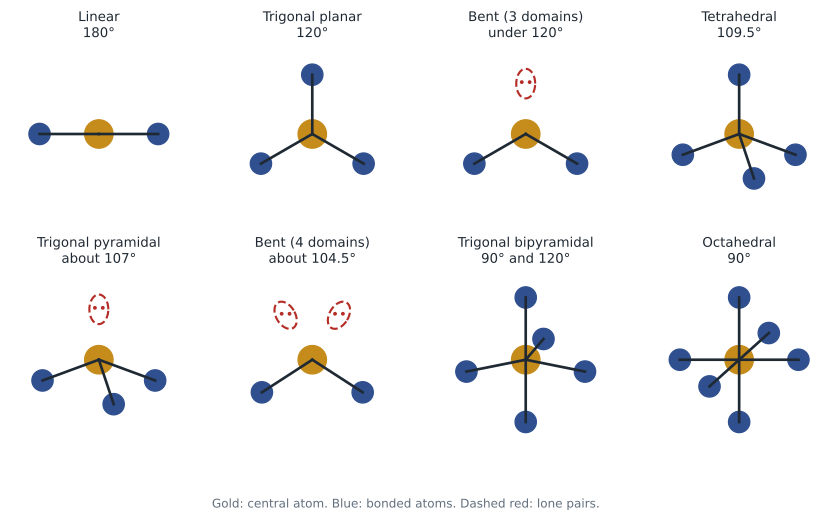
| Electron domains | Lone pairs | Molecular geometry | Approximate bond angle | Example | Hybridization |
|---|---|---|---|---|---|
| 2 | 0 | Linear | 180° | CO₂, BeCl₂ | sp |
| 3 | 0 | Trigonal planar | 120° | BF₃, CH₂O | sp² |
| 3 | 1 | Bent | Slightly under 120° | SO₂ | sp² |
| 4 | 0 | Tetrahedral | 109.5° | CH₄ | sp³ |
| 4 | 1 | Trigonal pyramidal | About 107° | NH₃ | sp³ |
| 4 | 2 | Bent | About 104.5° | H₂O | sp³ |
| 5 | 0 | Trigonal bipyramidal | 90° and 120° | PCl₅ | sp³d |
| 6 | 0 | Octahedral | 90° | SF₆ | sp³d² |
Lone pairs take up more space than bonding pairs, because they are held by only one nucleus. That is why the H–N–H angle in ammonia is about 107° and the H–O–H angle in water is about 104.5°, both less than the tetrahedral 109.5°. The MCAT usually stops at six domains, and questions on five and six domains are rare compared with questions about carbon, nitrogen and oxygen.
Hybridization, sigma bonds and pi bonds
Valence bond theory describes covalent bonds as overlap of atomic orbitals. To explain the equivalent bonds in methane, the 2s and three 2p orbitals of carbon are said to mix into four equivalent sp³ hybrid orbitals pointing to the corners of a tetrahedron. The hybridization of an atom matches its number of electron domains: two domains, sp; three, sp²; four, sp³. Hybridization therefore follows from the VSEPR count, and you should never need to memorize it separately.
Head-on overlap of orbitals along the line between nuclei forms a sigma (σ) bond. Every single bond is a sigma bond. Side-by-side overlap of unhybridized p orbitals above and below that line forms a pi (π) bond. A double bond is one sigma and one pi bond; a triple bond is one sigma and two pi bonds. Because pi overlap requires the p orbitals to stay parallel, rotation around a double bond is restricted, which is the origin of cis and trans isomers in MCAT-122. Pi bonds are weaker than sigma bonds individually, but a double bond as a whole is stronger than a single bond.
Worked problem
Counting bonds and hybridization in acetonitrile
Acetonitrile has the structure CH₃–C≡N. How many sigma and pi bonds does it have, and what is the hybridization of each carbon?
Show solution
- Bonds: three C–H single bonds, one C–C single bond and one C≡N triple bond.
- Sigma bonds: 3 + 1 + 1 = 5. Pi bonds: the triple bond contributes 2.
- The methyl carbon has four domains, so it is sp³. The nitrile carbon has two domains (the single bond and the triple bond), so it is sp and linear.
Answer: Five sigma and two pi bonds; the CH₃ carbon is sp³ and the nitrile carbon is sp.
Hybridization also affects acidity and bond length. Orbitals with more s character hold electrons closer to the nucleus. An sp carbon is about 50 percent s character, sp² about 33 percent and sp³ about 25 percent, which is why a terminal alkyne C–H is far more acidic than an alkane C–H and why bonds from sp carbons are shorter.
Bond length, bond order and bond energy
Bond order is the number of shared electron pairs between two atoms: one for a single bond, two for a double, three for a triple, and fractions for resonance hybrids (each C–O bond in carbonate has a bond order of 4/3). Higher bond order means a shorter and stronger bond. The C–C single bond is about 0.154 nanometers long, C=C about 0.134 and C≡C about 0.120, with bond energies rising in the same order.
Bond dissociation energy is the energy needed to break a bond homolytically in the gas phase. Breaking bonds always requires energy; forming bonds always releases it. A recurrent misconception, which the MCAT exploits in bioenergetics passages, is that ATP's phosphoanhydride bonds release energy when broken. They do not. Hydrolysis of ATP releases energy overall because the bonds formed in the products (and their solvation and resonance stabilization) are more stable than those broken. Lesson 6 uses bond energies to estimate enthalpy changes.
Molecular polarity and dipole moments
A polar bond has a bond dipole, pointing from the partial positive end to the partial negative end. Whether a molecule is polar depends on both its bonds and its shape. If the bond dipoles cancel by symmetry, the molecule is nonpolar even though its bonds are polar. Carbon dioxide is linear, so its two C=O dipoles point in opposite directions and cancel. Water is bent, so its O–H dipoles add to give a net dipole. Carbon tetrachloride is tetrahedral and symmetric, so it is nonpolar; chloroform, CHCl₃, is not symmetric and is polar.
A quick test for polarity follows from the shape table. Molecules whose central atom has no lone pairs and identical outer atoms (CO₂, BF₃, CH₄, PCl₅, SF₆) are nonpolar. Lone pairs on the central atom, or different outer atoms, usually make a molecule polar. Polarity then predicts solubility ("like dissolves like"), boiling point and behavior in chromatography, the subject of lessons 3 and 10.
| Molecule | Shape | Polar bonds? | Dipoles cancel? | Polar molecule? |
|---|---|---|---|---|
| CO₂ | Linear | Yes | Yes | No |
| H₂O | Bent | Yes | No | Yes |
| NH₃ | Trigonal pyramidal | Yes | No | Yes |
| CCl₄ | Tetrahedral | Yes | Yes | No |
| CH₂Cl₂ | Tetrahedral | Yes | No | Yes |
Coordinate covalent bonds and complexes
In a coordinate covalent bond, both shared electrons come from one atom. Once formed, the bond is no different from any other covalent bond. The reaction of ammonia with a proton to form ammonium is an example, and it is also a Lewis acid-base reaction: the electron-pair donor (ammonia) is a Lewis base and the acceptor (H⁺) is a Lewis acid. Metal complexes form the same way. A central metal ion acts as a Lewis acid and binds ligands, Lewis bases such as water, ammonia, chloride or the nitrogen atoms of a porphyrin ring. Heme iron in hemoglobin is coordinated by four porphyrin nitrogens and a histidine side chain, leaving a sixth position for oxygen. Chelating ligands such as EDTA bind one metal ion through several atoms at once, which is why EDTA is used in blood collection tubes to bind calcium and prevent clotting.
Passage-style practice
Passage. A chemist studied three small molecules used as solvents in a laboratory that prepares drug formulations: carbon disulfide (CS₂), dichloromethane (CH₂Cl₂) and dimethyl sulfoxide ((CH₃)₂SO). She recorded each molecule's measured dipole moment and its miscibility with water. Data invented for this course, though the trends match real behavior.
| Solvent | Dipole moment (debye) | Miscible with water? |
|---|---|---|
| CS₂ | 0.0 | No |
| CH₂Cl₂ | 1.6 | Slightly |
| (CH₃)₂SO | 4.0 | Yes, in all proportions |
Practice problems
Work each problem on paper first, then reveal the answer to check.
Explain the zero dipole moment of CS₂. (Skill 1: knowledge of scientific concepts)
Show answer
Carbon has two electron domains and no lone pairs, so CS₂ is linear and its two C=S bond dipoles cancel.
What is the molecular geometry around sulfur in dimethyl sulfoxide, which has one lone pair on sulfur? (Skill 1)
Show answer
Sulfur has four domains (two C–S bonds, one S–O bond and one lone pair), so the molecule is trigonal pyramidal at sulfur.
Why is dimethyl sulfoxide miscible with water while CH₂Cl₂ is only slightly miscible? (Skill 2: scientific reasoning)
Show answer
Its large dipole and its oxygen, which accepts hydrogen bonds from water, let it interact strongly with water; CH₂Cl₂ is less polar and cannot accept hydrogen bonds as well.
A student predicts that CH₂Cl₂ should be nonpolar because methane is nonpolar. Which feature of the data refutes this? (Skill 4: data-based reasoning)
Show answer
Its measured dipole moment of 1.6 debye. Replacing two hydrogens with chlorines leaves bond dipoles that no longer cancel.
Which solvent would best dissolve a nonpolar compound such as iodine, I₂? (Skill 2)
Show answer
CS₂, the nonpolar solvent, by the "like dissolves like" principle.
Common mistakes
MistakeA molecule with polar bonds must be polar.
InsteadSymmetric shapes can cancel bond dipoles, as in CO₂ and CCl₄.
MistakeBreaking a chemical bond releases energy.
InsteadBreaking bonds always costs energy; energy is released when bonds form.
MistakeResonance structures interconvert rapidly.
InsteadThey are alternative drawings of one real structure, the resonance hybrid.
MistakeA double bond counts as two electron domains in VSEPR.
InsteadEach single, double or triple bond counts as one domain.
MistakeMolecular geometry and electron geometry are always the same.
InsteadThey differ when the central atom has lone pairs; water has tetrahedral electron geometry but a bent shape.
Summary and key terms
- Electronegativity difference sorts bonds into nonpolar covalent, polar covalent and ionic; metals bond through delocalized electrons.
- Lattice energy grows with ionic charge and shrinks with ionic size, following Coulomb's law.
- Lewis structures are built from total valence electrons; formal charge picks the best structure; resonance spreads charge and stabilizes.
- VSEPR predicts shape from electron domains; lone pairs compress bond angles; hybridization matches the domain count.
- Single bonds are sigma bonds; double bonds add one pi bond and triple bonds two; higher bond order means shorter, stronger bonds.
- Polarity depends on bond dipoles and shape; coordinate covalent bonds link Lewis acids and bases, including metals and ligands.
- Octet rule
- The tendency of main-group atoms to reach eight valence electrons.
- Lattice energy
- The energy released when gaseous ions form an ionic solid.
- Formal charge
- Valence electrons minus nonbonding electrons minus half the bonding electrons on an atom.
- Resonance hybrid
- The real structure of a species that is represented by several Lewis structures.
- Electron domain
- A region of electron density around a central atom: a lone pair or a bond of any order.
- Hybrid orbital
- An orbital formed by mixing atomic orbitals, such as sp³.
- Pi bond
- A bond formed by side-by-side overlap of p orbitals.
- Dipole moment
- A measure of the separation of charge in a bond or molecule.
- Coordinate covalent bond
- A covalent bond in which one atom supplies both shared electrons.
Practice problems
Work each problem on paper first, then reveal the answer to check.
What is the molecular shape of the ammonium ion, NH₄⁺?
Show answer
Tetrahedral: four bonding domains and no lone pairs.
What is the formal charge on nitrogen in NH₄⁺?
Show answer
5 − 0 − 4 = +1.
How many sigma and pi bonds are in ethene, C₂H₄?
Show answer
Five sigma bonds (four C–H and one C–C) and one pi bond.
Which has the higher lattice energy, NaF or CaO?
Show answer
CaO, because its ions carry charges of +2 and −2.
Is BF₃ polar?
Show answer
No. It is trigonal planar and symmetric, so its three B–F dipoles cancel.
What is the hybridization of the oxygen atom in water?
Show answer
sp³: two bonds and two lone pairs make four domains.
Lesson quiz · 5 questions
Score 60% or more to complete this lesson.
Create a free account to save your progress, take quizzes and earn a certificate.